You’ve been bitten by the bug to travel to the Philippines, you’ve heard it’s a cheap country, but how much money are we talking about? We’re aware that one of the main questions you might have when setting off on an adventure like this is: how much does it cost to travel to the Philippines? Is the Philippines cheap?
The answer to that second question is yes, traveling to the Philippines is cheap, but, obviously, there are nuances. It basically depends on the budget you have for traveling to the Philippines and what you compare it with. Even so, we can already tell you that the cost of traveling to the Philippines is far lower than doing so in Europe, Oceania or the United States.
After many years living and traveling around the Philippines, we know a fair bit about this, so here we’re going to tell you in detail how much it costs to travel to the Philippines depending on the type of traveler you are: low cost, backpacker, mid‑range with a little luxury, or all‑out.
Is traveling to the Philippines cheaper than to other Southeast Asian countries?
Traveling to the Philippines is cheap, but not as cheap as traveling to other countries in Southeast Asia. We’ve spent years traveling around Asia and, in fact, we’ve spent long stretches in countries like Indonesia or Thailand. We’d be lying if we said the Philippines is cheaper than those two or than Laos or Vietnam (which we find the most affordable in the region). Even so, you can spend about the same traveling around the Philippines as in Thailand, only the quality of services will be a bit lower.
That is, in the Philippines you can also spend €6–7 per person on lodging or €2 on food, but you’ll get more basic accommodation and meals that are a little less eye‑catching or exotic.
As for tours and dives, the Philippines tends to be a little more expensive than other places in Southeast Asia, without being outrageous. Depending on the place and the number of people you are (the more you group up, the cheaper it usually is), tours in the Philippines can cost from €15–20 to €40 including lunch. Dives run around €22–35, depending on the dive shop and the site.
So, is it cheap to travel to the Philippines? Yes. Is traveling to the Philippines cheaper than to Thailand? It depends, although broadly speaking we’d say no.
If you’re weighing up other countries in the region, don’t miss our article Travel to the Philippines or Thailand? We’ll soon be doing more comparing the archipelago with other places.

This is Cresta de Gallo; a boat for up to 6 people from Sibuyan will cost you about €40 for a whole day.
How much does it cost to travel to the Philippines?
Alright, you want numbers. Here we’re going to show you, broken down by category, how much a trip to the Philippines might cost you.
Heads up: those prices you’ll see here are in Philippine pesos, the currency of the Philippines. The conversion to euro usually ranges between 58 and 61 pesos per euro. In January 2025 €1=59.80 PHP. You can check it easily on pages like Xe.com.
1. Price of flights to the Philippines
When you’re planning a trip, one of the categories that will shape the budget is flights. As we tell you in How to find cheap flights to the Philippines, unless you travel in very high season (Easter or Christmas and, lately, the European summer) or you look for flights with very little advance notice, it’s normal that a flight from Spain to the Philippines is around €700–800. Of course, it’s also possible to find a bargain from €500 or €600 per person, something often seen with Chinese airlines like Air China.
2. Price of accommodation in the Philippines
When assessing how much it costs to travel to the Philippines, accommodation is possibly the main variable that will determine your budget. This is because you’ll find accommodation from €8 per night per person (or even cheaper) to infinity and beyond.
The price of hotels in the Philippines varies considerably depending on the place we’re talking about and the season. For example, accommodation in very touristy areas like El Nido or Siargao is usually higher than in less visited ones like Siquijor or Romblon. And, in addition, prices soar from November through May, with Christmas and Easter being the periods when they reach their peak.
In general, we could tell you that someone with a budget for traveling to the Philippines on a low‑cost basis will be able to find hostels and dorm beds from €7 per night. Of course, if you go up to €15 per night you’ll find slightly nicer places, with air‑conditioning and hot showers. A good figure could be €20 per night per person, which would already get you good hotels.

Our room in Sablayan (for Apo Reef) with sea views for 800 pesos (€13)
If you have more budget for traveling to the Philippines, of course you can also stay in much higher‑end hotels. On many islands such as Palawan, Siargao, Panglao or Boracay there are jaw‑dropping resorts, including bungalows with sea views. In Best resorts in the Philippines you can see places like these, where prices rarely drop below €200 per night for a double room and can even reach €1,000 per night.
Take a look at hotels from here:
3. Price of transportation in the Philippines
With so many islands, it won’t surprise you that another important item when determining how much it costs to travel to the Philippines is transportation.
Well then, broadly speaking, we can tell you that transport is cheap, but it will be cheaper if you don’t try to cover too many destinations and if you have plenty of time to avoid taking lots of flights.
To move between islands you can use slow ferries, fast boats and planes. In the Philippines there are several airlines that we talk about in Airlines in the Philippines and some of them are low‑cost.
The price of a domestic flight varies a lot depending on the route, the season and how far in advance you buy it. For example, between Manila and Cebu you can find flights for less than €20 per leg, but from Manila to El Nido (which is only operated by a company called Air Swift, with much smaller planes) prices don’t usually drop below €70 and can be €120 in periods of high demand or if you buy with little notice. Try using the Skyscanner search tool:
As for fast boats and ferries, prices range from the €3 that a trip between Sibulan and Liloan (Dumaguete–Moalboal) can cost to the €50 boat from El Nido to Coron and vice versa. One way to travel cheaply around the Philippines is also to use overnight ferries with bunks. For example, the ferry from Cebu to Surigao (to then go on to Siargao) costs about €20 and includes the use of a bed, so you save on accommodation.
Within the islands or cities themselves you’ll find many methods of transport. For example, in Manila or Cebu you can take taxis or Grab cars (the Asian Uber), but also buses, vans, jeepneys, tricycles or habal‑habal, among others. A taxi ride rarely exceeds 350 Philippine pesos (about €6) if you’re going far. A ride in a jeepney or tricycle usually runs around 12–15 pesos if it’s shared with other people. A bus or van trip can cost from 100 (€1.50) to 900 pesos (€15), depending on the route. If you do private journeys, it will cost you much more, since you’ll have to negotiate with a driver.
Many travelers also choose to rent a motorbike and explore an island on their own. Motorbike rental is around 300–500 pesos (€5–8) per day, depending on how long you take it for, your negotiating skills and the destination.
In short, how much does it cost to travel to the Philippines in terms of transport? As you’ve guessed, it depends on whether you fly a lot or not, which is the decisive factor. If you have little time, it’s common to take several flights and thus not spend so much time getting around. Booking in advance will be key here because prices skyrocket when the flight date is near. Even so, for a rough calculation, you could estimate about €50–60 each time you change islands. Further down we give you an estimate by days and weeks.
You can read much more on this topic in Transport in the Philippines.

Fast boat from Cebu to Maasin to get to Padre Burgos for 600 pesos (€10)
4. Price of food and drink in the Philippines
As with any trip, if you eat where locals eat, you’re very likely to save a lot. Therefore, you can travel cheaply in the Philippines if you do as Filipinos do and eat in the carenderias. These are local eateries where you’ll find lots of pots with prepared dishes and you can choose which small dishes you’d like to try. Of course, they always come with a good serving of rice.
If you go to a carenderia, which we encourage you to do, you’ll find that the prices of these “Filipino tapas” will cost you from 15 pesos (€0.20) for a plate of vegetables to 60 pesos (about €1) for a portion of meat. A serving of rice usually costs 20 pesos (€0.30). Do the math, you can eat for less than €2 if you want.

The pots at Filipino carenderias. Eat local; it’s cheaper
In the morning, for breakfast, you’ll find a bakery almost anywhere in the country. These Filipino bakeries sell rolls (the delicious pandesal) and all kinds of pastries from 3 pesos (€0.05), so a breakfast with an instant coffee won’t cost you more than €0.80–1.
Obviously, if you go to higher‑end restaurants or cafés, you can easily pay 10 times more. This is 100% up to you. In the Philippines there are also pizzerias, burger joints, gourmet cuisine restaurants, cool smoothie bowls… But, of course, they’re more expensive.
As for drinks, a beer in a local bar usually costs 70–80 pesos (€1.10–1.30). In a supermarket, it tends to cost 50 pesos. If you go to higher‑end places, it can run about 100–150 pesos (€1.70–2.50); you just have to know where to look.
And what about water? As we tell you in Backpack for the Philippines, we’re 100% in favor of carrying a stainless‑steel bottle to refill. In 99,99% of restaurants, bars, dive shops, markets, hotels and so on, you’ll find purified water sources that are totally safe to drink. We remind you that Filipinos don’t drink tap water. The cost of refilling a bottle is usually either free or under 10 pesos per liter (€0.17), and it’s even normal for it to cost only 2 pesos. By contrast, for a one‑liter bottle of water you can be charged about 30 or 50 pesos. If you do the first option, you not only save money, you also avoid using plastic and practice responsible tourism.
All in all, we could estimate from €5–6 per day for eating and drinking in the Philippines if you go low‑cost up to €20 per day for more flexible budgets.

Beer at Binucot Beach, Tablas, for 60 pesos (€1) and the views are free
5. Price of tours and other activities in the Philippines
Another important factor for knowing how much it costs to travel to the Philippines is the price of tours and scuba dives. There are many places where you won’t need anything but your own body and that’s it, such as hanging out on the beaches of Malapascua, Bantayan or Port Barton, but there are other corners where the best is found when you hop on a bangka (the traditional Filipino boat) and go exploring.
For example, tours in El Nido or Coron (which are usually the most expensive) where you spend the whole day on the boat and they typically include lunch, water and snorkel‑mask rental usually cost about 1,200–1,400 pesos (€20–24). If you do them privately, the price depends on the number of people on the boat, but it’s most common that it won’t go much beyond €35 per person.
In other parts of the Philippines, such as Siargao, Bohol or Camiguin, it’s usual to pay between 900 and 1,200 pesos per person (€15–20).
The budget for traveling to the Philippines for these tours obviously varies depending on the place and the type of tour, but, broadly speaking, we could say that it would be rare for you to spend more than €22–30.
On the other hand, if you’re a diver, you can’t miss the chance to go diving in the Philippines. Being one of the best places in the world, it would be a shame not to take advantage. A dive usually ranges between 1,300 pesos (€22) and 2,000 pesos (€33), including gear rental and fees. In places like Moalboal or Camiguin they’re usually much cheaper than diving in Malapascua (thresher shark) or Balicasag (Bohol / diving in Panglao), since higher conservation fees are paid here and the navigation time is also longer.
So, if you’re going to dive, you should devote an important part of your Philippines travel budget to it. Don’t worry, it’ll be money well spent—we can vouch for that.

Big Lagoon on the El Nido island‑hopping. The whole day for about 1,300 pesos (€22)
6. Extra costs in the travel budget for the Philippines
We can’t forget, when calculating how much it costs to travel to the Philippines, the cost of the essential travel insurance. It’s something we consider essential, since it saved us from shelling out a whopping more than €22,000 in Manila.
As we tell you in Best travel insurance for the Philippines, we always travel with IATI coverage, which has always given us impeccable service. That’s why we never skimp. Insurance under the IATI Mochilero plan (which covers adventure sports like snorkeling—something you’ll surely do) is around €70 for a 2‑week trip to the Philippines. For lower coverage, you can go for IATI Estándar, which costs about €50 for 2 weeks.

By reading Visa for the Philippines you’ll see that the visa for Spaniards and most Europeans and citizens of Spanish‑speaking countries is free for stays under 30 days. If you’re staying longer, you can extend it while in the Philippines for about 3,100 pesos in its express modality (approximately €52) or do it in your country of origin for about €28.
If you want to have internet in the Philippines, you’ll find lots of good‑value data packages. You can estimate between €8 and €15 for a month of internet.
Although less and less (since they’re gradually being included in the ticket price), in the Philippines you’ll have to pay fees at some airports. Don’t get mad; they’re the same fees you’d pay in Europe, they’re just paid separately. In Manila and Cebu they haven’t been paid for several years now. On the other hand, you’ll also be asked to pay fees at most ports in the Philippines. These are usually no more than 25 pesos (€0.30).
If you need to do laundry, you’ll find laundries almost anywhere in the country. It can cost you less than €1 per kilo if you get away from the most touristy areas.
Of course, the cost of a trip to the Philippines will also depend on whether you buy souvenirs, hygiene products, repellents or sunscreens and treat yourself to a few luxuries like massages or other beauty services (manicures, pedicures and so on are very inexpensive).

The Kultura Filipino store in Manila
Some reference prices in the Philippines
To give you an idea of how much it costs to travel to the Philippines, here are some reference prices:
| Item | Price |
| One‑liter bottle of water at a supermarket or local shop | 30 pesos (€0.50) |
| Refilling 1 liter of water | 5 pesos (€0.10) |
| Dish at a local eatery | 90 pesos (€1.50) |
| One kilo of mango | 150 pesos (€2.30) |
| Beer in a bar | 80 pesos (€1.30) |
| Motorbike rental for 1 day | 350 pesos (€6) |
| Kayak rental for 1 day | 400 pesos (€7) |
| Van ticket from Puerto Princesa to El Nido | 600 pesos (€10) |
| Jeepney ride in Manila | 10 pesos (€0.17) |
| Grab from Manila airport to a hotel in Makati | 350 pesos (€6) |
| Boat from Bohol to Cebu | 800 pesos (€13.40) |
| Bed in a trendy hostel in El Nido | 900 pesos (€15) |
| Double room in Siquijor | 800 pesos (€13.40) |
| Surf lesson and board rental in Siargao | 500 pesos (€8) |
| Island hopping in El Nido | 1,300 pesos (€22) |
| Snorkel gear rental | 100 pesos (€1.80) |
| Dive in Balicasag | 2,000 pesos (€30) |

Diving in Balicasag can cost around 2,000 pesos (€30) per dive
Budget for traveling to the Philippines
Travel to the Philippines on the cheap or not? By now you’ll have a rough idea of whether traveling to the Philippines is cheap or not, but here we want to show you a summary table of what a backpacker‑style trip to the Philippines might look like:
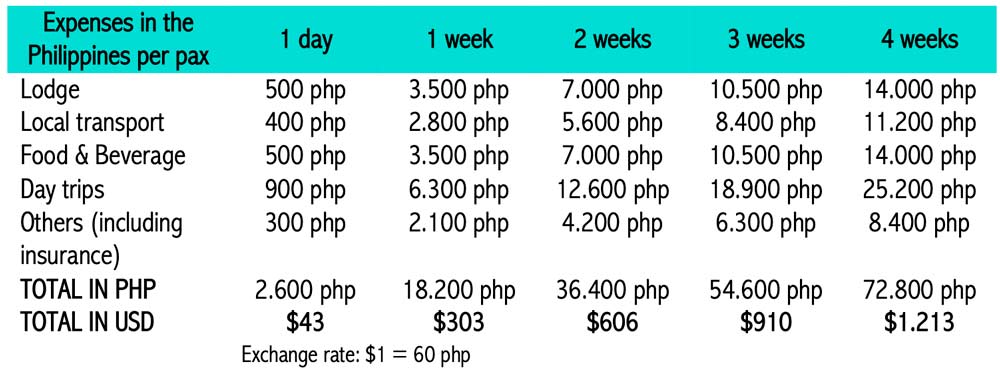
These costs for traveling to the Philippines are the most economical, meaning that from here you could spend quite a bit more depending on the type of traveler you are. In fact, it’s also possible to spend much less money, but you’d only manage it if you spend a good amount of time in the Philippines in less touristy places and you don’t do as many island hopping trips or dives. We’ve managed to spend an average of €20 per person per day.
On the other hand, the costs of traveling to the Philippines as a couple are lower than doing it solo. Bear in mind that if you rent a motorbike or you like staying in private rooms, it’ll be cheaper if you split the price between two. Same if you take a taxi or any other private transport.
To these prices you’d have to add the international flight which, as we pointed out, is usually around €700 from Spain or other European countries. If you move around a lot by plane and buy without advance notice, the bill could go up by about €150–200.
So, how much does it cost to travel to the Philippines? If you do it very low‑cost, as we’ve done many times, you can spend between €20–25 per day. If you want to enjoy it properly and not hold back on tours and beers while staying moderate, think about around €40 per person per day. To sleep in higher‑quality hotels, you should already consider at least €50 or €60 per day.
Tips for traveling cheaply in the Philippines
- Go local. Eat in local places, use local transport instead of private, choose simple rooms… This applies to all kinds of trips, but in the Philippines the difference is quite significant if you step off the tourist circuit.
- Travel for a long time. If you have 15 days, you might need to take 3 flights and 3 fast boats. If you travel 20–30 days, you can do everything more relaxed, opt for slower ferries and, therefore, your trip to the Philippines will be cheaper.
- Haggle, but respectfully. Although less than in other Southeast Asian countries, if you want to travel cheaply in the Philippines, you can also haggle, especially if you’re staying in a hotel for several nights or renting a motorbike for several days. If you need private transport—especially a tricycle—in many cases they’ll try to charge an oversized price because you’re a tourist. Keep calm. One thing we usually do is ask at the hotel reception or any Filipino how much they usually pay for that route, so we know “what ballpark we’re in”. No one wants to feel ripped off, obviously, but don’t spend your life haggling over €0.10—believe it or not, 20 pesos is 3 plates of rice for a Filipino family.
- Find other travelers to share tours or transport.
- Forget plastic bottles and reuse your own.
- If you have a student card, you can use it on some transport and attractions to lower the price.
- Share mobile data. If there are 2 or more of you, you can always share it by doing tethering. We talk more about this in Internet in the Philippines.
- Travel in low season. As we’ve told you, you can greatly reduce how much your trip to the Philippines costs if you do it in low season. If your budget is a big concern, go for September and October, which are usually the cheapest months. Avoid Christmas, Easter, Chinese New Year and the May long weekend.
- Book flights in advance. The eternal question: do I book flights beforehand or wait to see what the weather is like? It boils down to: do you prioritize flexibility or money? Booking a flight in the Philippines the day before is much more expensive than doing it months in advance.
- Consider booking hotels in advance. No, booking hotels on the spot is often not cheaper. Unless you’re going to travel to areas that don’t usually get tourism or you’re going to stay many nights in the same hostel, it’s usually better value to book online on platforms like Booking or Agoda.
- Get travel insurance. Not to be doomsayers, but accidents happen. Save 5% on the best travel insurance for the Philippines using this discount.
- Carry cash and a good travel card. In the Philippines, outside Manila and Cebu, cash is king. Most hotels and restaurants don’t accept cards and, worst of all, withdrawing from 99% of ATMs carries a fee of almost €5 per withdrawal. In Money for the Philippines and Best card for the Philippines we tell you much more about this, including tips to save on your trip.

And that’s everything we can tell you about how much it costs to travel to the Philippines! We hope you’ve been able to get an idea of what you might spend on a trip to the Philippines. For us, it’s possible to travel cheaply in the Philippines—as long as you know how and want to do it.
As you can see, it’s also a great destination if you want to spend more because it’s a special occasion, such as a honeymoon in the Philippines. There are plenty of places that offer quality service on par with other countries like Thailand or the Maldives—you just need the right budget.
Do you have any question or comment? We’ll be happy to read you below.