This guide to the best things to do in Camotes is something we should have written a long time ago. How is it possible that an island with so much to offer, so close to one of the country’s main cities, is so overlooked by tourists? How, after so many years traveling around the Philippines, had we never stopped to visit this destination before?
Whatever the case, the wait is over and, after spending quite a few days exploring the area, we’ve put together the most complete Camotes guide so you too can enjoy everything it has to offer.
Ready to discover a new destination away from mass tourism despite being so close to an international airport? Let’s get started!
Where are the Camotes Islands?
The Camotes Islands are part of Cebu province and the Visayas region. More specifically, they are east of Cebu (or rather northeast of Cebu City), southwest of Leyte Island and north of Bohol. As we’ll explain in How to get to Camotes (coming soon), the most direct way to get there is through the port of Danao, located about 30 kilometers north of Cebu City. From there, it’s a 2-hour boat ride to the Camotes Islands. If you compare it with journeys to other islands such as Malapascua or Bantayan, it really is a very accessible destination.
If you look at their location on the map, it’s also possible to reach the Camotes Islands from Leyte. Since it’s a less touristy and less populated island, not many travelers venture there this way.
What to expect from the Camotes Islands: why go?
Before going into detail about each of the things you can do in Camotes, we want to give you an overall idea of what awaits you here. After our first two days exploring Camotes, our first impression was that it had a bit of a Siquijor Island feel. Better in some ways, different in others, worse in others… But, just like Siquijor, there are 3 main things you’ll find here: paradise beaches, cool waterfalls and caves.
When it comes to beaches, Camotes has better and more varied ones. If we’re talking about waterfalls, the ones here aren’t on the same level as our beloved Cambugahay Falls but, hey, they’re another addition to your route around the island. And finally, when it comes to caves, we could call it a tie, since each island has its own style.
That said, the main difference and one of the things you should be aware of before deciding to discover the Camotes Islands is that, because they are so untouristy, there isn’t a huge variety of accommodations or places to eat. There are some, but nothing comparable to what you’ll find on the “similar” island of Siquijor. Forget about nightlife (beyond a few videokes), cool cafés or anything like that.
So, if, in addition to waterfalls, beaches and caves, you’re looking for that feeling of being somewhere little explored, don’t hesitate to include these islands in your Philippines travel itinerary. It’s no coincidence that Filipinos call them “The Lost Horizon of the South.” You won’t regret it!
Why the name Camotes? According to an account by Miguel de Loarca from 1582, the islands already had this name. It is believed that when the first Spaniards arrived, they asked the locals for the name and the locals thought they were asking what they were growing, to which they replied: “camote”, which is simply a sweet potato. Since this is the term commonly used for them in Latin America, it’s possible that a ship carrying Mexicans or Peruvians had introduced the word earlier. But it’s all speculation. In any case, don’t leave without trying camotes in the Camotes 😉

How many days do you need to visit the Camotes Islands? A suggested itinerary
In our experience, the minimum amount of time to visit the Camotes Islands would be 2 full days (not counting your arrival and departure days). Of course, if you can stay longer, especially if you like beaches or exploring islands independently by motorbike, you’ll enjoy it even more. Even so, with 2 days you’ll be able to check off a good number of the things to see in Camotes that we’ll tell you about throughout this guide.
What to do in Camotes in two days? You could plan a route like this (it’ll make more sense if you look at it alongside the Camotes map we’ve made at the end of this article):
- Day 1: tour Pacijan Island, stopping at Heminsulan Beach, Palanas Beach, Mangodlong Beach and Bakhaw Beach (and Karaoke), and visit Tulang Diot Island, Timubo Cave and Heaven Cave.
- Day 2: on the way to Poro, stop at Santiago Bay, then visit Buho Rock Resort, Busay Falls and Bukilat Cave.
Since the interior of Poro doesn’t have anything particularly noteworthy and Mactang Beach (which we’ll tell you about below) isn’t anything special, our recommendation is to return along the same coastal road you took on the way there. It’s in better condition than the road that cuts across the middle of the island, and we can tell you that from experience.
If you have more days to visit Camotes, you can split day 1 into two parts and spend more time enjoying the beaches.
Things to see in the Camotes Islands
Sometimes we refer to this destination as Camotes and other times as “the Camotes Islands” because, although they’re connected by a bridge that you barely even notice when crossing it, the reality is that there are 4 islands. The two largest, Pacijan (known by its residents as SanFran) and Poro, are where you’ll find the vast majority of things to do in Camotes. Pilar, to the east, is completely untouristy and, since there isn’t much to see there, you can skip the trip. Finally, Tulang Diot is an island you can reach from the north of Pacijan to enjoy its beach.
We want to show you the best things to do in Camotes. That’s why you won’t find filler information here about caves that aren’t worth visiting or “walks along the baywalk.” With that said, let’s show you everything this destination has to offer:
Santiago Bay Beach
If you take a look at the few Filipino blogs that talk about the Camotes Islands, you’ll see that this is one of their favorite beaches. We were really looking forward to visiting it, but it ended up being one of the beaches we liked the least. While it’s true that it’s the most accessible because it’s close to many of the accommodations in the area and there are restaurants nearby where you can grab something to eat (something that’s hard to find on the island), it struck us as a typical Philippine beach without any special charm or that feeling of being somewhere untouched.
It’s highly advisable to check the tide times before heading to this or any other beach in Camotes. Try to time your visit for high tide if you don’t want to have to walk a long way to reach the water and see Santiago Bay Beach looking less beautiful.
On the other hand, keep in mind that beaches are part of nature. It sounds very obvious, but a lot of people get upset about this. Beaches don’t look the same throughout the year, or even throughout the same day. This is even more important in the Philippines because the archipelago is affected by two monsoons or winds that blow in different directions depending on the month. Santiago Bay is affected by the Habagat, the southwest wind, between June and November. What does this mean? That the water tends to be less clear and, unfortunately, all the seaweed and trash carried by the ocean wash ashore. We witnessed this ourselves, which is why we didn’t like it that much. In contrast, the beaches on the western side of the island were spotless and beautiful.
On the other hand, depending on the route you take around Camotes or how far it is from your accommodation, it can be a good place to come for lunch or dinner.
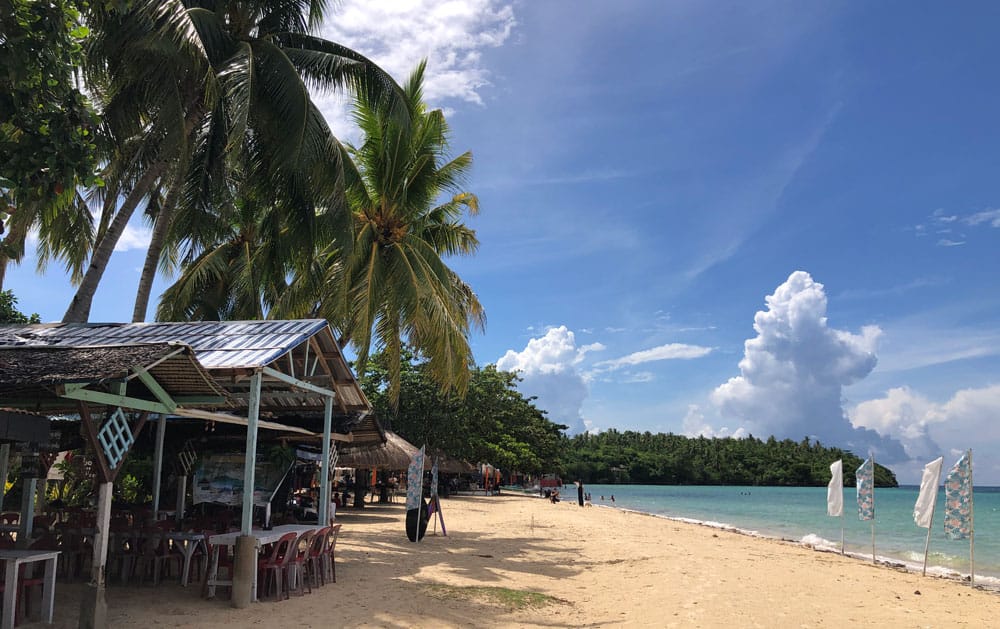
Heminsulan Beach, one of the best beaches in Camotes
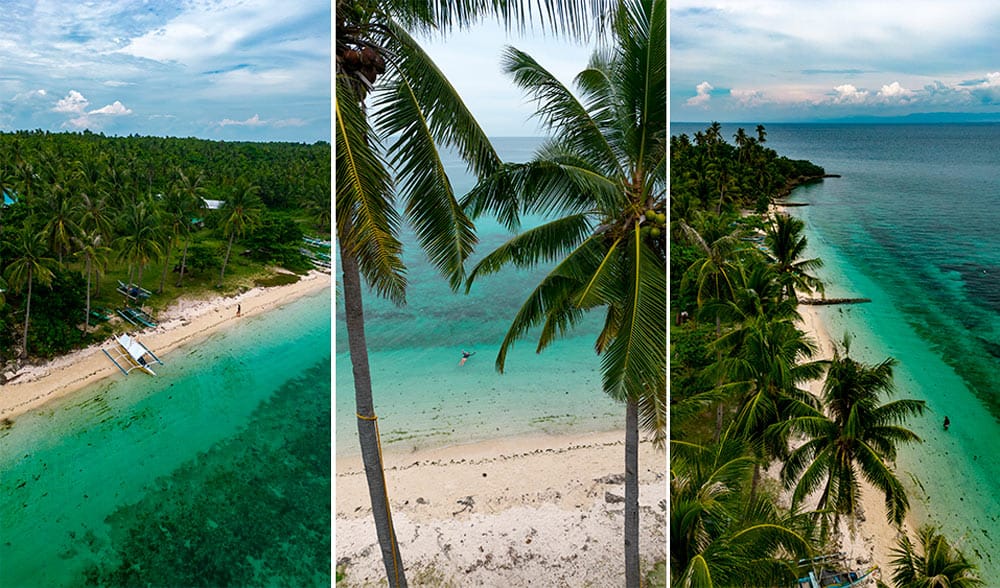
We didn’t have this beach on our original list of things to see in Camotes, but the owner of our accommodation recommended it to us and we decided to ride over on our motorbike. What a surprise! After Santiago Bay had left us a little underwhelmed, Heminsulan Beach welcomed us with turquoise waters, palm trees and a much more relaxed atmosphere.
Although the colors of the water and sand are spectacular, we’re sure the first thing to catch your eye will be the enormous floating cottages that take up one side of the beach. Starting at 700 pesos per hour, you can rent one to hang out with friends while eating and having a drink, but if you want more fun, you’ll see that some even have large slides on the sides that you can use to launch yourself into the sea. The explanation for this? Apparently, they started with one of these cottages and, because it was successful, they began building many more.
Don’t expect restaurants here. If you’re lucky, you’ll be able to buy something to drink from a local stall and enjoy it while lying on the sand. Keep in mind that this is the kind of beach that attracts more Filipinos on weekends and holidays, but from Monday to Friday you can have it completely to yourself, just as we did. Also, from the entrance, if you look to the right and walk along the beach, you’ll find a completely untouched and wonderful stretch of beach. It’s every bit as good as the beaches on Bantayan, for example.

Palanas Beach
Camotes certainly isn’t short on beaches, and here’s another example. Just a 10-minute motorbike ride from popular Santiago Bay Beach is another beach where we spent a good while completely alone enjoying a swim: Palanas Beach. On rainy days, it’s worth taking it easy on the motorbike ride there, as parts of the road get very muddy and you need to be careful, but it’s worth it once you park at Palanas Beach Resort and, as is the case in much of Camotes, get to enjoy the place practically all to yourself.
This area doesn’t particularly stand out for its snorkeling, but it’s a perfect place to relax among palm trees and crystal-clear waters.
By the way, we were able to explore it completely independently and without paying anything, just like almost all the beaches in Camotes that we tell you about in this guide.
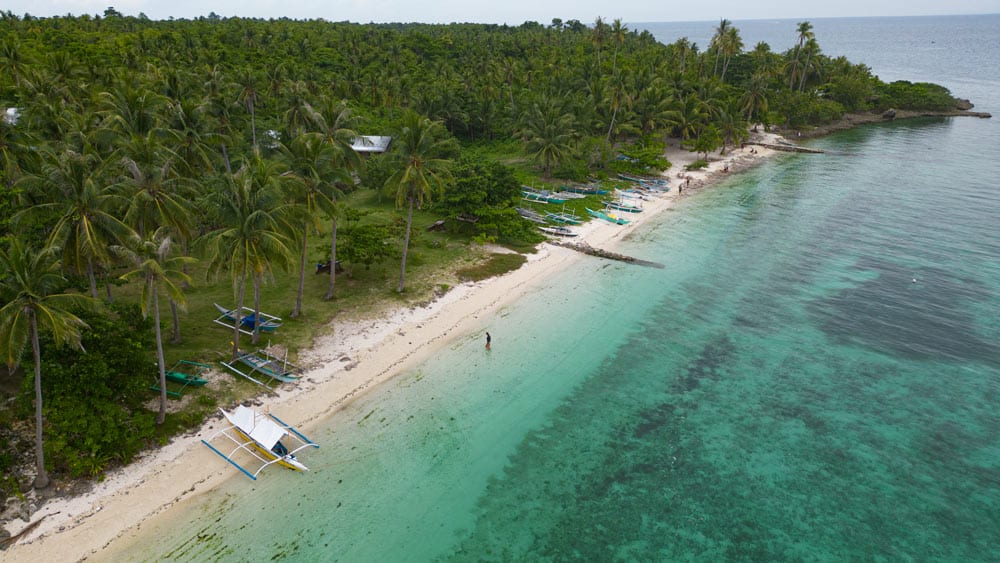
Bakhaw Beach and “Karaoke Beach”
We love getting off the main route in search of new beaches and places. Sometimes we end up in the middle of thorny bushes or knee-deep in mud, and other times we come across incredible beaches like these.
On the way to the small island of Tulang Diot, we decided to turn off the main road and unexpectedly came across what became our favorite beach in the Camotes Islands: Bakhaw Beach. Here you’ll find turquoise waters, fine sand, palm trees and even some interesting snorkeling nearby. You’ll also see some huts where you can have a drink. When we passed by this beach, we were completely alone—not only was nobody swimming, but there wasn’t even anyone running the huts.

If you continue along the unpaved road that runs past here and heads north, you’ll see that Google Maps shows another beach also called Bakhaw Beach. We decided to name it “Karaoke Beach” to tell them apart because it was full of small groups of Filipinos enjoying their private karaoke sessions and a few shots of Tanduay. If you go over and say hello, they’ll probably want to invite you to both. Go for it, sing your heart out while raising a glass with them!

Mangodlong Beach
You can access this other beach through the resort of the same name. Admission costs 30 pesos, but if you tell them you’re going to order something at the restaurant, you can enter without paying anything else. We had a delicious mango shake for 80 pesos. For an extra 100 pesos, you can use the swimming pool but, to be honest, with the beach they have, we think that’s more than enough.
Mangodlong Beach is a beautiful little cove with crystal-clear water that, like the rest of the beaches in Camotes, we recommend visiting at high tide. Take a dip, relax in the hammocks, eat there if you happen to be there around lunchtime (the food isn’t bad and the prices are reasonable), and you can even take a freshwater shower for 15 pesos if you want to continue your route around Camotes without salt and sand all over you.
On the right side of the cove, you’ll see a rock formation that you can jump from into the sea. Go closer and you’ll see that it’s a huge octopus built into the rock! Don’t try to find an explanation for it; it’s a perfect example of Filipino style.


Tulang Diot, an interesting island to visit in Camotes
North of Pacijan Island (the island on the left in the Camotes group) you’ll find a small island (literally, “small island”) with a beautiful beach where you can go for a good swim. Although we were told that turtles can sometimes be seen here and that there’s some good snorkeling, we didn’t see any turtles or find the good snorkeling we’d heard about (it seems you need to hire a boat to take you to areas farther away from the beach), so we simply let ourselves drift with the waves and relaxed on the sand.
As on other beaches in the area, you’re guaranteed crystal-clear water here and that feeling of getting away from it all that less crowded destinations give us. We did go during the week, but we have no doubt that on weekends the island may see more local tourists who come here to spend the day with their families. That’s also part of the charm of these kinds of destinations: discovering how much Filipinos love spending their free time with family and friends.
How do you get to Tulang Diot? It’s super easy. First, you’ll need to head to Tulang Dako Beach, which we’ve marked on the map at the end of this article. There you’ll see a small booth where you’ll need to pay 50 pesos (20 each way and 10 in environmental fees). The journey takes around 5 minutes because, as you’ll see on the map, it’s just off the coast. Sometimes, the people charging for the round trip tell you you’ll have to wait a long time for 10 people to show up, but that you can pay for the whole boat and leave straight away. Ignore them! Tell them you have plenty of time, and within a few minutes they’ll take you without waiting for anyone else.
On the island, they may ask you for your ticket (they didn’t give us one), so make sure they give it to you. We brought food we’d bought at a restaurant on Tulang Dako Beach with the intention of eating at one of the tables on the island, but the price convinced us to eat on the sand in peace instead—150 pesos for a small table and two chairs! Once we arrived, we realized they also served some basic meals and instant noodles, in case you’re thinking of doing the same.
As you can see in the photo, the island is beautiful and absolutely worth visiting on your route around Camotes. We also think it’s a very affordable option.

Buho Rock Resort
If you come to explore the Camotes Islands, you’re definitely going to want to visit Bukilat Cave, the islands’ standout cave. Since you’ll most likely be staying on Pacijan Island (which, from our perspective, is also the most advisable option), Buho Rock Resort will be on your way and is an ideal stop to add to your tour of the area. This complex is located in an area of steep cliffs and, at the bottom, they’ve built an access point to the sea where you can jump in from a couple of diving boards or go down two large slides (when we visited, they needed a little maintenance).
If you want to have some fun jumping over and over again into turquoise waters with an easy way back up, don’t hesitate to give cliff jumping at Buho Rock Resort a try. Admission costs only 20 pesos (you have to pay separately for the pool), so you shouldn’t even have to think twice.

Bukilat Cave, the best cave to see in Camotes
Among many other things, the Camotes Islands stand out for the large number of flooded caves and cenotes they have. We visited many of them on our route and we’re going to show you the ones you shouldn’t miss. Many others are so underwhelming that we don’t even think they’re worth mentioning, let alone wasting your time on.
The best, the most spectacular, the number 1 cave to see in Camotes is Bukilat Cave. It’s not only the most beautiful on the island but also one of our favorites in the Philippines. Admission costs just 50 pesos.
As you make your way down the stairs leading inside, the backlighting will make it hard to see exactly where you’re going but, suddenly, wow! You’ll find yourself facing a huge rocky chamber where light pours in spectacularly through several natural openings in the ceiling. The rays of sunlight falling through the darkness onto the turquoise water create an amazing effect!
Here you can take a refreshing swim in its two natural pools, enjoy the rock formations and take some beautiful photos with the play of light. That said, keep in mind that the ground is very slippery and right after entering you’ll have to walk through an area where the water comes up to your ankles. Water shoes or, at the very least, flip-flops are highly recommended!
At the entrance to Bukilat Cave there’s a small sari-sari where you can buy snacks and soft drinks, but don’t expect any restaurants in the area.

Other caves to see in Camotes
We visited several caves in the Camotes Islands and had to miss out on others because they were closed due to rockfalls or lack of maintenance. So you don’t waste your time and money on things that aren’t worth it, we recommend visiting the ones we’re going to list below. Almost all of them are open from sunrise until roughly sunset.
Keep in mind that, although they aren’t very deep and access isn’t difficult, they’re still places with low oxygen levels, so we don’t recommend visiting them if you have asthma or mobility problems.
It’s always advisable to visit the caves in Camotes when the tide is high because they have more water and look prettier. Even so, don’t worry, you can swim at any time.
1. Timubo Cave
It’s possibly the best known of the caves to visit in the Camotes Islands, after Bukilat. In other words, it’s the one everyone visits on Pacijan Island, partly because it’s close to Tulang Diot Island.
Why do we like this cave? Because the entrance is really cool: after you go down some stairs, you’ll find a large, well-lit chamber full of rock formations. But on top of that, after crossing a “small river”, you reach a chamber with a fairly long pool where you can take a dip (the water temperature is perfect) and where there’s also a beautiful chapel. We loved the experience and admission is 75 pesos per person.

2. Heaven Cave
Despite being much smaller and shallower, it almost rivals the previous one; what blew us away about this place was the adventure it offers. It’s not for everyone, especially if you’re somewhat claustrophobic. After going down a few steps, you’ll find a small chamber with some stalactites and clear water where you can swim without any problems.
If the tide is high, the fun starts when the guide (who kindly offers to go with you and is included in the admission price, 60 pesos per person) tells you to hold your breath to reach the next chamber. Don’t panic, he’ll do it first and you’ll see that you’ll only need to hold your breath for 10 seconds and swim barely half a meter. The reward? A network of chambers full of columns, stalactites and stalagmites. He’ll even take you on a short walk through the cave and show you a heart-shaped rock. To get back, you’ll have to hold your breath again.
Seriously, we know it may sound difficult, but it’s an experience we really loved.
3. Paraiso Cave
Compared with the previous two, this one can’t really compete and, to be honest, we thought the admission price was a little high (100 pesos), but it’s more or less on your sightseeing route around Pacijan. So, if you have the time and feel like it, you can visit it too.
It’s somewhere in between Heaven and Timubo. In other words, less adventurous, more accessible and shallower. The area is very well maintained, with a few quirky statues and a small restaurant (by the way, in season they sell great avocados for 80 pesos per kilo). You enter the cave via a long, very well-lit staircase and, at the bottom, there’s a very pleasant pool where you can take a dip. It reminded us of the cenotes around Mérida, in Mexico.

Busay Falls
Busay Falls are the most famous waterfalls to see in Camotes. Although they’re far from being as spectacular as Cambugahay Falls in Siquijor, it’s a very beautiful place that you’ll pass on your way to Bukilat Cave. If it’s rained in the previous few days, you’ll be lucky and get to enjoy them at full flow. Otherwise, it’s still an appealing place to cool off in the Philippine heat.
Once you park your motorbike by the road, you’ll only have to follow a downhill trail for 5 minutes until you reach the entrance. Don’t expect anything complicated; it’s super easy to get there. Admission costs 20 pesos, but when we visited they were carrying out improvement work and weren’t charging anything.
The upper part of the waterfall is shaped like a slide and we saw signs suggesting there was some way (although we doubt it’s very safe) to climb to the top and slide down, but we couldn’t figure it out. If you decide to try, be very careful—the ground is super slippery.

Lake Danao
Before starting our route in search of the best places to see in the Camotes Islands, we did some research in guidebooks and small Filipino blogs. They all mentioned Lake Danao as one of the must-sees and, once you’re on the island, you’ll also see it promoted as one of the major tourist attractions.
As we always do, we’re going to be completely honest with you and give you our unfiltered opinion. You don’t need to come here unless you have time to spare. There are beaches, caves and waterfalls to discover that are much more worthwhile. If you have extra time on your way to Tulang Diot or Timubo Cave and want to stop by for a look or even have something to eat, go ahead. But don’t come here expecting to find a fascinating lake.
Is it pretty? Yes, it is. It’s a huge lake surrounded by vegetation where you can rent a small boat (which probably looked better 20 years ago) and go for a ride by pedaling or rowing. There are a couple of restaurants and a zip line that takes you to a small islet. But that’s about it; it’s not something you’ll remember a few days later.
The ones who will surely remember it, and curse every day they spend there, are the animals kept in cages in appalling conditions as part of Lake Danao Park. We saw monkeys going crazy with anxiety from being locked up 24 hours a day in cages the size of a refrigerator, baby monkeys screaming in panic and a huge snake that no longer seemed to have any will to live. That was more than enough for us to turn around and, despite how hungry we were, leave without eating so we wouldn’t spend a single dollar at this kind of “zoo of horrors.”
Admission here is 10 pesos per person and 5 for the motorbike.
More things to do in the Camotes Islands (if you have more time)
If you have 3 or more days to visit the Camotes Islands, you can also add these to your list:
- Amazing Cave: another of the caves to see in Camotes. It’s one of the smallest and admission costs 100 pesos.
- Nonok Beach: right next to Heaven Cave is this small beach that, at high tide, almost disappears, but where you can have a great swim. From our perspective, the prettiest and best-maintained section is the one next to White Sand Beach Resort Malbago. You’ll easily find it on the map we’ve included at the end of this Camotes guide. On weekends, it’s common to see people from the island having family gatherings.
- Mactang Beach (historic beach): we went all the way around Poro Island because we like a bit of adventure and eventually ended up at this beach. It’s really nothing special and swimming at low tide is almost impossible, but, interestingly, they say Magellan and Lapu-Lapu (the local chief) fought here, with the former dying in the battle. We find it strange because, in theory, it happened on Mactan (next to Cebu and home to the airport), but, in fact, there’s even a sculpture with a huge globe at the entrance to the beach.
- Scuba diving and freediving: we asked around quite a bit because we were eager to explore a new diving area in the Philippines, but between the extremely high prices and how unappealing the dive sites seemed to us, we decided against it. We also met a freediving instructor in the northern part of Pacijan, near Tulang Diot. If you try either of these activities, we’d love it if you left us a comment. In terms of snorkeling, we didn’t see much. Apparently, if you hire a small boat to take you around Tulang Diot, it’s possible to see more, including turtles.
- Panganuron Falls: a somewhat more remote waterfall on Poro Island. We didn’t go, but the photos we’ve seen look pretty interesting.
- Stay in the Tudela area and from there hop over to the Cuatro Islas in Leyte: yes, one thing to do in Camotes is take that island-hopping trip that we enjoyed so much. Depending on sea conditions, it’ll take between 90 and 120 minutes, so a good idea would be to spend the night on Digyo and return the following day. If this sounds like your kind of plan, we can give you the contact details if you leave us a comment.
Practical information about the Camotes Islands
You’ve already seen everything you can do in the Camotes Islands, but now we’re going to get a little more practical and give you some information that will help you plan your visit.
Tips for visiting Camotes
Based on our experience, here are a few tips for visiting Camotes:
- Best time to visit Camotes: between December and May, since it’s the dry season, as in the rest of the Visayas. Even so, we went right in the middle of the rainy season (July-August) and enjoyed it enormously. We had the occasional downpour, but you can see from our photos that we also had plenty of sunshine. We talk about this topic in depth in Best time to travel to the Philippines.
- Know what to expect: the Camotes Islands are still a relatively untouristy destination, and there aren’t many accommodations or restaurants, nor is the overall quality particularly high. That’s something that doesn’t bother us (quite the opposite!), but perhaps it isn’t for you. We don’t know how long it’ll stay this way, since there are quite a few development plans and we see plenty of potential, but, for now, that’s the situation.
- Choose where to stay carefully: distances within Pacijan Island aren’t that long, but believe us, Pacijan to Bukilat Cave is a long way and doing the round trip is exhausting. On top of that, the selection of restaurants isn’t very large and we don’t think driving long distances at night is advisable. That’s why, as we explain just below, we think it’s better to stay in Santiago Bay. We recommend booking accommodation in advance, especially from Friday to Sunday because it’s a very popular island with people living in Cebu.
- Internet connection: you already know that we work online and also share our adventures on social media. We were even able to work in Camotes, but don’t expect an amazing Wi-Fi connection. During our visit, we found that Smart’s network worked a little better than Globe’s across most of the island. Around Santiago Bay, the connection is pretty good and there’s even a resort here with Starlink now. You can read more about this topic in Internet in the Philippines.
- Money: there are a few ATMs around the island, but they tend to belong to rural Philippine banks and sometimes foreign cards aren’t accepted. Bring plenty of cash from Cebu just in case and don’t put all your eggs in one basket. In Cebu, there’s an HSBC ATM; HSBC ATMs are the only ones that don’t charge local fees in the Philippines. We tell you all about this in Money in the Philippines.
- Healthcare: there’s a hospital in San Francisco and a clinic in Consuelo, but as you can imagine, they’re nowhere near as well equipped as we’d like. If anything serious happens to you, you’ll have to return to Cebu. That’s why it’s important to always travel with good travel insurance for the Philippines that even covers emergency transportation. We don’t want to be doom-mongers, but accidents happen (a fall from a motorbike… it wouldn’t be the first time it’s happened to us). Click here and get 5% off the one we use.
Where to stay in the Camotes Islands – Best area
This was something that gave us a bit of a headache when we were looking online because it doesn’t seem at all clear which is the best area to stay in Camotes. After doing a lot of research and spending a few days there, we can tell you that, without a doubt, the best option would be to stay on Pacijan Island. And once there, if you want more restaurant options and to avoid riding long distances on your motorbike at night (which seems very reasonable to us), then stay in the Santiago Bay area or nearby. It’s also what we could call a “midpoint” between Pacijan and Poro, although the distance is actually veeeery long.
Even so, there are some really nice hotels on Pacijan with their own restaurant and, most importantly, beautiful beaches, so if your budget allows it, staying at a resort would be our preferred option.
After traveling all over the island and even going into hotels to have a look around, we can recommend the following from the limited accommodation options in Camotes:
- Camotes Backpackers Resort: this is where we stayed, both because of the location and the price. About a 5-minute walk from Santiago Bay, it’s a recently opened hostel/guesthouse run by a Nordic-Filipino couple, with double rooms, family rooms, small cabins and an air-conditioned dormitory. The truth is that we felt very comfortable there, the internet worked relatively well and the food at the restaurant is good value for money.
- RedDoorz at Homa Resort Hotel: this private villa has recently been converted into a hotel belonging to the RedDoorz chain. It’s not far from Santiago Bay, and you only need to look at the photos of the infinity pool to fall in love with it.
- Sunset Vista Sea Front Guest House: very close to one of our favorite beaches, Bakhaw Beach, and Tulang Diot. A humble but clean seaside place run by a lovely couple. Breakfast included. If you have a bigger budget, this one is even better.
- Ana Jean Lodging House: another good alternative would be to stay near Consuelo Port, which is the main port for traveling to/from Cebu. It’s also close to the best beach area on Pacijan Island. This place is basic but cheap. So we think it’s one of the best places to stay in Camotes.
- Mangodlong Paradise Resort: for us, the best resort in Camotes. We were lucky enough to go in and check it out, and it’s a proper resort, with an enormous pool, beach and restaurant. You can also buy a day pass (500 pesos, of which 250 can be used for food and drinks) to use the facilities.
One thing to note: Camotes sleeps from Monday to Thursday, but on weekends it gets lots of visitors from Cebu. So don’t sleep on it either and book in advance because, if the selection of hotels in Camotes is already limited, it shrinks considerably on weekends and you can end up facing extremely high prices.

How to get there
Basically, from Cebu City (or Mactan) or from Leyte. We’ll explain everything in detail in How to get to Camotes.
How to get around Camotes
Public transportation in Camotes is practically nonexistent. If you’re lucky, you’ll see the occasional shared vehicle run by a private operator go past, and it won’t stop no matter how much you wave at it. For this reason, you’ll basically need a motorbike to explore Camotes independently. Prices are around 400 pesos but, as always, we pulled some strings to find better prices for you. So, if you want to rent a motorbike for at least 2 days, our contact can rent one to you for 350. He only has a couple, so it’s better to book in advance rather than wait until you reach the island to let him know. If you want to get in touch with him, just tell us in the comments below and we’ll happily pass his details on.
If you’re not entirely convinced about riding a motorbike, if you don’t feel like riding on some of the dirt roads, or if you’re traveling as a group and want someone to drive you around, we also have another contact you might find useful. Our friendly and trusted tricycle driver, Russel, offers daily tours starting at 1,500 pesos. If this option appeals to you more, you can also ask us for his contact details.
If you’re in a much larger group, there are plenty of multicabs on the island. These are like “ventilated” vans or jeepneys. We don’t know the prices, but obviously it’ll be a more affordable option if there are more than 6 of you. Any hotel will arrange it for you in no time.
Where to eat in the Camotes Islands
As with accommodation, the limited tourism development of this Philippine destination is also reflected in the small number of places to eat in Camotes. Even so, we had time to try quite a few and we’ll tell you about them here:
- Pito’s Sutokil & Bamboo Rock Resort: a legend in Camotes and a place that groups of Filipinos traveling to the island often visit. It’s very popular and gets its name from a dish called Sugba-Tola-Kilaw. We didn’t think it was anything mind-blowing, but we liked the mushroom sisig and thought the prices were good. It’s by the sea, in Santiago Bay.
- Santiago Bay Garden & Resort: this resort’s restaurant has amazing views of Santiago Bay that, for us, make it the best in the area. Good prices too.
- Camotes Backpackers Resort: as we said, we stayed here and had time to try several things. The pizzas are Filipino-style, so don’t expect anything very Italian, but they’re good. The burgers, although small, are tasty and the same goes for the pasta. Since we’re vegan, they adapted several dishes for us. The breakfasts aren’t bad at all because they make their own bread and have single-origin coffee from the mountainous regions of the Philippines, which they brew using a proper coffee machine. Seriously, you really appreciate this when you’ve been traveling around the country for months and drinking instant coffee.
- Mangodlong Rock Resort: this resort’s restaurant is in a fantastic spot because the beach is great and the prices aren’t bad at all. Plus, if you order something, you don’t have to pay the entrance fee. We had a vegetable curry here that was pretty good.
- When’s Foodhub: at the place where the bangkas leave for Tulang Diot, there’s this modest spot where we got some really tasty noodles for very little money and took them with us to the island.
In San Francisco, you’ll find plenty of eateries/carenderias, and grilled skewer stalls spring up like mushrooms all over both islands as soon as the sun starts to go down. San Francisco also has a kind of open-air food court called Katunggan, in case it’s on your way.
Map of the best things to do in the Camotes Islands
To help you locate all the things to do in the Camotes Islands that we’ve told you about in this guide, we’ve made this map:
As always, if you have any questions or want to suggest something, we’ll be happy to read your comments.