On Travel Around the Philippines we’ve told you dozens of times to allow plenty of time for transfers in your itinerary around the country. But how do you get around the Philippines? What are the transport options like for us to emphasize it so much? The reality is that the Philippines is a complex country. It is an archipelago of more than 7,000 islands and, although it is gradually opening up to tourism, it is a developing nation, which in many cases translates into slow and inefficient transport.
To help you handle this variable of your trip in the best possible way, we’ve created this super guide in which we explain in detail what it’s like to get around the Philippines. Buses, planes, ferries, jeepneys, taxis… Don’t go crazy—discover Philippine transport with us, plus tips from long‑journey experts.
What is transport like in the Philippines for getting between islands?
The first thing you need to understand when figuring out how to get around the Philippines is that it’s an island country. As a group of islands with infrastructure far from being 100% developed, getting around the Philippines takes time. That’s why we always suggest allowing 1 travel day when you move from one destination to another. This makes even more sense when you have to go between islands that are far apart and there are no direct flights.
In the vast majority of cases, getting around the Philippines means taking several types of transport. For example, if you’re going from Panglao (Bohol) to Malapascua:
- Tricycle or taxi to the port (45’)
- Boat from Tagbilaran to Cebu City (2 hours)
- Taxi from the port to the north bus station (45’)
- Bus or van to Maya (5 hours)
- Boat from Maya to Malapascua (45’)
Considering it gets dark in the Philippines around 18:00, you’ll have spent that day traveling from one island to another by combining several transports.
On the other hand, on the islands not everything works perfectly or in an easy way. If you take private transport, you’ll have to negotiate, which can get tiring. Also, there isn’t a single website where you can check all bus and boat schedules. In fact, many bus or boat companies don’t even have a website. Luckily, you’re in the best place to find it. At Travel Around the Philippines we’re constantly updating our articles so you don’t need to look elsewhere. In each guide you’ll find an article called “How to get to X” where you’ll see schedules and prices for the different transports.
Plus, we’re talking about a tropical country, where the weather plays an important role. Strong winds and torrential rains aren’t rare, so they can also affect transport in the Philippines, causing cancellations and delays.

How to get around the Philippines by plane
More and more airports are opening in the Philippines and, although far from every island has one, flying is the fastest way to get around the Philippines. If you have little time in your itinerary, our advice is to try to plan it so that you take as many flights as possible. The cost will be higher, but it will save you the tedious adventure of combining several transports to reach your destination.
As we tell you in Airlines in the Philippines: domestic flights, there are several low‑cost airlines in the archipelago, so it’s possible not to spend that much. Flight prices range from 14$ to 180$, depending on the route, the dates, and how far in advance you buy them.
The most expensive flights are usually the ones that arrive in or depart from Palawan. That’s because the airline Air Swift has a monopoly on flights from El Nido’s small airport to tourist destinations such as Cebu, Bohol, Coron, Manila, or Boracay. As the only company and with fairly small planes, prices are around 66$-170$, even more if you don’t book in advance.
In addition, most airlines in the country don’t include the cost of checked baggage in their cheapest fares. Since paying to check a bag at the airport is considerably more expensive, it’s better to add this when you buy your ticket or check in online. Almost all allow carry‑on up to 7 kilos.
✈️ Our advice is that, when buying flights, you always compare with a flight search engine. We always use Skyscanner’s:
How to get around the Philippines by boat
You’ve probably already thought about it, but the most traditional way to get around the Philippines is by boat. Being an archipelago, most islands are connected by common ferries, large RO‑RO ferries (that is, they carry vehicles), fast boats and bangkas (the typical Philippine outrigger boat with two side floats for greater stability).
Ferries cover long distances and tend to be slower than fast boats and bangkas, but most of them have the advantage of having beds. This will be very useful if you want to cover long distances overnight and save money, as in the case of the ferry from Cebu to Surigao to then go to Siargao. On them you can choose bunks on deck, in air‑conditioned areas, and private cabins. They usually have a restaurant and shop, and some of them also have showers, hairdressers and even karaoke.
Bangkas are used for shorter journeys, although, depending on size, they also run longer routes. For example, the route from Coron to San Jose Mindoro (between 5 and 8 hours) is done on a huge bangka. These are much more uncomfortable than ferries and fast boats, but sometimes they’re the only alternative you’ll have.
The prices of this Philippine transport vary greatly depending on the type of boat and the route you’re going to take. Thus, short distances such as from Sibulan (Negros) to Santander (Cebu) cost 80 pesos, while from Cebu to Surigao it’s common to pay around 900 pesos (depending on the seat type), or from Coron to El Nido (and vice versa) they charge 1,800 pesos because it’s a fast boat.
Keep in mind that at the vast majority of ports, you need to add the port fees to the ticket price. These are usually no more than 10 pesos and are paid separately, normally at a booth in the terminal. Don’t get upset; they simply have a different charging system—they’re not making you overpay.
The best‑known shipping companies for traveling by boat in the Philippines are Montenegro, Cockalion Shipping, Oceanjet, Lite Shipping, Navios, 2GO, Supercat, Super Shuttle and Weesam Express.
As a rule, in case of rough seas, the coast guard in each area cancels any departures. Please, if this happens it’s for serious reasons—don’t hire just any bangka someone offers you and put your life at risk. The sea in the Philippines can be treacherous.
As much as we strive every day (yes, literally) to keep the schedules for this Philippine transport updated, if you’re going to make trips off the tourist radar, we recommend reconfirming with the corresponding shipping companies. This way you won’t go to the port in vain, especially if there’s only one daily departure. Things in the Philippines change a lot!

Where to book ferry tickets
While not all of them can be booked online and you sometimes have to do the process at the port itself, the best (and most reliable) site to book your ticket is 12go Asia. You won’t need to worry much, as you’ll receive your ticket on your smartphone.
You can find more information in How to book ferry tickets in the Philippines online.
The famous island hopping as a way to get around the Philippines
Of course, you’ll also move around the Philippines by bangka when you do the popular island hopping. These are tourist routes from island to island to enjoy their beaches and snorkeling.
Prices are around 1,200-1,500 pesos per person, although the best way is to do them privately to avoid as many travelers as possible and enjoy those places as they deserve. You have more information in Island hopping in El Nido, Island hopping in Coron, Island hopping in Port Barton, Island hopping in Siargao and Island hopping in Camiguin.
For a different adventure—where you’ll feel like a castaway—you also have the famous El Nido‑Coron Expedition. This takes you to explore the best corners of both and the amazing islands in between.

How to get around the Philippines by land
The most common way to get around within the same island in the Philippines is by land. If you’re going to make long journeys, there are buses and vans, but you also have local transport such as jeepneys, tricycles, habal‑habal or taxis. If you have a license, you can also rent a motorbike—great for day trips within an island and moving at your own pace.
Below we talk about each of them and give you tips on how to get around the Philippines with them without losing your mind.
Transport in the Philippines: the bus
One of the most common ways to get around the Philippines is by bus. You’ll find them on almost all the islands you visit (especially if they’re more or less large), with some exceptions. As in other countries, they run set routes and make stops as people request—not necessarily at stations.
Although more modern buses are starting to appear, this transport in the Philippines is not usually very comfortable. The seats are quite narrow, often with rows of 3 passengers where you’ll be shoulder to shoulder with the person next to you. Even so, they’re a very economical alternative to consider.
The cost of a bus trip depends on the route you take and the type of bus (with or without air‑conditioning). You don’t pay the driver. There’s usually a conductor who collects fares using a very rudimentary system, marking each ticket one by one to indicate the kilometers you travel and the price. For trips of a couple of hours, you can estimate around 120-150 pesos.
As a rule, Philippine buses with air‑conditioning are faster than those without it. It’s quite normal for those with the windows open to make more stops than the others, as people hop on from villages and sometimes they stop again a few kilometers later.
If you’re traveling with a backpack, tell the conductor in advance so they can open the luggage compartment for you, as there’s usually not much space in the overhead area. Heads up: try to use a cover because these compartments are often dusty.
The best‑known companies are Ceres Bus Liner (in the Visayas) and Cherry Bus (in Palawan).
In big cities you’ll also find city buses, although the network is hard to understand—especially in Manila—since they’re private concessions. The easiest ones to use are MyBus in Cebu, which stop at the port and are more useful.
Unlike other Asian countries—and except for some routes such as from Manila to Banaue and back—you won’t see many night buses in the Philippines. Also, don’t expect those types of sleeper buses that you see in Vietnam, for example.
If you’re going to make long legs such as from Puerto Princesa to El Nido or from Manila to Banaue (for the rice terraces), you can check schedules and book on 12go Asia.

Getting around the Philippines by van
For those who want to save time and aren’t afraid of speed, another way to get around the Philippines is by minivan or van. These operate like small buses that cover certain routes.
The biggest advantage over the bus is speed, but there are several drawbacks to consider. The first is discomfort, since this transport in the Philippines is designed to make use of every last inch. It’s not that you’re being scammed; it’s just not unusual to be packed in like sardines inside a van, as they usually fit around 18 people, placing extra “seats” between the regular ones. In addition, it’s normal for the driver to drive “like crazy” and for the air‑conditioning to be blasting.
Seat prices in minivans depend on the route you’re going to take. It’s normal for them to be around 150-600 pesos, depending on the length of the journey. You usually pay halfway or at the end, and there’s almost always a conductor who handles the process. Sometimes, if the van is packed to the brim and there’s no more room for luggage, if you’re carrying a very large suitcase or backpack, they may ask you to pay for a seat to put it on—especially if there’s no roof rack. This is common on the route between Cebu and Maya to go to Malapascua.
Although it might seem like a tourist‑oriented transport, the truth is that locals and foreigners alike take vans, and they’re used on most islands.
The most in‑demand vans are those from Puerto Princesa to Port Barton, from Port Barton to El Nido (and vice versa), and from Puerto Princesa to El Nido. These can also be booked through 12go Asia.

The jeepney, the quintessential Filipino transport
The jeepney (‘yipni’) is a symbol of the Philippines. This kind of bus is the result of converting U.S. Armed Forces Willys MB jeeps that were left behind after World War II. Filipinos added metal roofs and decorated them with bright colors and very quirky artwork.
Over time, they got bigger, adding two long rows of seats where passengers sit facing each other. In fact, it’s said their name comes from the combination of jeep + knee, because people are constantly knocking knees.
Unfortunately, as the years go by, you see fewer and fewer jeepneys like the ones from the past. The lack of spare parts to fix them and the appearance of new versions such as the so‑called E‑jeepneys, which are electric, make us think that before long there won’t be many left. Even so, it’s also comforting to think the atmosphere will suffer less, since the older ones release terrible smoke.
In big cities it’s a bit complicated to get your bearings with jeepneys, as there’s no map like a metro map. The best thing you can do to use them is ask at your accommodation or the people you see at the stops. In Cebu you can consult this map, which will help you a lot. If you’re going far, it’s normal to have to connect several of them.
The price of a jeepney ride varies a lot, since it depends on the distance. Even so, it’s rare for it to cost you more than 15 pesos within a city, with 8-10 pesos per person being typical. If you go long distances, you could pay 50-100 pesos.
How do jeepneys work? You can sit next to the driver or hop in at the back through the rear. Sit down and get ready to squeeze in. If you’ve never done that route and don’t know how much it costs, you can ask other passengers or the driver. Then you need to prepare the amount (it doesn’t have to be exact) and hand it to someone else—they’ll pass it along until it reaches the driver, who’ll ask where you’re going to calculate it. They’ll give you the change the same way. If you see you’re approaching where you want to get off, you just have to shout “para” or tap a coin on the roof to make a metallic noise.
If you’re carrying luggage, it won’t be the most comfortable option within cities because there really isn’t much space. In more rural areas, it’s normal for goods to be placed on top. If it’s very full, don’t be surprised to see people sitting up there too.
In some places (such as Puerto Princesa or Siquijor) there’s a smaller version of the jeepney with the same operation. The multicab doesn’t have such a long hood; it’s a small van with side benches.

The Filipino tricycle (not tuk tuk)
The tricycle (‘traisikel’) is the Filipino version of the tuk tuk. It’s basically a motorbike with a sidecar, but much better utilized. In fact, although they look so tiny, it’s common for them to carry at least 6 passengers, and often many more. You’ll see people on the designated seats, but also behind the driver or even standing on the rear platform.
Most tricycles operate as a fixed‑route service, that is, following a set route and charging a set price according to the kilometers traveled. It’s common to see a price list at the front. For the shortest rides—for example, within a city—fares are usually around 8-12 pesos. If you want to get off somewhere, as with the jeepney, just say “para” and pay when you get off.
However, in the more touristy places (Bohol, Siquijor or El Nido, for example), you’ll also see them offering private services, meaning they’ll take you from a given point—such as the port or airport—to your hotel. In these cases, you’ll need to bring out your negotiating skills. Don’t stress—on our website you’ll find approximate prices for the most common routes.
One of the nicest things about this mode of transport in the Philippines is that it varies from island to island, and you can even see different models depending on the neighborhoods or areas you’re in. Thus, you’ll see tricycles in different colors and shapes along your journey. In our opinion, the most beautiful are in Romblon, where they go out of their way to decorate them in the quirkiest ways possible.
There’s an intermediate version between the tricycle and the jeepney that can be found on some islands: the motorela. It’s basically a motorbike, but with 4 or 6 seats at the back, bus‑style. They usually work like any transport in the Philippines, meaning you just hail one and hop in, paying for the stretch you ride. You can see motorelas in Camiguin and Anda.
Lastly, it’s not very common to rent your own tricycle to drive, but in Siargao there’s a company that rents tuk tuks. It’s a great way to see the island, especially if there are 3 or more of you, as it’s considerably more comfortable and safer than a motorbike.
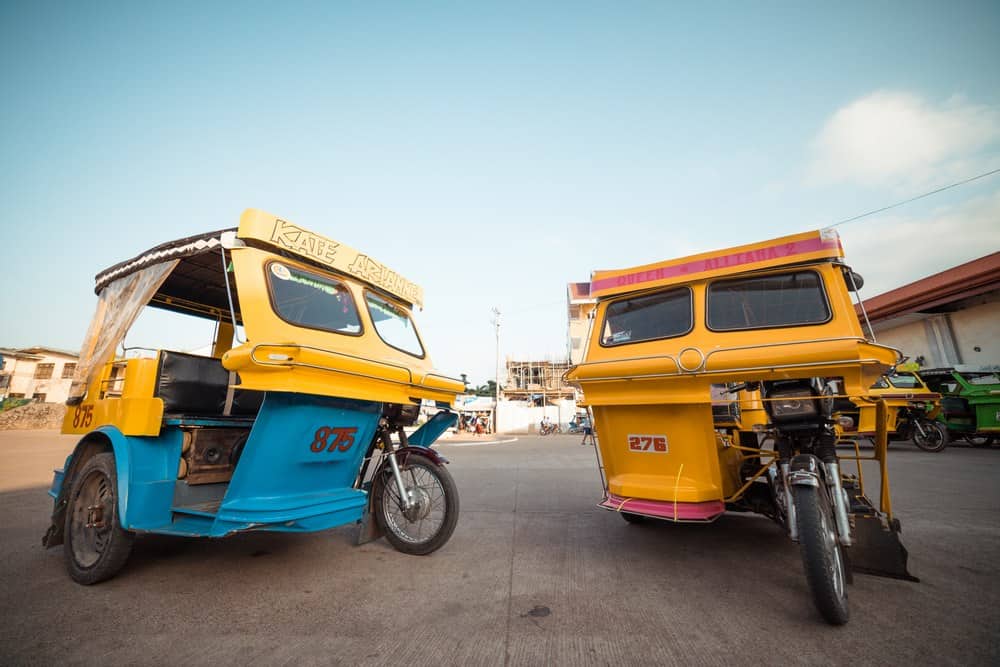
Transport in the Philippines: the habal-habal
One of the most curious ways to get around the Philippines is the habal-habal. This is nothing more than a motorbike with a driver. In other words, you’ll sit on the back.
It’s usually a cheaper alternative than a tricycle, especially if you don’t have anyone to share with. You’ll also see them more often in parts of the Philippines where there are fewer tricycles. A ride usually costs around 10 or 20 pesos, depending on the distance you’re going to travel.
Don’t be alarmed if there are 2 or more passengers—habal-habal can handle it! We’ve even ridden them with our huge backpacks.
In Manila and Cebu there’s an app called Angkas to find habal-habal, and it works similarly to Uber. Prices are per ride.
Taking a taxi in the Philippines
In large cities like Cebu or Manila, one of the most comfortable ways to get around the Philippines is by taxi. It’s really worth it, especially if there are 2 or more of you, since prices are very affordable. As in most of the world, they have meters, and it’s rare to pay more than 300 pesos for a 1‑hour ride.
Even so, in the case of Manila, we try to avoid them as much as possible. After living there, we ended up exhausted. Many drivers don’t want to turn on the meter and try to scam you, so here we opt for GRAB. This is a mobile app that bought UBER in Southeast Asia and works wonderfully. Although it’s a little more expensive than a regular taxi, it’s a safe and cheap alternative. You can also use it in Cebu. Plus, you can pay by card.
At the Manila and Cebu airports there are also yellow taxis or “airport taxis” that charge a much higher fare than the white ones. They won’t try to scam you, but we always avoid hassles by using GRAB, especially in Manila.
For certain long stretches—such as from Cebu to Maya (to go to Malapascua) or from Cebu to Moalboal—you might prefer a car with driver. This way you’ll get to your destination much faster, avoiding buses that make countless stops. You can negotiate the price on the spot, but we have contacts for most of these routes and, if you leave us a comment with the one you’re interested in, we’ll send you all the information. Estimate around 2,000 or 3,000 pesos for routes like these.

Transport in the Philippines: the motorbike
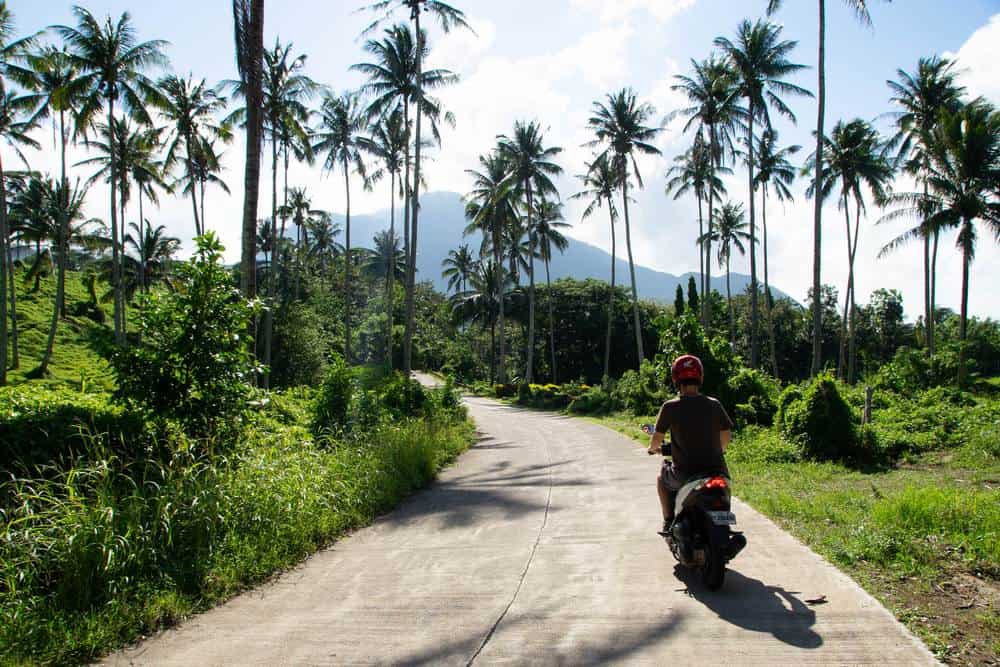
One of our favorite things to do in the Philippines is simply to tour the islands by motorbike. They give you total freedom and ensure you’ll find corners you probably wouldn’t discover with other Philippine transport.
Getting around the Philippines by motorbike is relatively straightforward because, with the exception of the big cities, there’s usually not much traffic. However, that doesn’t mean you shouldn’t proceed with extreme care. Accidents are common, as it’s not unusual to come across dogs, chickens, and other animals. Plus, some roads are in poor condition or very sandy, which can cause a skid. For all these reasons—and besides wearing a helmet and proper footwear—we recommend having experience and, most importantly, making sure you have the proper driving license.
You can read more about this in Driving and renting a motorbike in the Philippines.
Motorbike rental prices vary depending on the island and the number of days you rent it. Usually it’s between 300 and 500 pesos per day, with Palawan and Coron being the most expensive islands in this regard. If you’re renting for several days, you can negotiate.
Most rental bikes are automatic, although on some islands—especially the less touristy ones—you’ll also find semi‑automatics and manual bikes. If you’re going to tackle tougher routes, such as the stretch between Port Barton and San Vicente, it’s advisable to take a cross‑type bike.
Another aspect when talking about this transport in the Philippines is gasoline. Depending on where you are, you’ll see more or fewer petrol stations. On less touristy or less populated islands, the most common thing is bottles (usually Coca‑Cola bottles) filled with fuel at sari‑sari stores (neighborhood shops). A standard price is 50 or 60 pesos per liter.
Given the state of many roads, it wouldn’t be unusual to get a flat tire at some point. Don’t worry—you’ll find plenty of places to fix them. Look for or ask about a vulcanizing shop, where they’ll repair it in no time. It shouldn’t cost more than 50 pesos.
Bear in mind that most bikes don’t include insurance, so when you rent one you’ll sign a paper indicating you’ll be responsible for any damage you may cause. Of course, it’s also vital to travel with insurance that covers you for any accidents you might have. This is the insurance for the Philippines that we use.
Finally, note that although you don’t usually see much police, they do exist—especially on islands like Siargao or Bohol. Follow the traffic rules, especially those regarding not wearing flip‑flops and wearing a helmet, since (besides for your safety) you may get fined.
Renting a car in the Philippines
Finally, although it’s not the most common, you can also rent a car in the Philippines. We only recommend it if there are several of you and if you want to cover long distances—as in the case of Luzon—if you’re thinking of doing a route around the Cordillera area and perhaps heading further north via Sagada, Vigan, La Union…
You can search for rental cars in the Philippines via this link.
Other common places to get around the Philippines by car are Siargao and Bohol. On these islands there are car rental companies, but don’t expect less than 2,000 pesos per day.
Please keep in mind that driving in the Philippines isn’t the same as driving in Europe, Australia, etc. Do it very carefully.
Tips for getting around the Philippines like a fish in water
As you can see, you won’t be short of options for getting around the Philippines. Still, here are some tips so you don’t lose your mind:
-
- Plan ahead where you want to go: it sounds obvious, but it helps enormously to be clear about the exact point on the map you want to reach—especially if you’ve booked accommodation or want to search in a particular area. There are many ports and stations in the Philippines and, depending on where you want to go, you’ll have to go to one or another, so it’s worth checking in advance. For this, you’re in the right place. On our website you’ll find hundreds of routes described in detail. If you need one in particular, leave us a comment and we’ll be happy to reply.
- Cultivate your patience: getting around the Philippines isn’t easy or fast, and not everything goes perfectly. Delays on boats, planes and buses are common. Don’t despair—think of it as part of the experience.
- Allow more time than you estimate: don’t cut it too fine, especially if you have a boat or a plane to catch at a certain time. Leave earlier—especially if it’s in Cebu or Manila—where traffic isn’t unusual.
- Expect the unexpected: the Philippines has a tropical climate, which means occasional typhoons, cyclones and tropical storms, especially in the rainy season. If you travel then, we suggest leaving even more margin—particularly if you have to catch an international flight.
- At Christmas and Holy Week, book in advance: on these dates and other local holidays, Filipinos travel a lot, so tickets sell out. Be proactive and book.
- Start early: if you’re taking a bus in big cities, it’s 100% worth leaving before sunrise—you’ll save 1 or 2 hours of traffic.
- Ask around: if you plan to take a tricycle or habal‑habal, ask at your accommodation or locals nearby about the approximate price for the trip you want to make. That way you’ll have a ballpark and won’t be misled.
-
- Bring motion sickness tablets: it’ll be your great ally for boats and vans if you tend to get motion‑sick. They sell similar pills in the Philippines, but they make us very drowsy.
- Bring warm clothing: even though we’re in the Tropics, dress for winter on long transport days in the Philippines—the air‑conditioning is usually cranked up.
- If you sleep in Manila and plan to take a bus somewhere, it’s better to stay near Buendia or Cubao, which are the main departure areas. From experience, we prefer the Makati area—it’s nicer. You’ll find more info in Where to stay in Manila.
- If you’re in Cebu and you have to overnight before moving on to other islands, take into account which station or port you’ll depart from when choosing your hotel. In Where to stay in Cebu you’ll find recommendations.
- Bring your driver’s license: In the case of citizens of many countries you don’t need to carry an International Driving Permit, since your license is valid in the Philippines for 90 days for driving cars. Check with your embassy or consulate and this: Rent and drive a motorbike in the Philippines.
In short, the Philippines is a country best enjoyed unhurried. It’s far better not to cram so many destinations into your itinerary and instead explore them in greater depth. That way you won’t get overwhelmed by so many transfers and you’ll make the most of them. It’s not about ticking off islands but savoring them. In any case, the effort of taking so many transports in the Philippines is always worth it.

Do you have any questions about how to get around the Philippines? We’ll be happy to answer you in the comments.