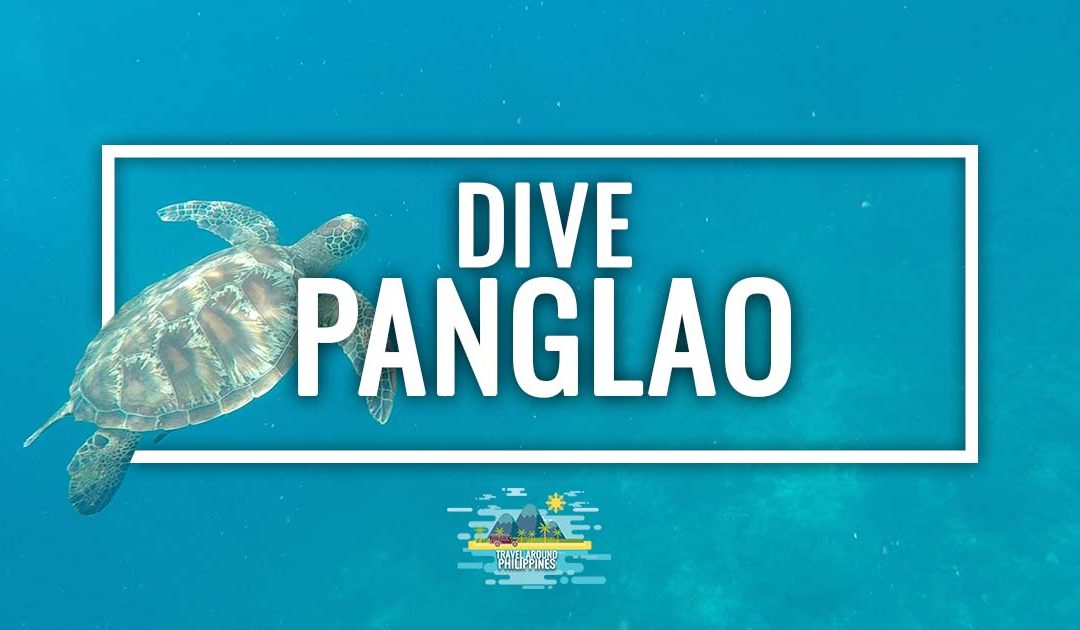
When people talk about diving in Panglao, all eyes immediately turn to little Balicasag. With good reason: this small island, 40 minutes from Alona Beach, holds some of the most beautiful dives in the Philippines, leaving us all astonished by the huge turtle population and the massive schools of jacks (jack fish). However, if you’re going to travel to the Philippines, you’re thinking of including this corner of Bohol and you like diving as much as we do, you can’t miss the chance to discover some of the best dive sites in Panglao, which has one of the most colorful and lively reefs we’ve seen in the whole country.
If you ask us, diving in Panglao is 100% worth it. No wonder we spent 2 weeks on the island last time, more than happy.
What is diving in Panglao like? What can you see?
Panglao, like the whole archipelago, sits in the Coral Triangle, the place with the greatest marine biodiversity in the world. This coral island is surrounded by a gorgeous reef in which its northwest and southwest sides stand out. The shallowest platform is very shallow (around 5 or 6 meters), but they drop dramatically down to depths between 33 and 56 meters.
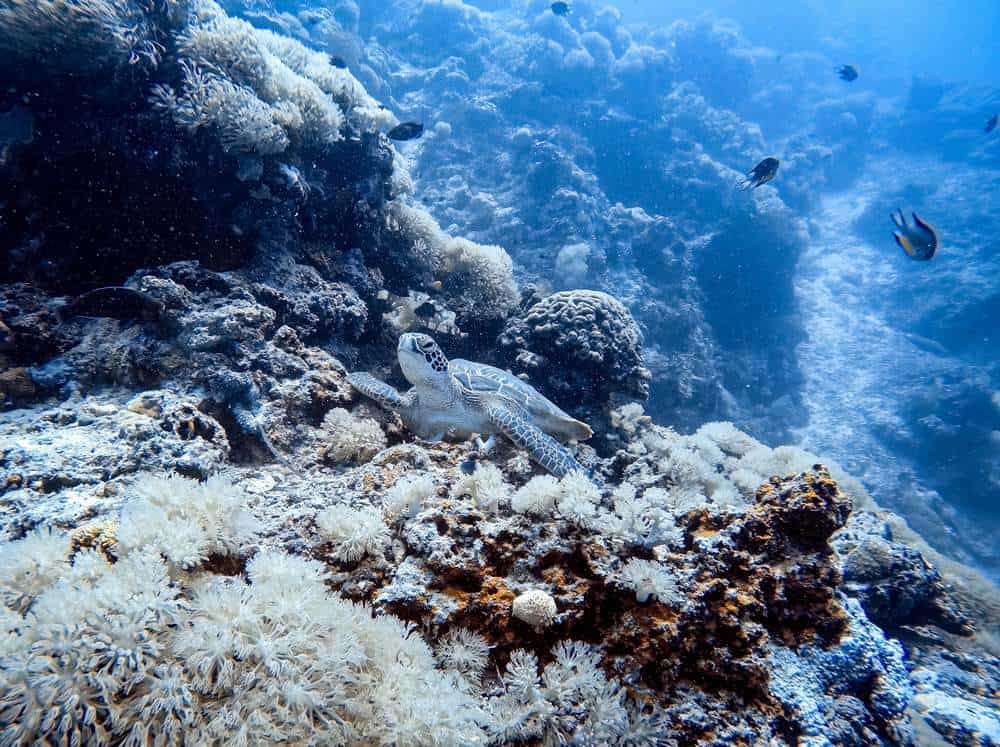
Whether you’re a beginner or an advanced diver, the moment you descend we promise you you’ll be blown away by the amount of hard and white corals you’ll see which, combined with the schools of tuna, mackerel, snappers and groupers and the common sightings of frogfish, nudibranchs, moray eels, lionfish, scorpionfish and turtles, among many other marine animals, is a real treat. Plus, without getting your hopes up too much, natural sightings of whale sharks are increasingly common, far from the horror that happens in Oslob, where they are fed. There’s nothing more beautiful than coming across the largest fish in the world when you’re not expecting it.
Diving in Panglao is very diverse, so you’ll enjoy it whether you’re into coral walls, where you go at your own pace peering into cavities and caves; if you like macro or muck diving; or even wrecks, since there’s one off Alona waiting for you to explore.
If you’ve made it this far but you still don’t have a dive certification or you’re traveling with people who don’t dive, don’t miss our article Snorkeling in Bohol and Panglao.
Where is Panglao and how do you get there?
Although we often talk about diving in Bohol to refer to Panglao, the truth is that, although administratively it belongs to Bohol, the latter is a separate island from the former.
Even so, Panglao is connected to Bohol by two bridges, so you won’t have to take any boat to get there and access is very easy.
Most hotels and dive centers in Panglao are located around Alona Beach, so we’ll focus on explaining how to get there.
To go diving in Panglao, you basically have 2 ways to get there:
- Taking a ferry to the island of Bohol from other destinations in the Philippines. The most common routes are from Camiguin, from Cebu and from Siquijor. We explain them in depth in How to get to Bohol. Once in Bohol, if you’ve arrived at Tagbilaran port, you can take a taxi (500 pesos), a tricycle (300 pesos) or a jeepney (50 pesos) to reach Panglao. If you’ve arrived in Jagna (from Camiguin), the best is to take any bus or van that goes along the road to Dao Terminal in Tagbilaran (about 100 pesos) and from there the bus to Panglao (70 pesos).
- Flying to Bohol–Panglao International Airport (IATA code: TAG). You have flights to Panglao from several destinations in the Philippines (Manila, Clark, Davao, Cagayan de Oro and El Nido) and from Seoul (South Korea). From Panglao Airport you can get to Alona Beach by tricycle (100–150 pesos) or by an air‑conditioned bus that runs around the island (70 pesos per person to Alona).

How much does diving in Panglao cost? Prices
Prices for dives in Panglao don’t differ much from those in other places in the Philippines. It’s common for local dives to cost around 1,600–1,700 pesos with equipment and fees included.
If you want to dive in the north of the island (the Doljo side), since more time is required in the bangka (the local boat), the price goes up to about 5,500–5,800 for 3 dives.
Night dives are around 1,800 pesos.
Besides diving in Panglao, as we’ll tell you below, there are diving day trips from Alona Beach. These are the so‑called “island trips” and the best known is Balicasag, although we’re particularly in love with Pamilacan. These diving trips from Panglao usually include 3 dives and cost about 5,500–5,800 pesos (including equipment, fees, coffee/tea and some snacks). If you bring your own gear, it’s about 800 pesos cheaper.

Where to dive in Panglao? Best dive sites in Panglao
Unless you have loads of days and you’ve come to the Philippines specifically to dive, you’ll surely have to do a little selection and choose which dive sites in Panglao suit you best. As you can imagine, with 18 local sites plus those on the neighboring islands (Balicasag, Pamilacan and Cabilao), things get tricky.
In our opinion, Balicasag and Pamilacan are well worth it, but doing at least 1 extra day of diving in Panglao will also delight you.
Among the dives in Panglao, perhaps the most interesting are Doljo, Puntod and Arco, but here we briefly tell you what you can see at each dive site:
- Arco Point: beautiful coral wall with visibility that usually ranges between 10 and 25 meters. The maximum depth is usually 25 meters. It’s named after an arch through which you enter into a small cave. What you usually see: frogfish, ghost pipefish, moray eels, sea snakes, butterflyfish, blue‑ringed octopus, orangutan crab, porcelain crab, and, with luck, whale shark…
- BBC: located in front of the pretty Bohol Beach Club resort, it’s a good site for beginners as there’s usually not much current. You’ll also find a coral wall, but with a sandy area at the bottom. As a curiosity, there are two sunken jeepneys here. What you usually see: frogfish, pygmy seahorses, nudibranchs…
- Hoyohoy: situated opposite Eskaya Resort, you’ll also enjoy a coral wall from 5 to 25 meters deep and, beyond it, a sandy slope with hard‑coral formations. What you usually see: frogfish, scorpionfish, clownfish…
- Tawala Sanctuary: pretty coral garden that was damaged by a typhoon, so you’ll find lots of broken corals. Even so, thanks to that, many camouflage experts can be spotted: scorpionfish, stonefish, frogfish, ghost pipefish, nudibranchs…
- House Reef: beautiful wall dive where discover scuba dives are usually done because of how easy it is. What you usually see: clownfish, lionfish, moray eels, nudibranchs, frogfish, moray eels, mantis shrimp…
- Garden Eel: great for night dives; beyond the coral wall, at about 20 meters deep, a sandy slope begins where you can usually find the garden eels that give it its name. What you usually see: giant and warty frogfish, ghost pipefish, striped shrimps, nudibranchs, trumpetfish…
- Bohol Divers Wreck: what’s special about this Bohol dive site is an aluminum yacht 10 meters long lying at about 32–37 meters deep. The dive combines exploring the wreck and the neighboring coral wall. What you usually see: pipefish, batfish, octopus, moray eels…
- Kalipayan: varied dive combining sandy slopes with soft‑coral walls. At 32 meters there’s a bangka (a Filipino boat) with even scuba tanks inside. What you usually see: pegasus, seahorses, lionfish, pipefish…
- PPB: combines a coral wall with a sandy slope where the Napoleon eel is usually found. What you usually see: frogfish, lionfish, ghost pipefish, moray eel…
- Green Garden: this gradual sandy slope is super interesting. At the start, full of algae, it’s common to find seahorses and pipefish. What you usually see: seahorses, pipefish, nudibranchs, lionfish…
- Danao Wall: as its name suggests, you have a gorgeous coral wall combined with sandy patches where macro life abounds. What you usually see: giant frogfish, turtles, nudibranchs, whale shark…
- Gak Ang: located opposite a small island of the same name, here you’ll find gardens of soft and hard corals with plenty of reef fish.
- Puntod: located on neighboring Puntod Island, what will surprise you most here is the coral wall that drops to 45 meters and is full of caves and crevices. What you usually see: nudibranchs, frogfish, scorpionfish…
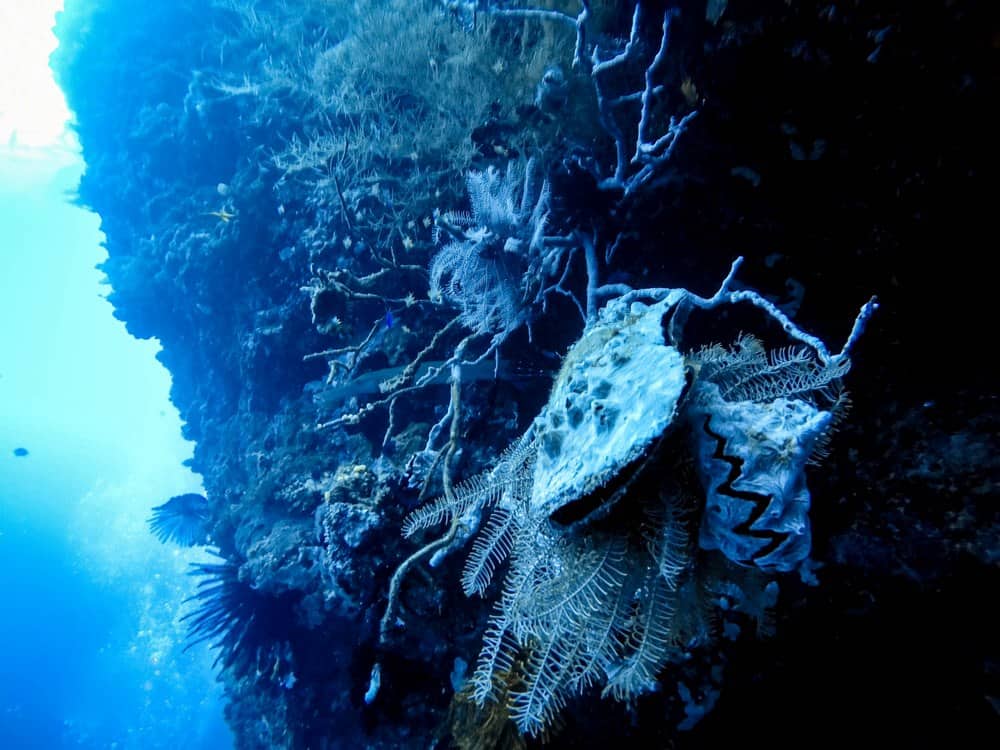
- Doljo Point: one of Panglao’s most beautiful dive sites, featuring stunning corals such as elephant‑ear sponges, tube corals, gorgonians and table corals. Note that currents can sometimes be strong. It’s often a drift dive. What you usually see: butterflyfish, pufferfish, moray eels, schools of barracuda…
- Doljo Sanctuary: combines coral walls with sandy slopes where spectacular gorgonians and corals abound.
- Momo: a Panglao dive site that’s also very nice for snorkeling, as corals can be seen from 4 meters. Visibility is usually very good.
- Napaling: beautiful coral wall featuring black corals, gorgonians and tube corals. What you usually see: frogfish, batfish, scorpionfish…
- Neptune Garden: an awesome dive site where you can often find a school of millions of sardines next to a coral wall that drops to 40 meters deep.

Here’s a map with all the dive sites in Panglao and the neighboring islands. If you click on each one, you can see its name:
Diving trips from Panglao
You’ve already seen that there are dive sites in Panglao galore, but it doesn’t end there… The excursions or island trips usually done from Alona are:
- Balicasag Island: an impressive marine sanctuary featuring black corals, huge numbers of turtles and schools of jack fishes. These are typically wall dives. The trip usually consists of 2 dives at Balicasag sites and an extra dive on the Panglao reef. If you can choose, Black Forest is one of the best dives in the Philippines. In Balicasag you can’t do courses or discover dives, but you can go snorkeling. We tell you more about this in Snorkeling in Balicasag and Diving in Balicasag.
- Pamilacan Island: a small yet beautiful white‑sand island where you can find the remains of a Spanish‑era watchtower. Here you’ll find gorgeous coral gardens, with turtles (the population keeps growing) and tons of macro life. Usually 2 dives are done here and combined with another in Panglao, typically Arco Point. The best time is May to June, but people usually go all year round.
- Cabilao Island: as it’s much farther away (3 hours by bangka), it’s visited less from Panglao.

Who to dive with in Panglao? The best dive center with Spanish‑speaking pros
As you can imagine, being a diving mecca there are loads of dive centers in Panglao. We’ve had the chance to try several of them (all the Spanish‑speaking ones in our case) and, as everywhere, there are more and less professional people, more or less worn gear, more or less comfortable boats, more or less pleasant centers, and varying cleanliness and safety.
Unfortunately, we’ve even seen centers where all the gear is washed in the same tank (wetsuit and regulator on the same side…), gear in a dreadful state, compressor filter changes done very infrequently…
Also, as Spaniards, we feel much more comfortable if we’re served in our own language, especially at the beginning, when you have doubts and fears about diving; so on our latest visits to Panglao we’ve always opted for a center with Spanish staff.
Note, that doesn’t mean all workers are Spanish. Philippine law requires all businesses in the country to have a percentage of local workforce so the Filipino population is supported too (which we think is great). Thus, most instructors in Panglao are foreigners, while dive guides (dive master) are usually Filipino. That said, there are always Spanish instructors on the boat whom you can ask for help or to translate the briefing.
If, like us, you want to feel a bit at home, meet people and grab a beer after the day’s dives, leave us a comment on this article and we’ll send you all the info about our trusted dive center in Panglao. We’ll bet a San Miguel you’ll love it!

Open Water course and discover scuba in Panglao
As we already told you in Diving in the Philippines, Panglao is an ideal place to learn to dive or try what it’s like to get on the tank. From the very first dive you’ll be enjoying marine life, visibility is usually excellent and it’s rare to find strong currents, so we can’t think of a better place to do it.
As for discover scuba dives (called DSD or Discovery Scuba Diving), these are dives for people without certification in which you’re accompanied at all times by an instructor and you don’t go too deep. Prices for discover scuba in Panglao are around 3,500 pesos.
If you’re set on taking the course to become an Open Water Diver (OWD), which will allow you to dive anywhere in the world for life, the first thing to know is that you’ll need at least 3.5 to 4 days of your vacation. Over these days you’ll learn both the theory (although now you can advance a lot in the theory beforehand, since the center will send you the materials online — this is known as e‑learning) and the practice so that you can then be an autonomous diver and descend anywhere in the world.
The prices of OWD courses in Panglao are very competitive compared to other places in the Philippines: about 18,500–19,000 pesos. In Panglao you’ll find super professional instructors who teach you in your language and help you forget those fears we’ve all had at some point. We tell you more about it in Open Water Diver course in Bohol.
Do you want a trusted dive school in Panglao? Leave us a comment and we’ll send all the information to your email.

Where to stay in Panglao
The vast majority of dive schools in Panglao are organized around Alona Beach. It’s a very touristy area, although if you know where to stay you can take advantage of the benefits this brings (ease of getting around, shops, tasty restaurants and lively bars) and avoid its downsides (noise, mass Chinese and Korean tourism). Our recommendations for staying in Panglao are:
- Panglao Moravian Apartments: if you ride a scooter, this place is 15 minutes from Alona Beach and absolute peace at a great price. They have a pool and the rooms are huge and new. We tell you about our experience in Staying at Moravian Apartments Panglao. ➡ More information here.
- La Sirenita: literally 1 minute from the quietest area of Alona Beach, so you can take a dip whenever you fancy and it guarantees you can walk to the dive center. Huge rooms with 2 double beds and a little terrace for breakfast with sea views. Watch out, it’s addictive — we spent almost 2 weeks here on our latest visit to Alona. ➡ More information here.
- Alona42 Resort: in Alona but away from all the hustle and bustle. Plenty of comforts without going crazy on the price. ➡ More information here.
Find more options in our article on Where to stay in Panglao.
Tips for diving in Panglao
Here are a few tips of our own so you can enjoy diving in Panglao to the fullest:
- Bring plenty of cash. Almost 99% of dive centers in Panglao don’t accept cards or they charge a percentage for card payments. Since most Filipino ATMs charge a fee of almost 6€ to withdraw 10,000 pesos, it’s advisable either to bring euros or dollars and change them at a money‑changer or withdraw from HSBC ATMs located in Cebu or Manila. You’ll find more details in Money in the Philippines.
- If you’re doing a dive trip around the Philippines, it’s worth bringing your own gear to avoid rental costs.
- If you’re very keen on diving in Balicasag (please do!), book well in advance. There’s a quota of 150 divers per day, so try to make your reservation as soon as possible. This is particularly important during peak periods such as Christmas, Holy Week, Chinese New Year and local holidays (May long weekend, for example). If you want information to make your Balicasag diving reservation, leave us a comment on this article and we’ll send it to you.
- Be very careful with air‑conditioning in the Philippines; temperature changes are brutal and you don’t want to catch a cold and miss out on diving.
- Please choose a good dive center and don’t be guided by saving a couple of euros. Safety in diving is paramount. Bargains end up being expensive.
- Travel with a good travel insurance like the one we use. Here’s a 5% discount.
Did you like this article? Do you have any questions about diving in Panglao? We’d love to get your comment below.