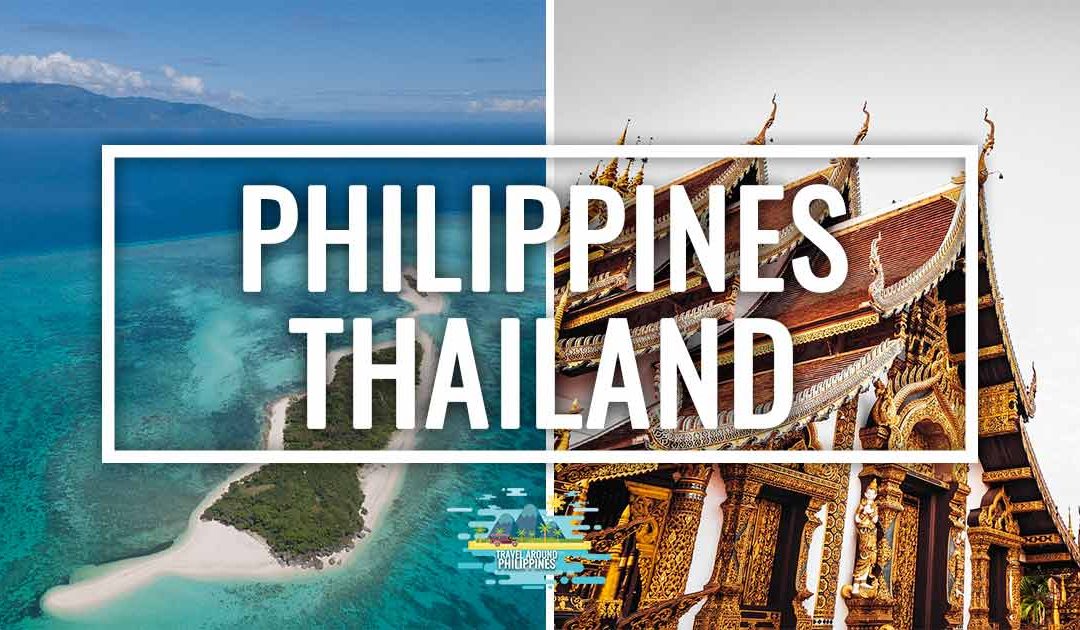
Philippines or Thailand? Which to choose? Which is better? It’s not unusual for us to get these questions every week, or others that compare the archipelago we’re passionate about with other corners of Southeast Asia. As the saying goes, “comparisons are odious,” and we’ll tell you upfront that you won’t leave here with a hard-and-fast answer, but rather with reasons to tip the balance one way or the other, depending on what you’re looking for in your trip.
Luckily, those of us who write this website have had the good fortune to travel extensively through both countries. Specifically, we’ve been visiting Asia since 2010 and, in 2014, we set off to travel indefinitely, spending a large part of our time exploring Southeast Asia. While the Philippines is our “darling” (if it weren’t, this site wouldn’t exist…), Thailand has been our home on several occasions, and we’ve spent seasons between Koh Tao and Chiang Mai, which gave our weary backpacks a breather.
Without rambling on, we’re going to tell you what it’s like to travel to the Philippines or Thailand and which to choose in each case. Of course, if you can combine both destinations and give each a reasonable amount of time (15–20 days), all the better!
Philippines or Thailand: tourism development—or not
Let’s start with one of the points we find most important when comparing the two countries: tourism development. Like most things in life, it has its pros and cons—and its “detractors and defenders.”
Broadly speaking and without getting too economic, we could say that Thailand is a bit more developed than the Philippines. You notice this almost as soon as you arrive when you see the transport infrastructure, and then increasingly in tourist areas.
Does this mean there aren’t decent ports or airports in the Philippines? Of course not—there are—but there’s still a long way to go if you want to visit certain corners, especially the less touristy ones. In other words, getting to very well‑known places like El Nido or Boracay is as easy as catching a plane from the big cities, but to explore destinations like Romblon you’ll have no choice but to combine several boats or a plane and a boat—or invest more time. You also won’t find a multitude of high‑end resorts and restaurants here, so you’ll need to fend for yourself. In our opinion, this is more of an advantage than a drawback for travelers because it means there are thousands of places where you still won’t find anyone and that are, so to speak, more “pure.”
On the flip side, for those who want the convenience of flying in, getting around by taxi, and going to good hotels and restaurants, you’ll have no problem—but even in places as touristy as Bohol or Siargao, you’ll still feel less crowding or “touristification” than in Thai spots like Phi Phi or Koh Tao.
We don’t want to be pedantic—Thailand also has thousands of little‑visited places, okay? But it’s true that the well‑known ones have become extremely touristy. The numbers give you an idea: in 2019, almost 40 million people traveled to Thailand, while only 8.2 million reached the Philippines.
In short, both countries are set up for backpackers and for travelers seeking more comfort. In both you’ll find well‑trodden routes and more remote places, but perhaps there are more of the latter in the Philippines—appealing both to backpackers and to those just getting started with this style of travel.

Romblon in the Philippines and a market in Chiang Mai
Philippines or Thailand: nature galore
Here comes the good stuff! When you think of Southeast Asia, images of jungles, wildlife, rice terraces, waterfalls, and volcanoes probably pop into your head, right? You’re not far off, because that’s what you’ll find—more or less—in the Philippines or Thailand. But which is better in that sense? To be honest, for us, the Philippines is more complete, and these are the reasons:
- Beaches: without disparaging Thai beaches (there are some great ones in Koh Lipe, Koh Tao, or Koh Phangan), the Philippine ones look more like “postcards” to us. With their crystal‑clear waters, sugar‑white sand, and elegant coconut trees, in our opinion the only rivals are in the Maldives. Of course, with more than 36,000 kilometers of coastline, there are all kinds of beaches, but the best beaches in the Philippines will blow your mind. And between El Nido and Phi Phi, there’s really no comparison.
- Diving and snorkeling: here—except for what you’ll see in the Similan (where diving isn’t particularly cheap)—we don’t think there’s much debate either. The Philippines sits within the Coral Triangle, the place with the greatest marine biodiversity on Earth, and you’ve got a great chance of spotting turtles, whale sharks, thresher sharks, and even the elusive hammerheads. Read Diving in the Philippines to start dreaming about them. If you don’t have a dive license and don’t feel like getting it, snorkeling in the Philippines will win you over.
- Volcanoes: we have a special attraction to volcanoes, so this is a huge reason to choose a destination. Among the best volcanoes in the Philippines are the majestic Mayon (a perfect cone) and Pinatubo—both visitable. Plus, Camiguin is the spot on the planet with the most volcanoes per square kilometer.
- Waterfalls: you’ll find them everywhere in both countries, but although Thailand’s Erawan and Doi Inthanon national parks have cool cascades, we think the Philippine ones are much more impressive. On top of that, most can be enjoyed in all their glory—taking a dip or even canyoning through them. Take a look at the waterfalls of the Philippines and you’ll see what we mean.
- Fauna: beyond the incredible marine life we’ve mentioned, in the Philippines you’ll be able to meet the famous Philippine tarsier—one of the smallest primates in the world, with huge eyes. The archipelago is also a paradise for bird lovers, and it won’t be unusual to spot macaques or monitor lizards. In Thailand, as you know, you’ll find—among other animals—the wonderful Asian elephants. Please, never ride them, and do your research if you’re thinking of visiting a sanctuary, because most are a fraud. If there’s human interaction, be wary. If you want to see them in the wild, Khao Yai National Park is your best bet.
Philippines or Thailand: churches vs. temples
It’s undeniable that Thailand has an extra dose of exoticism expressed through its religion. About 95% of its population practices Theravāda Buddhism, so you’ll find thousands of temples scattered around the country. By contrast, an estimated 80% of Filipinos are Catholic—and you have to add Protestants and Orthodox Christians to that—so it’s rare not to see dozens of churches during your trip, many with several centuries of history, dating back to Spanish times.
Of course, if you’re coming from Europe or America, the culture shock is greater in Thailand; but, in our opinion, it’s also very interesting to see how faith is lived in the Southeast Asian country with the largest number of Christians. Oh, and if you feel like it, in several corners of the country you’ll also find Buddhist or Taoist temples, such as the excellent Taoist Temple of Cebu.

Philippines or Thailand: Manila vs. Bangkok
Do you like visiting cities on your trip, or do you prefer to focus on nature? Both countries have massive metropolises to get lost in, but it’s true that the Thai capital beats the Philippine one in attractions and is also easier to visit. Even so, our advice is that, if you can, devote at least half a day to visiting Manila. There’s plenty to dig into (a simple stroll through Intramuros is already worth it), and it has fantastic malls, top‑notch hotels, restaurants and, if you’re into nightlife, clubs and discos.
Urban tourism in the Philippines doesn’t end with Manila. Cebu also has interesting places—especially related to the Spanish era in the archipelago—and Iloilo and Vigan likewise deserve at least a day.
All this is to say that the Philippines isn’t a great destination for city tourism, but alongside its natural wonders you’ll find places packed with history that we consider essential. Add to that a huge offer of restaurants, hotels, and entertainment venues for anyone wanting a little luxury.
Philippines or Thailand: pad thai vs. adobo
Let’s talk food: which is better, Filipino or Thai? Here the exotic factor comes into play as well: Thai food has little to do with the flavors we’re used to in Europe or American countries, so it tends to impress us and win us over more easily. Pad thai, curries, sticky rice… new stimuli everywhere!
Does this mean Filipino food is boring or bad? Not at all; but it’s true that it leans heavily on stews that remind us of home (even the names caldereta or adobo may ring a bell), on grilled meats or fish, and, of course, lots of rice. The fact that it’s not as unusual (for the most part—there are “quirky” things like balut or halo‑halo) as Thai food also has an upside, especially for those who don’t love spicy food or taking too many risks when eating. Plus, in touristy spots you’ll find cuisine from all over the world if you want to mix it up.
You can read much more about this in Philippine cuisine. Ah! And if you’re vegetarian or vegan, don’t worry—it’s not as bad as people say. Check out our article on vegetarian restaurants in the Philippines and get ready to drool.

Philippines or Thailand: which country is cheaper?
Let’s start from the premise that both countries are very cheap to travel in; but, broadly speaking, the value for money of accommodation and food tends to be a bit worse in the Philippines. This is more noticeable in the country’s most touristy places (El Nido, Boracay, or Siargao), where it’s harder to find budget hostels—but it also depends a lot on the season. Price differences can become brutal during peak demand such as Christmas or Easter, when we strongly recommend booking well in advance.
In short, you can travel very cheaply (or very expensively, if you feel like it) in both the Philippines and Thailand; but you’ll need to allocate a slightly larger budget (not dramatically so) in the former if you want “nicer” places. That said, in both countries you can eat from $1 and find accommodation from $8–10 per person per night. You can see more details in our article on “How much is to travel to the Philippines?”.
Philippines or Thailand: people and language
Here we think there’s not much room for debate: the Philippines wins. Why? Because a large part of the population speaks English. It’s taught in school—and some subjects are taught directly in English—so you’ll even be able to communicate with the little ones.
This not only makes it easier to get around the Philippines, but it also makes the trip more interesting: you’ll be able to chat with any Filipino, not just those who work in tourism. What’s more, the vast majority of people are open and eager to share, so don’t waste the opportunity—talk to them and make the most of it. For us, this is a crucial part of any trip, and even more so in the Philippines, where you can discover that special character in its people—somewhere between Asian and Latin.
If you don’t speak English, don’t worry! Muttering a few words gives you an edge, but people will also go out of their way to understand you if the language isn’t your thing. Truly, Filipinos are very helpful and eager to please. Plus, did you know that many Tagalog and Bisaya words are of Spanish origin? They may understand you more than you think. Read more about this in our article on the languages of the Philippines.
This doesn’t mean you can’t talk to anyone in Thailand, but you’ll likely have to stick more to people in the tourism sector or younger folks, who are more likely to manage in English. Also, from our own experience, we find Thais a bit more reserved—perhaps out of fear of not understanding you, or because they’re more used to (and sometimes tired of) tourism.

Philippines or Thailand: the weather
Broadly speaking, the weather of the Philippines and that of Thailand are quite similar. However, you need to take into account the peculiarities of each country—and, within them, each region. Thus:
- March to May: the hottest months in both countries. Average temperatures are around 32°C, though it’s not unusual for cities to exceed 35°C. In the Philippines it’s high season because it’s their “summer”; besides school and work holidays, Holy Week is added.
- June to November: rainy season due to the monsoons; it’s usually downpours that last just a few hours. Temperatures drop a little. In the Philippines there’s a risk of tropical storms and typhoons.
- December to February: the coolest months, and the chances of rain decrease a lot. In Thailand it’s high season, so prices tend to rise a bit. In the Philippines, except for Christmas, these are quieter months with more moderate prices. January and February are great months to travel.
You can read much more about this in Best time to travel to the Philippines and When to travel to the Philippines?
Rainy season in Thailand and the Philippines
We’ve already covered the general theory, but then you need a couple of clarifications on what worries travelers most: the rainy season—especially if it affects your beach time.
In Thailand we can distinguish by the southern coasts of the country. So:
- East Coast: the Gulf of Thailand area (Koh Tao, Koh Phangan, and Koh Tao) is better in August. The rainiest months are October, November, and December. The best time, nevertheless, runs from January to April.
- West Coast: in the Andaman area (Phuket, Krabi, Koh Lipe) it usually rains more from May to October—especially in August and September. In other words, it’s better to go here between November and February.
In the Philippines, on the other hand, grosso modo, we could talk about two parts:
- Luzon, Palawan, and Western Visayas (Negros, Panay, Mindoro, Romblon…): the rains run roughly from June to November. From September to October there’s a greater risk of typhoons, although Palawan rarely gets hit hard. They usually enter along the eastern coast in the central part and move up toward Luzon.
- Eastern coast of Mindanao (Siargao) and the eastern part of the Visayas (Leyte and Samar): the rains start around November and don’t calm down until February–March. The rainiest months are December and January. That is, the best time to visit these areas is July, August, September, and October. Islands like Camiguin and Bohol in Central Visayas can also have good weather then.
In short, there’s nothing particularly conclusive to make you choose the Philippines or Thailand based on climate alone. The best months, generally, to visit both countries are from December to March, though that shouldn’t stop you from visiting at any time. Truly, even in the rainy season it doesn’t mean it will rain all day— and it’s going to be warm anyway.
Perhaps the most important thing is that you should be a tad more attentive in the Philippines regarding typhoons, since if one comes you could have 3–4 days of rain and wind. To avoid them, keep an eye on the weather and dodge them; forecasts are given a week or more in advance.
Add to this that weather throughout Southeast Asia tends to be unpredictable. As a rule, no one can tell you what the weather will be like X months from now in Bohol (or any other random destination). Imagine that in the same day you might get blazing sun, a sudden downpour, or overcast skies—you never know! Take things philosophically and be aware you’ll enjoy it just the same.

Combining the Philippines and Thailand in one trip
To make things even better—why choose between the Philippines or Thailand if you can have both? Travelers who have more time and want to combine the two destinations can end up delighted with this Southeast Asia trip. In our opinion, the minimum time to devote to each would be 15 days—that is, a month in total. If you have more, even better.
To craft a balanced trip, what we’d do is prioritize cultural immersion spots in Thailand and, in the Philippines, nature, beaches, and diving. That way you’ll squeeze the most out of both destinations. For example, you could follow this 15‑day itinerary in the Philippines and in Thailand split your time between Bangkok, Chiang Mai, Chiang Rai, and Sukhothai. Of course, the Kingdom of Siam has fabulous islands and beaches like those in Koh Lipe or Koh Tao, but if we’re being impartial, we prefer the Philippine ones—same for the waterfalls.
If you have more time, don’t hesitate to include the rice terraces of Banaue and Batad. You’ll be blown away by these quintessential Southeast Asian landscapes. Of course, you can also tweak your route through the Philippines in a thousand ways. That’s why we always encourage you to read up on the different destinations and choose according to your tastes.
As for logistics, if you’re coming from Europe/America, you could start by flying to Bangkok, explore the Thai areas you choose, and then fly from Bangkok to Manila or Cebu. You can return to your country directly from the Philippines (for this, it’s best to look for multi‑city flights); but if that’s very expensive, you can always return to Bangkok with one of Asia’s low‑cost airlines and fly home from there. In that case, it’s much better to leave a 1–2 day buffer between the flight from the Philippines to Thailand and the Thailand–home leg, just in case.
Of course, you could also do it the other way around—putting the Philippines first. However, we always like to end the trip with a bit more beach time. Take a look at flight prices and schedules and start planning your dream trip:
Cheap flights from Bangkok to Manila
Cheap flights from Bangkok to Cebu
Multi‑city flight: Europe–Bangkok–Manila–Europe

And that’s it! As you can see, both are great countries and sooner rather than later we encourage you to visit them. Still, if you’re at the decision‑making stage, we hope we’ve helped you choose between traveling to the Philippines or Thailand according to what best fits what you’re looking for. We’ve highlighted the aspects we find most interesting, but of course there are many more. If you have any ideas or questions, we’ll be more than happy to answer you in the comments.
If you can’t wait any longer and want to start preparing your trip, we encourage you to start by reading our Philippines Guide. Across our site you’ll find all the information you need to plan your trip, such as itineraries around the Philippines, detailed guides to specific destinations like Siargao or El Nido, and even detailed routes for getting around the country.
(Oh, and if you hadn’t noticed already—with how much we love Thailand—we’re on #teamPhilippines. What else would you expect reading Travel Around the Philippines? What more do you need for us to convince you?)