
In a country made up of more than 7,700 islands, it’s practically impossible not to take a domestic flight in the Philippines during your trip. Whether it’s your only option, the most comfortable, the fastest or even the cheapest, using one of the Philippine airlines is something you’ll hardly be able to avoid.
So that you can learn about the different options within reach and have useful information at hand such as each airline’s baggage allowance, we’ve put together this complete guide to Philippine airlines and domestic flights in the country. Fasten your seatbelt—we’re taking off!
Cheap flights in the Philippines
In most cases, the different airlines in the Philippines tend to offer fairly similar prices on their domestic routes and none of them stands out from the rest in this regard. In our Guide to Cheap Flights to the Philippines we share some of the tricks we use to find budget flights, which also work perfectly for flying from one destination to another within the country.
Instead of checking Philippine airlines one by one, we use the Skyscanner price comparison to see all the options at a glance and pick the flight that best fits our plans.
There are some airlines, which we’ll talk about below, that (for now) don’t always appear in flight search engines and for which you need to go directly to their websites to buy. For this reason, it’s very useful to know which routes they cover.
How much do domestic flights cost in the Philippines?
This depends a lot on the specific route, how far in advance you buy, and the dates. For example, you have very cheap domestic flights in the Philippines such as Manila–Cebu (and vice versa) that can be found for under $25 if booked several weeks in advance, but less than a week out they often double. Others are pricey even when purchased well ahead, such as direct Manila–Siargao flights, which are typically over $130 a month out.
Obviously, on dates such as Holy Week (Easter) and Christmas/New Year’s, prices multiply and it’s even more important to plan ahead.
On the other hand, bear in mind that except for certain fares on the Philippine airline Philippine Airlines, none will include checked baggage, so you’ll need to factor this in (unless you’re traveling with carry‑on only). That said, it isn’t very expensive: expect $15–20 per 15–20 kg bag.
All in all—being an island country—unless you’re traveling between nearby islands that are connected by ferry, count on a good part of your Philippines budget going to flights. If you want to save, we recommend booking in advance and reading our destination guides in detail, where you’ll find sections called “how to get to X” with the different options.
Is it advisable to book flights in the Philippines in advance?
The million‑dollar question! Many travelers wonder whether it’s better to book domestic flights in the Philippines ahead of time or do it on the fly because they want to improvise—either due to the weather or simply preference. If you ask us, it really depends on what you value most:
- You prioritize saving money or not having to worry about checking flights during your trip: as we mentioned above, prices for domestic flights in the Philippines tend to double when there are 1–2 weeks left, so if you’re taking several flights within the country, booking in advance saves you a bundle.
- You prioritize flexibility: you’re concerned about the weather and prefer to see how things are on the ground. In this case, you need to be aware that you’ll spend considerably more, especially at peak‑demand times.
A middle‑ground solution could be to book the first flights and then go with the flow. Or perhaps the inbound and return, if you already have your Philippines itinerary clear.
To see the price range for flights you might be interested in, the best thing is to use Skyscanner and search with its calendar view. That’s what we do all the time.

What is the best airline in the Philippines?
Being used to big names like Emirates, Qatar Airways or Turkish Airlines, it’s very common that when you read you can take a domestic flight in the Philippines with, for example, AirSWIFT, doubts arise. “Is this Philippine airline reliable or is it a scam?” Questions like this lead many travelers to wonder which is the best airline in the Philippines. The answer is that all the airlines we cover in this guide are completely reliable and recommended.
There isn’t a Philippine airline that’s better than the rest or with a lower risk of cancellations—this can happen no matter which one you choose. Keep in mind, especially during the rainy and typhoon season, that flight delays (and sometimes cancellations) are normal. Therefore, when planning your Philippines travel itinerary, it’s very important to allow some buffer time for your air travel. From our experience, it’s highly advisable to return to Manila or Cebu the day before your international flight—we’ve seen countless travelers miss theirs…
As for prices, there usually isn’t much difference between companies, except that airlines like AirSWIFT (now owned by Cebu Pacific) operate small prop planes, which makes tickets slightly more expensive.
The different Philippine airlines occasionally share promotions and discounts on their social networks. If you follow them there it’s a great way to snag them.
Philippine domestic airlines
Some general notes about Philippine airlines—since you ask us about this a lot:
- Remember to pay for your domestic flights in the Philippines with a card such as Revolut ($10 when you sign up with our link) or N26, since you’ll be paying in Philippine pesos and this way you won’t get charged foreign‑currency fees.
- All Philippine airlines allow 7 kg of carry‑on baggage, consisting of a suitcase/backpack plus a personal item (handbag, laptop bag, etc.). Those 7 kg are the total for both pieces.
- The dimensions of the backpack or suitcase are usually 56×36×23 cm and they aren’t very strict about them. If you’re carrying a backpack, it’s unlikely they’ll pay much attention as long as it’s not too bulky—which is hard if you respect the weight limit, as soft bags can be compressed.
- You can’t say they’re generally strict about weight—neither for checked bags nor for carry‑on. Sometimes they weigh, sometimes they don’t; it totally depends on who you get at the counter. If you’re overweight, you’ll have to pay—and this costs 2–3× more than buying baggage online. You’ve been warned.
- If you won’t be checking a bag and you’re traveling carry‑on only, try to do online check‑in and skip the counter so they won’t weigh your carry‑on.
- You can travel with very little luggage—not just because of the climate, but because there are laundries everywhere. You can read more in What to Pack for the Philippines.
- These Philippine airlines’ websites don’t exactly work flawlessly—be patient, especially when doing online check‑in.
- It’s advisable to be at the airport 1.5–2 hours early. If you’re departing from Manila, be very careful with traffic. We don’t leave the hotel with less than 3 hours to spare (unless you’re sleeping nearby, of course). You can find accommodation tips in Where to Sleep Near Manila Airport and How to Get from Manila Airport to the City Center (and vice versa).
- Don’t allow less than 3 hours for self‑connections, unless they’re offered by the same airline and bought on the same ticket.
- Plan your last domestic flight home at least the day before your international flight—you really don’t want the stress. This is especially important at small, lightly equipped airports such as Coron, El Nido and Siargao.
- Domestic flights follow the same rules as elsewhere in the world: liquids up to 100 ml. If you want to bring sunscreen, for example, you can split it into several small bottles.
- Be careful with repellents, especially sprays, if you want to carry them in your hand luggage—it’s quite common for RELEC and GOIBI to end up in the trash because they’re considered flammable.
Cebu Pacific Air (CebGo)
Cebu Pacific is one of our favorite Philippine airlines. With almost 40 destinations within the country, it offers connections to practically any area you might need to visit. Its fleet is mostly composed of Airbus aircraft—very similar to what any European low‑cost airline operates—but they also have some turboprops that fly to smaller airports or those not prepared for larger planes.
Cebu Pacific lets you do online check‑in on its website, as well as choose your seat or even your in‑flight meal (which, we warn you, isn’t very varied). As a curiosity, on many of their flights they run a “quiz” with general‑knowledge questions in which winners can get some airline merch. The questions are really simple, and if you take more than one domestic flight with them you’ll notice they repeat them (Titanic and Harry Potter are very common answers).
In 2024, Cebu Pacific bought the airline AirSWIFT, which for decades was the only one able to land at El Nido airport. In other words, Cebu Pacific now operates the Manila–El Nido, Cebu–El Nido, El Nido–Bohol and El Nido–Coron routes (and vice versa).
Fares and baggage on Cebu Pacific
This airline offers three different fare types:
- GO BASIC: allows only one piece of carry‑on up to 7 kg (plus a small personal bag) and no seat assignment.
- GO EASY: includes one carry‑on (plus a small personal bag) and one 20 kg checked bag. It also lets you choose a seat.
- GO Flexi: lets you buy fully flexible tickets (obviously more expensive), i.e., with the possibility of canceling up to 2 hours before departure. The money is refunded to a voucher (travel fund). It also includes one 20 kg checked bag, in addition to carry‑on.
In any case—just like in Europe—you can pick the basic option and then add extras (add‑ons) such as checked baggage or meals. This is usually cheaper than buying the Go Easy fare, but compare.
Travel Around the Philippines tip: Cebu Pacific is “very cheeky,” and whichever fare you choose they’ll pre‑select travel insurance for you by default (sometimes even meals and seats, though less often). So remember to remove everything you don’t need, or you’ll end up paying for it. To remove the insurance, go specifically to that section and click “remove TravelSure”.
Cebu Pacific baggage
If you want to take extra baggage, you can always indicate it and buy up to 32 kg of checked baggage. You can also buy three 20 kg bags, or increase the weight in 4, 8 and 12 kg increments. Be very careful if you go over the limit. Although sometimes they don’t look too closely, it’s not unusual for Cebu Pacific to charge you for overweight.
Prices depend entirely on the route, but as a ballpark, 20 kg of checked baggage bought in advance with Cebu Pacific is around 750 pesos.
They also accept special baggage such as surfboards or other sports equipment and musical instruments.
Carry‑on may not exceed 56 cm × 36 cm × 23 cm and can be accompanied by a small bag (handbag, laptop sleeve, toiletry bag, etc.) no larger than 35 cm × 20 cm × 20 cm. Note that both pieces combined may not exceed 7 kg. Do they usually check? It’s 100% down to who you get at the counter, but if they weigh it and you’re over, you’ll be charged—and it will cost you roughly 3× more than buying baggage online. If you can check in online and avoid the counter, even better.

Philippine Airlines (PAL)
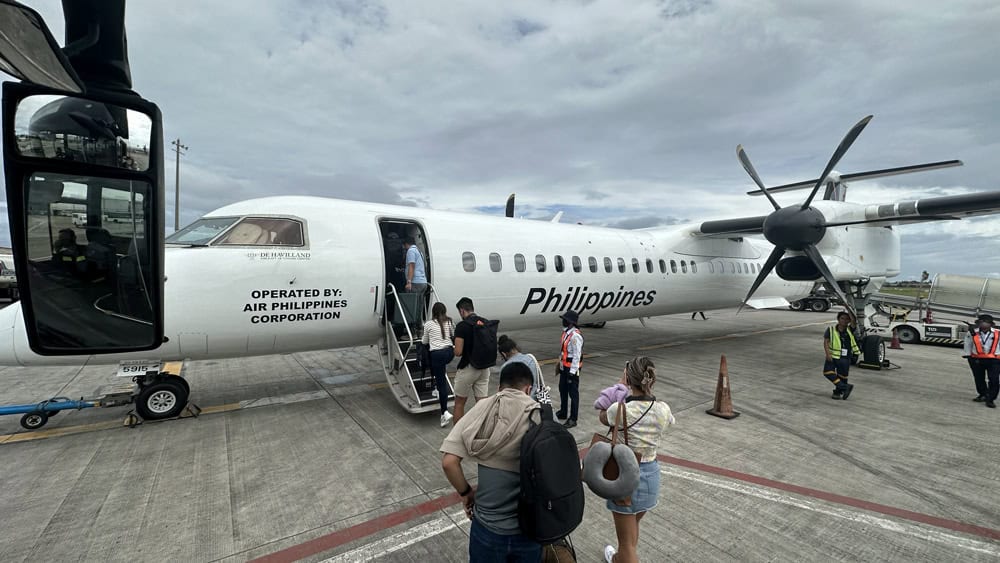
Philippine Airlines is the other big Philippine airline—the country’s flag carrier—and it also offers more than 30 destinations across the country. Like Cebu Pacific, it operates medium‑sized aircraft made by Airbus and Boeing. It’s the oldest operating airline in Asia and also flies to Europe, North America and Oceania.
When comparing it with Cebu Pacific, as we mentioned earlier, there isn’t a huge difference. If you can choose between the two, we recommend going with the one that best fits your schedule and price.
PAL has a “little sister” called PAL EXPRESS. They operate interchangeably, but we’re flagging it in case you see it when buying your ticket.
Fares and baggage on Philippine Airlines
Depending on the route you take with Philippine Airlines, there are different fares available:
- Economy: Within this cabin there are the variants Supersaver (no checked baggage and a small snack); Saver (10 kg checked baggage and a small snack); Value (20 kg checked baggage—10 kg when flying on the Q400—and a small snack); Flex (20 kg checked baggage—10 kg on the Q400—and a small snack); and Comfort Class (25 kg checked baggage).
- Business: there’s Value with up to 30 kg of checked baggage and a hot meal; and Flex, which allows 35 kg.
If available, the best option is to buy any of the economy fares and then select the baggage you want in the next step. All cabins allow a maximum 7 kg carry‑on with maximum dimensions of 56×3623 cm. As above, two pieces are permitted, but together they may not exceed 7 kg.
Travel Around the Philippines tip: as with Cebu Pacific, this airline pre‑selects flight insurance by default at around 500 pesos. Don’t forget to uncheck it before paying if you don’t think it’s necessary.
In this case, you won’t choose a seat at the time of purchase, but when you do online check‑in or at the airport when you check your bags.
AirAsia MOVE
AirAsia (now called AirAsia MOVE) is one of the largest low‑cost airlines on the continent, so it’s sometimes nicknamed “the Ryanair of Asia” (although, luckily, the service tends to be much better than the Irish carrier’s). If you’re arriving in or leaving the Philippines from another Asian country, it’s one of the airlines with the best prices and the widest range of destinations, offering, for example, excellent connections via major transit hubs like Kuala Lumpur.
For domestic flights in the Philippines, AirAsia has fewer routes than Cebu Pacific and Philippine Airlines, but on the routes it does operate it offers very competitive prices. For example, you’ll find flights to Dumaguete, Puerto Princesa, Bohol and Cebu mainly from Manila. The most convenient way to find a suitable route is to use Skyscanner.
Fares and baggage on AirAsia
AirAsia has different fares, but depending on the route chosen it offers one set or another:
- Low Fare: this is AirAsia’s cheapest fare. It doesn’t include seat selection or checked baggage. For carry‑on it allows one cabin bag up to 56 cm × 36 cm × 23 cm and one small item (handbag, camera bag, laptop) up to 40 cm × 30 cm × 10 cm that fits under the seat in front. Both pieces together may not exceed 7 kg.
- Value Pack Lite: in addition to the Low Fare carry‑on, it includes one checked bag up to 15 kg and seat selection.
- Value Pack: the same as the above, but with 20 kg checked baggage and one meal.
- Premium Flex: includes the same as Value Pack and also offers extra‑legroom seats or perks such as fast‑track boarding and expedited check‑in. It also lets you change your flight twice (you’ll still pay any fare difference).
If you don’t want to commit to any of these bundles (which we recommend), the best thing is to choose the Low Fare and add baggage in the next step. The price depends on the number of kilos and the flight segment, but figure about 700 pesos per 15 kg bag for domestic flights in the Philippines.
Note: AirAsia lets you do something very interesting—buy extra carry‑on allowance (“XTRA CARRY ON”). This allows up to 14 kg of carry‑on (with the main cabin bag weighing at most 10 kg). You can select it during the purchase process in the carry‑on section.

AirSWIFT (now Cebu Pacific)
The third Philippine airline operating small planes is AirSWIFT, commonly chosen by those who on their trip to the Philippines prioritize optimizing time over saving money. It stands out for its connections from El Nido, such as flights to Manila in 45 minutes or to Coron in 25 minutes.
As mentioned above, this airline was absorbed by the giant Cebu Pacific Air and you now purchase these flights directly with them.
Fares and baggage on AirSWIFT
All AirSWIFT flights let you bring one piece up to 7 kg as carry‑on (+ one small bag/laptop that fits under the seat in front). Beyond that, they follow the same fare types as Cebu Pacific (GO Basic, GO Easy and GO Flexi), in which you can choose checked baggage.
AirSWIFT routes
With its hub in El Nido, AirSWIFT offers flights to Basco, Busuanga, Clark, Davao, Boracay, Cebu, Manila, Puerto Princesa, Tabgbilaran (Panglao, Bohol), Tablas and Sicogon.

Sunlight Air
You might not see it very often because they started operating in December 2020 and don’t have as many flights as the others, but it’s one of the Philippine domestic airlines that releases promo fares most frequently, so it’s worth keeping an eye on.
We’ve used it several times without issues. They fly small planes and, as a curiosity, they serve a drink and a snack that’s usually a bag of fried banana.
Fares and baggage on Sunlight Air
The LITE fare doesn’t allow checked baggage, while VALUE includes 10 kg and PLUS 20 kg. Be very careful because, in our experience, they’re quite strict about weight. If you go over, you’ll have to pay according to the rates listed on their website.
For carry‑on, two pieces are allowed (one of them a small personal item) with a combined limit of 7 kg. The larger item’s dimensions are 53×40×20 cm.
Sunlight Air routes
Relatively recently, it established its base at Clark Airport (located 3–4 hours by land north of Manila), from where it operates flights to Coron, Boracay and Siargao. It also flies direct from Manila to Cebu and, from there—with a connection—to Siargao and Coron. Obviously, from Cebu it also offers routes to Coron and Siargao at very good prices. All these routes will show up if you search here, so don’t worry.

Flying after diving in the Philippines
Since diving in the Philippines is one of the reasons many travelers come to the country, it’s important to remember one of the basic concepts you learned during your Open Water course—and one you might have overlooked.
When we dive we’re subjected to high ambient pressure that significantly affects how nitrogen behaves in our bodies. Ascending slowly and then staying at sea level helps our bodies reabsorb this nitrogen properly. When you get on a plane your body is again exposed to a considerable pressure change, which—if it happens while you’re still recovering from a dive—can have serious consequences such as decompression sickness. For this reason, the medical community recommends the following surface intervals before flying after diving:
- Flying after a single dive: a minimum surface interval of 12 hours is recommended.
- Flying after multiple dives: if you’ve dived more than once in a row or over several days, it’s advisable to wait 18 hours before flying.
- Flying after a deep dive: if you’ve done a deep dive with a required safety stop on ascent, the medical community recommends waiting 24 hours before taking a flight.
Traveling with a drone on domestic flights in the Philippines
If you’re traveling with a drone to capture the Philippines’ countless wonders from the sky, you might be wondering whether these airlines will give you any trouble. Don’t worry! In our article on traveling with a drone to the Philippines we explain all the details—but we can already tell you that you won’t have issues in that respect.
Frequently asked questions about Philippine airlines
To quickly recap what we’ve covered, here we answer the questions you most frequently ask on this topic:
Which Philippine airlines are there?
Within the country, Cebu Pacific Air (and its sister CebGo), AirAsia MOVE, Philippine Airlines (and its sister PAL EXPRESS), Sunlight Air and AirSWIFT (now part of Cebu Pacific) operate.
Which is the cheapest airline in the Philippines?
Prices are actually similar across the board; it depends on the route and how far in advance you buy. Sunlight Air and Cebu Pacific Air often launch good promos.
What carry‑on can you fly with in the Philippines?
All Philippine airlines allow 7 kg of carry‑on split between two pieces: a backpack/suitcase whose dimensions may not exceed 56 cm × 36 cm × 23 cm, and what’s called a personal item. Sometimes they weigh your baggage and sometimes not—it’s pure luck. If you check in online, it’s less likely they’ll weigh it.
How much do domestic flights cost in the Philippines?
This depends on how far in advance you buy, the dates and the specific flight. Prices range from $20 to $150.
Do you have questions about airlines in the Philippines or domestic flights around the country? Leave us a comment and we’ll try to help!