We’ll never get tired of saying that Malapascua has a unique atmosphere, magical sunsets, gorgeous white-sand beaches, and that it’s a great base for trips like the sandbar excursion to Kalanggaman Island. There are many things to do in Malapascua! But if there’s one thing that truly makes this place unique, it’s the chance to meet one of the most spectacular animals you can see while traveling around the Philippines. Diving with the thresher shark in Malapascua is a one-of-a-kind, breathtaking experience that’s very hard to fully convey with words alone.
That’s why we want to share every detail so you can plan it yourself in the easiest way possible. You’ll find information and tips from two people who’ve been in love with the island since 2015—so much so that they decided to stay and complete their Divemaster course here just to try to dive with thresher sharks in Malapascua as many times as they wanted.
Diving with the thresher shark
Diving with the thresher shark is unlike almost any dive you’ve done before. This time, instead of following a route that takes you to different spots, you’ll calmly move around a submerged platform at about 13–15 meters, looking for these magical animals as they rest here each morning while small fish clean them.
The thresher shark is a shy animal that rarely comes close to the surface. It lives at depths of around 400 meters, so it’s very uncommon to run into one on a typical dive. What makes Malapascua one of the only places in the world to dive with thresher sharks is Kimud Shoal.
You may have heard of Monad Shoal at some point (in fact, most dive centers on the island haven’t even updated their websites and still talk about this dive site as the thresher shark spot), but after many years being the thresher shark’s home in Malapascua, during the coronavirus pandemic—and for no clear reason—the sharks decided to move to Kimud Shoal. Although it’s a bit farther from Malapascua, as divers we were more than happy because since then the dives rarely go deeper than 20 meters, which makes a big difference in terms of visibility and gas consumption. Not only that: thresher sharks are much less skittish, and sightings are literally right in front of you. In plain terms: you’ll be blown away.
The good news is that at Monad Shoal, sightings of elusive tiger sharks are now common. Add to that the ones you can see at Gato Island and the very common baby blacktip reef sharks you can spot snorkeling near Tepanee Resort, and Malapascua truly becomes a “shark Eden.”
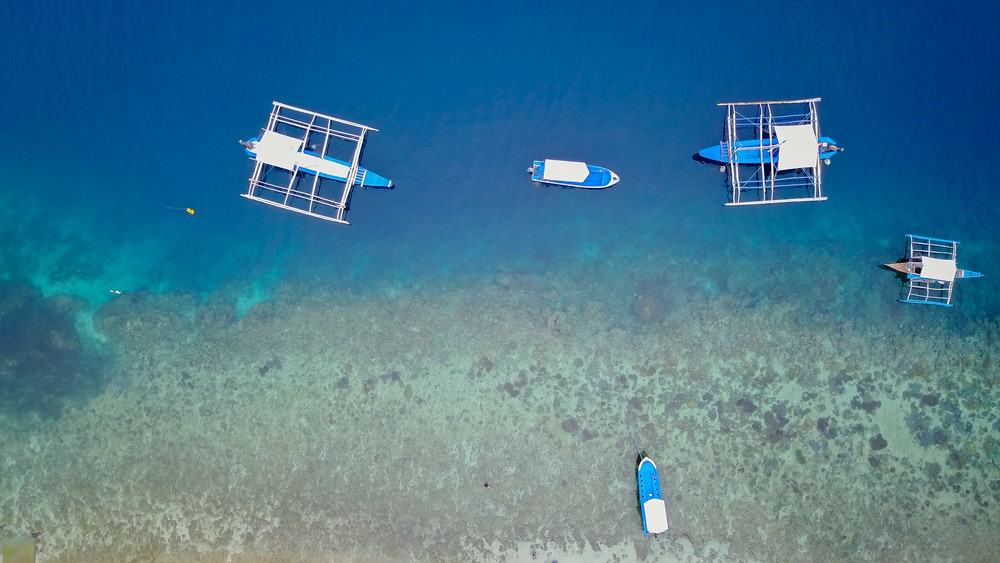
Kimud Shoal: thresher shark cleaning stations in Malapascua
The “ritual” of diving with thresher sharks in Malapascua starts very early, before sunrise. Around 4:30–5:30 am, divers head to the dive shops to hop on the bangka that will take them to Kimud Shoal. Despite the early wake-up, the excitement of what’s about to happen means that, between coffees, smiles are everywhere. Since it starts so early, it’s normal to stop by the dive shop the day before to get your gear ready and waiting for departure time.
The ride to Kimud Shoal takes about an hour—just enough time to properly wake up with a second coffee, get your gear ready, and imagine what the encounter will be like. But what makes this place so special? Kimud Shoal isn’t just any dive site: it’s a huge plateau that starts at around 10 meters deep and then slowly slopes down to about 29 meters before dropping off into the ocean’s depths. Thresher sharks use this “sunken island” as a cleaning station in its shallowest area (these days they’re usually around 15 meters). Before the sun rises and gets too bright, these sharks swim in circles while different fish remove parasites from them.
With a bit of luck (and when the water is colder, which usually happens between April and May), you can also see hammerhead sharks here—and in fact, before the threshers “moved to Kimud,” it was an infrequent dive only for those who wanted to try their luck with hammerheads.
The thresher shark dive in Malapascua
Once you jump in, probably with your heart racing because of what you’re about to see, your guide will take you to the area where they’re usually found. Thresher sharks are very timid, and it’s strictly necessary to follow all the rules to interfere as little as possible with their routine.
Don’t get discouraged—although nothing is ever 100% guaranteed with wild animals, it’s very likely that after a few minutes you’ll see them appear. Truly, your chances of seeing thresher sharks in Malapascua are close to 99%—and it’s not that you’ll see just one: it’s more than likely you’ll see many more.
You’ll never forget the first time a thresher shark glides past, incredibly elegant, just a few meters away. Some people let out a scream, others feel their heart beating even faster, and some of us even tear up with emotion—even if it’s not the first time we’ve seen them.
Whatever your reaction, enjoy it while staying still and don’t bother them. That way, besides respecting them, you can also extend the encounter a bit. Please try not to rest on the seafloor, so you won’t damage the marine life in the sand or the corals. Unfortunately, some dive centers take inexperienced divers and allow these harmful practices. Luckily, unlike Monad, Kimud is full of coral, so good buoyancy is more important than ever. Also, the better you control your body, the more chances you have that the shark will feel comfortable and swim in front of you for longer—and closer.
There are many things that will surprise you about the thresher shark. The first one, without a doubt, is its huge tail (caudal fin), which can reach 50% of its total body length. They use it like a whip to stun small fish with a powerful strike before eating them. It’s unlikely you’ll see it use it there, since they mainly come to be cleaned of parasites. So if it happens, you can consider yourself very lucky. And don’t worry—there are no recorded thresher shark attacks in Malapascua or anywhere else. In fact, to many of us they feel less like a shark and more like a “cute plushie.”
The second thing that will catch your eye when diving with thresher sharks in Malapascua is their big black eyes. You might even feel like it’s staring right at you as it passes by again and again. Their morphology is due to the fact that they live immersed in darkness hundreds of meters below the surface, and that’s why, when the sun rises, they leave Kimud Shoal until the next day.
Because Kimud Shoal is quite far away and due to current fuel prices, most dive centers on the island now run a trip with 3 dives. They usually do 2 thresher shark dives in Kimud (separated by a surface interval of about an hour) and, since it’s on the way (before or after), one at Monad to try to see the tiger sharks that have settled on this other sunken island. On some occasions (less often), they combine Kimud with Gato Island or Kalanggaman.
Trust us: after your first thresher shark dive in Malapascua, you’ll want more. For this reason, and because it gives you different encounter options, we strongly recommend doing the 2 dives that dive centers offer.

Requirements for diving with thresher sharks in Malapascua
Although in Monad Shoal the cleaning stations are at 30 meters deep, that’s not the case in Kimud, and as we said, it’s possible to dive with thresher sharks in Malapascua within the depth range allowed with an Open Water (OWD) certification.
That said, there are a few details to keep in mind. Since December 2025, Kimud has been a protected marine area, and some conservation rules were introduced. Specifically:
- Those with an OWD certification can go, but only if they do a buoyancy “workshop.” For this, most centers ask you to do a dive the previous day (so they can see your level) or have an instructor assess you in some way on the day of the thresher shark dive in Malapascua. The most respectful centers on the island usually do this at Monad before going to Kimud and, as we mentioned, with an instructor while completing one of the Advanced (AOW) course specialties.
- Those with an AOW certification but fewer than 50 logged dives also have to do that buoyancy control workshop.
- Try dives and dives within the OWD course are not allowed. They are allowed within the AOW course.
- OWD divers with fewer than 50 dives must be supervised by an instructor in a group of a maximum of 4 divers per instructor, or by a Divemaster with a ratio of 2 or 3 divers per group per Divemaster.
If you want us to send you the local rules, we can do so without any problem.
As lovers of Malapascua and the sea, we believe it’s our duty to advise you to do this dive only if you have good buoyancy skills and some experience. In fact, as we said, the most respectful dive centers usually ask divers to have an Advanced Open Water certification or to do the Shark Conservation adventure, where you’ll be accompanied by an instructor who will better control your dive and make you feel more comfortable. If you go for it (we really hope you do), the Advanced course can be completed in just 2 days, and it will help you enjoy other dives around the Philippines more comfortably and get the most out of them—like the shipwrecks of Coron or the coral walls you’ll see when diving in Balicasag.
On the other hand, since many travelers ask us: it’s not possible to snorkel or do try dives. You can only dive with thresher sharks if you’re an Open Water Diver and meet the requirements mentioned above.
As for prices, it depends on the dive shop and how many dives you do, but it usually costs around 1,800–2,000 pesos (including equipment rental) plus 450 pesos for the conservation fee. If you do a 3-dive trip, prices range from 5,500–7,000 pesos.
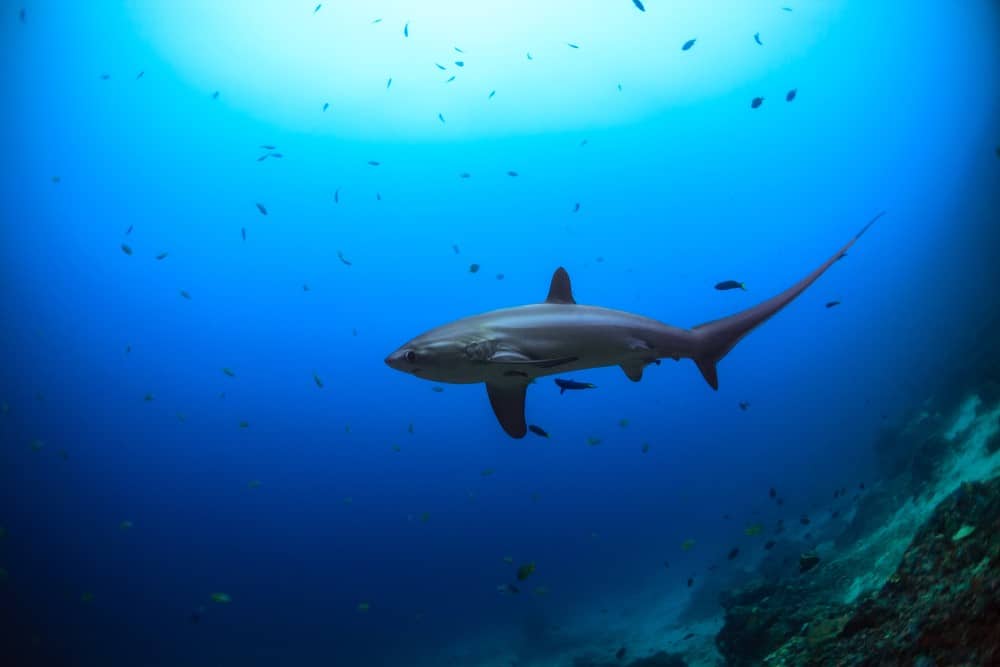
Malapascua dive shop for the thresher shark dive
Most dive shops in Malapascua offer the possibility of doing the thresher shark dive, and some even have instructors who speak multiple languages. Prices can vary a bit from one shop to another, as well as the quality of the gear and their commitment to respecting the animals.
After many visits to Malapascua (we’ve been in love with it since 2015) and many thresher shark dives with different dive shops, we’ve found what, for us, is the best dive shop to dive with thresher sharks in Malapascua. They have dive professionals who’ve lived on this island for more than 15 years, and on top of that, you’re lucky enough to communicate with them in many languages and enjoy the most beautiful stretch of beach in Malapascua.
If you’d like to dive with this beautiful animal with our trusted dive shop, leave us a comment below and we’ll send you the info.
Other facts about diving with thresher sharks in the Philippines
In addition to everything mentioned about the thresher shark dive in the Philippines, here are a few more tips and useful details:
- Choose a responsible, professional dive center—Standards matter.
- Try not to move suddenly or wave your arms around so you don’t scare the sharks—this way, they’ll come closer to you.
- Pay close attention to buoyancy and try to stay as low as possible, but be extremely careful with corals, because as we said, Kimud is full of life.
- If you don’t have your Advanced Open Water certification yet, going to Malapascua to dive with thresher sharks is a great chance to get it, since the dives in Kimud count toward it and you’ll get it in just 2 days. In other words, you improve your diving skills, have fun, and on top of that, you see these sharks for only a little more than what the course would cost elsewhere.
- In high season (March–May, especially around Easter and long weekends), book your dives in advance.
- Don’t stay in the north of the island—it’s less convenient. It’s better around the market area, the port, or Bounty Beach. We talk about that in Best hotels to stay in Malapascua, but we highly recommend this hotel, this one or, if you want something better, this one.
- Most dive centers require cash payments, or they charge a fee for card payments. Since it’s quite a lot of money, our advice is to use Remitly at one of the island’s pawnshops (there are 2). We explain it here: Remitly in the Philippines, and just so you know, with our link, you get $15 free on your first transfer.
- Gloves and reef hooks are not allowed.
- Flash is not allowed.
- Selfie sticks are allowed, but only up to 1.5 meters long.
- Equipment rental is cheap—unless you’re going to do a lot of diving in the Philippines, it’s not worth traveling with so much weight.
- Take advantage of being in Malapascua to do other dives. For us, the other must-do is Gato Island.
- In our opinion, you should stay in Malapascua for at least 3 days: one to dive with thresher sharks, one for Gato Island, and one for Kalanggaman. After the thresher shark and Gato dives, since you’re back by midday, you can use the afternoon to explore Malapascua.
- Keep in mind that after diving you need to wait 18 to 24 hours before flying. Consider this when planning your Philippines itinerary.
Useful information for traveling to Malapascua
If you are going to travel to Malapascua, these articles will be very useful, as we explain how to get there, what to do, where to stay, and many more things about this paradise:
- How to get to Malapascua
- Things to do in Malapascua
- Where to stay in Malapascua
- Diving in Malapascua
Frequently Asked Questions About Diving with Thresher Sharks in Malapascua (Philippines)
To wrap up, here are answers to the most common questions you have about this dive:
Where can you dive with thresher sharks in Malapascua?
The dive takes place at a site called Kimud Shoal, located roughly an hour by boat from Malapascua. Thresher sharks are seen here in around 99% of dives, usually at depths of 10 to 18 meters.
Is it safe to dive with thresher sharks? Is it dangerous?
It’s completely safe. Thresher sharks aren’t known for being aggressive, and they come to this area because they’re cleaned by smaller fish, so you won’t run into “tricky” situations. There haven’t been any incidents involving these sharks in Malapascua. It’s a relaxed, shallow dive.
What sharks can you see in Malapascua?
Besides thresher sharks, it’s also possible to spot tiger sharks and blacktip and whitetip sharks at Monad Shoal. Along the coast of Malapascua, right in front of Tepanee Resort, there’s a community of baby blacktip sharks that you can see while snorkeling.
Who should you dive with to see thresher sharks in Malapascua?
There are dive shops of all kinds. Our advice is to choose one with qualified professionals on staff, well-maintained gear, and a respectful approach to marine life. We can share the contacts we recommend—and the one we always dive with whenever we visit the island—if you leave us a comment.
What requirements do you need to dive with thresher sharks in Malapascua?
You need to be at least Open Water Diver (OWD) certified. OWD divers and Advanced Open Water (AOW) divers with fewer than 50 logged dives will need to do a buoyancy control workshop beforehand.
How much does it cost to dive with thresher sharks in Malapascua?
The trip includes 2 dives at Kimud Shoal and 1 dive at Monad Shoal. It costs between 6,000 and 7,000 Philippine pesos, including equipment rental and fees.
Ready to dive with the thresher shark in Malapascua? We hope so! If you have any questions, we will answer you in the comments.