After countless trips to Malapascua, Bantayan, and the main spots on Cebu Island, we noticed on the area map an island we had never heard of. We searched out of curiosity and, when we saw that no Spanish website talked about it and only a few small English blogs mentioned it, we knew we had to head there and discover for ourselves all the things to do in Kinatarcan.
In this complete guide to the island, we’re going to talk about its main charms and tell you everything we would have liked to know before setting off for this little‑known gem.
What to expect from Kinatarcan Island and how many days to spend
Kinatarcan Island, also known as Guintacan Island, or “Cebu’s last frontier,” is a very special destination in the Philippines that isn’t for every traveler. Although you’ll find gorgeous beaches, lagoons, natural pools, and cliffs here, the island’s limited openness to tourism and the lack of accommodation, transport, and places to eat will likely lead many travelers to choose other, more “easy” destinations.
If you take the plunge and decide to discover all the things to do in Kinatarcan, you should know that one of its main draws is its exotic, unspoiled feel. So few tourists visit that most locals will be left open‑mouthed when they see you pass by and will want to come up and say hello. That’s something you’ll find elsewhere in the Philippines to a lesser extent, but here it’s at its peak and, believe us, it’s a very lovely experience. It’s also an island where you’ll hardly find any signs (and in many places not even people to ask), so you’ll get to feel like a true explorer.
Since we also like to tell you the “less good” side, you should know that the beaches on Kinatarcan are not the most well‑kept we’ve seen. Unfortunately, the lack of tourism means there isn’t yet a strong sense of the beach as a leisure space to be cared for. Although in many cases the trash comes straight from the sea and far‑off places thousands of kilometers away, environmental awareness on the island is still limited and you may find plastic bottles and other debris. If so, we encourage you to do a quick cleanup and do your bit.
If you plan well and optimize your time, you can visit the main places to see on Kinatarcan in a single day. So you’d only need the day you arrive, the day to explore, and the day you leave. That said, if what you’re after is soaking up this disconnection and enjoying the tranquility of its villages and beaches, you can extend your stay ad infinitum.
Things to do in Kinatarcan
1. Pasil Beach, the best beach to see on Kinatarcan
Unlike islands such as Malapascua—where almost the entire coastline is beach—Kinatarcan Island is a place where cliffs and rocky walls predominate. But don’t worry, that doesn’t mean it doesn’t have some spectacular beaches capable of winning over even the most seasoned travelers.
Pasil Beach, on the island’s east side, is one of our favorite beaches on Kinatarcan. Here you’ll find fine white sand, crystal‑clear waters and, thanks to the lack of tourism, an almost complete absence of resorts, businesses, or anything that might keep you from feeling practically alone on the beach.
Given its location on the eastern side of the island, we recommend visiting in the morning if you want a good dose of sun. In the afternoon the palms’ shade slowly creeps toward the shoreline.

2. Hagdan Beach
Hagdan Beach is another beach well worth seeing on Kinatarcan. Its most notable feature is that it sits in front of a small fishing village, ringed by a huge crescent‑shaped stone wall that shelters it.
To access the beach you’ll need to use one side of the cliff, heading down the stairs that connect to the top. Once it’s time to climb back up, you’ll quickly learn a new word in Tagalog, since Hagdan means “staircase,” which is exactly what you’ll have to tackle when you want to continue your route around Kinatarcan.
Although the sand at Hagdan Beach isn’t as pretty as Pasil Beach’s, it’s well worth going down, discovering its crystal‑clear waters, and snorkeling near either of the two small islets a short distance from the shore. As you can imagine, with zero tourism there’s nowhere to rent a mask and snorkel. As we mention in Backpack for the Philippines, we always travel with our own—this is the one we show you here. Both for hygiene reasons and for cases like this where there’s no rental, it’s the best option when traveling in the Philippines.
Don’t leave Hagdan Beach without first spending a few minutes enjoying the views from one of the viewpoints on either side of the beach, right before the point where you start descending the stairs. Our favorite is the one further south:

3. Langub Beach
Langub Beach is another of the four main beaches to see on Kinatarcan. With white sand and beautiful waters, it stands out a bit less than the others because it’s where Langub’s fishermen park their boats, which somewhat blurs the image of the idyllic beach it could truly be. Still, you’ll get to see the fish‑drying process live here, with many nets holding fresh fish under the sun.
This beach might be the most “quick stop” of them all if you want to get straight to the point on the island. Hop off the motorbike, take a walk to the small cliff where you can jump in from the northern end, check out the coral garden just a few meters from shore, and continue your route discovering all the things to do in Kinatarcan.
Right before our visit to Kinatarcan Island, a typhoon had swept through the area and they weren’t there, but this beach usually has a sort of floating breakwater that creates a lively scene in the afternoon with kids playing on it, plus a small floating hut you can rent to enjoy a different kind of sunset.
4. Bitoon Beach
The name of this beach is truly a mystery to us. But since both Langub Beach and Pasil Beach take the name of the barangay they’re in, we’ve done the same with this one, which belongs to Bitoon.
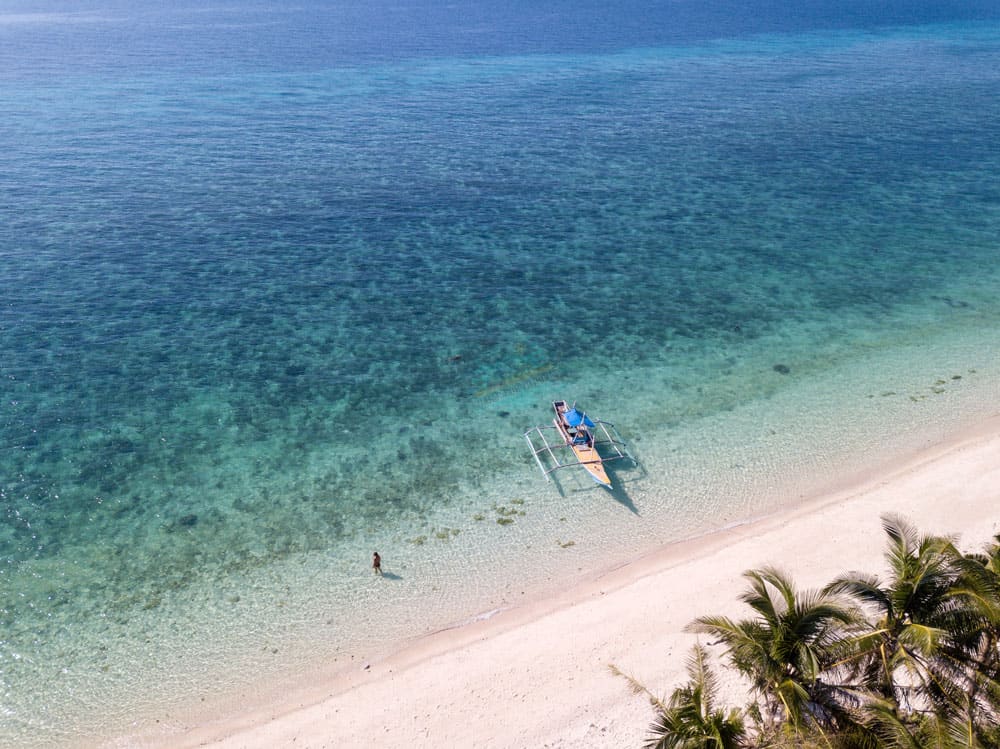
If Pasil Beach is our favorite on the east side, on the west there’s no doubt we’d choose this one. With almost a kilometer of white sand and gorgeous, crystal‑clear water, it’s an ideal place to enjoy a swim in absolute peace and quiet. What’s more, there’s even less hustle and bustle here than on the opposite side. If you pass near the school at recess, or you come here for a magical sunset, don’t be surprised if a group of curious kids comes over to meet you.
5. Biaring Beach
Biaring Beach is more of a cove than a beach per se. Finding it on your own isn’t easy, since you have to reach a remote northern barangay and ask someone to show you the way—there’s no signage or even a hint of a path. On the Kinatarcan map we try to show you how to get there, but the safest bet is to let a local guide you.
After completing the approach, you’ll have to go down the cliff via some stairs to reach this tiny rocky cove. From there, if the tide is low and calm, you can try to get around the nearby area to discover pretty rock formations or small caves. Again, if you’ve brought your mask and snorkel and have time, you can jump in to look for fish of every color.

6. Forest Beach
Forest Beach—at least the part above its little cliff—belongs to the owner of the accommodation where we stayed during our visit to Kinatarcan. With great care and dedication, he’s fixed up the area and it now has a springboard and a slide for jumping into the water, décor, and a few little tables at the cliff’s edge that are an epic place to enjoy the sunset and will be among the most sought‑after spots on the island if it ever sees a tourism boom. Entry costs 20 pesos, and they rent life jackets for those who need them.

7. Laaw Lagoon (or La-aw Cove)
One of the most special places to visit on Kinatarcan is the small Laaw Lagoon. We’ll warn you now that getting there isn’t exactly easy. And not because it’s a difficult trail, but because—even though it’s one of the most popular excursions and things to do in Kinatarcan—there is no signage whatsoever indicating how to reach it.
In our case we had to lift the drone a few meters to try to find the path, but if you ask at your accommodation they’ll help you find a guide to take you.
Once you’ve found the path and after an easy 20‑minute walk down stairs and through doors built into the rocks, you’ll reach the lovely Laaw Lagoon. This unique saltwater lagoon is a small, special oasis in the middle of the forest you’ll have to cross to get to it. Its waters—two meters deep in places—let you swim and jump in from nearby rocks, but you can also simply sit on one of its benches and enjoy this beautiful spot.
Whether you dive in or not, you’ll easily notice that the bottom is covered with one of the Philippines’ marine delicacies, “lato.” This tasty seaweed, which looks like tiny grapes and is rich in iodine, calcium, and magnesium, commonly accompanies salads, fish, or seafood.
There’s a local belief that this lagoon can grant wishes to locals and cast curses on disrespectful visitors. All the more reason to be a responsible traveler!
Although we didn’t run into anyone at all when we went, it’s a popular spot that draws local tourists on weekends.

8. Coral Cliff, the natural pool to see on Kinatarcan
Coral Cliff, or Tamboan ni Leon, will be the grand finale after crossing the island and first visiting Laaw Lagoon. Once you’ve enjoyed the lagoon, take the small path that starts there and cuts across the cliffs until you reach this beautiful natural pool.
Walk around it, take in the views and, if the sea is calm, follow the path that descends through the trees to reach the lower area and enjoy a swim—very likely all to yourself. The postcard‑worthy scenery here is incredible, with those rock walls sheltering this little pool of turquoise water, making this excursion a clear must‑do among the things to do in Kinatarcan.

9. Pasil Cave
Near Pasil Beach there’s another spot that local tourists like to include among their things to do in Kinatarcan, but it didn’t particularly catch our eye. Pasil Cave is a small, semi‑flooded underground cave accessed via a tiny staircase. It’s a really damp, poorly lit place that we mention only for fans of this kind of adventure, but we wouldn’t mark it as a must‑see in Kinatarcan.
10. Getting lost by motorbike, the best thing to do in Kinatarcan
Beyond all these suggestions for enjoying this still little‑known island, our recommendation is to lose yourself a bit and look for your own “off‑route” places. That’s how we reached a hidden beach at the northern tip—where people looked at us as if we were the first to arrive in years—and a small barangay where we found one of the island’s few sari – sari stores opposite the basketball court of a bustling school.
We’re sure this island hides more treasures in the form of coves or spectacular cliffs that you’ll undoubtedly discover if you let yourself wander and ask the people you meet along the way.

How to get around Kinatarcan
In Kintarkan you won’t find the classic Filipino tricycles, or buses, or shared vans. There are two jeepneys that cover part of the island on a totally random timetable you can’t rely on for exploring. And although the island isn’t very big, the distances between the different sights are too long to cover on foot.
So you’re basically left with three ways to get around:
- Habal-habal: one option to connect some points in the south of the island is to ask a local on a motorbike to take you to your destination. If your idea is to reach places like Laaw Lagoon or Coral Cliff, it will be quite hard to find someone to take you there from the south unless you arrange it in advance with help from your accommodation.
- Guided tour: a resource used by some of the few tourists who make it here is to arrange a several‑hour tour that takes you to the island’s main spots. There’s no company or office in Kinatarcan that handles this, so once again you’ll need to book through your accommodation and choose which places to see.
- Motorbike rental: this is the option we chose, since coming to such a pristine place we wanted to be fully in charge of the experience—managing times and places and getting lost at our own pace. Once again, since there are no businesses focused on this, you’ll have to get the bike through your accommodation. In Kinatarcan, 99% of the motorbikes we saw had manual gears, so it’s very likely you won’t be able to get an automatic. If you’ve never ridden a motorbike before, this isn’t the island nor are these the bikes to do it for the first time. In Renting and Riding a Motorbike in the Philippines we talk more about it.
Once you get the motorbike, agree clearly on the price and the time of use. We rented a motorbike at 14:00 for 400 pesos per day and, when returning it, it took a while to clarify that it was for 24 hours and not just for use within the same calendar day.

Eating in Kinatarcan
If you ask us which place in the Philippines we think has the fewest dining options, without a doubt we’d say Kinatarcan. Literally, we found just one single place on the entire island that served food. We were lucky that near our accommodation there was a kind of mix between a snack stand and a restaurant where we could eat during the days we were there—mainly “veggie burgers,” pasta, fries, and the odd homemade treat. On the map we mark the exact location of this restaurant.
We understand that a resort on the east side of the island has a restaurant, but we found it completely closed the different times we went to try it.
Besides there being no restaurants, another thing that’s very hard to find on Kinatarcan is sari – sari stores—those little Filipino shops that sell a bit of everything. Because of this, it’ll be hard even to find water to buy. Take advantage of the street‑side machine opposite the restaurant we recommend, which you can use to refill your reusable bottle with cold water; it’ll be rare to find another place unless you head up to the small barangay in the middle of the island.
Where to stay in Kinatarcan
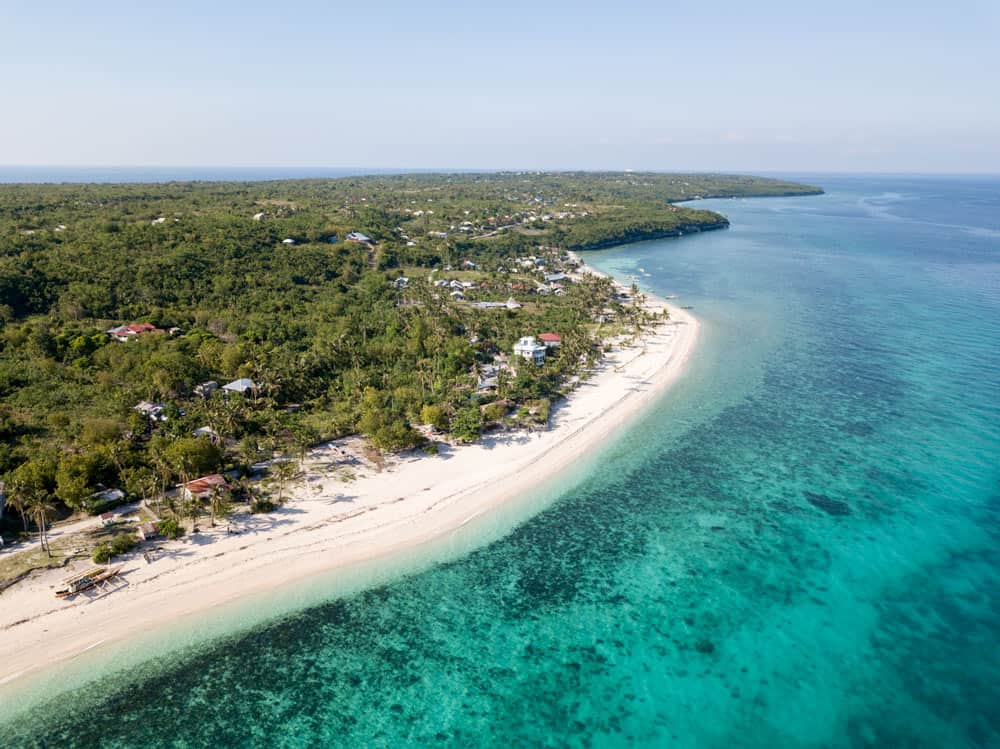
As we’ve already mentioned several times, the level of tourist development you’ll find in Kinatarcan is practically nil. On the map you’ll see a few “resorts” and homestays. But unless you call and give notice in advance, it’s very likely you’ll arrive and find them closed for lack of guests. On neither Booking.com nor Agoda—the two main accommodation search portals used in the Philippines—will you find anything at all. So here are a few places in the area that offer lodging and that you’ll have to contact personally if you want to stay there.
Forest Beach Resort
Hold on to the “forest” part—there’s forest around—and the “beach” part—you have it right in front. But forget completely about the “resort” part—nothing to do with it. This is where we stayed during our time in Kinatarcan (all the others were either closed or didn’t answer the phone), and we should warn you that it isn’t accommodation for every kind of traveler. Mr. Berlito, the owner, is one of those smiling, kind Filipinos who go out of their way to help. He came to pick us up when we disembarked on the island, found us a motorbike, gifted us a couple of coconuts to sip at sunset… But the lodging is very, very basic.
It’s a large room with 4 beds arranged in a very odd way, where the upper part of the walls is open, allowing mosquitoes to come in freely. He solved this by setting up a giant mosquito net that protected us, but depending on what kind of traveler you are, the place might put you off. The bathroom is also very rustic and doesn’t have running water or, of course, hot water (a whole experience bathing with buckets and cold water!). There’s no Wi‑Fi, but there is a kitchen where you can make your breakfast if you’ve brought some food with you.
We were comfortable at Forest Beach Resort and it’s a very budget place (250 pesos per person per night), but we want you to know all these details before taking the step and including it in your adventure.
Location: Forest Beach. You can contact Mr. Berlito Mantao at +63 920 380 4640 or via Facebook
Giggle Resort
Giggles Resort is right in front of the place where we told you we went to eat several times. It’s a simple place but certainly much better than Forest Beach Resort. It has 3 rooms with sea views (with shared bathroom) and an area by the sand with hammocks and a spot to relax. Typhoon Ursula blurred the picture we’d seen of this place in photos, so we hope it’ll be back to 100% soon. Before the typhoon it also had a restaurant with breakfasts and dishes like chicken, fish, or beef.
They offer island hopping to nearby islands.
Location: Bitoon Beach. A double room costs 1,300 pesos. You can contact 0927 3729983 (Globe) or +63 908 970 0663 (Smart).
Kinatarcan Wellness Resort
From what we were told there—and have read—it’s the closest thing to a resort you’ll find in Kinatarcan if you snag their star room with air‑conditioning. We went by a couple of times to try to check it out, but we always found it closed.
Prices start at 2,500 pesos for a two‑person tent with breakfast included, which seems outrageous to us. They also have some truly pretty bungalows with air‑conditioning—the closest thing to a resort on the whole island. We haven’t been able to find info on their price but, considering the tent rates, it’ll very likely be scary.
They organize island hopping trips on a nice, spacious boat with mattresses to lie on.
Location: Pasil Beach. You can contact them via their Facebook page.
Other accommodation in Kinatarcan
In Kintarcan everyone knows everyone, and they can easily guide you anywhere. Ask for these two people if you’re interested in this type of lodging in the Pasil area.
Kuya Willi’s (Beach Resort): as you can see, they call everything a “resort” here. Kuya Willi’s rents tents at 250 pesos per night and hammocks at 150.
Nanay Lidia’s Home: rents tents at 250 pesos per night and a very simple room at 300 pesos per person per night.
How to get to Kinatarcan
Departure from Daanbantayan
Although it’s possible to connect Kinatarcan with Bantayan Island, the main entry route is the one that departs from Daanbantayan Port. Something useful to know is that the few bangkas that leave from there to Kinatarcan do so once a day and practically at the same time. So if you miss one, you’ll likely have to wait until the next day. Boats to Kinatarcan depart at around 12:00, although if they don’t fill up they wait a while until more people arrive. Given the circumstances, we recommend being at the port at least one hour early to secure your seat and avoid being left on the dock.
The fare is 50 pesos per person and the crossing can take between 45 minutes and one hour. The bangkas usually arrive at Pasil Beach, and the return schedule is every morning at 8:00.
Heads‑up: this crossing is in open sea and when the sea is rough it’s usually very bumpy. On our return trip we encountered strong waves and it was one of our worst crossings in years. It’s not that it’s dangerous, but you may get seasick and a bit wet if conditions aren’t favorable.

How to get from Cebu
Getting from Cebu to Kinatarcan is very straightforward.
- You’ll need to take a bus at the North Station toward Daanbantayan Bus Terminal. The journey takes about 4 hours and costs around 230 pesos on the regular bus or 250 on the air‑conditioned bus.
- Once at Daanbantayan Bus Terminal you should head to the port. It’s about a 20‑minute walk, so you can take a tricycle for 15 pesos.
How to get from Malapascua
This route isn’t complicated either.
- Take the boat that connects Malapascua with the new port of Maya. It costs 200 pesos and takes about 45 minutes.
- Ignore the vans you’ll see and keep walking a little until you find the Maya bus station. Ask around and hop on the one heading to Daanbantayan. It costs 30 pesos and takes about 15 minutes to complete the journey to the point where you have to ask to get off.
- Tell the driver you’re going to Daanbantayan Port and he’ll tell you where to get off. If you have GPS on your phone, look for B.M. Arriola Street—that’s the one you want.
- Once in Daanbantayan you can walk 10 minutes to the port or take a tricycle for 10 pesos.
How to get from Bantayan
There’s a boat run by the owner of Forest Beach Resort that connects Bantayan with Kinatarcan once a day. It’s a 2‑hour trip and costs 70 pesos. It departs from Santa Fe and the schedule can be a bit variable (they usually leave Bantayan around 12:00 and Kinatarkan to Bantayan around 7:00). We recommend contacting Mr. Berlito Mantao at +63 920 380 4640 if you want to take this route so he can inform you.
IMPORTANT, SATURDAYS AND SUNDAYS: The captain of the boat that runs the route connecting with Bantayan belongs to a church that gathers on Saturdays, so the route is canceled that day. On Sundays, since many people go to the common church, boats to Daanbantayan may be in short supply.
Tips for visiting Kinatarcan
Now that you know what to do on Kinatarcan Island and how to get there, here are some final tips that will surely be useful if you decide to explore this little‑known island:
- In Kinatarcan there are no ATMs and no option to pay by card. Make sure you arrive with enough cash for the days you plan to stay.
- If you rent a motorbike, try to fill the tank whenever you can, since places to refuel are scarce.
- Get lost in the north of the island and ask locals to discover new cliffs or little‑known spots.
- There is very little signal across the island. The place with the best connection is Pasil Beach.
- Pay close attention to the times when the bangkas arrive and depart the island, and decide how much time you want to spend. Unlike other places, if you miss the boat here you’ll have to stay an extra day.
- If you don’t eat meat or fish, it might be a good idea to bring a can of food like legumes or a snack. If you’re not vegetarian, it doesn’t hurt to bring something with you in case nothing is open.
- On weekends there may be local tourism from other islands. If you’re going to Kinatarcan looking for that explorer experience, you might prefer to visit Monday to Thursday.
- Always remember to carry travel insurance for the Philippines. There are no hospitals on Kinatarcan and, if something happens to you, you’ll have to pay all costs to reach the nearest one as well as the medical consultation.
Map of Kinatarcan
Here we mark the points of interest we’ve talked about in this article on things to do in Kinatarcan:
What do you think of this little‑known island? Are you up for discovering all the things you can do in Kinatarkan? If you have questions, don’t hesitate to write to us in the comments so we can help.