
We are sure that, in a few years, island hopping in Dinagat will become as well known as the tours in the increasingly popular Balabac area or nearby Siargao—or perhaps, much further down the line, even those in Coron or El Nido. There are plenty of reasons for this: deserted, paradise-like beaches, incredible limestone cliffs inhabited by exotic birds and turquoise lagoons that look just as beautiful from ground level as they do from a drone.
That is why we decided to create this detailed guide to island hopping in Dinagat, where we will tell you about all the options available, the most common and coolest stops, how to book the tours, prices, tips and everything else we usually cover at Travel Around the Philippines, always based on firsthand experience and written in a friendly tone to help you enjoy it as much as we did.
Where Dinagat is and why you should go
The Dinagat Islands, the largest of which is also called Dinagat, are located in the southern Philippines. More specifically, they are part of the CARAGA region, in Mindanao.
If you look at the map, Dinagat is northeast of Mindanao, east of Leyte and northwest of the incredibly famous Siargao. Although we explain it in greater detail in How to get to Dinagat, since it does not have an airport, the main gateway is Surigao City, where boats depart for San Jose, the capital of Dinagat, and the crossing takes barely an hour. From Surigao, you will also have access to Siargao, so combining both destinations on the same trip is highly recommended.
Not only that, a route between the port of Del Carmen (Siargao) and Cagdianao (Dinagat) has recently opened, making it easier than ever to combine both destinations.
Why visit Dinagat? Because, as you will see throughout this guide, it is a place with fascinating scenery (on a par with Coron and El Nido, although on a smaller scale) that gives you the opportunity to discover it in almost complete solitude in the vast majority of cases. Aboard a bangka, the traditional Filipino boat, you will “hop from island to island” while enjoying many of these landscapes. We will go into more detail now.
Given their proximity, transport links and shared weather pattern, visiting Siargao and Dinagat is a fantastic combination: on the one hand, you have Siargao’s huge range of hotels, restaurants and bars, along with its natural wonders, and on the other, Dinagat’s remote atmosphere, with scenery that would not look out of place on any island-hopping tour in Palawan.
What to expect from Dinagat
Although we have already given you a few hints above, we always like to provide a quick summary of the main features of a destination so you can decide whether it is right for you. After years of advising travelers, we have realized that we are not all the same and, therefore, we do not all enjoy the same things. That is why it is particularly important to do plenty of reading so you can decide what interests you enough to include in your Philippines itinerary and arrange your connections properly so that you do not feel as though you are spending the entire day in transit.
With all that said, and considering that we fell in love with it from the very beginning and it quickly became one of our favorite island-hopping destinations in the Philippines, we think Dinagat is best defined by the following:
- You come here to go island hopping because, apart from a couple of things, the island where San Jose, the capital, is located is not particularly interesting and does not offer beautiful beaches, charming accommodations or many tourist attractions.
- Do not expect stylish hotels or resorts here. All you will find are basic guesthouses. For the same reason, you will not find a wide variety of places to eat or establishments that are particularly geared toward tourists.
- It is not yet an easy destination to plan a trip to, as there are not many tour agencies you can visit once you arrive. In other words, forget about the typical street lined with little shops offering excursions like you find elsewhere. Here, you will need to put in a little more effort. From our perspective, it is better to arrange everything in advance so that you do not waste time, as San Jose is not particularly attractive.
- Since there is hardly any international tourism, if you want to venture beyond the usual Filipino tourism circuit, it will be harder to find other travelers to share a tour with and you may have to cover the cost of a private island-hopping tour in Dinagat. The good news is that prices are not excessive.
- For the same reason, the level of service is not comparable to what you get on island-hopping tours in El Nido, Coron or Port Barton. Lower your expectations in this regard.
- Most importantly of all: this is a place where you should spend at least 2 days island hopping and, preferably, spend the night on one of the islands in a small hut. You will enjoy breathtaking scenery comparable to Palawan (although always keeping the differences in mind) and deserted beaches. Take a look at the photo below: the little hut among the coconut trees is where we slept. What a paradise!
- Although there are a few decent reefs, it is not a snorkeling or diving destination.
- Since we know you are concerned about the weather, the best time to enjoy tours in Dinagat is from March to October, with March to May being the very best period due to the lack of rain and calmer waters.
With all of the above in mind, we are going to tell you what island hopping in Dinagat is like and how you can organize it.

How many days to spend in Dinagat
Based on our experience, we recommend spending at least 2 full days to do 2 island-hopping tours. If you can stay for 3 days, you will enjoy it much more.
Since boats leave Surigao very early and also return from San Jose relatively late, you could consider spending just one night in Dinagat. Even so, it is best to discuss all of this with the agency to make sure that the schedules line up properly with the tours.
Island hopping in Dinagat: stops and route
Below, we will tell you about the usual stops on Dinagat island-hopping tours and provide a little information about each one. Since we took a private tour (something we strongly recommend you do as well), we were lucky enough to stop at other beautiful places that caught our eye and enjoy them without having to rush. So, if you find a friendly captain/guide, do not hesitate to ask. Since this is still a relatively undeveloped destination, you have room to adjust the route to your liking.
On the other hand, although we will tell you about the traditional stops on Dinagat tours, part of the charm is simply enjoying the scenery, which is incredible thanks to the limestone formations.
We will place asterisks directly before the names of the places we loved so that you can make sure to include them in your Dinagat island-hopping tours.
***1. Pangabangan Blue Lagoon (Tidal Pool)
On many Dinagat island-hopping tours, the farthest point visited is Pangabangan Island, located almost 2 hours by boat from San Jose and home to one of the crown jewels: the Blue Lagoon or Tidal Pool. If you have seen photos of Coron, this place will probably look instantly familiar because, just like the lagoons there, it is surrounded by incredible limestone walls of deep black dotted with vegetation.
The view from the little beach is already beautiful, but we recommend making a small effort and climbing to a viewpoint that has been set up to the right of it (bring water shoes, as they will make things more comfortable). Also, do not miss the chance to take a dip and feel embraced by an almost mystical landscape.
Access to the Blue Lagoon is through what is known as a “resort,” which is really just a collection of huts that Filipino families rent for the day, so you need to pay 20 pesos per person. Since we arrived at around 8:00 in the morning, we found the place completely empty, which was a real treat. If you can, do the same because it has much more charm that way.
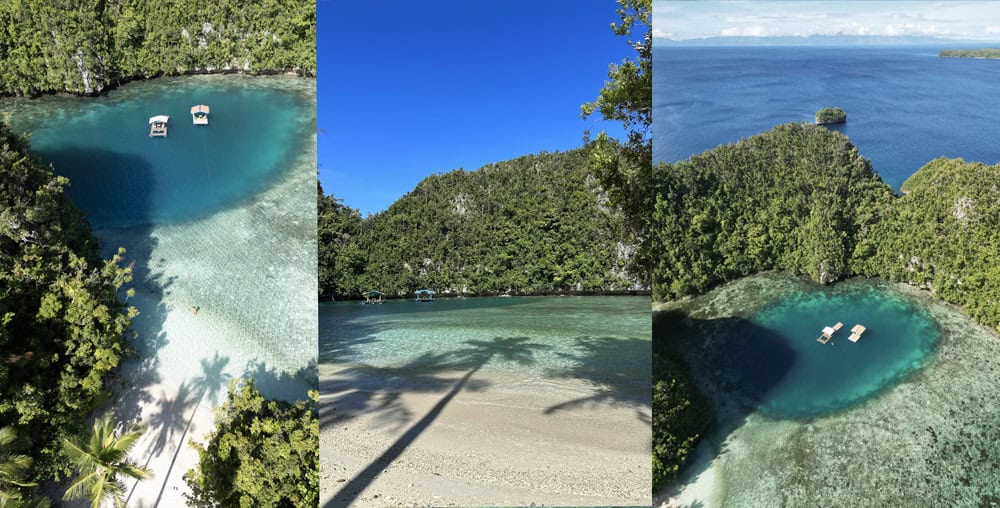
From this resort, you can also walk to Paganbangan Beach, a beautiful beach overlooking Libjo. Unfortunately, when we visited, it was closed because reconstruction work was still underway after the typhoon that destroyed most of its huts in December 2021. It can now be visited, although the huts are still not available for overnight stays. A small fee is charged for mooring the boat.

2. Kisses Islets
If you set off early or feel like continuing farther north in Dinagat, the most distant point is the Kisses Islets or Islets of the Kisses. These are a cluster of limestone islands packed closely together, creating a beautiful landscape and also giving you the opportunity to go snorkeling.
Personally, we did not find them particularly impressive, and they involve spending more time traveling by boat—time you could use for something else. We preferred the islets you can see in front of the Blue Lagoon, which are the ones shown in the photo.

3. Jelmars Resort
Also next to the Blue Lagoon is this curious floating “resort,” which, we were told, is usually full of families and groups of friends spending the day. It consists of a series of bridges and wider platforms where you will find the typical huts with tables, a few rooms, a kitchen and a sari-sari store, so it is often recommended as a place to stay overnight if you do not want to return to San Jose. There are also several photo spots and even karaoke!
If you feel like it, they also have a viewpoint on the mountain, on Dinagat Island itself (look at the bridge on the left-hand side of the photo and the small yellow house). The climb will take you 10-15 minutes, and remember to wear suitable footwear. You can also snorkel from the resort, as you will find a small reef if you swim a little farther away from it.
Although we do not consider it an essential stop on a Dinagat island-hopping tour, admission is 20 pesos per person and it is barely a 3-minute boat ride from the Blue Lagoon, so we think it is worth visiting.

4. RSG Munting Paraiso
Given its geography, Dinagat has several interesting caves to visit, the best known of which is located at another “resort” called RSG Munting Paraiso. As soon as you get off the boat and register, you will walk to the left and enter through a narrow opening in the mountain. After a few steps, you will need to get into the water to access the most interesting part of the cave, which is filled with stalactites and stalagmites that you can see thanks to the lighting that has been installed.
That said, it is best to check with your guide again that access is possible, as there have recently been some landslides and the cave is sometimes closed for safety reasons.
Admission is 50 pesos if you swim and 20 pesos if you only stop at the resort, which is not particularly attractive, as the beach disappears when the tide is high.

5. Miracle Cave
Would you like to visit another cave? A lesser-known one that is very close to the previous cave is Miracle Cave. Access is easier, and you could say that it is a little less intimidating. The only thing is that they have installed green lighting which, rather than granting you good health or, as the locals say, fertility, makes it look as though you have walked into a “rave.” Judge for yourself from the photo…
Admission is 50 pesos per person.

6. “Travel Around the Philippines Lagoon”
Pay attention because this place does not appear in any guide and no agency will offer it to you, but it is one of those little gems of Dinagat tours, which are still so little known that they give you the chance to feel a bit like an explorer.
The thing is that, while traveling from Miracle Cave to our next stop, we saw a completely empty beach (like almost every beach in the area) that looked wonderful. Looking at Google Maps, we spotted an inlet that looked suspiciously interesting, so we asked our captain to stop at the beach. There, we spoke with its only inhabitant, who confirmed that, after walking along the shore for a few minutes, we would reach an unnamed lagoon that we decided to christen “Travel Around the Philippines Lagoon.” What do you think?
Admission is completely free, including the Indiana Jones experience. Do not worry, we have marked it on the Dinagat island-hopping map farther down.

7. Hagakhak Rock Formation
The next place to visit in Dinagat is Hagakhak Rock Formation, which is hugely popular on social media among Filipinos who take these tours. Although we did not find the site particularly impressive, these “pancake”-style rock formations are an unusual sight, and tours sometimes stop at nearby Sondayo Beach.
For us, the best part of this section of the island-hopping tour was admiring Dinagat Island itself from the coast, as it is filled with little beaches reminiscent of El Nido.

***8. Bababu Lake
As you can see, island hopping in Dinagat is quite varied, but you can also hike along a trail to reach Bababu Lake, one of the best-known places in the Caraga region. Its name comes from the Cebuano words “baba sa buwaya”, which mean crocodile’s mouth, because of its shape.
This is a meromictic lake, meaning a lake in which the deeper layers do not mix with the surface layers due to density gradients. In addition, because of an underground cave system, it contains both fresh water and salt water. Interestingly, this underwater cave is around 650 meters long and has an average depth of 14 meters, making it one of the longest in the Philippines, and some experienced divers have ventured through it.
To reach Bababu Lake, you will first need to dock at Bababu Beach, where Ricardo lives for almost the entire year. A steep trail begins there, climbing to the top of the mountain before descending toward the lake. The route is not difficult, but because of the elevation gain and humidity, it will easily take you around 45 minutes. Do not forget to wear good footwear to avoid unnecessary slips.
If you feel like it, you can take a dip and admire the lush scenery surrounding the lake from its very heart.
Admission to Bababu Beach costs 20 pesos. If you want to visit Bababu Lake, there is an additional entrance fee of 50 pesos and a 300-peso fee for the guide (shared among the entire group).

9. Banuyo Beach
We now move on to the southern section of Dinagat island hopping, which focuses mainly on Lalaking Bukid, the local name for Unib Island because the people of Dinagat say the island is shaped like a man. Several paradise-like beaches can be found around this island, and in our opinion, they easily rank among the best beaches in the Philippines.
Banuyo Beach is very small, especially if you visit at high tide, and is usually a gathering place for families and groups of friends from San Jose because it is the closest to the capital. Here, you will find several huts where you can spend the day, kayaks and a volleyball net.
In our case, this was the first stop on our second day of island hopping in Dinagat, but it is not usually included in standard itineraries because it is not the most spectacular beach. Admission is 50 pesos per person.

***10. Cabacongan Beach
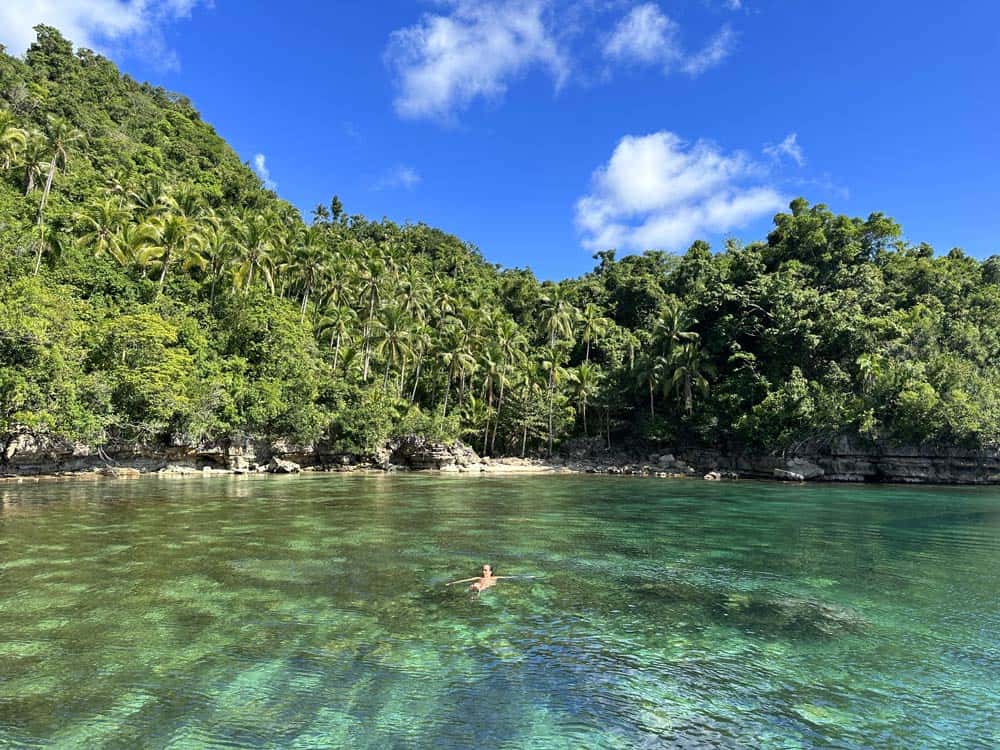
We have been visiting beaches in this country since 2010, but the moment we set foot on Cabacongan Beach, we were captivated and, above all, surprised that this place is still so little known. Seriously, this beach could easily rank among Palawan’s best, with impressive limestone mountains, lush vegetation and, on top of that, no one else around! It is true that the sand is not super fine, but it is white and the water looks like a real swimming pool, making it perfect for a swim even at low tide.
Not only that, what made us fall completely in love with Cabacongan is that it is a sanctuary for kalaws, or rufous hornbills, a species endemic to the Philippines with an enormous reddish beak. They nest in the huge rock wall, and we were incredibly lucky to see more than 5 of them flying around, which left us amazed because we had never seen so many, or spotted them so easily, on any other island. If you see them, listen carefully because the sound they make is spectacular!
This beach is not usually included in many Dinagat tours because it does not have any huts or facilities for tourists (we hope it stays that way for a long time), but please do not leave it out because, to us, it is one of the main reasons to visit this part of the country. In addition, the caretaker is a charming older gentleman who gave us a couple of papayas freshly picked from his trees.
There is no fixed entrance fee; you can pay whatever you wish.

11. Duyos Beach
Very close to the previous beach is Duyos Beach, which is much more developed for tourism and filled with large cottages for groups, but it has a wide stretch of white sand that is perfect for a swim. We recommend not venturing too far from shore, as the current can be fairly strong due to its location and boats regularly pass through the area.
Duyos is also a good place to spend the night in a tent if you want to do a couple of Dinagat island-hopping tours without staying overnight in San Jose.
Admission is 50 pesos per person.

**12. Bitaog Beach
Of all the stops on Dinagat tours, the most famous beach is Bitaog. Why? Its extremely fine white sand (similar to White Beach in Boracay) and its limestone walls, which once again compare very favorably with those found on the most famous islands in the Philippines.
The beach is actually quite small, but it also has a couple of adjoining areas where you can relax peacefully. Personally, we did not love it because it was the only place in all of Dinagat where we encountered a large concentration of boats, possibly because it was a Saturday and we visited at peak time. For that reason, we strongly advise making it clear to your guide that you want to avoid this and asking them to arrange your itinerary so that you visit at another time.
Bitaog also has a few huts where you can spend the day and even a couple of rooms. Therefore, agencies often offer it as an overnight stop. We do not think it is a bad option, as waking up in such an incredible paradise must be wonderful.
As with the previous beaches, admission is 50 pesos per person.

***13. Pagkawasan Garden
We are nearing the end of our Dinagat island-hopping tour and are still on Unib Island, where we want to tell you about another of the beaches we loved most: Pagkawasan. It is actually divided into 3 sections (from east to west): Pagkawasan Getaway, Pagkawasan Cove and Pagkawasan Garden. Without a moment’s hesitation, we would say that the last one is the most beautiful of all, so we strongly recommend including it in your Dinagat itinerary.
It is divided into what look like two sections, separated by a beautiful limestone rock, but both have fine, pale sand and palm trees that provide shade. The depth close to shore means you can swim at both high and low tide, so you could spend hours here.
Whether viewed from the sea, where you can admire the enormous rock walls, or from the shore itself, with its elegant coconut trees, we think it is an absolute dream.
Admission is 50 pesos per person.


14. Pagkawasan Beach (Getaway)
The easternmost little beach in Pagkawasan is not as picturesque as the previous one, but we include it because this is where we spent the night, in a basic but beautiful hut with wonderful sea views. They have a generator, so electricity is available, but bear in mind that they charge quite a lot considering how simple everything is: 1,500 pesos per night.
They also have some cottages that are perfect for stopping for lunch, as there are usually few people and you can enjoy the peaceful atmosphere of Dinagat that made us fall in love with it.
They charge an entrance fee of 50 pesos per person.

Typical itinerary for tours in Dinagat
You now know all the stops, but how are they usually divided? More or less like this:
- Day 1, Libjo island hopping: Hagakhak Rock Formation, Pangabangan Tidal Pool (Blue Lagoon), Jelmars Islet Resort and RSG Munting Paraiso. Depending on the operator, Punta Buena Suerte (which is not particularly impressive) and Kisses Islets may or may not be added. If the sea is very rough, tours on this day usually depart from Libjo, a port farther north (you will have to pay the transportation cost).
- Day 2, Basilisa island hopping: Bababu Lake and Beach, Duyos Beach, Cabacongan Beach, Bitaog Beach and Pagkawasan Beach.
If you have 3 days, the most interesting option would be to divide day 1 into 2 parts, spend one night in the northern area, another at Bababu Beach, Duyos or Pagkawasan, and use the final day to explore the beautiful beaches of Unib Island that we have mentioned.
In our case, we slept at Pagkawasan Beach, but remember that most shared tours return to San Jose each day so that travelers can stay at one of the accommodations there. If you want to do it differently, it is best to arrange it in advance.

Map of the Dinagat island-hopping destinations
To help you visualize it more clearly, we have created this map showing the main points of interest on Dinagat island-hopping tours.
How to organize your island hopping in Dinagat
Most travelers who visit Dinagat are Filipino tourists traveling in groups. They use agencies that offer packages for 2- or 3-day tours around the islands, and we would say that 99% of them spend the night in San Jose between excursions. In addition, Dinagat receives nowhere near the volume of tourism found in other parts of the Philippines, so you will not find many agencies offering island-hopping tours. As a result, almost everyone contacts an operator in advance to arrange everything at fairly competitive prices.
That said, although you will not see many people at the different stops on Dinagat island-hopping tours and therefore do not need to take a private tour for that reason, we got the impression that shared tours are very much geared toward a Filipino audience that prefers beaches with little huts, unusual rock formations or “photo spots” that, personally, do not do much for us. In our experience, Dinagat has wonderful unspoiled beaches and much more to explore at your own pace, so we strongly recommend booking a private multi-day tour.
How do you organize private tours in Dinagat? Since prices are not excessive, our recommendation is to negotiate everything beforehand so that you arrive with everything already arranged. Agree in advance on the stops you want to make, what is and is not included (do not forget to ask about food) and the schedule. Remember to be patient at all times, as they are not yet accustomed to providing services to international travelers. Another option is to go to the port and try to find a boatman, but bear in mind that many do not speak good English, so you will also need to hire a guide who can facilitate communication and take care of preparing the meals.
If you leave us a comment below, we can send you the contact details of the guide we became friends with. We are sure he will help you in every way possible and, in addition, he offers the tour at a much better price than any Dinagat agency does when you say you were referred by Travel Around the Philippines. After guiding us, he also knows what international travelers usually enjoy (we gave him plenty of advice in this regard), and we think you will have a much better time. Do not hesitate to ask him for whatever interests you most, as he even knows some great snorkeling spots.
Prices of tours in Dinagat
Unlike island hopping in Coron or island hopping in Siargao, we cannot provide fixed official prices. It really depends on whether you share the tours with other people and on the type of tour, but to give you an idea, a private boat for 2 days of tours with a capacity of 4 people costs around 12,000 Philippine pesos (for the entire boat, to be divided among your group). You will need to add the cost of food, which in most cases you will have to buy in advance in San Jose, the fee for the guide/cook (usually 2,000-2,500 pesos for 2 days), the fees charged at the places you visit and, if you sleep in a hut on one of the islands, that cost, which varies (budget 1,500-3,500 per night for the group).
If you want to do “public” island hopping in Dinagat, meaning booking through an agency and sharing a tour with other travelers, you can expect to pay around 3,500 pesos for a 2-day all-inclusive tour. Just bear in mind that groups consist of 15-20 people.
Bear in mind that if the sea is rough, you will need to travel overland to Magsaysay for the Libjo-area island-hopping tour and pay for that transportation yourself. Prices are around 2,000-2,500 pesos for the round trip for a group of 3-4 people (the number of people who fit in a tuk-tuk). Keep in mind that this is only advisable when the sea is rough, as you will visit fewer places.
Things to do in Dinagat beyond island hopping
To sum up, coming to Dinagat and not going island hopping would make no sense because you see the most beautiful places in the area on boat tours. However, there are also a few things you can see on Dinagat’s main island itself, and we want you to know about them.
- Islander’s Castle: you will see it as soon as you arrive because it is a castle on the mountain in San Jose. You cannot visit the interior because it belongs to the Ecleo family, but you can see it from the outside by taking a bao bao (20 pesos per person). There is also a sanctuary belonging to the same congregation that can be visited free of charge, and the views are the most interesting part.
- Yamashiro Boat: one of the battleships in the Japanese fleet during World War II sank during the Battle of Surigao Strait, off the coast of Dinagat. The wreck remains in Philippine waters and cannot be dived, but you can see a replica in the government office area. It is a building that will house government facilities. It is not particularly impressive, but if you rent a motorcycle, you can stop by.
- Bonsai Forest: Mount Redondo, Dinagat’s highest mountain, is located in the town of Loreto and is home to 100 hectares of forest where the vegetation grows no taller than 60 centimeters and is estimated to be more than 100 years old. Because of the weather, we were unable to visit, but we have added it to our list for next time. Bear in mind that it is 2.5 hours or more from San Jose and that you need to obtain a permit because it is a mining area. If you are interested, it is best to contact the Dinagat tourism office in advance.
- US Landing Marker at Black Beach: if you are heading north and are interested in history, there is a memorial commemorating the arrival of US forces (October 17, 1944) to liberate the area from Japanese oppression. There is a small museum containing objects from the period.
- Santa Cruz Beach: the beach next to San Jose, which is not bad at all, as it has golden sand.
- Hinabyan Beach: located on the opposite coast of the island, north of Cagdianao, this is a spectacular one-kilometer beach with fine white sand. The downside is that it is only accessible by boat from Cagdianao (you can get to Cagdianao by tricycle for 300 pesos or by habal-habal for 200 and then negotiate a price for the boat), and the waves are strong between September and December, so it is only accessible from May to August.
All in all, if you have time to visit Dinagat and want to do something besides island hopping, we would choose Hinabyan Beach. However, bear in mind that you can only visit between May and August, when the easterly winds are calmer. Once in Cagdianao, you can also visit Tagbirayan Beach, Cagdianao Red Mountain (you can climb to the viewpoint, which involves around 1,200 steps) and Daku Falls.
For the others (except Santa Cruz Beach, which is next to San Jose and can be reached on foot or by bao bao), you will need to rent a motorcycle, and this can be somewhat difficult in Dinagat because they are not accustomed to this type of tourism. We recommend asking at your accommodation.
The Dinagat tourism office is quite active on Facebook and usually responds quickly. We recommend messaging them if you have questions about these places, as they may be able to help you without any problems.

Practical information about Dinagat
To help you plan your island hopping in Dinagat more effectively, below we provide some practical information about this Philippine destination.
Where to stay in Dinagat
Even if you spend the night on one of the islands during your Dinagat tours, you will most likely need to stay overnight in San Jose at some point. Since tourism has not yet really taken off, the selection of hotels in Dinagat is extremely limited:
- Island View Suites: this was our choice and, without a doubt, it is the best hotel in San Jose. They have double and quadruple rooms with all the amenities: air conditioning, hot water, internet, etc. Some have sea views, and the hotel is located on the main street, with a nice restaurant nearby. It is also the only one that can be booked through Booking. We have included some photos just below.
- Along D Road Homestay: a clean and comfortable family-run accommodation with double and family rooms starting at 600 pesos. You can contact them through Facebook or book through Airbnb. There is a laundry directly below.
- Camagong Suites: very close to the port, with fairly decent rooms starting at 1,000 pesos. It can only be booked through Facebook.
The selection of accommodations in Dinagat is still very limited, and standards are generally low, so our advice is to try to book in advance, especially if you are traveling on a weekend. Filipinos usually visit Dinagat in groups on weekends, filling the few available options.
As we mentioned above, if you can spend a night on the islands, you will be glad you did. Many agencies offer overnight stays at Jelmars or Munting Paraiso. We slept at Pagkawasan, which seemed more idyllic to us, but you are sure to enjoy any option outside San Jose. If you can, try to stay at Cabacongan, Duyos or Bitaog. We think you will be glad you did.
Bear in mind that if the sea is very rough, guides will recommend that you do not sleep on the islands for your own safety, especially when the habagat is blowing (May-September). At this time of year, the only island that is usually recommended is Biray Biray because of its location. It even has air-conditioned rooms. In any case, you can ask your guide. If an overnight stay on an island is not possible, the best option is to sleep in San Jose at one of the accommodations we have mentioned.

How to get to Dinagat
The main gateway to this wonderful corner of the Philippines is Surigao, which can be reached by plane (search for flights here), by boat from destinations such as Cebu or Siargao, or by overland transportation. You will find all the relevant information in our article How to get to Dinagat.
Since April 2024, boats have been running several days a week from the port of Del Carmen in Siargao to Cagdianao. At present, they only depart on Mondays, Wednesdays and Fridays at 1:00 p.m., returning on the same days at 2:30 p.m. The trip takes roughly 1 hour. Once there, you can take a bao bao (tuk tuk) or a habal-habal (motorcycle with a driver) to San Jose, the departure point for island hopping in Dinagat.
Where to eat in Dinagat
Despite being the island’s capital, San Jose does not have much of a dining scene, and you will not find any restaurants aimed at tourists. However, you will have no shortage of local food options at the typical carinderias, barbecue stands or fried chicken places around the market.
Because of its opening hours and convenience, we went to Boss Fons Grill and Restaurant a couple of times. This restaurant seems to be the “place” for family celebrations or dates, as it is decorated with little lights and, in addition to very reasonably priced Filipino dishes, serves pizza and pasta. They are nothing special, but they do the job in a pinch. If you are vegetarian or vegan, they also have options for you.
Tips for visiting Dinagat
To round off this guide to island hopping in Dinagat, here are a few tips that we think may be useful:
- The best time to visit Dinagat is from March to May, although you can also visit between June and October (in this case, it is always best to check the weather forecast to see whether a low-pressure area is approaching). The rainiest season is from November to January. Even so, the rainy season does not mean that it will definitely rain. In our case, we took the tour in late October/early November and, as you can see, the weather was excellent. Our guide did tell us that the sea can be rougher at certain times of year and that the crossings may be more difficult. That said, just like Siargao, it is a great destination if you want to travel to the Philippines in July, travel to the Philippines in August or travel to the Philippines in September.
- This is not a famous destination and, outside of weekends, when you may find groups of Filipinos who come mainly from Surigao, you will hardly see anyone taking tours. Unlike almost every other tourist destination in the Philippines, you will not find a large selection of agencies through which to arrange your tours as soon as you arrive. Therefore, based on our experience and to avoid wasting time in a city that is not particularly tourist-oriented, we recommend contacting one or more agencies in advance.
- Finding other travelers may be difficult because Dinagat is not included in the usual Philippines itineraries, but you can look for other travelers to share the tour and save money through our calendar.
- Although you should not expect an extremely fast internet connection, you will have 4G in San Jose and on the islands closest to the coast of the main island during your Dinagat island-hopping tour. We had a Smart SIM card and enjoyed a near-perfect connection. You can read more in Internet in the Philippines.
- Do not expect to be able to pay by card for your island hopping in Dinagat, accommodation or meals at restaurants. There are a few ATMs in San Jose, but you never know whether they will be working or have any cash left, so we recommend bringing enough money and not relying on being able to withdraw cash or exchange currency.
- Leave some buffer time between flights and ferries in case boats to or from Surigao are canceled due to rough seas.
- Remember to bring plenty of sun protection, your snorkeling gear and mosquito repellent. You will have difficulty finding the first two in San Jose. Read What to pack for the Philippines for more information.
- Since you are already in the area, we recommend combining island hopping in Dinagat with a few days in Siargao and, in season, with the incredible experience of swimming with whale sharks in Pintuyan.
- If you have food intolerances or are vegetarian or vegan, let the agency know in advance so that you do not encounter any surprises. In our case, we went shopping around San Jose with the guide, but do not expect a huge variety of products.
- Alcohol is not sold in the municipality of San Jose, so if you want to buy some drinks to take with you while island hopping, you will need to bring them from Surigao/Siargao or ask your guide whether you can go to Santa Cruz to buy them.
- If your accommodation is far from the port or you do not feel like walking (San Jose has many hills), you can use a bao bao, one of Dinagat’s tricycles. Within the municipality, they cost 10 pesos per person. Avoid the ones at the port, as they will try to charge you more.
- As you can imagine, the healthcare infrastructure in Dinagat is basic, and the nearest decent hospital is in Surigao (or even Cebu). Therefore, it is very important to travel with good travel insurance for the Philippines that provides prompt assistance if you need emergency treatment and includes transportation to a good medical facility. Purchase the policy we have been using for more than a decade through this link and get a 5% discount.

We hope this guide to island hopping in Dinagat has helped you plan your trip around one of the most interesting off-the-beaten-path destinations in the Philippines. That said, we are happy to answer any questions you may have in the comments section below.