Palawan is the star of many trips around the Philippines, but almost all travelers focus on two corners: El Nido and Port Barton. Eager to discover more, we decided to stop in Sabang, a small village located 80 kilometers northwest of Puerto Princesa, the island’s capital. This is known as the base for exploring the famous Underground River and, although almost everyone does a round-trip excursion from Puerto Princesa, if you have enough time, our advice is to spend at least one night and tick off all these things to see and things to do in Sabang that we suggest.
Things to do in Sabang: recommended activities
Besides visiting one of the 7 Natural Wonders of the World, there are several things to do in Sabang that will keep you busy for one or two days. Not only that, it is a slumbering coastal village that reminded us of those first corners of the Philippines we visited more than 10 years ago. So, if you want to discover quiet places, enjoy the beach, read with the soundtrack of the sea, or dine with your feet in the sand, Sabang is a perfect spot for you.
Traveler to traveler, here we’re going to tell you what to do in Sabang and how to enjoy it to the fullest.
1. Visit the famous Puerto Princesa Subterranean River National Park
The main reason for our visit to Sabang was the Subterranean River National Park or Underground River. Declared a UNESCO World Heritage Site in 1999 and one of the New 7 Wonders of Nature in 2011, it is one of the most emblematic places to see in the Philippines.
Although the park is huge (more than 22,000 hectares), what has truly achieved worldwide fame is its underground river of more than 25 kilometers long, which winds through the bowels of the earth until it flows into the South China Sea. Only a part of it, a little over 8 kilometers, is navigable, but we travelers have to settle for visiting a little less than the first 2. Along the route, in a paddle boat for about 8 people, you can see loads of formations in the cave you explore: stalagmites, stalactites, and pillars of curious shapes. The experience is by no means claustrophobic, since the river runs through huge channels as well as enormous chambers, such as the so-called “Italian Chamber,” with an area of 2,5 million square meters.
As you might guess, during the tour you will also be able to see many specimens of the park’s 9 bat species, as well as other birds that live inside it. Outside the cave, around the entrance, it’s also not unusual to see long-tailed macaques and monitor lizards.
The Underground River is managed by the Philippine Department of Environment and Natural Resources, and therefore you need permits to visit it. The vast majority of travelers don’t worry about this by taking an excursion from Puerto Princesa and, therefore, it’s the agencies that obtain them. If you’re going to spend one or two days in Sabang, our advice is to arrange it yourself, as you’ll have time to handle it. To do so, you just have to go to the tourist office at the pier (on Google Maps it appears as Sabang Boat Terminal) and say that you want to book your permit. We did it the afternoon before and didn’t have to pay anything.

The entrance to the Underground River is about 20 minutes by boat from Sabang port, so you need to hire a bangka to get there. Once there, on a gorgeous beach surrounded by karst rock, you’ll have to walk just under 5 minutes to access the cave entrance. The next step is to get into one of the rowing boats, wait for them to give you your audio guide in the language you want, and enjoy the route, which lasts about 45 minutes. Don’t worry, they have everything well organized.
The first bangkas leave Sabang port at 8:00 in the morning, so our advice is to be at the tourist office around 7:30, which is when they usually open. Try to get in line so the agents don’t cut in and you’re among the first, as you’ll enjoy the experience more and won’t have to wait so long to enter the river. Once you’re at the office, you’ll have to fill out some papers and pay the entrance and fees, which are distributed as follows for adults:
- Entrance: 500 pesos
- Audio guide: 85 pesos
- Environmental fee: 150 pesos
- Terminal fee: 5 pesos
Subtotal: 740 pesos (children 3 to 12 years old pay 305 pesos and 13 to 20 years old 381,50 pesos)
Once you have your papers, head to the boarding area and you’ll have to pay the cost of the boat, which depends on how many of you there are:
- Boat for 6 people: 1,100 pesos (184 pesos per person)
- Boat for 7 people: 1,255 pesos (180 pesos per person)
- Boat for 8 people: 1,425 pesos (179 pesos per person)
If you want to leave without waiting for more passengers, you can pay for the full 6‑person boat.
That is, the cost of the visit is 740 pesos + the price of the boat. So the cheapest package would be 919 pesos per person.
Once you have everything ready, you can start your Underground River adventure. If you like walking and nature, keep reading our list of things to do in Sabang and you’ll discover a fun way to return to the village.
⭐ Read all about this activity in Puerto Princesa Subterranean River National Park: how to visit it?

2. Do the Jungle Trail — a classic thing to do in Sabang
If you like nature, a great way to round off your visit to the Underground River is to combine it with the Jungle Trail. This is a trail that goes from Sabang Beach to the river entrance. It is about 3,5 kilometers long and must be done with a guide, so it’s necessary to add 200 pesos to the Underground River cost (yes, you still pay the cost of the round‑trip boat, but you also need to add this extra). Even so, it’s interesting, as the guide will explain details of the tropical forest you’ll be walking through, what vegetation there is (more than 800 types of plants!) and what animals can be seen. If you’re curious, it’s common to encounter macaques and monitor lizards (varanids).
The path runs through the forest, passing by karst rock formations. You can enter some caves. Although most of it is in good condition and there are wooden platforms and stairs, keep in mind that if it rains it can be a bit muddy. Wear closed shoes and don’t forget the repellent, otherwise you’ll suffer the mosquitoes.
Unfortunately, when we visited Sabang, we couldn’t do the Jungle Trail because it was closed for maintenance. If you’re keen to do it, it’s best to ask at the port’s tourist office. You can walk it either to go or to return. We recommend doing it on the way back so you can enjoy the river without many people.

3. Fly the zipline — Sabang X Zipline
Although we still find the one in Loboc prettier, this zipline will give you a good time. About 45 meters above the sea and 800 meters long, it runs alongside the beautiful Manlipien Beach. To get there, you’ll have to climb a small hill. It won’t take more than 15 minutes and the path is simple, so you don’t have much excuse not to include it on your list of things to do in Sabang.
Riding the zipline costs 550 pesos, but it’s a bit cheaper if you book it through the KLOOK agency. You can book here. If you want to go “Superman style,” you have to pay 200 pesos more.
4. Take a dip at Pyamaluguan Falls (Sabang Falls)
Don’t expect them to be the Kawasan Falls or the beautiful falls of Camiguin, but the walk to the Pyamaluguan Falls (better known as Sabang Falls) is a pleasant thing to do in Sabang. You simply have to pass the tourist office and walk along the sea for 15 minutes. The trail is shaded and passes by an interesting Buddhist temple, a legacy of Palawan’s Vietnamese immigration. After 5/10 minutes you’ll reach the entrance, where you’ll have to pay a fee. They asked us for 100 pesos, which seemed quite expensive, but it’s true that the trail is very clean and perfectly maintained.
About 10 minutes later, you’ll reach a high vertical wall beside the ocean from which fresh water flows. It fills a small pool barely a meter from the sea, where the waves usually crash quite intensely, creating a curious landscape.
The waterfall has more or less water depending on the rains of the previous weeks. Thus, you’ll find it with more flow between June and September, when the rains are more abundant. Even so, you can always take a dip in this natural infinity pool.

5. Explore the mangroves of the Sabang Mangrove Forest
If you have more time and want to explore, another thing you can do in Sabang is take a ride through the mangroves next to the village. The ride is on a canoe piloted by a guide, who explains facts about the mangrove forest and looks for animals such as monitor lizards, macaques, or snakes and birds like the beautiful kingfisher. In addition, you’ll also be able to see the famous tamilok, worms that the people of Sabang consider a delicacy.
You can arrange it at any of the agencies you see along the beach, but it will be cheaper if you simply walk to the end of the beach and reach an office where you make the payment. It’s 350 pesos per person and the tour lasts about 45 minutes.
6. Climb Ugong Rock or enter the Hundred Caves
Another lively activity to do in Sabang is exploring Ugong Rock, a limestone massif of almost 71 meters high surrounded by rice fields. If you’re up for it, you can visit its network of caves and do a bit of “moderate” caving. Don’t expect major difficulties, and the route lasts barely 30 minutes. Admission is 200 pesos per person.
You can also complete the adventure with another zipline that runs on bamboo bicycles or “Superman” style. You can zip to the start of Ugong Rock or back, and the ride costs 450/500 pesos per person.
If you really like caves and caving, the visit to the Hundred Caves is more interesting. This is a cave system of about 1 kilometer that passes through different levels. The tour can take from 45 minutes to 2 hours, depending on the level of difficulty you prefer. The price also depends on the route, but ranges between 350 and 1,000 pesos per person.
In both cases, try to go well prepared with closed shoes and avoid carrying a large backpack, as it will be uncomfortable for walking through the passages.
To get there from Sabang, you can hire a tricycle (they usually charge about 700 pesos round trip) or rent a motorbike (about 350–400 pesos per day).
7. Enjoy Sabang Beach
Lots of canoeing, ziplining, or waterfalls—but how about simply lying on the beach? One easy thing to do in Sabang is simply to enjoy its long and solitary beach. Walk it to the end and soak up the scenery of palm trees, golden sand, and turquoise waters. While it’s true that the water is usually a bit rougher than other Philippine beaches, in Sabang you can take a dip and relax under the shade of a coconut tree.
If you get hungry or thirsty, don’t worry—there are several bars and restaurants where you can order something without breaking the bank. We, for example, loved having dinner at one of the beachfront restaurants, with our feet in the sand and a little candle. In few places in the Philippines can you be so relaxed and enjoy a romantic dinner by the sea.
In addition, you also have massage therapists and beauticians, in case you want to pamper yourself a bit.
If you’re the adventurous type, you can also walk to Manlipien Beach, the beach where the zipline we mentioned above is located. You’ll probably find it all to yourself.

Day trips to Sabang from Puerto Princesa
If you don’t have much time or want to spend it in other parts of the Philippines, an easy way to get to know Sabang without overthinking it and maximizing your time is by booking a day trip from Puerto Princesa. Here are some that might interest you:
- Underground River tour with KLOOK / Tour with CIVITATIS
- Underground River + Zipline + Mangroves + Lunch at the Sheridan Hotel
- Underground River + ATV (jungle quad ride) + Lunch at the Sheridan Hotel
- Hundred Caves + Lunch at the Sheridan Hotel
- Ugong Rock + Lunch at the Sheridan Hotel

Where to stay in Sabang
Hotel options in Sabang are still very limited. Since most travelers only come to visit the Underground River for a few hours and then head to Puerto Princesa or other corners of Palawan, there are few hotels in the area. Even so, if you want to enjoy the tranquility of this coastal village, you have options for all budgets, including gorgeous upscale properties. Keep in mind that, outside of these, most places to stay in Sabang are modest clusters of bungalows without air‑conditioning, hot water, or Wi‑Fi.
Here are some suggestions on where to stay in Sabang:
- Four Points by Sheraton Palawan: without a doubt, the best hotel in Sabang. With its huge beachfront facilities, which include a massive swimming pool (the largest in Palawan), hammock area, and restaurant, stay here if you want comforts. Check availability and prices here.
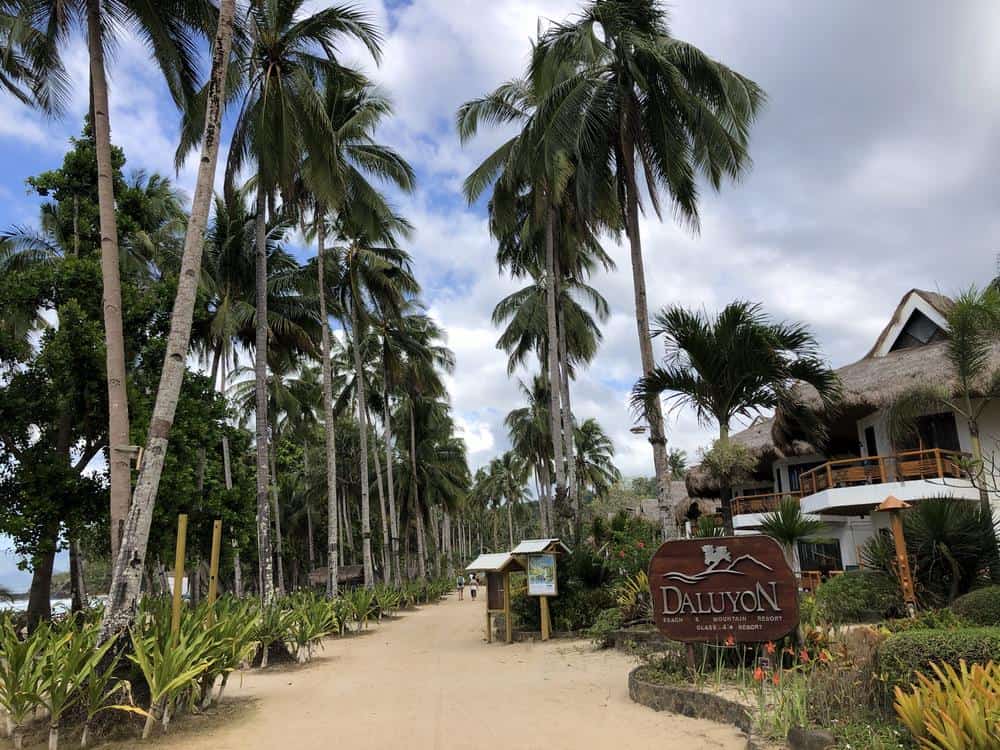
- Daluyon Beach and Mountain Resort: located in an even quieter part of the beach, this hotel also offers every comfort and villa‑style rooms with sea views. They also have a lovely pool. Book your room here.
- Hill Myna Beach Cottages: among Sabang’s budget hotels, this one has the best beachfront area, with hammocks to enjoy it. The bungalows are extremely basic, but they’ll do for one or two nights if you’re looking to pay little. Check if they have a room here.
- Café Sabang: if you’re traveling solo, this basic option will interest you, as they have shared rooms with a bed for just $8. Book here.
If you want to get away from it all, here are 2 more recommendations relatively close to Sabang from which you can easily access everything this part of Palawan has to offer:
- Atremaru Jungle Retreat: about 20 minutes by car from Sabang Beach, this impressive hotel set right in the jungle with a small beach is a great option to stay and spend a few days relaxing. It has a pool and clean, well‑kept rooms with traditional handcrafted décor. See prices and availability here.
- Kahamut-An Beach and Cottages: very close to the previous one, with a beautiful seaside location, you have basic fan‑cooled cottages for $25 including breakfast. You can book here.
Find more accommodation options in Sabang here.
How to get to Sabang
Depending on where you are, you can get to Sabang in different ways. The most frequent and common transports are from Puerto Princesa, the capital of Palawan, so we encourage you to first read our article on How to get to Puerto Princesa. Sabang is about 80 kilometers from Puerto Princesa (between 1,5 and 2 hours by road); to cover them, you can opt for the following:
- Vans: they’re the most frequent and the fastest. You can catch them at the bus terminal or have them pick you up at your accommodation in Puerto. You’ll also find them as you exit the airport. Prices range between 250 and 400 pesos, depending on where you catch them. They usually take just under 2 hours to make the trip. Schedules are: 7:30, 8:30, 10:30, 13:30, 15:30, and 17:30. The company that runs the most services is Lexxus and you can book here.
- Jeepney: they depart from San Jose Terminal in Puerto Princesa. They cost 150 pesos per person, but keep in mind they are slow. It’s usual for them to take about 2,5–3 hours to reach Sabang. Also consider they’re not very comfortable. Departure times are: 7:20 and 12:00.
- Non‑air‑conditioned buses: they also leave from San Jose Terminal. The company is D’Christ and they usually depart at 11:00. They take about the same time as the jeepney, but are a bit more comfortable. They cost 150 pesos per person.
If you want to go from Port Barton to Sabang, you have two options:
- Go by van from Port Barton to Sabang: there are some that go directly to Sabang—ask for the schedules at the terminal, but there are usually 3–4 a day. They take about 4 hours and the ticket costs 600–800 pesos per person. You can reserve your seat here.
- Take the non‑air‑conditioned bus that goes from Port Barton to Puerto Princesa, get off at the Salvacion junction, and wait for a transport to Sabang: it’s the cheapest option, but keep in mind it can take quite a while, as it’s hard to find empty vans going to Sabang and the jeepneys or buses are infrequent. The bus usually leaves Port Barton bus terminal at 8:30 and takes almost 3 hours to reach Salvacion. They usually charge 150 pesos for this leg. Once in Salvacion, it’s hard to find a ride for less than 200 pesos.
If you want to go from El Nido to Sabang, you also have two options:
- Go by van from El Nido to Sabang: as with Port Barton, they usually stop at the Salvacion junction and transfer you to another van to Sabang. The journey takes about 5 hours and the departures are at 4:00 and 11:00. Prices are around 700–800 pesos, depending on the agency, although Lexxus runs more services. They leave from El Nido bus terminal, at the start of Corong Corong. You can reserve your seat here.
- Go by bus to Salvacion and take another transport there: you can take buses from the companies Cherry or RO‑RO going to Puerto Princesa from El Nido and get off at Salvacion. Once there, you’ll have to try to catch another transport. Keep in mind it will take about 7 hours, depending on how long you have to wait. As in the previous case, vans from Salvacion to Sabang usually charge 200 pesos, although a more reasonable price would be 150. From El Nido to Salvacion we don’t know how much they charge, but the price is per kilometer; you could expect around 300 pesos per person.

Where to eat in Sabang
You’ll see you don’t have a multitude of options to eat in Sabang, but the ones there are aren’t bad at all. In the village itself you’ll find several carenderias (typical Filipino eateries) where you can eat for little money, and on the beach itself there are also restaurants where you can eat with your little feet in the sand. Here are some recommendations for eating in Sabang:
- Asiano Gourmet Cousine: lots of typical Asian dishes at good prices. The seafood section is a little pricey, though. If you’re vegetarian, you won’t lack options and the curries are spectacular. They used to be located right on the beach, but now, unfortunately, they’re a bit away from it.
- Pawikan Restaurant: it’s the restaurant of the Daluyon Hotel, so it’s a little more expensive, but worth it.
In addition, very close to the Underground River office, you’ll find many stalls selling basically pancakes, fruit shakes, and coconuts for 30 pesos!

Other tips for visiting Sabang
Now that you know where to eat, how to get there, and where to stay in Sabang, here are some extra tips to enjoy your trip even more:
- As we mention in When to travel to the Philippines, the best time to travel to Palawan is from January to May. However, you can visit Sabang at any time of year, except that July, August, and September are usually the rainiest months. It’s rare for this island to be affected by typhoons, but in the rainy season there can be low‑pressure areas that can be a nuisance.
- There are some ATMs in Sabang, but it’s advisable to always carry cash, as card payments aren’t widespread.
- Don’t go too late for dinner because Sabang is super quiet and beyond 20:00 there’s usually no “life,” except for the ever‑present karaoke.
- Be careful with some parts of Sabang Beach, as it’s not uncommon to have sandflies, sand mosquitoes, or “nik nik.” These are small flies that bite without you realizing it and at night you’ll feel quite an itch. In fact, you’ll see some signs in the resorts indicating their presence. You can use repellent or coconut oil so they don’t bite you and, if you’ve had the bad luck already, go to a pharmacy to buy “calamine,” which greatly relieves the itch.
- Travel with a good international health insurance that covers transfer to Puerto Princesa if needed, as there are no hospitals in Sabang. Read all about the one we use in Travel insurance for the Philippines.
Map of Sabang
Do you have any questions or suggestions? We’d love to read them in the comments!