– Guide updated in 2026 –
If you are planning to travel to the Philippines and want to be able to connect to the Internet from your own cell phone “at all times,” you’re in luck. In this guide, we’ll explain which companies you can choose from, where and how to buy a Philippine SIM card, and plenty of other information that will be incredibly useful for getting internet in the Philippines as cheaply and easily as possible.
eSIM or Philippine SIM card: which option is better?
We have been traveling around the Philippines for more than fifteen years and have always used a Philippine SIM. We knew about companies such as Airalo and Holafly, which we actually use regularly in other destinations such as Japan and the United States, but we had never used them in the Philippines. After receiving hundreds of emails from you telling us that they are the best solution for many travelers, we have decided to include them in our guide to Internet in the Philippines, along with their respective discounts. That said, we still want to be honest and clarify a few points that we consider important.
- eSIMs are a very good solution for travelers who want to arrive in the Philippines and already have internet access while they are still on the plane. This is helpful for many people who land and immediately catch another flight to another destination in the country and do not have time to stop and buy a Philippine SIM. It is also useful for those who arrive in the middle of the night and want to go straight to their hotel without wasting time, and even for those who are not confident speaking English and do not want the hassle of turning down an overpriced tourist plan.
- These companies offer unlimited data plans, which can be very useful for anyone planning to use their connection heavily.
- They are eSIMs, so your phone must be compatible.
- You keep your WhatsApp number.
On the other hand, bear in mind that the price is slightly higher and that you will not be able to send SMS messages or make calls. Since you have an unlimited connection, you can make calls through Skype, although it is not our favorite solution. SMS messages, despite being used less and less now that WhatsApp is finally becoming widespread, are still useful in some situations.
With all that said, you can purchase them here and take advantage of the discount.
Airalo in the Philippines
Airalo has slightly lower prices than Holafly, which is its main advantage. It now also offers unlimited data plans. Aside from that, it works in exactly the same way. You install the eSIM, activate it when you arrive, and you have internet access. In addition, unlike other companies, it allows tethering, meaning you can share your data with your laptop or another person.
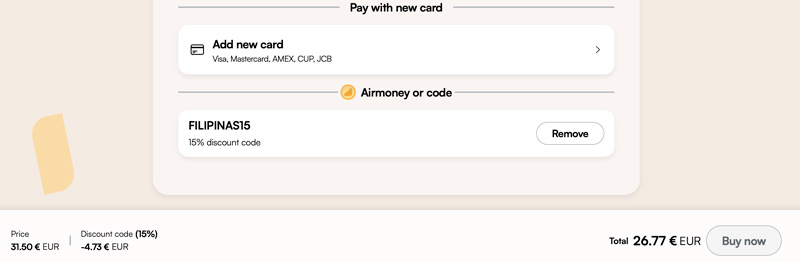
You can purchase one by clicking this button, but do not forget to activate your discount with the code FILIPINAS15 before making the payment. You’ll get a 15% discount!
Holafly in the Philippines
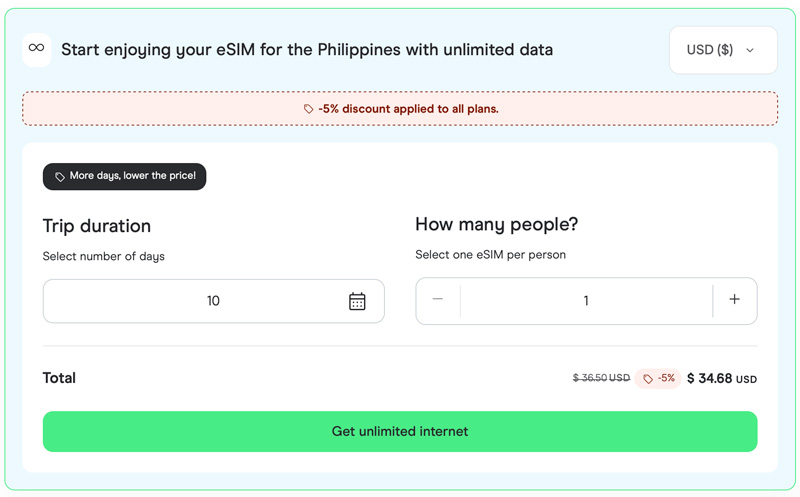
Holafly is a well-known company and is extremely useful in destinations where internet access is as expensive as it is in Japan or the United States. Its main advantage is that it now offers cards with unlimited data, so you will not have to worry about whether the gigabytes you purchase will be enough, and it also provides excellent customer service. When you click here, the code VIAJARPORFILIPINAS will be applied automatically, giving you a 5% discount for using our link.
In addition, if you are going to travel through other Asian countries, you may be interested in THIS OTHER CARD. It will give you internet access in the Philippines, Japan, China, Indonesia, Thailand, South Korea, Vietnam, Singapore, Hong Kong, Sri Lanka, Malaysia, Taiwan, Pakistan, Cambodia, Macau, and Laos. For this reason, it is a good option if you are planning a layover in China, as it also includes a VPN and will allow you to use WhatsApp and all social media platforms.
Globe and Smart eSIMs
For several years now, the Philippines’ two main phone companies (Globe and Smart) have also offered eSIMs that can be used by international travelers. If your phone is compatible and you prefer the idea of using a local eSIM, this may be exactly what you are looking for.
Like everything else, they have their advantages and disadvantages. Their main strengths are the price, which is lower than options such as Airalo or Holafly, and the fact that, since you are given a Philippine number, you can make calls and send SMS messages. We usually use the number to contact hotels, drivers, or guides who still do not use WhatsApp.
The downside of a Philippine eSIM from Globe or Smart is the mandatory registration process, which is tedious and sometimes almost impossible to complete. We know of many travelers who, after already paying for one, ultimately switch to Holafly or Airalo because they cannot activate it. From our own experience, we can confirm that the process can sometimes become truly frustrating.
Which eSIM for the Philippines is best?
In this case, we do not think there is a single best eSIM, but rather a suitable eSIM for each type of traveler. Or even a different one for each type of trip, since we sometimes use Airalo, Holafly, or a physical Philippine SIM, depending on the circumstances.
| Feature | Airalo | Holafly | Globe / Smart eSIM |
|---|---|---|---|
| Price | Cheaper than Holafly | More expensive | Cheapest option |
| Internet as soon as you land | Yes | Yes | Depends on when you activate it |
| Unlimited data | Yes | Yes | Depends on the plan purchased |
| Calls and SMS | No | No | Yes |
| Internet sharing (tethering) | Yes | Depends on the plan | Yes |
| Mandatory SIM registration | No | No | Yes, and it can be somewhat complicated and frustrating |
| Network used | Smart | Globe | Depends on which one you choose |
| Ideal for… | Anyone looking to save money and have unlimited internet from the very first minute | Anyone who wants unlimited data, maximum convenience, and excellent service | Anyone looking for the lowest price and a Philippine phone number |
Why buy a Philippine SIM card to get internet in the Philippines
Yes, you may have spent the entire year waiting for your trip to the Philippines and already imagined yourself on a paradise beach thousands of times, relaxing on the sand and completely disconnected from everything. We totally agree with you and are looking for exactly the same thing! But trust us, having internet in the Philippines can genuinely make your trip much more convenient. Here are a few examples:
- If you get a SIM card in the Philippines, you will be able to use GPS and always know exactly where you are and how to reach your destination. Although you will often find signs, at other times the roads can be a maze. For us, for example, GPS was incredibly helpful when getting to Can-umantad Falls in Bohol.
- On more than one occasion, you may need to make calls and send SMS messages to Filipinos to arrange a pickup with a driver, book a hotel room, or meet someone to organize an island hopping tour. With a Philippine prepaid card, you will have your own phone number and be able to do so as cheaply as possible.
- In cities such as Manila or Cebu, you are very likely to use Grab to get from one place to another. Although there is Wi-Fi in the Philippines and you can order a taxi from your hotel, you will have no way to use it while walking around unless you are connected.
- If you are thinking about getting a portable Wi-Fi device for traveling to the Philippines, forget it: it is a waste of money. It is much better to get a Holafly or Airalo eSIM with unlimited data and use that connection instead. We work on our laptops using that connection!
- And, of course, in the age of social media, who does not enjoy sharing their trip to the Philippines from time to time? You will be able to send your mother a WhatsApp message, reply to emails from your friends, and, for example, upload your travel photos to Instagram.

Which phone company is best in the Philippines: Globe, Smart, or DITO
Although there are three reasonably large companies that can provide you with internet in the Philippines, we are going to focus on the two main options for your trip: Globe or Smart.
Globe and Smart: speed and coverage
In truth, Globe and Smart are fairly evenly matched. Neither one is 100% reliable throughout the entire country, and whichever you choose, we are sure that at some point you will find yourself without coverage in certain places. In different parts of the Philippines, one of the two performs slightly better. In terms of internet speed in the Philippines, Smart has a slight edge over Globe in some places. The opposite is true for coverage, where Globe usually delivers better results.
We always used Globe and were very happy with it. However, in recent years, we have opted for Smart more often. The bottom line is that they are very similar. Depending on the island you are on, or even the specific part of the island, one may sometimes have better coverage than the other. It is generally said that Globe is better in major cities and Smart in the rest of the country. These days, we tend to prefer Smart (it worked incredibly well on our latest trip around the country) when we are not using Airalo or Holafly, but we know this is something that changes over the years.

via GlobalSignal
DITO in the Philippines
A few years ago, the Philippines’ third-largest phone operator was Sun, but it gradually lost its position to DITO. DITO performs very well in terms of speed, but the problem is that it still does not reach many parts of the country, which is why we cannot recommend it yet. In a few years, however, it is very likely to rise to the top and rank higher in this guide to the best SIM cards for the Philippines.
Where to buy a SIM card in the Philippines
The easiest way to buy a SIM card in the Philippines is at the airport where you first arrive in the country. At both Manila Airport and Cebu Airport, after collecting your luggage and going through the exit, you will easily find the Globe and Smart sales counters right next to each other. They will help you choose a plan and set up your phone so that you can leave the counter ready to send a WhatsApp message saying, “Mom, we’ve arrived in paradise.” The counters are open 24 hours a day.

Please note: it is important to bear in mind that in recent months, these airport counters have stopped selling “regular” SIM cards and top-ups and now only offer tourist plans costing around 1,200 pesos (or considerably more) for one month.
We recommend taking a look at the plans we suggest in the following section (at these counters, they will tell you outright that those plans do not exist and that they cannot sell you a SIM card on its own). In our opinion, they are much better and cheaper. If these tourist plans do not interest you, forget about the official counters and go straight to any convenience store (such as 7-ELEVEN or Uncle John) or sari-sari store to buy your SIM.
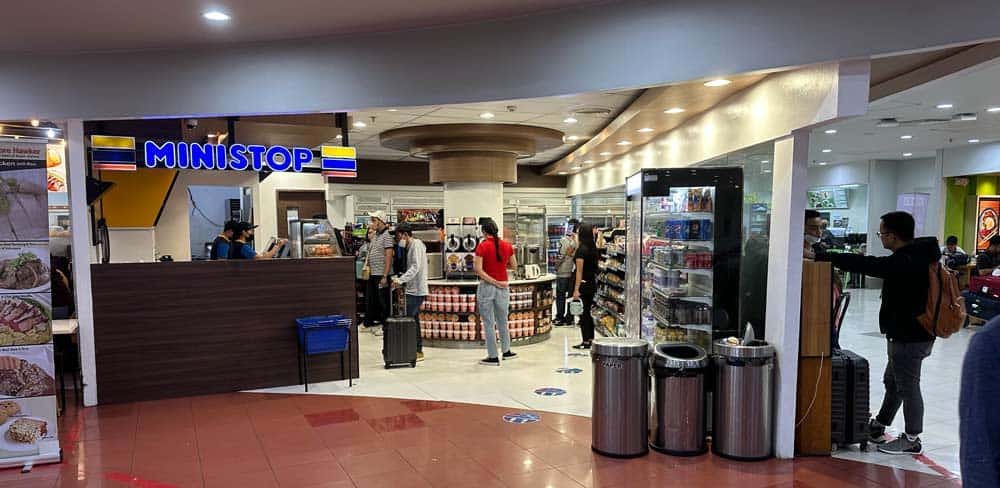
At Manila Airport Terminal 3, if you go up to the upper floor, you can buy the SIM and any top-ups you need at the Uncle John store (formerly called Ministop) shown in the following image. Travelers also tell us that they are sold at the Lawson store on the floor below.
Pros and cons. If you buy it at the official counters, they will normally activate it for you, but it is much more expensive. If you do it yourself, it is much cheaper, but you will have to activate it on your own.
How to register a Philippine SIM card or eSIM
In the Philippines, both eSIMs and local SIM cards must be registered by law before you can make calls, send SMS messages, or use mobile data. To do so, you will need to follow the steps provided on the Smart or Globe website or app. As a tourist, you will be asked to enter your personal details, verify your number using a one-time code sent to you, upload a photo of your passport, and take a selfie. On some occasions, they may also ask you for an accommodation booking or even your ticket out of the country, as has happened to us.
If you manage to provide all the requested information despite the recurring error messages that prevent you from continuing, you will be able to submit it and, once approved, your Philippine SIM or eSIM will be activated and ready to use.
It seems like a straightforward process. However, both we and many other travelers have become extremely frustrated by the form’s constant errors and the problems involved in verifying our accommodation.
Prices and data plans for calls and Internet in the Philippines
Every so often, Globe and Smart introduce new plans and prices. As you will see below, each plan includes a bonus that, depending on the plan selected, may consist of free messages, calls, or megabytes for specific apps.
A very simple way to activate your preferred data plan is to add credit using prepaid top-up cards, which you can buy in many different places (we explain where later in the guide), and then select your plan through the Globe app or Smart app.
The first time we created this guide to Philippine SIM cards for getting internet access, we listed countless different Globe and Smart plans here. Over the years, as new data plans have appeared, we have gradually learned what you are genuinely interested in. For that reason, we have removed many of them and kept only those we consider most practical for you, based on our experience and your comments.
The key points are as follows:
- Plans with a minimum validity of 7 days. Trips to the Philippines usually last two or three weeks. We have removed the three-day plans. A seven-day plan is perfect for your first week, allowing you to use whichever plan you think will work best. After that week, if you have lots of data left over or have run short (you can check your usage in the app), you can adjust the number of gigabytes up or down.
- SMS: Although more and more Filipinos have WhatsApp, it is still very common to use SMS messages to contact guides, hotels, or restaurants.
- Price: Obviously, we want you to spend as little as possible.
At the moment, these are the plans available:
Globe Philippines prices and plans
Once you have the Globe SIM in your phone, you will need to add credit before you can start using it. We recommend activating a data + SMS plan and topping up with enough credit to cover any calls or a new data plan you may need in a few days. For example, if you choose the GO+129 plan (one of our favorites), adding 300 pesos is a good idea. This gives you enough for two weeks on that plan (129 x 2 = 258), with 42 pesos left over in case you need to call a Smart number.
These are the three Globe options we recommend:
| Globe | Go+99 | Go+129 | Go+149 |
|---|---|---|---|
| Total data | 20 GB | 26 GB | 28 GB |
| Calls and SMS | Unlimited SMS to all networks | Unlimited SMS to all networks and unlimited calls to Globe and TM | Unlimited calls and SMS to all networks |
| Price | 99 pesos | 129 pesos | 149 pesos |
| Validity | 7 days | 7 days | 7 days |
| How to activate | Through the GlobeOne app | Through the GlobeOne app | Through the GlobeOne app |
These data plans divide the allowance among general data, data used on 5G, and data for apps of your choice. For example, with Go+99, you could have 8 GB for apps such as Facebook, Instagram, TikTok, etc., and 4 GB for 5G, all included within the plan’s total 20 GB.
Activating any of these plans once you have credit is extremely easy:
- You will easily find them in the GlobeOne app under “Globe Recommends.”
- By dialing *143# and following the menu steps: 1) Go+, 2) Go+129… etc.
Smart Philippines prices and plans
As you will see, the prices and offers are fairly similar in both cases. If you choose Smart for your Philippine prepaid card, our advice is the same as with Globe: get a data plan and always keep a few extra pesos for calls or SMS messages, or simply choose a plan that includes everything at once.
| Smart | ALL DATA 99 | ALL DATA 299 | New Power All 99 | New Power All 149 |
|---|---|---|---|---|
| Total data | 6 GB | 24 GB | 21 GB | 26 GB + unlimited Facebook or TikTok |
| Calls and SMS | Not included | Not included | Unlimited calls and SMS to all networks | Unlimited calls and SMS to all networks |
| Price | 99 pesos | 299 pesos | 99 pesos | 149 pesos |
| Validity | 7 days | 30 days | 7 days | 7 days |
| How to activate | Through the Smart app | Through the Smart app | Through the Smart app | Through the Smart app |
Activating any of these plans once you have credit is very easy:
- Through the Smart app, where you can check the available plans, activate them, and monitor your usage.
- By dialing *123# and following the steps shown in the menu.
So, which SIM or eSIM should you buy for internet in the Philippines?
As we said at the beginning, it depends on your needs, preferences, usage, type of trip… At the moment, the most convenient option is to choose an eSIM such as Airalo or Holafly, with unlimited data and no activation headaches. If you want to make calls and send messages during your trip, a Philippine SIM may be the best solution. If you are traveling as a couple, we suggest doing what we do now: combining an international eSIM with a Philippine SIM so that you have everything covered.
If you choose an international eSIM
Airalo and Holafly cost roughly the same, although Airalo usually has slightly lower prices when you apply our code FILIPINAS15 at checkout. Both are very easy to install, and both offer good customer service that can answer any questions you may have. Therefore, since Airalo uses Smart’s network and, in our experience, currently provides slightly better coverage, it would be our main recommendation. However, once again, if you choose Holafly, you will also have a good connection throughout most of the country.
If you choose a Philippine SIM
As we have explained, both are very similar in terms of prices and coverage. Depending on which island you are visiting (and even which part of the island), one may offer better coverage than the other. As a general rule, we believe Smart currently performs better, but it ultimately depends on the island and even the exact location where you are.
If you are traveling as a couple, we suggest doing what we do now: each person uses a different card. One of you uses a Globe plan with the amount of data you think you will need, plus SMS/calls. The other gets a Smart data-only plan. As long as one of you can send an SMS message when necessary, that is more than enough. This way, there will always be someone with coverage who can share their data with the other person.
How to top up your Philippine SIM card
If your data plan falls short because you have been using it heavily to send so many beautiful photos, or if you have run out of credit for calls and SMS messages, you may need to top up your prepaid card.
Whether you have chosen Globe or Smart, you can top up in the following ways:
- Go to a convenience store such as 7-ELEVEN or Uncle John, where the staff may be able to top it up for you directly, although this is not always possible.
- Buy a card with a top-up code at a convenience store or one of the many small neighborhood shops. We usually choose this option and carry one of these cards with us so that we can top up whenever we need to. You scratch off the section covering the hidden top-up code, follow the instructions, and your balance is topped up in no time.
- Online. You can top up and pay by credit card through the Globe Philippines website or the Smart Philippines website. Obviously, this option makes no sense if you do not have internet access. Another more convenient online option, which also lets you monitor how much data you have left, is to download the official Globe and Smart apps and manage everything from there.

Tips and useful information about getting internet in the Philippines and using a SIM card or eSIM
- One of the two phone companies performs better in each area of the country, but the difference is rarely enormous. If you are unsure which one to choose and are traveling as a couple, you can each get a different card.
- In some places, you will notice that internet speeds vary depending on the time of day. This is due to the number of people using the network. While we were in San Juan La Union, the internet was very fast throughout the morning. At around 4 p.m., when large numbers of children left school, the network would often become overloaded.
- If you have never used a foreign SIM card, do not worry: you can have a Philippine phone number and continue using your home-country number for WhatsApp. When you activate the card, simply indicate that you do not want to change your number in WhatsApp. You will continue using your old number for that app only. With an international eSIM, it is even easier because it does not have its own phone number.
- If you need to make an online purchase, you may have to receive an SMS message to confirm it. In that case, you will need to insert your home-country SIM card. Remember to activate roaming and disable mobile data so that you do not receive an enormous bill from your phone company.
- To avoid the unpleasant surprise of quickly running out of data, it is very useful to disable automatic updates. It may sound obvious, but you would not be the first person to wake up in the morning and discover that you have run out of megabytes because your phone has used up your data. Many apps use data even when the phone is locked.
- Most cell phones today include the option to share internet access. Thanks to this, if you have a data plan with a Philippine SIM, you will be able to connect your laptop or tablet, or even share the connection with other cell phones. Both Airalo and Holafly also offer this option.
- Nowadays, practically everyone stores their contacts on their phone or in the cloud. If that is not the case for you, it would be a good idea to do so before traveling to the Philippines so that you do not lose them while using the Philippine SIM.
- Depending on where you buy the SIM, its price may vary slightly. However, it is usually around 50 pesos.
- Remember that to use a Philippine SIM, your cell phone must be unlocked and able to accept SIM cards issued in other countries.
- Lastly, remember that Wi-Fi is available in many hotels, airports, and coffee shops in the Philippines. You can rest assured that you will be able to connect even without mobile internet, although outside Manila or Cebu, Wi-Fi is usually fairly unreliable.
Do you have any questions about getting internet in the Philippines? We look forward to hearing from you in the comments!