This list of activities things to do in Sagada will help you plan your route around Luzon if, in your itinerary for the Philippines, you want to explore beyond the beaches.
Sagada is a destination in the Cordillera region that is gradually gaining prominence in local tourism thanks to its mountainous landscape (yes, besides rice terraces, there are plenty of pine trees in the Philippines!), variety of outdoor activities (hiking, caving…), cuisine and culture. Here you’ll find the legendary and mysterious hanging coffins, coffins hung on a mountainside that are the best-known tradition of the tribes who inhabit this part of the country, collectively known as Igorots or Igorotes.
Although there are still few international travelers who venture to visit this corner of the Philippines, we are convinced that it has enough attractions that it will really take off in the coming years. Add to this that it is relatively close to the famous rice terraces of Banaue and Batad and to lesser-known ones such as those of Maligcong in Bontoc, and we think there are plenty of reasons to come here.
In this Sagada guide you’ll find everything you need to make the most of this Filipino destination.
Where is Sagada, location
Sagada is located on the island of Luzon, the same one where Manila, the country’s capital, is found. Specifically, it is 390 kilometers to the north, in Mountain Province, Cordillera region.
Although we’ll tell you in detail below how to get to Sagada, keep in mind that the most common way is by overnight bus from Manila. Of course, if you are exploring other parts of northern Philippines, you can also get here by linking different buses.
Why go to Sagada, what to expect
It won’t come as a surprise if we tell you that the vast majority of travelers who visit the Philippines do so motivated by its paradisiacal beaches. However, not all of us like the same things and perhaps you are looking for different experiences to balance out that turquoise‑water Philippines. In Sagada you will find something completely different: caves, hiking, tribal culture and even low temperatures.
The original residents of these lands are known as Igorots or igorots, a term that brings together the different indigenous groups of the Central Cordillera of Luzon. Although it’s a topic for long conversation—and we encourage you to research it before or during your trip by talking to different people you’ll meet—a good portion of Sagada’s inhabitants are Kankanaey.
Although you will hardly see anyone dressed as they used to in the past, many have preserved their own languages (in this case Kankanaey), traditions and beliefs, which, of course, have been mixed and sometimes diluted with the arrival of Spanish and American religious missions. Due to the complicated orography of the terrain and the resistance of these indigenous groups, foreigners arrived quite late compared to other places in the Philippines; therefore, the cultural component here still beats strongly as soon as you start to scratch the surface, a good example being the funeral rites that can still be seen in Sagada.
How many days to spend in Sagada
The number of days to spend in Sagada depends a bit on the time you have on your trip and what you really want to do, since if you’re not going to do many hikes, you can see quite a lot in just one day. In fact, we saw some travelers who only went to visit the hanging coffins and then left.
If you ask our opinion, we think it’s worth squeezing more out of it and spending at least two full days, and if you like this kind of mountain activities, three or four will be a more suitable number for you.
That said, in a single day you could do the following in Sagada: sunrise at Marlboro Hills, Sumaging Cave, Hanging Coffins and Bomod‑ok Falls. You’ll end up exhausted, but it’s doable.
If you have two days, we recommend taking the above more calmly and adding one or more places such as Lumiang Cave and/or the Cave Connection and the Paytokan Walk (which includes the Hanging Coffins). Always up to you, of course.
If you’re thinking of visiting Sagada from Manila, given the bus schedules, you’ll arrive early in the morning in Manila. On that day and the next, make the most of the morning and then leave back to Manila or towards Banaue on the 13:00 or 14:00 buses. It’s quite a slog, but it can be done if you have little time and want to get a first impression of northern Philippines.
What to see and do in Sagada, essentials
Let’s get to it! Here are the best things to do in Sagada.
1. Visit Echo Valley and the popular Hanging Coffins
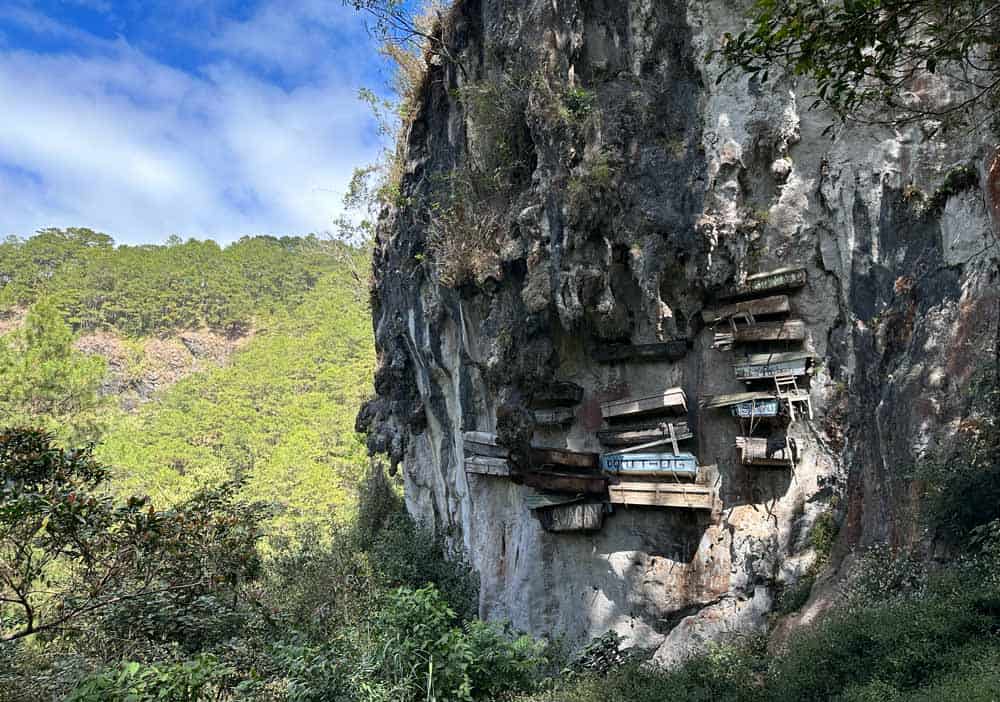
The star of the activities to do in Sagada is the visit to the Hanging Coffins or Ataúdes Colgantes. Although they are not the only ones in the area—since this is a funerary tradition of its inhabitants—the ones in Echo Valley (known as the Baw‑eng Hanging Coffins) are the best known and the ones everyone comes to see.
According to studies, the Kankanaey have been practicing this way of burying their dead for more than 2,000 years. They believe that placing the coffins in this way will bring them closer to the anito, the ancestral spirits who will accompany them eternally. In addition, it is a way for their bodies to be better protected both from inclement weather (if you look, they are located under the rock) and the possible arrival of wild animals.
The oldest coffins are quite small, measuring around 1 meter, because the Igorots have the custom of placing the bodies of the deceased in the fetal position. In other words, we leave this world the same way we came into it. Even so, more recent ones are a bit longer, since more recent generations were afraid of breaking their relatives’ bones.
Although the guide will give you more details, you will also see some chairs hanging next to the coffins. This is the sign that the deceased underwent the sangadil rite; that is, after death, they were placed in a wooden chair (also called sangadil) in their house facing the door. The body is usually covered with several fabrics and fastened with ropes and roots so that loved ones can pay their respects and communicate with them as if they were alive, since they believe the spirit remains in them.
It seems that the sangadil was only performed for people with certain political or economic power, since the funeral rite also included the sacrifice of several animals and only the wealthiest could afford it.
After a few days of vigil, the person is carried in procession to their burial place on the shoulders of family members. The belief is that any bodily fluids that might fall on them will pass on their knowledge and good luck.
Is this form of burial still practiced? According to what we were told in Sagada, less and less due to the arrival of Christianity. Even so, some families still do it.
How to see Sagada’s hanging coffins?
Although you can go on your own and only pay the entrance fees (10 pesos per person), we think it really is worth hiring a guide at the tourism office. It only costs 300 pesos per group of up to 10 people and this is a place of more cultural than scenic importance, so you’ll come away more satisfied with the visit. The path, even so, is easy to follow, not complicated, and will take you barely 30 minutes round trip.
The route begins after passing the Church of Saint Mary the Virgin, a church built in 1904 by missionaries of the Anglican Church who arrived from the United States. Here you can also see a copper and aluminum bell and one of the wheels brought from the U.S. for the modernization of Sagada. The guide will give you more details about this topic.
Then, after passing the fee booth, you cross the Church of Saint Mary the Virgin Cemetery, filled with white crosses, and start a short trail from which you get nice views of Echo Valley. Before reaching the hanging coffins, on the left there is a small detour where there is a cave with more coffins and the odd skull. Our guide, ceremonially, lit a cigarette and left it smoking in front of them.
After this, you will begin to descend. You will pass a wall where you can practice climbing and, shortly after, you will see where the Baw‑eng Hanging Coffins are located, on a limestone rock wall. Although they look in good condition, it is believed that some are centuries old (the guide told us more than 500 years).
By the way, despite its name, keep in mind that shouting is prohibited in Echo Valley. Unfortunately, after Sagada appeared in a movie (That thing called Thadana, you can watch it on Netflix and we warn you it’s as romantic as can be), many people came here to imitate the protagonist by shouting. As it is a place of ceremonial importance, please be respectful and try not to be noisy.
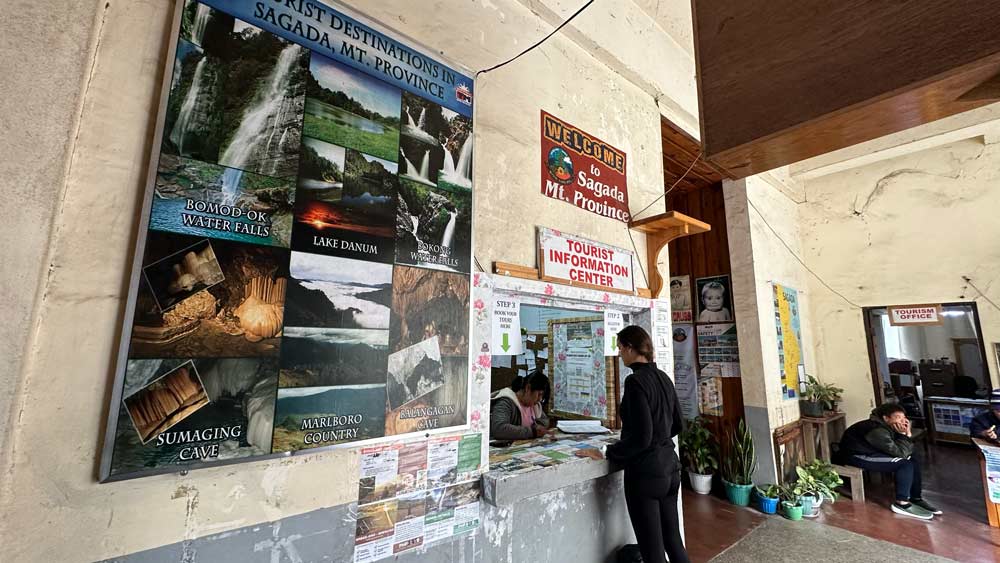
How to organize activities in Sagada? The Tourism Office is your best ally
If only more places in the Philippines had an organization like this! The truth is we were quite impressed with how Sagada’s Tourism Office works. There you can find set prices for guides and transport to the start and end points of the vast majority of activities in the area.
While the prices are not outrageous, the truth is that for 1 or 2 people they can add up, especially if you’re considering several and you’re on a backpacker budget. So the office has set up a board where you leave your name, phone number, the activity and the date you’re interested in so that other people can contact you and thus save costs. That’s how we found more people to share guides and transport for all the places to visit in Sagada that we’re going to tell you about.
Note that most activities to do in Sagada organized by the tourism office do not depart beyond 16:30. As for hikes, there are ones from sunrise and even earlier, as in the case of the Marlboro Hills trek we’ll discuss below.
2. Paytokan Walk
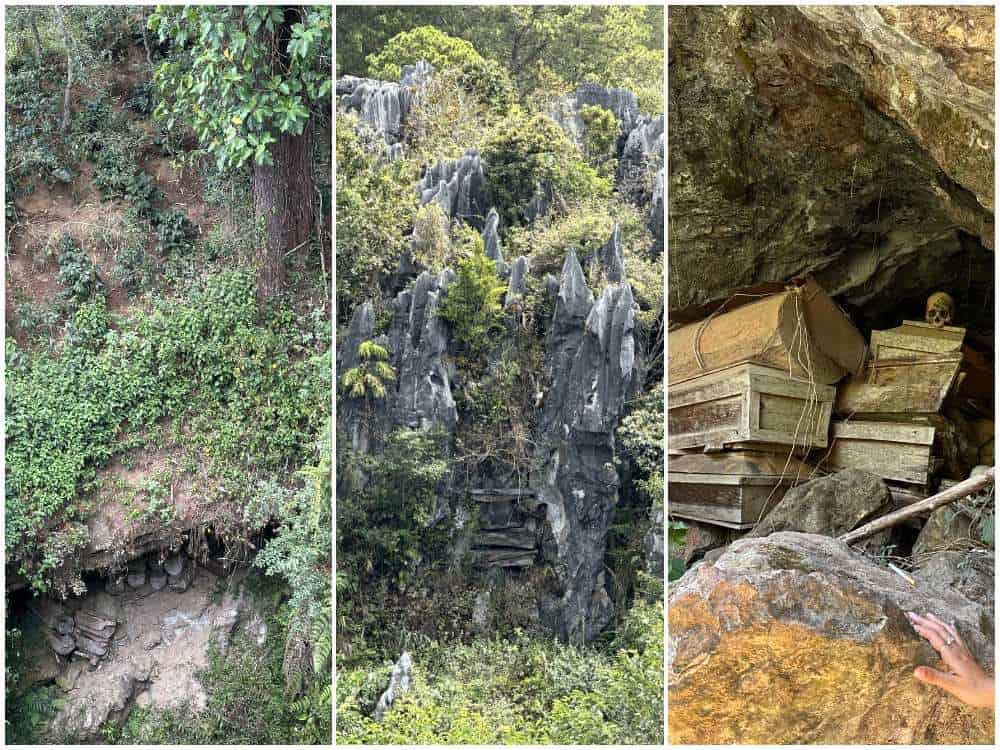
If you enjoy walking and have the time, one of the most famous trails to do in Sagada is the Paytokan Walk. It combines the Hanging Coffins with other places, so if you choose this one, you wouldn’t need to “book” the previous activity.
It lasts between 2 and 3 hours and you’ll discover other spots in Echo Valley and the surroundings, as well as other hanging coffins. You’ll also enter Matangkib Cave and the underground river.
Price: 1.000 pesos for the guide in a group of up to 10 people
3. Other hanging coffins to see in Sagada
The popular hanging coffins are not the only ones to see in Sagada because it is estimated that there are thousands spread across different valleys. During the Paytokan Walk you can appreciate even more, but if you don’t feel like doing this trail, you can also see more in the following places:
- Sugong Hanging Coffins: you’ll find them marked in Maps.me, but you have to look at the left wall when walking from the tourism office to the Lumiang Burial Cave.
- Lumiang Burial Cave: we’ll talk about it later.
- In front of Lumiang Burial Cave: across the road, in a little niche looking downward.
To reach all these places, we recommend walking along the road, which goes downhill. The walk is pleasant and will give you the chance to admire Sagada’s landscape. As the way back will be uphill, if you feel like it, you can wait for a car to pass by or, why not, hitchhike.
Don’t worry, we’ve marked them all on the Sagada map you’ll find at the end of the guide so you don’t get lost.
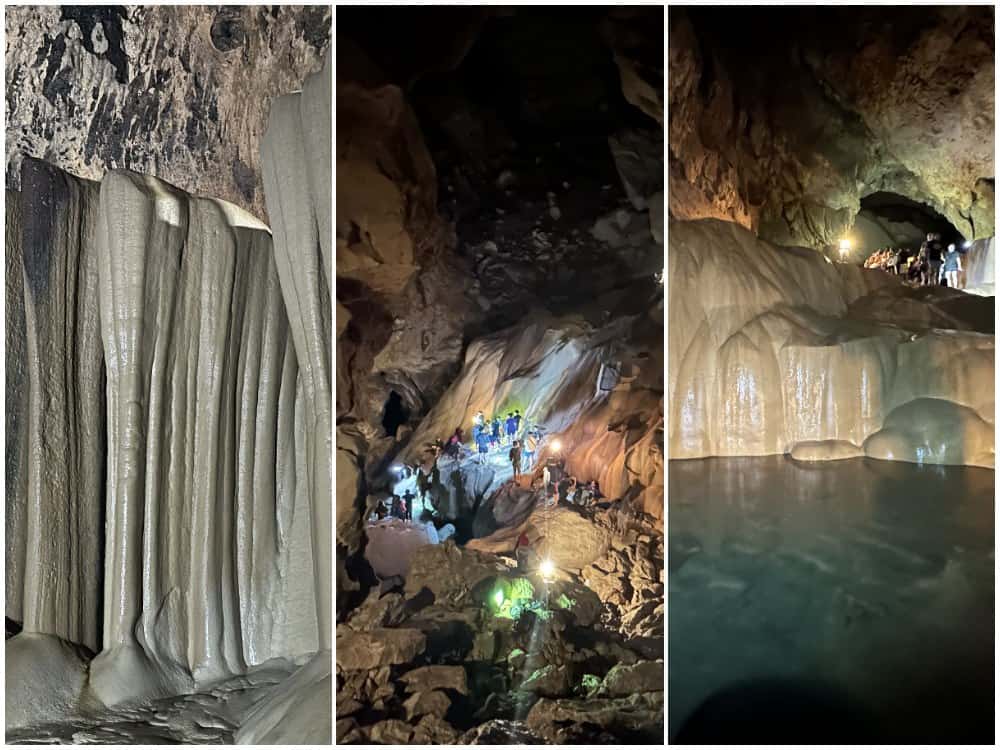
4. Explore Sumaging Cave
Given Sagada’s orography, another of its great attractions is its caves. They’re not kidding here—these are truly spacious and deep, with lots of chambers that speleologists are still exploring. For this reason, one of the things to do in Sagada without fail is to venture into one of them, with the best known being Sumaging Cave.
Unfortunately, as it is one of the most popular activities in the area and even though a permit is required, the cave gets packed during weekends and holidays and, rather than a quiet nature spot, it feels like a fair. Flashes everywhere, noise, floodlights…
Guides are also aware of Filipinos’ passion for photos everywhere, so they’ll offer you a shot every two minutes with a “cave icon”: the elephant, the vagina, the queen’s curtain… It never stops and also causes constant queues. It’s a shame that capacity isn’t controlled because the experience loses a bit of charm, but in our opinion it’s still a place worth visiting, especially if you do it Monday to Thursday.
How to visit Sumaging Cave in Sagada?
It is located in the southern area of town; you can get there on foot or by tricycle. However, note that to enter you’ll need to process the permit at the tourism office.
As we mentioned above, what works out best is to form a group with other visitors so you can visit it for less than 400 pesos including transport (depending on how many of you get together).
Although we went quite cautiously, the truth is that it’s a fairly easy route where you’ll barely get wet. Most of the trail can be done barefoot and the water doesn’t go above your knees. However, if you have water shoes and a dry bag to protect your electronics, even better.
This visit in Sagada is by no means difficult, but we don’t recommend it if you suffer from claustrophobia or have mobility issues. The ground can get slippery, you have to make small jumps and, to return, you’ll have to “climb” a kind of tire ladder that isn’t very comfortable. The route lasts about 1.5 hours.
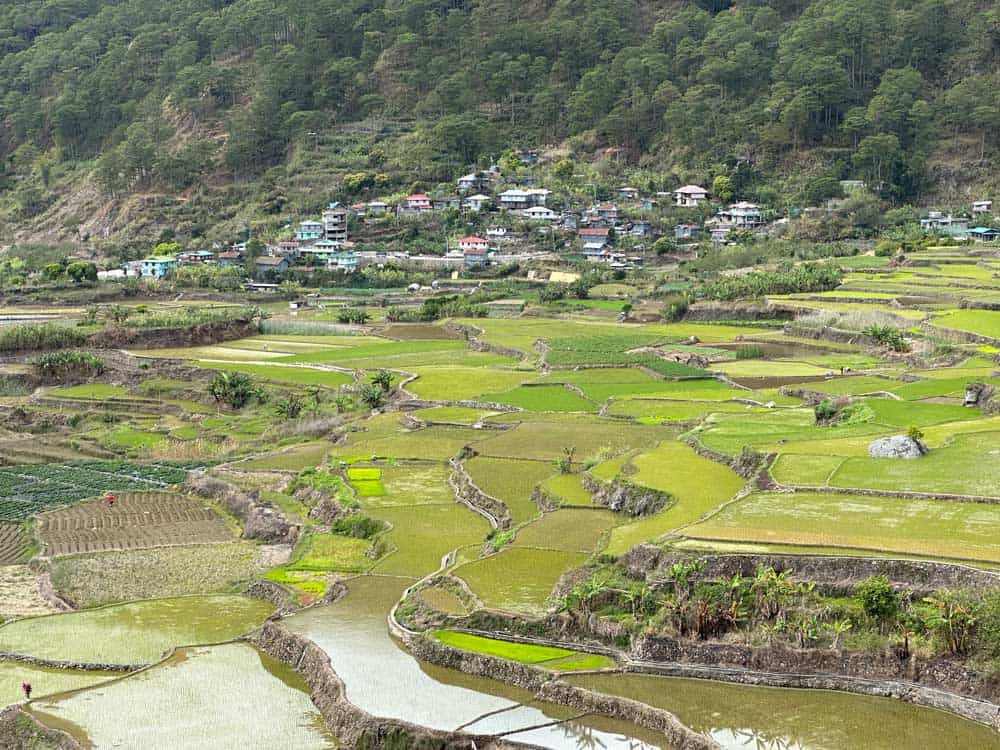
By the way, just before reaching the cave are the spectacular Kapay‑aw rice terraces. You can ask the driver to stop for a moment on the road to take a look, or come back to this area on foot or by tricycle to contemplate them more calmly. Gaia Café is also here, with a lovely terrace facing them.
Note, the cave is usually closed every year during the month of September. In case of heavy rains, you’ll also find it closed as a precaution.
Price: 1.200 pesos per group of up to 5 people (800 pesos for the guide and 400 for transport).
5. Hike the Bomod‑ok Falls trail
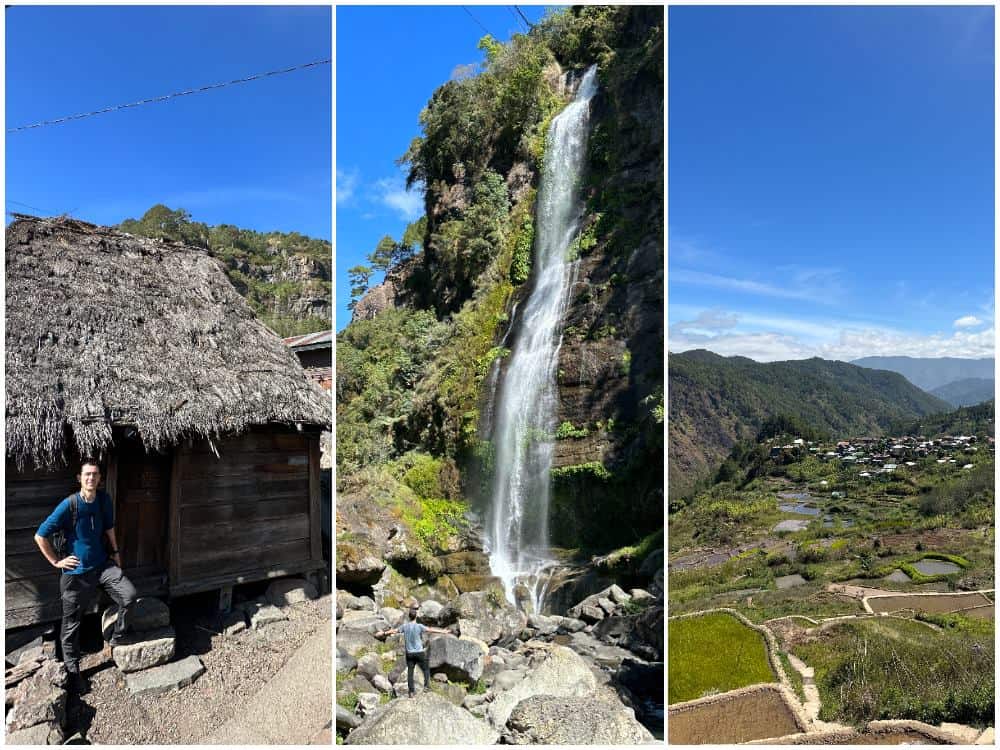
It would be very unusual if you didn’t enjoy seeing a beautiful waterfall, right? Well, the most famous one to see in Sagada is Bomod‑ok Falls, which can be reached relatively easily from the town center.
What is the trail like? Quite simple. It starts with a descent down a paved staircase, crosses the village of Fidelisan (where you can find a couple of traditional houses as well as a small altar where they perform rites to pray for the harvest) and continues through the rice fields until you reach the waterfall (always keeping to the right). The outward path shouldn’t take you more than 30 minutes.
The way back is tougher, as it’s pure ascent. It’s not very complicated either, but it does require a bit more effort. When crossing Fidelisan, what we did was keep to the right, where the village of Pide is. This way the climb is a little less steep and you also see a different part of the valley. If you want, you can also keep walking to Aguid.
In our case, we joined other travelers through the tourism office and we were very happy, since we didn’t have to worry about transport and, in addition, the guide told us some cultural facts about her town. However, the route is simple and perfectly marked in Maps.me, so you wouldn’t have much trouble doing it on your own.
We’re not 100% sure whether it can be done without a guide, since at the entrance to the village there is a checkpoint where you need to pay environmental fees (10 pesos per person), but if you’re thinking of renting a motorbike, you could ask. Going without transport can be a bit more difficult, as there are few tricycles in the area. As we separated from the group on the way back, we hitchhiked from the village of Pide and had no problem getting back to Sagada.
Price: 1.150 pesos per group of up to 10 people (500 for the guide and 650 for transport).
6. Walk the Marlboro Hills (Lamagan to Blue Soil hike)
One of the most famous hiking routes to do in Sagada is the one that takes you from Lamagan to Blue Soil. This route is also known as Marlboro Hills‑Blue Soil because the first is an area of grasslands where there used to be wild horses, like in that brand’s advertisements in the 1980s.
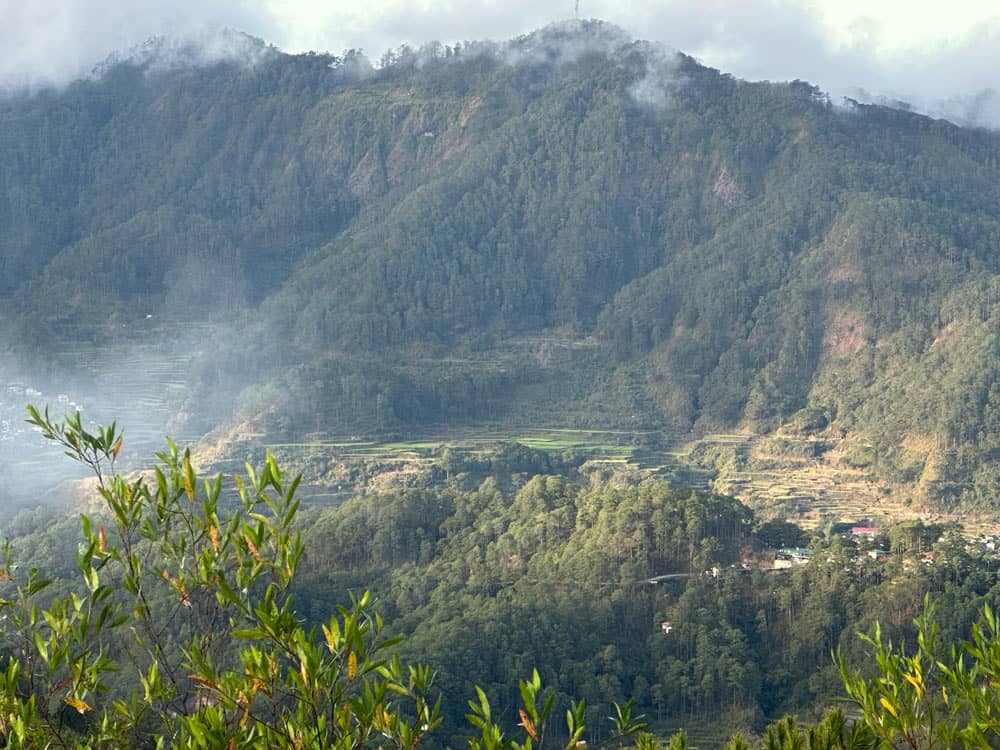
According to our guide, there are no horses left here, but almost all Filipinos who come to Sagada decide to do it because from the highest point (approximately 1,500 meters above sea level) you get wonderful views and there is the possibility of seeing the Sea of Clouds or “Mar de nubes”.
To admire the sunrise from the summit and the famous “sea of clouds”, it’s common for this route to do in Sagada to start around 4:30 in the morning. The pick‑up point is usually the tourism office, where the vans that take you to the start (just 10 minutes away) wait. There is a control and fee booth here where your guide will handle the formalities.
The hike to the top of Marlboro Hills takes just 45 minutes at a slow pace and, although it is uphill, it isn’t very demanding. The most complicated part is that it’s done in the dark, so you have to be careful while walking, although guides tend to carry powerful lights. When you arrive, you’ll find lots of food and drink stalls with little tables where you can sit down to have an arroscaldo, a warm champurrado or a coffee.
Afterwards, the descent begins through extensive pine forests, a rather curious landscape that reminded us at some point of Europe, were it not for the rice terraces that can be glimpsed on the surrounding mountains.
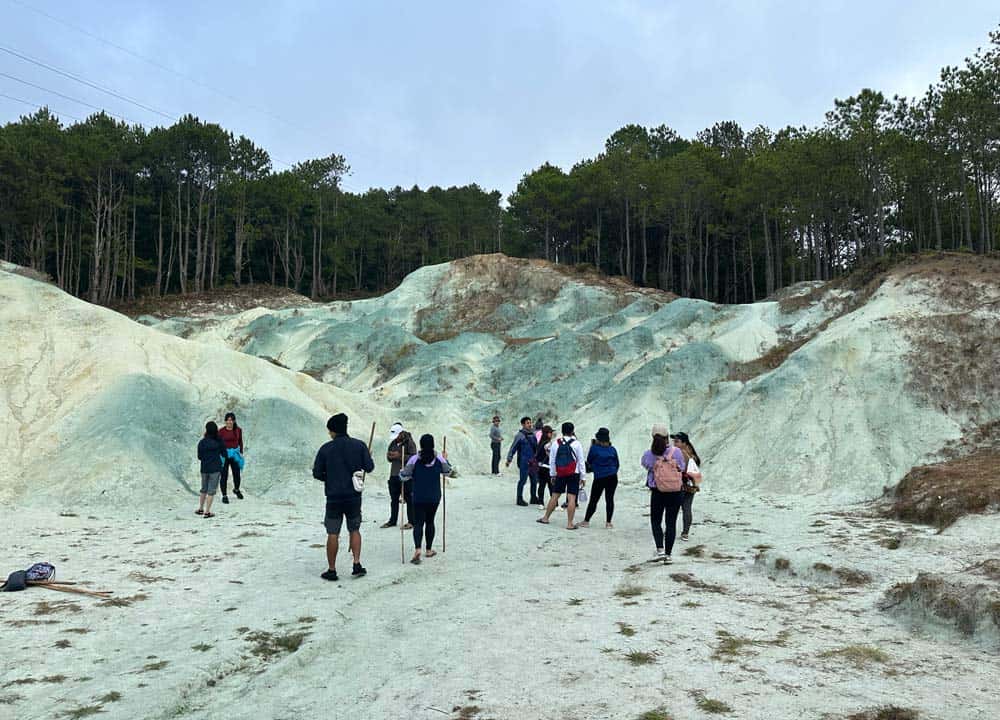
After a stop or two, the route reaches the so‑called Blue Soil or, as the locals call them, the Kaman‑utek Hills. This curious blue‑colored terrain is the result of the large amount of copper sulfate in the soil. If it has rained, it’s cloudy or there is little light, it can look a more intense color. So if you arrive at midday, you might be disappointed.
Once you’ve admired the place—or even had a halo‑halo (yes, there’s food here too)—you only have about 5–10 minutes to the end of the trail, where the vans that take you back to the tourism office are usually waiting.
As you can see, if you want to reach Blue Soil, this is not a circular route. If you’re only interested in the Marlboro Hills section, it’s feasible to retrace your steps from the summit, and the same if you only want to see Blue Soil.
Although Filipinos you meet in the area and even the tourism office itself may talk up the difficulty of the trek, we can assure you that it is suitable for all audiences, even for those who aren’t very used to hiking. In fact, without many stops and at a normal pace, it shouldn’t take you more than 3 hours. What happens is that, doing it with a guide and other people, it’s normal to make lots of stops to eat or take photos.
Some useful facts about this route to do in Sagada
We don’t know whether it’s feasible to do this trail on your own outside sunrise hours, but you should consider that at the start and end there is a booth where fees must be paid. According to other travelers, these usually only open on weekends, so you shouldn’t have a problem doing the route by yourself. The trail is perfectly marked in Maps.me.
That said, we loved doing it with our guide because it was when we learned the most about Sagada’s culture, flora and fauna. If you’d like to go straight to the point, you can leave us a comment below and we’ll pass you her contact; she speaks excellent English. Plus, it was very cheap for us (less than $8 per person) and we didn’t have to worry about transport, as there were 7 of us in the group.
Although, as we say, it isn’t a demanding activity and you’ll even see Filipinos doing it in flip‑flops, we do recommend wearing hiking footwear and some warm clothing for the early hours of the morning (you’ll warm up later, so it’s best to dress in layers). You’ll find food and drink stalls every so often if you want to travel lighter. Guides also carry flashlights.
Price: 2.900 pesos for the group of up to 10 people (1.600 for the guide and 1.300 for transport).
7. Visit the Lumiang Burial Cave
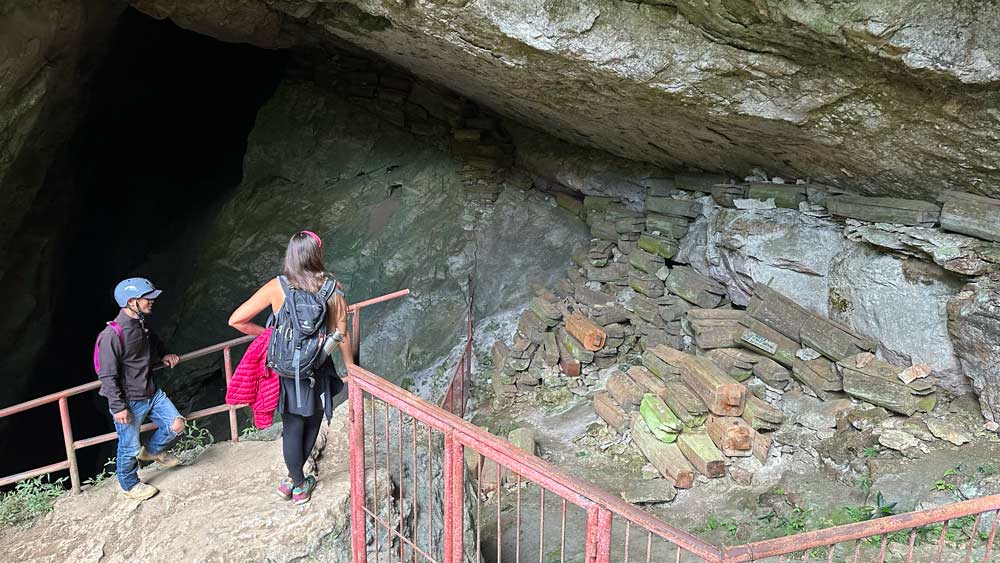
Another interesting spot to see in Sagada is the Lumiang Burial Cave. As the name suggests, it’s a burial place, a cave‑cemetery where you can once again learn a little more about the traditions of this area.
Although you can easily reach the cave entrance on foot or by tricycle, you cannot access it without a guide. We processed the permit and the guide at the tourism office and agreed on a time with him.
Right at the cave entrance you can see a huge wall full of wooden coffins (more than 100 are counted), some of them more than 500 years old. The guide explained that these are usually made from a single log and are placed at the beginning of the cave so that they can receive light and thus prevent evil spirits from disturbing their eternal rest.
The descent takes no more than 5 minutes and the staircase is paved 99% of the way, so there’s not much mystery to it. Going back up is a bit harder, but it’s by no means an issue for a person with normal physical condition.
For the record, it isn’t possible to enter the cave unless you book the “Cave Connection” activity, which we’ll discuss next.
Price: 300 pesos per guide (up to 10 people).
8. Cave Connection
This activity to do in Sagada is only suitable for the bravest and, above all, for those who don’t suffer from claustrophobia. Why? It’s a 3–4 hour route between Sumaging and Lumiang Cave without going to the surface. In other words, you’ll explore the bowels of the earth, passing through gaps that in some cases are quite small and having to jump or climb. Of course, you should be very aware that at any time an insect, spider or bat may appear.
As you can imagine, it is not possible to do it on your own and a guide is required. Everything is organized again at the tourism office, where you can also look for more people to share with to make it cheaper.
We’ll be honest and say that we haven’t done it out of “respect”, but we don’t rule out giving it a go the next time we come here.
Price: 1.900 pesos per group of up to 3 people (1.500 for the guide and 400 for transport).
9. Other rice terraces to see in Sagada
On the trail to Bomod‑ok Falls (including the villages of Aguid and Pide) or on the route between Marlboro Hills and Blue Soil you can admire beautiful rice‑terrace landscapes. However, as this is an area where this cultivation method has been used for centuries, it’s possible to find many more rice fields.
Perhaps the most beautiful are the Kapay‑aw rice terraces, located just before the entrance to Sumaging Cave. As we said, you can admire them from the road, but you can also venture for a walk through the rice fields.
Mt. Polis, south of Sagada, also offers cool views of the rice fields. The ascent takes just 1 hour and no guide is needed. You’ll find the path marked on Google Maps.
By the way, if you like this kind of place, we highly recommend visiting the rice terraces of Banaue and Batad, as well as the nearby ones in Maligcong (a couple of hours from Sagada and 45 minutes from Bontoc).
Kapay-aw Rice Terraces
10. Try Sagada coffee
If you’re a coffee lover like us, you can’t leave Sagada without trying the coffee, especially if you’ve spent the whole trip living on the (horrible) instant coffees they give everywhere. Honestly, for us, it’s the best in the Philippines and here, as you can probably imagine, it’s cheaper than if you try to buy it in other parts of the country.
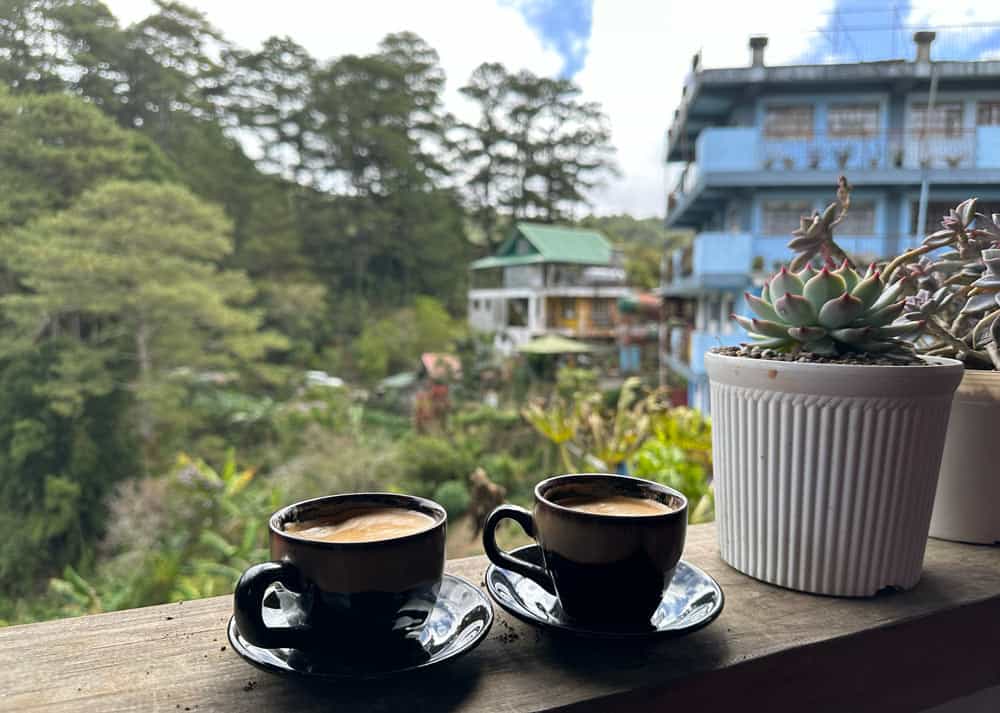
Asking around, we were told that the best one could be found in a little place called Bana’s Coffee and they weren’t lying. We loved it! The place is really cool, as it overlooks the valley and, besides good locally grown coffee, they have hearty breakfasts and lunches at reasonable prices. They also have a shop area where they sell bags of coffee beans or ground coffee that’s truly delicious and that we think is a great way to take the taste of the Philippines home.
They say that the first Arabica coffee plants arrived in the Philippines at the hands of the Spanish and that it was a Catalan, Jaime P. Masferré, married to a native of Sagada, who introduced coffee cultivation in this area of the country. You can snoop a bit more about the curious history of coffee here.
Thanks to Sagada’s climate, it thrives wonderfully and on the hikes you can do around the area (we saw it especially on the one to Bomod-ok Falls) you’ll be able to admire the beautiful coffee plantations.
11. More things to do in Sagada
Although the main things to do in Sagada are the ones we’ve already detailed, if you have more time or feel like doing something different, take a look at these other activities:
- Bokong Falls: the path is much easier than the one to Bomod-ok Falls and starts from the road. It’s perfectly marked on Google Maps. Unless you want to walk quite a bit, it’s best to rent a motorbike or take a tricycle.
- Pongas Falls: a set of two waterfalls south of Sagada, which you reach in about an hour walking from Ankileng village. Entrance is 30 pesos, plus 600 for a guide per group and 650 for the shuttle. You’ll also see some nice rice fields here.
- Nabas-ang-Ampacao: an easy 2–3 hour route through pine forests and grass fields. It’s known for sunrise and sunset views. It costs 1,850 pesos per group of up to 10 people.
- Balangagan Cave: much less known than the previous ones but equally beautiful, and you can also find Igorot coffins. The guide costs 800 pesos per group and the shuttle is 850 pesos. Keep in mind they close in August.
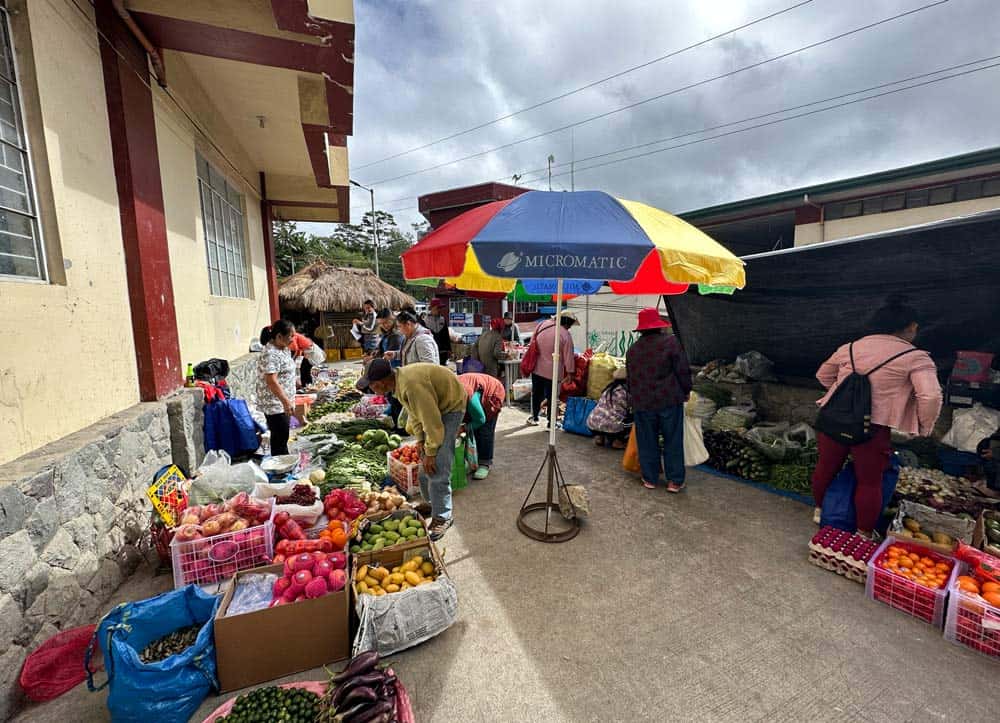
- Sagada Market: Saturdays are market day and it’s interesting to see how people from the surroundings come to sell mainly fruit and vegetables around the tourism office. There are some stalls that also offer typical products from the area. The market starts very early (around 4 in the morning they’re already setting up stalls) and they start taking them down around 11:00 or 12:00.
- Sagada Weaving: throughout the Cordillera region there’s a beautiful tradition of handcrafted textiles from the different tribes that inhabit it and, to be honest, we went to this shop with high expectations, but we found that the products here aren’t very appealing. We liked the things we saw in Baguio or Banaue more. Even so, if you want to snoop around, you can easily walk there from central Sagada.
- Sagada Pottery: although we went encouraged by good reviews, the truth is we passed by and didn’t find it to be anything special. We’ve added it to this Sagada guide in case you’re a fan of crafts and want to have a look at the clay work they do here, but we think the prices are completely exorbitant. You can join a pottery class (paying 200 pesos per group) and make a piece (100 per person plus what’s estimated for the piece). To get there, you’ve got quite a stretch walking uphill, although you can also wait to see if one of the buses heading to Besao (infrequent) passes by and pay just 15 pesos.
- Sagada Underground River: not the best thing to do in Sagada, but you can go explore on your own without a guide. A curious cave with a river running through it. It’s not comparable to the Puerto Princesa Subterranean River.
- Ganduyan Museum: we couldn’t find it open any day, but you might have better luck.
- Masferre Photograph’s: this Catalan documented a good part of the Cordillera tribes during the mid-20th century until he passed away here. Unfortunately, when we went, it was closed, but we were able to see part of his work at the Bontoc Museum. If you find it open, don’t hesitate and go into the gallery. The entrance fee is 100 pesos.
- Picking oranges at Rock Inn and Café: we wouldn’t dedicate much time on our trip to picking oranges, but Filipinos like this activity. The season runs from November to February. Usually you pay an entrance fee and then eat as many oranges as you want, or you pay per kilo picked. It doesn’t really appeal to us.
- Climbing: before reaching the hanging coffins there’s a wall (Paytokan Wall) where you can do this sport, suitable for all levels.
- Ambasing Bus Ruin: on the way to Sumaging Cave there’s this abandoned bus that’s all the rage among Filipinos for taking photos.
- Explore the rice terraces of Maligcong and Bontoc: although we’ll make a guide about this part of the Philippines, it’s possible to take a small excursion from Sagada. Bontoc is about 30–40’ from Sagada and Maligcong is more or less the same from Bontoc, so you’ll need to get up early to link the 2 jeepneys you’ll have to take or rent a motorbike, but we think it’s tremendously worth it. From our perspective, the Maligcong rice terraces have little to envy Banaue’s. The town of Bontoc doesn’t have much, but a walk through the museum and the market won’t take you long and you’ll leave happy.
- Stop by to greet the ultra-famous Whang-od: the Kalinga tattoo artist lives in the village of Buscalan, north of Sagada. You’ll have to invest a day to get there from Sagada, but it might fit if you’re interested. To do so, you’ll first have to take a jeepney to Bontoc and then another to the junction where the road to Buscalan begins. Once there, you’ll need to take a habal-habal (shared motorbike) and then walk for about an hour. It’s possible you won’t be able to see Whang-od until the next day and, due to jeepney schedules, you’ll have to spend the night in one of the houses, which become guesthouses. Since to return to Sagada you’ll have to pass through Bontoc, it actually makes more sense to continue south and from there take a bus to Banaue or Manila—it just depends on how you want to plan it.
Unfortunately, what you can NO longer do in Sagada is go up Mt. Kiltepan (a place that became very famous thanks to the Filipino film That Thing Called Tadhana), since it is now private property and access is not allowed.
Sagada practical information, how to prepare your visit
You’ve already seen all the things to do in Sagada, but here we’re going to tell you what you need so you can plan everything down to the last detail without a hitch:
Where to stay
To be honest, and as we tell you in the guide Best hotels to stay in Sagada, we were very surprised by accommodation prices in Sagada and even more so by their value for money, which, in general, seemed quite poor to us. We believe this may be due to the very sudden increase in Manila tourism and the limited variety of options, especially on weekends, when many tend to hang the “fully booked” sign.
This, together with the fact that many of them are located quite far from each other, makes us think that it’s advisable to go with a reservation already made or that, if there are several of you, one stays in charge of the bags while the other goes around town looking for something decent.
On this occasion, we can’t recommend the place we stayed because the owner may be the most despotic person we’ve met in the Philippines (which is quite unusual), but we can recommend some that we researched on site and that we think are good options for sleeping in Sagada:
- Agape Log Cabin: possibly the best value-for-money accommodation in the area and with that cozy little-cabin atmosphere we love. They have double and quadruple rooms, the former with shared bathrooms but with hot water. Great location, surrounded by restaurants. Prices and dates here.
- BAEY B0GAN Homestay: also one of the cheapest in the area. Rooms are small but cozy and the owner is lovely. It’s also well located and, if you’re traveling solo, you can have a room for yourself from just $10 per night. More info here.
- AJjaa’s Place: clean, spacious, and quiet rooms from $11 per night. The owner is also very nice. A good choice. You can see more by clicking here.
- Sagada Lodging Home: we’re going up in price, but also in quality, and we can already talk about a small hotel with clean, charming rooms. The staff are also very nice. Take a look by clicking here.
- The Shire of Sagada: if you want to treat yourself or you’re a Lord of the Rings fan, stop searching. Although it’s not central, this is surely the most charming hotel to stay in Sagada. Click here for all the info.
By the way, it’s sometimes worth comparing prices on this search engine, which may give you an extra discount.
How to get there
The vast majority of travelers decide to visit Sagada from Manila, although, of course, it’s possible to get here from other parts of northern Luzon such as Baguio, La Union, Bontoc, or Buscalan (to name just a few). Here we give you a few pointers about the different combinations so you can explore this part of the Philippines:
- From Manila: the most direct way is to take one of the Coda Lines buses that leave Cubao at 20:00 and 21:00. The ticket costs between 1,000 and 1,300, depending on the type of bus (the difference is basically whether it has a bathroom or not). They take between 10 and 12 hours to arrive (depending on traffic) and we recommend buying them in advance here. Victory Liner also runs hourly buses from Manila to Baguio between 00:30 and 23:45. They take between 5 and 7 hours. Once in Baguio there are buses to Sagada at 5:30, 7:00, 8:30 (this is the most direct), 10:30, and 13:00 and they take around 6 hours. Keep in mind that these schedules can change at any time and it’s best to reconfirm with the companies.
- From Banaue: in this case, you can hop on the Coda Lines buses, which pass through Banaue around 4:30–5 in the morning and head to Sagada. The price is around 350 pesos and they take about 3 hours. You can’t book online, but Coda Lines has an “office” behind the tourism office. Another option is to take one of the buses or jeepneys that go from Banaue–Bontoc (330 pesos/2.5 hours) and then a jeepney from Bontoc to Sagada (80 pesos/45’). Keep in mind that the latter leave from the so-called Sagada Jeepney Terminal (you’ll find it like that on Google) and you can walk there from where the bus drops you off—Bontoc is small. In any case, it’s better to reconfirm these schedules at the Banaue tourism office.
- From Baguio: buses leave from the Dangwa Bus Terminal and the company that runs the most direct route is GL Trans. Keep in mind that they also have buses to Besao, but we were told at the station that they take a longer way around. As of today, they only operate at 8:30 and the ticket is 300 pesos. You can’t book online. As always, it’s best to go the day before to reconfirm.
- From Bontoc: although you can also arrive with the Coda Lines buses coming from Manila/Banaue, the easiest way will be to go to the Sagada Jeepney Terminal and take one of those heading to Sagada for 80 pesos. They run from sunrise until about 16:00.
- From Buscalan: you’ll have to walk to the main road, take one of the jeepneys or buses to Bontoc (11:00/12:00 and 120 pesos) and then the jeepney to Sagada.
In How to get to Sagada we give you more information.
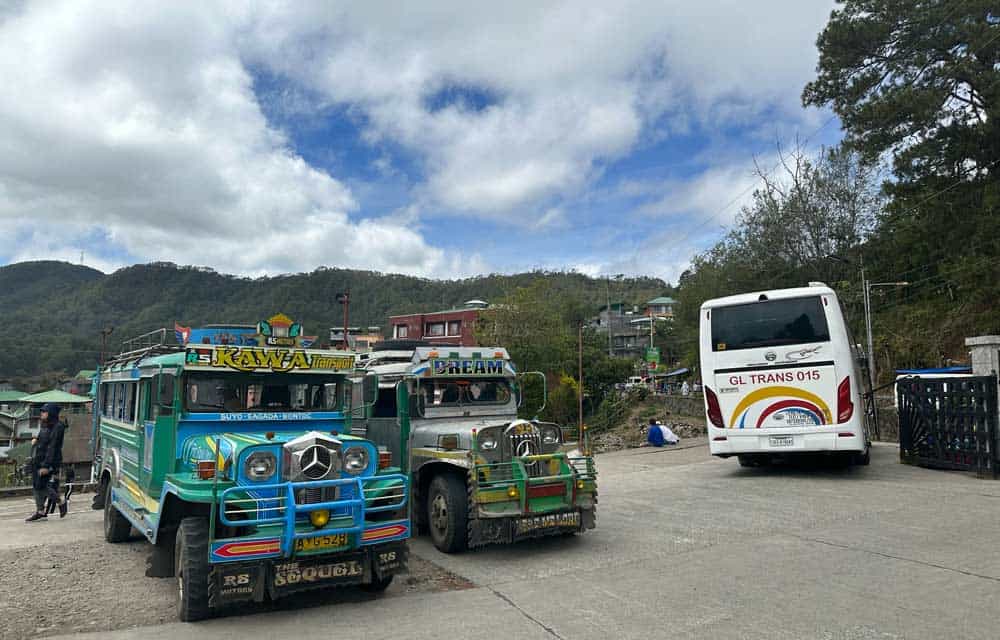
How to get around Sagada
You’ll quickly realize that Sagada is a town quite spread out across the different valleys and hills in the area, its “central” part being the tourism office, the bus station, and the church. Many accommodations are concentrated in this area, but that’s not the case with some restaurants or the starting points of trails or caves.
How to get around? In our case, we used our legs and, occasionally, a tricycle or two, especially for the return journey, as the slopes in Sagada can be “interesting”. Although in many cases you’ll have to bargain, the truth is that the official prices for routes are these.
On the other hand, in some hostels you can find “motorbike for rent” signs. We asked at several and the prices weren’t particularly cheap, around 800 pesos per day (while in other parts of the Philippines it’s possible to rent them from 300 pesos). Therefore, we think it only pays off if you’re going to do several routes on your own.
Where to eat in Sagada
There are more and more places to eat in Sagada and you’ll see that on weekends some even have lines at the door. The reason? Sagada’s leap to the big screen, which has many Filipinos eager to go to the place where “so-and-so” ate the lemon pie or “what’s-his-name” the yogurt with fruit. Seriously, there’s a foodie tourism that left us amazed.
Of all the places we tried (and they weren’t few), here are the ones we liked the most:
- Gaia Café: possibly the most pleasant place to eat in Sagada, with wonderful views of the rice fields. The food is vegetarian/vegan and quite tasty, as well as relatively inexpensive. Note that they take their time preparing dishes, so better go without rushing.
- Bana’s Coffee: if you’re a coffee lover like us, don’t miss it. Good for breakfasts and lunches.
- Yoghurt House: another place that causes a stir, especially on weekends, due to a few appearances in films or on TV. It’s known for its fruit yogurt bowls, but we ate here a couple of times and found the value for money to be quite good, with hearty pasta dishes. If you go on weekend nights, you’ll have to wait a bit. Vegetarian/vegan options.
- Log Cabin: no confusion with the name—you’ll feel like you’ve been transported to a Swiss or Canadian wooden cabin. European–Filipino fusion dishes at a good price, but they only open for dinner and on certain days. On Saturdays there’s usually an all-you-can-eat buffet for 500 pesos per person.
- Masferre Country Inn & Restaurant: after Gaia Café, it’s the nicest restaurant to eat in Sagada, with pretty good pasta and pizza and cold beer. The service is also super friendly. Some vegetarian/vegan options.
- Sagada Lemon Pie House: if yogurt is famous at Yoghurt House, here lemon pies are, for the same reason we mentioned above.
- Food court below Sagada Public Market: if you want something budget-friendly, next to the tourism office, down some stairs, there’s a small food court with several carinderias where you can eat typical dishes for little money.
- PMMD’s Store & Eatery: right in front of the market, it’s a simple eatery that stays open quite late. Don’t expect very elaborate dishes, but it can do in a pinch.
- Sunset View and Pizza Bar: a super popular spot on weekends to watch the sunset and Lake Danum (if it’s clear) while you eat a pizza. To get there, you’ll have to walk uphill for about an hour and a half, rent a motorbike, or negotiate a tricycle.
- Sagada Cellar Door: if you’re into craft beer, this is your spot. They make them with “unusual” ingredients like mango, turmeric, or guava. It’s a bit far from the center (beyond Sagada Pottery), so you’ll also need transport. On Saturdays they usually offer a buffet (550 pesos); otherwise, they basically have grilled sausages and homemade bread. It’s worth going during the day for the scenery or at sunset, when they tend to light a bonfire. Open every day from 16:00 to 22:00 (last entry at 20:00).
- Moon House: if you want a Tanduay-and-cola, this is one of the few places that stay open at night.
Keep in mind that many restaurants in Sagada close early, and when we say early we mean VERY early. Outside weekends we found that some closed at 19:00. Therefore, we recommend not delaying your meal times.
By the way, in Sagada (and more or less the whole Cordillera area) there’s a kind of smoked bacon (specifically, pork cured in salt for about a week and then sun-dried or smoked) that’s all the rage and can be seen in almost all restaurants and markets. It’s called etag and it even has its own festival at the end of January.
In this area there’s also a tradition of making wines from fruits such as blackberries, blueberries, strawberries, or even more exotic ones like pitaya or dragon fruit. We didn’t feel like trying them, but if you want, they sell them at a place called Piitik Wines.
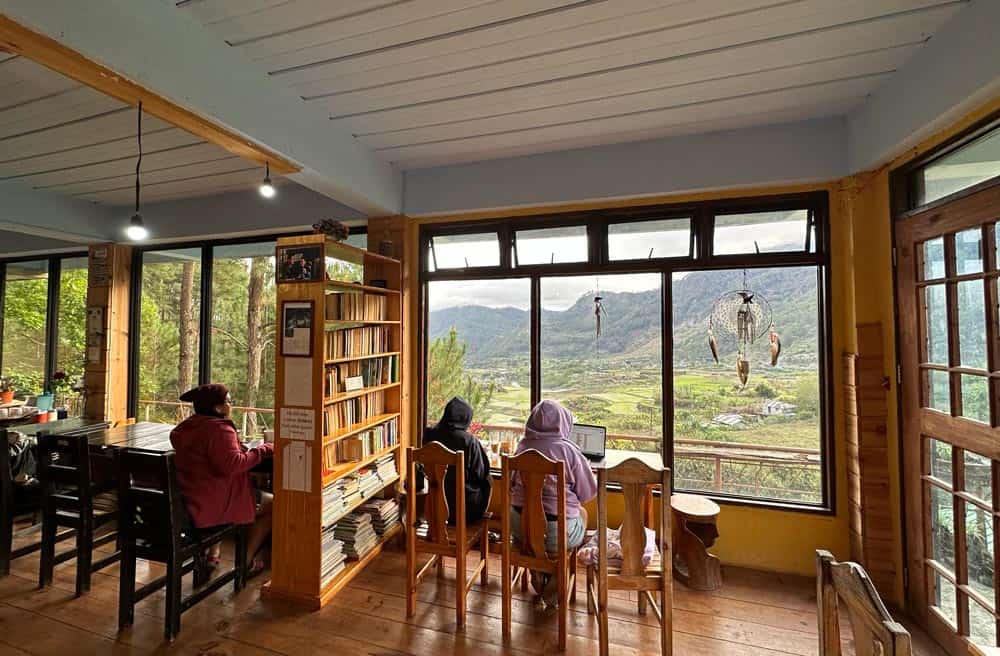
Gaia Cafe Sagada
Best time to visit Sagada
This guide is already getting a little long, but since it’s a destination where nature is paramount, we think it’s important to talk a bit about the best time to visit Sagada. Here are a few pointers:
- November to February: these are the best months because there’s little chance of rain. However, we’d avoid Christmas because more and more Filipinos go and in groups, so it can even get overwhelming. In February it’s often quite windy, although nothing that will keep you from enjoying the trails. Without a doubt, it’s the best time to visit Sagada.
- March and April: the rice fields tend to be greener and it starts getting warmer. It’s also a good time, but avoid Holy Week for the same reason as Christmas.
- May: it’s the hottest month, although in Sagada it’s not as noticeable.
- June–October: there’s a higher risk of rain from late June onwards; there’s even the risk of typhoons (especially in July and August) and, therefore, landslides and flooding. This can cause the caves to close and can also keep you from doing some hikes.
In Sagada it’s also chilly. It’s possibly one of the places where we’ve felt the coldest in the country, especially at night. Average daytime temperatures hover around 20–22°C, but lows can drop to 13°C in January and February, so don’t forget to pack warm clothes.
As we always say, the Philippines has a tropical climate, and this doesn’t mean that in the rainy season it’s going to rain on you and that, therefore, we don’t recommend visiting Sagada. It could be that in the middle of August you get a fantastic month, just to give you an example. If you ask for our opinion/experience, we travel wherever and whenever, and it almost always turns out great. You can read more about this topic in Best time to travel to the Philippines.
Tips for visiting Sagada
Here are some tips from our own experience after visiting Sagada that we think will be helpful:
- As far as possible, avoid weekends and local holidays. Truly, after its appearances in films, many Filipinos want to visit the area and it gets crowded. From our perspective, doing activities like visiting the caves or Marlboro Hills with lots of people around loses some of its charm. The good thing about the weekend is that it’s much easier to find other travelers to share with. Swings and roundabouts.
- When it comes to organizing your activities, be sure to go to the tourism office. You’ll have to register as a visitor first (stating your accommodation) and pay the environmental fees (100 pesos) as soon as you arrive, but they have a system that works very well to save costs. Sign up for the activity you want, leave your phone number, and they’ll call you if someone is interested in sharing. They also give you some very cool maps of the area, which will help you get your bearings.
- Keep the fee slip; they’ll ask for it every time you do an activity.
- Bring warm clothing (it’s the place we’ve felt the coldest in all the Philippines), a rain jacket, and good hiking shoes. Even if it’s cool, don’t forget to use sunscreen—the sun still hits very hard.
- The internet signal in town is fairly stable and accommodations usually have Wi‑Fi. We were able to work without problems with our Globe and Smart SIMs.
- We strongly recommend combining your visit to Sagada with the Maligcong rice terraces in Bontoc and the Banaue and Batad area—you’ll enjoy it a lot and it will make your trip to the Philippines more varied.
- Doing activities with a guide not only helps the community, but it’s your chance to “interrogate” them about their culture. Seriously, it’s super interesting and they don’t mind you “peppering” them with questions.
- Be aware that you won’t be able to pay by card almost anywhere and ATMs are scarce. In fact, there’s only one from a Filipino bank that normally doesn’t accept foreign cards. Forget about banks for exchanging cash here as well. Therefore, we recommend coming well supplied with cash. In Money in the Philippines you’ll find more information about this aspect of your trip.
- Please be very careful when exploring Sagada because if something happens to you, the hospital/clinic at the entrance to town is very basic. If it’s serious, you’ll have to be transferred to Manila. As we always remind you, it’s essential to travel with good travel insurance that will respond when you need it most. We’ve trusted IATI Seguros for more than 10 years and even in the most serious situations it’s gone well for us. With this link you get 5% off your policy and you also help us keep creating travel content.
Sagada map
So you don’t get lost, we’ve made this great map with all the places we’ve mentioned in the Sagada guide:
We hope this Sagada guide has made you curious and that you’ll want to discover other, less beachy corners of the Philippines. In our opinion, it’s a beautiful part of the country where you’ll get a different perspective, as well as being ideal for lovers of hiking and culture. Combine it with other destinations like Bontoc and Banaue and you’ll nail it. If you want, you can also explore other destinations in Luzon such as Vigan, Pagudpud, La Union, Baler, or Mt. Pinatubo, among many others.
You know we’re here for whatever you need: questions, suggestions, contacts… You can leave us a comment below.