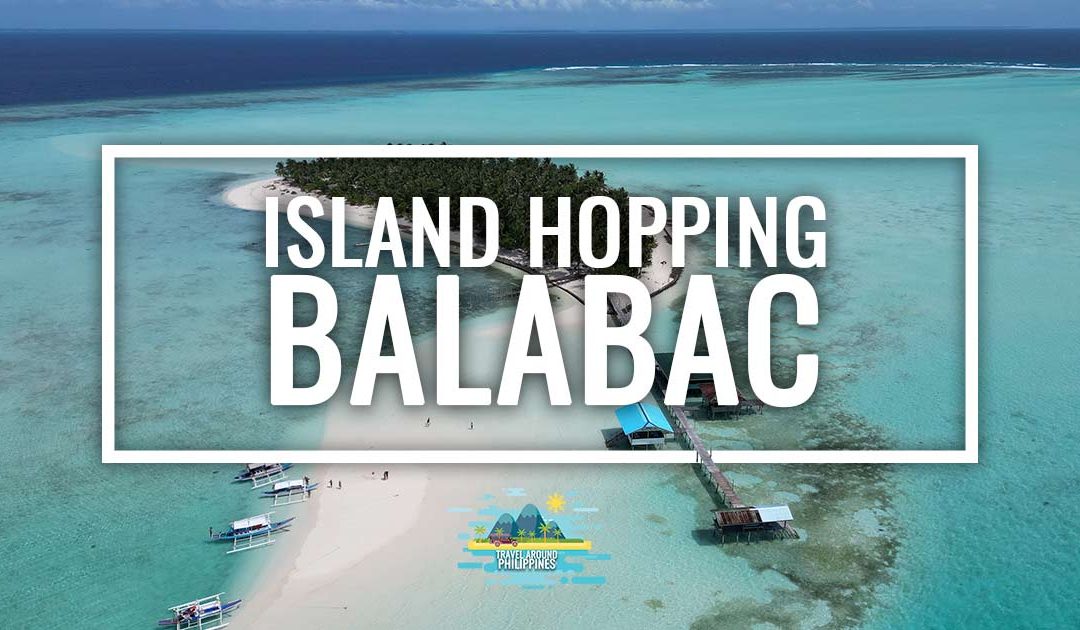
The Philippines, with more than 7,000 islands, is packed with countless places that can turn your trip into an unforgettable adventure. Jaw-dropping beaches, monumental waterfalls, rice terraces thousands of years old, cities with beautiful colonial architecture… You’ll never run out of things to do here.
But if you’ve found your way to this guide, it’s because, like us, you like to go beyond the usual and seek out one-of-a-kind experiences that are still far removed from mass tourism, even if that means devoting more time and giving up certain comforts. Island hopping in Balabac is one of those unforgettable adventures, and in this guide we’re going to cover it in detail so you can experience it for yourself and add it to your list of epic moments in the Philippines.
Ready to set off for this beach paradise? Let’s get started!
Where is Balabac?
Before we start revealing the secrets of this gem that blew us away on our first visit, let’s put it on the map so you know exactly where we are.
The “Balabac island hopping” experience does not necessarily involve visiting Balabac Island (as things stand today, we don’t think there’s any real reason for you to go there), but it takes its name from the municipality and the largest island in the archipelago. It lies in the eastern part of the Sulu Sea (also known as the Jolo Sea), just a handful of miles from the Malaysian border.
The gateway to Balabac is Puerto Princesa, the capital of Palawan Island. It has an international airport and can be reached from other parts of the Philippines and from elsewhere on Palawan itself, such as Port Barton and El Nido. You can read more about getting there in How to Get to Puerto Princesa. From Puerto Princesa, you travel overland to southern Palawan (Buliluyan), where the boats to Balabac depart.
Since this is where the Philippines ends, Balabac is popularly known as “The Last Frontier.” On this map, you can see exactly where it is and find the places we discuss in this guide marked out:
What to expect from island hopping in Balabac and how it works
Tourism infrastructure in this remote part of the Philippines is still light-years behind what you’ll find in the country’s best-known destinations, such as El Nido, which is less than 600 kilometers away. So the first thing you need to understand is that luxuries, restaurants, resorts, and any other tourism business you can think of are few and far between here.
Also, although these kinds of island hopping trips in Balabac have been running for years, don’t expect guides with a wealth of experience working with tourists. We don’t see that as a bad thing at all; we just want to give you a heads-up in case you had the wrong idea. It’s part of the adventure!
One of the great things about this island hopping experience is exactly that: leaving your comfort zone and setting off on an adventure to discover its other—and main—draw: the mind-blowing beaches and places you’ll discover here with practically no one else around. Spits of white sand, beaches with crystal-clear water, and tiny islands of every shape imaginable that see virtually no tourism beyond a small number of local visitors.
Many travelers ask us whether it’s worth visiting only Balabac and skipping places like El Nido or Coron. The question is difficult to answer, to say the least, and the answer will always be full of nuance and personal impressions. As we’ll explain later, we think Onok Island is absolutely incredible and one of the best islands we’ve ever seen (we’ve spent 15 years in the Philippines, to give you an idea).
Island hopping in Balabac is also great fun and offers excellent value for money (at least for now). That said, we should point out that the karst landscapes on the El Nido island hopping tours and the Coron island hopping tours are truly incomparable.
On the other hand, because reaching places like Onok requires a considerable amount of time at sea, you need to bear in mind that boat trips are frequently canceled at certain times of year. So you have to come prepared for anything. We don’t want to discourage you (quite the opposite!), but we do want to warn you that this is a destination where there’s always plenty of room for the unexpected.
If you’re looking for a similar experience but with better services and more qualified staff, we definitely recommend doing the Coron–El Nido Expedition (or vice versa).
With that said, how can you go island hopping in Balabac? At the moment, there are two ways to do it, although, based on our experience in the area, only one of them is worthwhile.
Island hopping from Balabac Island itself
At the moment, we rule it out completely. It means making your own way to Balabac Island, staying in one of its very few, extremely basic guest houses, and taking tours from there. We think it takes more time and effort, saves you very little, and means missing out on the wonderful experience of sleeping on the islands you visit during the island hopping tour. What’s more, given the limited tourist appeal of Balabac Island, we don’t think this option is particularly enticing.
The island will very likely develop its tourism infrastructure over the next few years and the options available may make it a little more worthwhile, but… not today.
Also, since you’ll still have to book tours from Balabac to see the truly beautiful places, and prices will be very high if you’re traveling alone or as a couple, you wouldn’t save much. That said, if there are several of you and you enjoy a good haggle, this option might be worth considering as a way to shave a few pesos off the price. From our perspective, we don’t think it pays off, but we’re not all the same. We always weigh up every alternative and then give you our honest opinion, but that is still just our experience and our opinion.
If you want to do it independently, vans and buses run to Buliluyan Port from Irawan Terminal in Puerto Princesa (5–6 hours). Once there, you have to catch the boat to Balabac, which is supposed to leave at 9:00, costs 500 pesos, and takes a couple of hours.
Island hopping with overnight stays on the islands around Balabac, organized from Puerto Princesa
This is where things get really interesting, because everything is arranged for you and the experience is completely immersive. All you have to do is book the tour in advance and get to Puerto Princesa. They’ll take care of driving you to southern Palawan (by van to Buliluyan Port), taking you island hopping, providing accommodation and food, and, once it’s all over, dropping you back at your hotel in Puerto Princesa. Not only that, a tour like this includes all the fees charged for visiting the different islands, saving you from making payments along the way and having to keep track of extra expenses.
In short, they make everything easy so you can focus on discovering what really brought you here. This is our favorite way to do it and the one we recommend. There are different 2-, 3-, and 4-day packages. In our case, we chose the 4-day, 3-night Balabac Expedition. Packages cost between 11,000 and 14,500 pesos per person (we paid 12,500) and usually include round-trip transportation from Puerto Princesa, island hopping, all meals, water, all entrance fees for the different islands, ecotourism fees, and a guide on the bangka.
As for Balabac island hopping prices, it’s also possible to arrange a private tour. Obviously, this usually costs a little more (around 4,000–5,000 pesos more per person), but it may work out well if there are several of you. This gives you a little more scheduling flexibility, although overcrowding is not something you need to worry about. For now, it’s unlikely you’ll feel as though you’re in a heavily touristed destination, even on a shared tour.
The itinerary they give you before the tour begins is purely a guideline and subject to (many) changes. You’ll most likely visit places that aren’t listed, miss others that are, and do everything in a different order because of weather conditions or private islands opening and closing to visitors. We’d tell you not to worry because, honestly, everything you see will be incredible.
Who should you book the Balabac expedition with?
There are now around 25–30 agencies selling these tours, but far fewer actually operate them on the ground. In other words, they work more or less as “subcontractors.” Unfortunately, as we mentioned, the level of service is still a long way from what you’ll find in other tourist destinations such as El Nido or Coron, so you need to be patient with them and understand that not everything works perfectly.
That said, it’s important to confirm every aspect of the tour carefully: price, included fees, campsite, itineraries, the number of people who usually join the tour, and so on. It took us ages to choose. We also strongly recommend trying to spend at least one night on Onok Island, which is undoubtedly the most beautiful of all the islands you’ll visit.
If you’re interested in doing it this way, feel free to leave us a comment and we’ll email you the details of the company we used and some extra tips.
Also bear in mind that some companies offer a mix of these two options: they arrange a multi-day island hopping tour but take you back to Balabac Island to sleep every night. Having slept on one of the islands visited during the tour, we wouldn’t do it any other way.
Can you book a Balabac tour after arriving in Puerto Princesa? Some travelers think Puerto Princesa is packed with agencies offering tours, as in El Nido or Coron, but that simply isn’t true. Despite being the main gateway to Palawan, it isn’t a tourist destination, and you won’t find people on the street offering you a Balabac expedition. What’s more, the expedition starts in the early hours (pickup from your hotel in Puerto Princesa is between 2 and 3 a.m.), so we recommend arranging everything weeks in advance if possible. Add in the logistics that need coordinating, the need to place you in a group, and the fact that not that many people take these tours, and it’s best to arrange your trip in advance. As we said above, we can help you.

DO YOU LIKE OUR CONTENT? Help us keep the website going.
Keeping this website up to date—from researching routes and trying out accommodations to writing every guide
and answering hundreds of your questions every day—takes time, energy, and more coffee than we’ll admit.
If any of our tips are useful and you’re thinking of getting discounted travel insurance,
booking a hotel, booking your flights, using Remitly, etc., we’d be grateful if you did so through our links.
- You pay exactly the same amount (sometimes even less thanks to our discounts).
- We receive a small commission, which we reinvest so we can continue working,
researching, and publishing free guides. - You get the same price, we can keep creating independent content,
and everyone wins.
Thank you for supporting this project and coming along with us to every corner of the Philippines.
How many days to spend in Balabac
As we’ve already mentioned, we decided to take the 4-day, 3-night Balabac expedition and, to be honest, even though the “beds” weren’t comfortable, we would happily have stayed another day exploring. We therefore think that, at the very least, you should take the 4-day, 3-night tour.
Bear in mind that the tour itself starts at around 2 a.m. on day 1, meaning you’ll need to have arrived in Puerto Princesa the day before. You’ll reach Buliluyan for breakfast and, once you’ve finished, the Balabac island hopping tour itself will begin. In other words, you’ll have days 1, 2, and 3 entirely devoted to visiting islands, and you’ll leave after lunch on day 4. You’ll be back in Puerto Princesa at around 8:00–10:00 p.m.
That said, if you don’t have as much time, the 3-day, 2-night option may leave you satisfied. But make absolutely sure they include Onok Island in your itinerary.
Possible Balabac itinerary
Although we’ve already warned you that routes often change depending on sea conditions, how the day is unfolding, or even what the travelers or crew feel like doing, this is a standard example of what Balabac island hopping companies usually offer:
Day 1
3:00–3:30 a.m.: Hotel pickup / Travel to Buliluyan Port (5-hour journey)
9:30 a.m.–4:30 p.m.: Tour
Places to visit:
- Patawan Island
- Canibungan Island
- Onok Island
- Overnight on Onok Island
Day 2
8:30 a.m.–4:00 p.m.: Tour
Places to visit:
- Giant clam viewing
- Mansalangan (if the tide is low)
- Punta Sebaring
- Overnight at Candaraman Campsite
Day 3
8:00 a.m.–4:00 p.m.: Tour
Places to visit:
- Starfish Sandbar
- Snorkeling at Candaraman
- Timbayan Rock Formation
- Sicsican Island (optional)
- Overnight at Candaraman Campsite
Day 4
7:00 a.m.–1:00 p.m.: Tour
Places to visit:
- Tangkahan Island
- Canimeran Island
- After the tour, return to Buliluyan Port
2:00 p.m.: Departure from Buliluyan Port
8:30 p.m.: Estimated arrival in Puerto Princesa City
By the way, for some time now, most operators have been taking travelers overland to Buliluyan, where you have to catch the public boat to Bancalaan Island (about 1 hour); your boat will then be waiting there to take you island hopping in Balabac.
Best time to visit Balabac
We always start from the premise that the weather in the Philippines isn’t an exact science: it can rain when you least expect it, while the sun can come out at times when statistics would suggest otherwise. Also bear in mind that, because Balabac is closer to Sabah (Malaysia) than to most places in the Philippines, its weather may bear little resemblance to conditions in other areas at the same time, even nearby ones. You could have an entire week of rain in El Nido while the sun is shining in Balabac.
That said, based on the data, the best time to visit is from March to May. At this time of year, you’re far more likely to enjoy the endless, cloudless blue skies you’ve seen in so many photos and, above all, much calmer waters that turn Balabac into a vast, crystal-clear swimming pool. This is crucial here, because rough seas can lead to all boat trips being canceled or routes being changed, which could mean missing the crown jewel, Onok, since the journey to reach it is quite long.
In theory, the traditional European vacation months of July and August aren’t exactly the best time either, since there can be more rain and wind. But, we repeat, this isn’t an exact science and, for example, many of the tours in late July this very year took place under glorious sunshine on a completely flat sea.
Taking all this into account, you can visit Balabac year-round, with the best time being from December to May, when the Habagat (southwest monsoon) winds are weaker.
The Southeast Palawan Coast Guard is the authority responsible for deciding when boats can and cannot sail in these waters. It announces possible closures on its Facebook page.
Islands to visit while island hopping in Balabac
Below, we’ll tell you about the main islands you’ll visit while island hopping in Balabac. Bear in mind that the weather is an extremely important factor here and may cause your itinerary to change. We also took a 4-day, 3-night Balabac tour. If your visit is shorter, the number of islands you visit will vary as well.
As we said, if you need help choosing a Balabac island hopping company, leave us a comment and we’ll send you all the information you need to arrange it.
Patongong Island (also known as Tangkahan Island)
Our first island hopping stop was practically the only one where the sun wasn’t entirely on our side, but even so, it was clear that we had come to the right place.
Patongong Island is covered in palm trees, with fine golden sand and a triangular shape that makes it great for swimming even when strong winds are blowing.

Patawan Island
Although we had already begun to feel the magic of island hopping in Balabac at the first stop, here on Patawan Island it was impossible not to let out the first of many cries of “Woooow!!” From the air, it’s recognizable by its distinctive shape, which reminds everyone of something different. A boomerang, a shark fin, an Among Us character… It doesn’t matter: whatever you see, it’s spectacular. The sand here is already starting to look whiter, the water is spectacular, and if you decide to go snorkeling (masks and fins are available to rent), you’re sure to find a few surprises on the reef just offshore.
This is the island where our tour stopped for lunch on the first day, and we got to chat for a while with the couple who look after it. They manage not only the island but also the small resort that had just opened when we visited. The rooms aren’t exactly cheap, but the spectacular views through the rooms’ sea-facing glass walls are a great excuse to treat yourself. Take a look here: Patawan Island Resort.


Canibugan Island
As you approach the island in your bangka, you begin to make out its unusual shape. It’s one of those incredibly long, narrow islands that you can still cross from one side to the other in just a few steps. As you draw closer, the quality of its water and sand confirms that, yes, your epic Balabac island hopping adventure is still going strong.
Your bangka continues toward the shore and suddenly… wait, what? You realize that palm trees don’t rule the roost here as they do on 99% of the country’s beaches because this island is full of something that’s hard to find in the Philippines: pine trees! Coming from another part of the world, you may not find them quite so striking, but Filipino tourists certainly do; the same goes for the swing that’s perfect for Instagram photos.


Starfish Sandbar
One of the most famous sandbars on this island hopping tour is Starfish, and its name already gives you a clue about what awaits you there. This sandbar, which changes in size and shape depending on when you visit, is often frequented by horned sea stars, the familiar starfish found in many parts of the Philippines that look as though their bodies are studded with chocolate chips. Please respect these animals and do not touch them under any circumstances. You could injure or kill them. If you want a photo, take it with an underwater camera while they remain in their natural habitat.
As you probably already know, the appearance and depth of sandbars change completely with the rise and fall of the tides. Before your island hopping tour, we recommend checking the tide table for the days ahead and making sure you visit Starfish at low tide (or as close to low tide as possible). Our guides, for example, wanted to take us to the next sandbar at high tide. Because we had this information, we pushed them to adjust the visit to a time when the tide was lower. It makes a huge difference to the experience!

Travel safely in Balabac
We always stress the enormous importance of having the best travel insurance for the Philippines, and this recommendation makes even more sense at this destination. Balabac is one of those once-in-a-lifetime experiences, and you want to enjoy it knowing that, if anything happens, you’re in the best hands. From health problems such as bites from disease-carrying mosquitoes or cuts caused by coral while snorkeling to incidents involving your transportation or luggage, the policy we’ve spent years using covers all of that and much more.
It has saved us more than $35,000, and you can get it here with a discount for coming through us:

Onok Island
The crown jewel. What the Eiffel Tower is to Paris, Onok Island is to Balabac island hopping: its most iconic place. For many, it’s the main reason to come here, and some even consider it the best island in the Philippines. We’ve spent more than 15 years truly exploring the country and have seen so many islands that it’s now hard for us to pick just one, but this one unquestionably shot straight onto our list of favorites.
Onok is outrageously beautiful. White sand, crystal-clear water, palm trees, sandbars that let you almost “walk on water”… Everything you expect from an idyllic island, turned all the way up—a marvel of nature.

The bangka docks in very shallow water, and right in front of you is the legendary walkway featured in one of the island’s most sought-after photos. On that same walkway, you’ll find a couple of huts. One is semi-open and is where tours usually stop for lunch; the other is the most coveted accommodation in Balabac. Sleeping there (we’ll tell you more about it later) gives you the unique opportunity to have this paradise to yourself at sunrise and sunset. Many companies offering this island hopping trip include this option, but it can be difficult to secure because there are only a few spots, demand is high, and the owner (a Filipino politician, as is the case with the owners of many islands in the area) can close it at any time to host a private event.
Our favorite area is opposite the huts, on the other side of the island. The first time we visited Onok, most people didn’t make it that far, and we were alone for most of the time. What’s more, it’s the most beautiful area for swimming.

Something we weren’t expecting at all and hadn’t read about anywhere was the huge number of turtles that come close to shore. We first saw them from the walkway connecting the huts, but hours later we spotted several more from the beach on the opposite side. It was magical!
Entrance to the different islands on the island hopping tour usually costs between 100 and 150 pesos, while entering Balabac costs 1,500 pesos. If you stay overnight, another 500 pesos is added to the bill.
Candaraman Island
People who decide to stay on Balabac’s main island and take trips from there to different islands don’t usually make it to the “good side” of Candaraman Island, settling instead for a visit to a rather unremarkable beach.
In our case, Candaraman was our base for three nights, and that gave us the opportunity to visit the beach in its southwestern corner, a perfect place to end the day as the sun is about to set.
An airstrip for small planes is being built on the opposite side of the island. We’ll be watching closely to see how the opening of the area to air travel progresses. Some people are worried about how the opening of hotels and resorts might affect it, while others see it as an opportunity to make island hopping in Balabac accessible to more people and, in turn, bring more amenities.

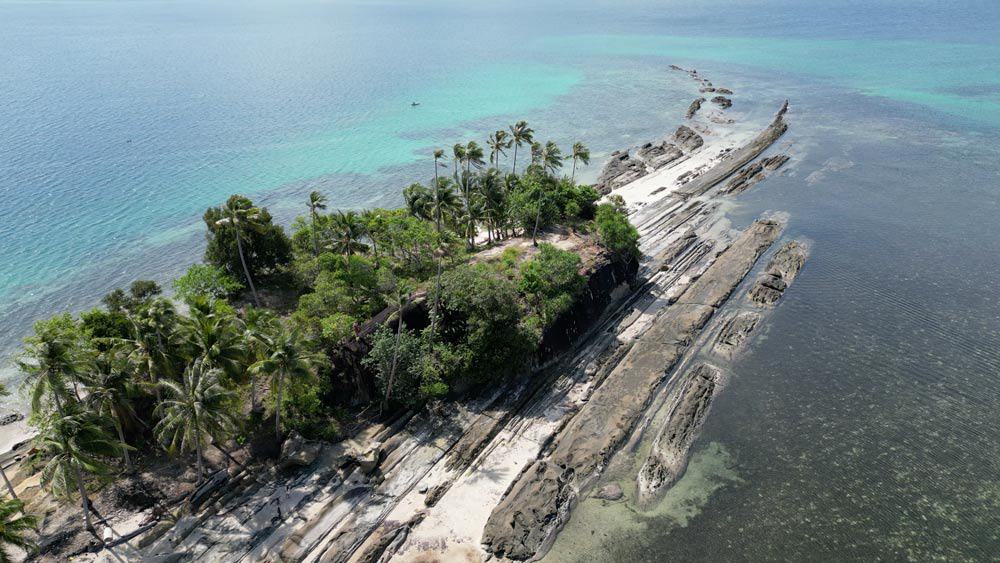
Timbayan Rock Formation
Although our stop at Timbayan was interesting, it was perhaps the one that impressed us least on the entire Balabac island hopping route. The main attraction is seeing the large, unusual rock formation at the end of the island.
Although the beach is quite decent on both sides of the rocks and we insisted on going for a swim, we were repeatedly told we couldn’t because it wasn’t safe. As we explain in the safety section of the Balabac Guide, the main island is home to saltwater crocodiles that terrify many locals. Given how close Timbayan is to the main island, that’s probably why you can’t swim here at the moment. In fact… If you look at the photos of this place on Google Maps, you’ll see a dead crocodile on the rocks.
In any case, even though it wasn’t our favorite place, it was a bonus stop we were glad to have made. We also found the journey through the channel between Balabac Island and Ramos Island very picturesque. It’s packed with mangroves and stilt houses.
Sicsican Island
Onok Island is our favorite island on this tour, hands down. But when it comes to beach time and snorkeling, don’t overlook Sicsican (also known as Caxisigan Island). We stopped on the west side of the island and then crossed the interior to the east coast, where one of the camps used by the different tour companies is located. We basically went there to eat in one of the huts, and once we had finished, we were given some free time. The rest of the group stayed on that same side in front of the camp, but we went back to where the bangka had dropped us off and had the beach all to ourselves.
We were perfectly happy enjoying the fine sand and the shade of the palm trees, and just when we thought it couldn’t get any better, we discovered its incredible underwater world. Just a few yards from shore in very shallow water, you’ll find countless corals in every color alongside fish of all sizes. You can’t miss it!

Secret Reef
We don’t know whether the name was made up, but one of the stops on our island hopping trip was the reef between Candaraman and Sicsican. Although we may have preferred the reef off the latter island, since it was shallower and easier to explore, you won’t regret jumping into the water here because we really did see very healthy coral and plenty of marine life.
Mansalangan Sandbar
Starfish Island’s big sister is far from the main area where the other stops are located and is usually visited at the beginning or end of the tour because of how long it takes to get there.
As we mentioned with the first sandbar, it’s very important to time your visit here for low tide. At high tide, you’ll see absolutely nothing and will simply walk through a vast flooded area where the water reaches your hips in some places. If, on the other hand, you manage to arrive at low tide, you’ll have the chance to see the sandbar that emerges, stretching more than a kilometer and a half. A spectacular place if you go at the right time.

Canimeran Island
This was the final island on our Balabac expedition, and we honestly weren’t expecting much more than a place to eat before heading to Buliluyan Port and then starting the journey back to Puerto Princesa.
The first thing that caught our attention was the small group of peacocks that live and wander around the island. Then, after crossing to the other side, we found an incredibly inviting beach with sand that took on a faint pink hue when the sun came out and lovely, calm turquoise waters that gave us a spectacular send-off from Balabac. It also had an “apocalyptic” feel with so many fallen palm trees. One of the best beaches? We wouldn’t rule it out.

Where to stay in Balabac
We’ve already mentioned that tourism services in this archipelago are still light-years behind those in other parts of the country, not only in quality but also in quantity. In part, that’s what makes it possible to visit Balabac without running into hundreds of other travelers.
If you choose a multi-day Balabac Expedition, you’ll sleep at the following camps, depending on the agency you book with and availability at the time:
Candaraman Campsite
This is a very basic, no-frills campsite used by several expedition companies. Ours has one main hut containing five rooms separated by nipa walls, each with a mattress on the floor and a ceiling light shared with the room next door. Zero luxuries. You can also sleep in a tent.
The bathroom area is even less luxurious. You’ll find two bathrooms where, in addition to answering nature’s call, you can shower using buckets of room-temperature water. For meals, there’s a shelter with a large table where breakfast and dinner are served. That is also where you can charge your devices from 6:00 p.m. onward.
One of its strong points is the direction it faces, which lets you enjoy the sunset from the beach. This camp has an enormous amount of potential, but it’s fairly neglected; with a couple of improvements, it could be a much better place.
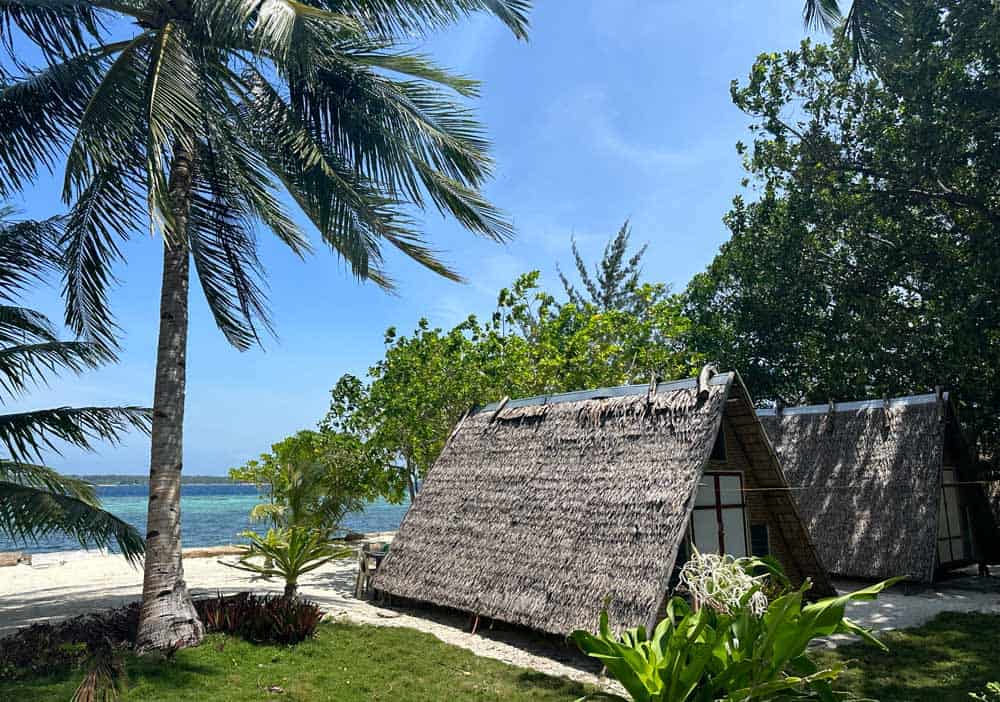
Sicsican Campsite
At the moment, this is the best-managed campsite, both in terms of cleanliness and the attention paid to decorative details. The main hut also has a small store with a refrigerator (something you won’t see often during the trip), where you can buy snacks and genuinely cold drinks. Interestingly, much of what is sold here is made in Malaysia because the country is so close.
The rooms are small triangular cabins that offer more privacy than those at Candaraman, and the bathrooms are more appealing in every respect too. They also have tents.
Onok Island Campsite
Without a doubt, enjoying sunset and sunrise on Onok Island and having the island practically to yourself for so many hours is what makes this the most sought-after accommodation.
The floating huts contain rooms with several mattresses, a tiny bathroom, a small refrigerator, and an area where you can charge electronic devices (from 6:00 to 10:30 p.m.). You can also sleep in a tent on the island itself or in one of the domes or igloos that were recently set up (things are changing at breakneck speed in Balabac).
Bear in mind that sleeping here costs an extra 500 pesos, that it isn’t easy to arrange unless you book well in advance, and that even then, a last-minute private event or rough seas may prevent you from doing it. In our case, sleeping here was included in the price of the expedition, but unfortunately, we ultimately couldn’t stay. We’ll make up for it!
Punta Sebaring Campsite (Bugsuk Island)
Despite being quite far away (a couple of hours by boat from Candaraman/Sicsican and even farther from Balabac Island), this is one of the usual stops on Balabac island hopping tours. In our case, although it was included in the itinerary, we didn’t get to visit because of the rough seas. It is usually visited after Mansalangan Sandbar, which lies more or less on the way.
Since we haven’t visited, we can’t tell you much, but we were told it has a very beautiful beach, although unfortunately there are quite a few sandflies or nik nik. We’ve included it here because one Balabac expedition operator has its camp there. Please let us know what you think if you visit.
Sleeping on Balabac Island
If you choose to stay on Balabac Island, either because you plan to take day trips from there or because the company running your island hopping tour doesn’t offer overnight stays on other islands, options are limited and mostly very simple:
– Sing & Swing (also known as JD Lodge): Extremely simple accommodation like the kind you’ll find in many places in the Philippines. Rooms with private bathrooms and old air-conditioning units, plus a 6- to 8-person dormitory with a fan. Bare-bones but acceptable given what the area currently offers. A room costs 1,000 pesos and can’t be booked online, but you can contact them at this number: +639399377948 or reach out on Facebook.
– Marloe Lodging House: A basic Filipino setup very similar to the previous option. There aren’t many differences, but it’s a little cleaner and tidier. You can inquire on Facebook.
– Batalla’s Lodging House: One of the island’s newer hostels, with modern air-conditioning units, but also a bit more “pricey.” A double room costs 1,500 pesos per night. You can book by phone (+63 9085505823) or by sending a message on Facebook.
– Balabac Eco Resort: Travelers tell us that the service is mediocre. However, it offers geometric “dome” rooms with air conditioning, a beautiful private beach, a speedboat for reaching the different islands in no time, and high-speed Wi-Fi via Starlink… A future magnet for Honeymoons in the Philippines. Take a look here: Balabac Eco Resort.
Useful tips for island hopping in Balabac
Now that we’ve told you everything you need to know about what to expect on a Balabac expedition, we want to wrap up this guide with a few tips that will make your experience even better:
Wet luggage: The bangkas used for island hopping in Balabac are small compared with those typically found on expeditions from Coron to El Nido or Coron to Coron. Add the fact that much of this adventure takes place on the open sea, and you should assume that you’ll get wet and that water will get into the boat. You may then wonder, “What should I do with my luggage?” Our recommendation is to take only the bare minimum to Balabac and leave the rest of your belongings in Puerto Princesa.
We’ve been staying at Golden Pension for years, a centrally located hotel run by an incredibly kind family. If you stay there, you can leave your belongings in their care without any worries. Among many other things, we left our two laptops there, and everything was exactly as we had left it when we returned. Not only that, they’ll take you to and pick you up from Puerto Princesa Airport for free. Take a look and book here: Golden Pension prices and availability in Puerto Princesa.
By the way, although we don’t want this to turn into a race for seats, the driest spot on the boat is the area closest to the captain. Seriously, there were moments when waves came right over the side of the boat, and this is where you’ll get splashed the least.
Cell service: Cell service here is completely unreliable. If you need to make a video call or take care of something online, this isn’t the right place. In places like Canimeran, you’ll see the cell tower in the distance and receive the odd WhatsApp message every few hours, while in others, such as Onok Island, we managed to send a few videos despite being in the middle of nowhere. Smart seemed to work better than Globe, but the difference wasn’t especially noticeable.
Money: There are no ATMs on any of the islands, including Balabac itself. Bring enough money to cover your expenses. If you take an expedition like ours, all you’ll need is a few pesos for drinks other than the included water (and to tip your guides if you feel it’s appropriate). Otherwise, you’ll also have to pay fees and excursion costs. We paid for the expedition on-site before it started, in cash.
Nik-nik: Although this isn’t the part of the Philippines where you’ll encounter the most sandflies, you may run into annoying sandflies on some of the islands—those tiny bugs that seem harmless while you’re on the beach but make their presence felt the next day when everything starts itching. If you’re someone who attracts them or reacts strongly to their bites, remember to apply a layer of coconut oil to keep them away.
Food: If you join one of the Balabac expeditions, all food is included from the moment they pick you up until they drop you back in Puerto Princesa. Drinking water is included too. You can still buy drinks at the camps, including the occasional beer. If you have an allergy/intolerance or are vegan or vegetarian, we recommend letting them know before booking and again when you reach the camp, where you’ll eat most of your meals. They’ll accommodate you, although you shouldn’t expect major adjustments. Otherwise, meals are usually fairly generous and sometimes include fresh seafood. If you can bring a few snacks from Puerto, you may be grateful for them at some point.
What to bring: Our comprehensive What to Bring to the Philippines guide already contains plenty of ideas about what may also prove useful while island hopping in Balabac. Some of our essentials are:
- Dry bag: It will be your best friend when waves keep coming over the side of your bangka and you want to keep things like your passport, camera, or drone safely protected. You can buy one in some places in the Philippines, but if you want to bring one from home, take a look at this: Dry bag for traveling [affiliate link].
- Power bank: Electricity at the expedition camps is limited to certain hours of the day, and when you’re visiting the islands, you’ll probably use up a lot of your phone’s battery capturing this paradise in hundreds of photos and videos. If you don’t want to run out of power, an external battery like this one can be extremely useful: Power bank for traveling [affiliate link].
- Power strip: You may not need this, but we thought we’d mention it. We travel with cameras, drones, phones, power banks, computers… It would be unfair to take up every available outlet in the camps’ common areas, so we always bring our “cube power strip.” We use just one outlet but can charge everything at once and even share it with other travelers. This is the one we use: Cube outlet with USB [affiliate link].
- Mosquito repellent: Another essential you shouldn’t be without. You can buy the classic OFF! mosquito repellent at any sari-sari store.
- Snorkel and mask: You already know that we always recommend traveling with your own snorkeling gear. It’s more hygienic, the equipment will be of much higher quality, you’ll save money, and it doesn’t take up much room in your backpack. This is the set we’ve been using for years: Quality snorkeling gear [affiliate link].
- Reusable steel bottle: Another thing we’ve traveled with for years. It’s perfect for keeping water cool in the middle of a hot day, and you can refill it for free throughout the Philippines without having to buy bottles that create plastic waste. This is the one we use now, and we’re extremely happy with it: Good reusable bottle [affiliate link].
- Sunscreen: You’ll be captivated by the beauty of the place, and the sun is intense even on cloudy days. Don’t forget to bring sunscreen, or you’ll regret it the next day when you’re sunburned. Please choose one that isn’t harmful to coral or marine animals, such as this: Eco-friendly sunscreen [affiliate link].
- Clothing: We won’t go into much detail here because swimwear is obviously the key item. But we do want to recommend bringing something warm in case you get bad weather or the temperature drops at night. Better safe than sorry!
- Motion sickness medication (with caffeine): if you don’t bring it from home, you can buy Bonamine at any pharmacy in the Philippines. It makes you drowsy but is effective if you get very seasick on boats. Some journeys may feel long, so taking half a tablet could be helpful.
- Shampoo/soap: they won’t provide either, and you won’t find either there. It sounds basic, but it’s best not to forget.
Travel insurance: We wouldn’t dream of traveling anywhere in the Philippines without it, and especially not here. A cut caused by coral, food that doesn’t agree with you, a bite from a disease-carrying mosquito… you don’t want to end up stranded in Balabac. We’ve been using this travel insurance for the Philippines for years (you already know it saved us more than $35,000 in Manila), and you’ll also receive a 5% discount if you get it by clicking here.

Frequently asked questions about Balabac in the Philippines
To wrap up, we want to answer the most common questions we receive from travelers who want to visit Balabac:
Is Balabac dangerous?
Not at all. It has a bad reputation because piracy was an issue many years ago, but it is now just another tourist destination in the Philippines, and you have nothing to worry about. Filipinos are also afraid of saltwater sharks, but there are hardly any, and if there are any, they’re in remote parts of the area. There have been no cases of tourists being attacked and, honestly, we would find it extremely strange if one occurred.
How do you get to Balabac?
You can travel independently from Puerto Princesa to Buliluyan Port and catch the boat to Balabac there, but the truly beautiful places aren’t on Balabac Island itself; they’re on the surrounding islands. That’s why it’s much better to arrange a trip departing from Puerto Princesa, so you don’t have to worry about a thing. This also means you’ll sleep on uninhabited islands, which is much more interesting.
Can you visit Balabac independently?
As we said, you can travel to Balabac Island and book day tours there, but unless there are several of you, it usually isn’t cost-effective, and Balabac town isn’t especially beautiful either. For this reason, it’s much better to take an organized tour from Puerto Princesa that includes all transportation, meals, fees, and trips around the islands. It won’t cost you more, and it’s more convenient. If you’d like, we can give you the contact details.
What is the best time to visit Balabac?
The sea will be calmer from March to May, when the chances of rain and tour cancellations are also lower. That said, you can visit Balabac year-round. If you can go between December and May, even better.
How many days should you spend in Balabac?
Based on our experience, the best option is the 4-day, 3-night Balabac tour. If you don’t have that much time, take at least the 3-day, 2-night tour. And, if you can, spend one of the nights on Onok Island.
All set to enjoy island hopping in Balabac? You’ll love it! If you have any questions or want more information, feel free to leave us a comment below and we’ll be happy to help.