What to do in Legazpi (Philippines) has a very clear answer: to see one of the most spectacular volcanoes in the Philippines (if not the most), Mayon. Granted, we’re not impartial, but having stood before Fuji in Japan and plenty more around the globe, Mayon is the one that has impressed us the most to date, and enjoying it the way we did was a dream come true. So, without a moment’s doubt, it went straight to the top of our list of things to do in the Philippines.
With its 2.462 meters above sea level and perfect conical shape, it’s one of the most active volcanoes in the Philippines and you can see it from all over Legazpi in such a striking way that it leaves you in awe. Whether you’re in love with volcanoes like we are or you’re crazy about this kind of landscape, here we’re going to tell you everything you can see and do in Legazpi, Mayon and beyond. Let’s get started!
Where is Legazpi?
Legazpi is located 527 kilometers southeast of Manila, both cities on the same island, the huge Luzon. It is the capital of Albay province and the Bicol region. The city center is just 10 kilometers from Mayon.
It has a modern airport inaugurated in October 2021: Bicol International Airport, also known as Daraga Airport. In addition, it also has a relatively large buses/vans/jeepneys station located next to one of the city’s huge shopping malls, SM City. If you look a little at the map, you’ll see there also used to be a train coming from Manila. Although many political programs have talked about reactivating this line, the truth is that it will still take quite a while.
What to expect from Legazpi and why go
Before we start telling you everything you can see in Legazpi, we want you to get an idea of what you’ll find there so you can see if it matches what you’re looking for during your trip to the Philippines.
To sum it up a bit: Legazpi = Mayon. Yes, what we all come looking for is to enjoy, from very close, the silhouette of one of the most perfect volcanoes in the world, and you’ll see it from everywhere in Legazpi because it’s just a few kilometers from the city and also from the sea, making it a natural spectacle from almost any angle.
Visiting Legazpi translates into admiring the volcano from different viewpoints, although there are also a few complementary activities such as the famous ATVs or quads, waterfalls, or Bicolano cuisine, one of the most renowned (and spiciest) in the Philippines.
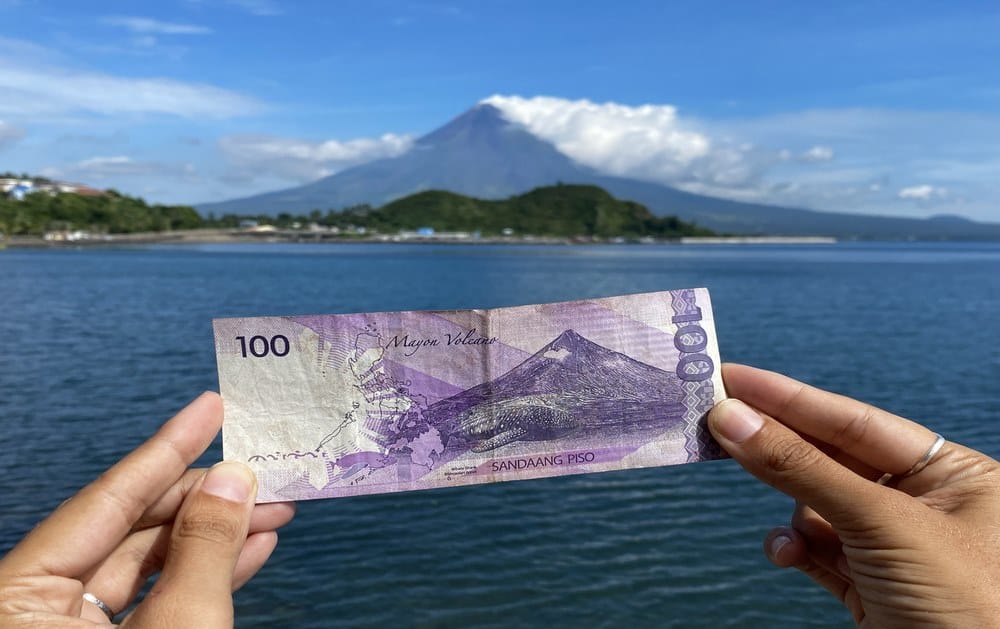
On the other hand, although Mayon is famous enough to appear on the 100‑peso bills, it is not a very well‑known destination among foreign tourists. Many Filipinos come here, but in almost the entire week we spent exploring the area, we barely crossed paths with 5 or 6 international travelers. Therefore, it’s a destination you’ll like if you’re looking for an off‑the‑beaten‑path experience and want to feel a bit like an explorer.
Finally, we can’t forget Donsol, a top destination for lovers of the underwater world. Located just 75 minutes from Legazpi City, it is one of the best‑known places to see whale sharks in the Philippines in an ethical way. Therefore, combining Legazpi with Donsol between the months of November and May is a good idea, since it’s not only the dry season but also whale‑shark sighting season.
BONUS: And, without going on too long, if you want to keep exploring the east of the Philippines, Legazpi can be a good starting point to explore Caramoan. This is where Survivor-style shows are filmed and it’s like a small El Nido but without tourists. You can read all about it in our Caramoan Guide.
Why is it called Legazpi? If you’re Spanish, you’ve surely heard this name more than once. It is named in honor of Miguel López de Legazpi, an important figure in the history of the Philippines and of Spain. A 16th‑century Spanish admiral and the “founder” of Manila and Cebu. If this topic interests you, spend a little time at the Legazpi Museum in the heart of the city.
The Mayon Volcano
Mayon is a stratovolcano and the most active of the volcanoes in the Philippines. Since records began, it seems to have erupted more than 50 times in the last 500 years, some of them quite destructive. The last significant one was in 2018, when lava could be seen descending from the crater, and as of today (December 2022) it is at alert level 2, with gas emissions and what could be described as a glow in the crater.
Legend has it that Daragang Magayon was a beautiful princess who fell in love with a tribal chief named Panganoron, and that a jealous Pagtuga, an Iriga chief who was madly in love with her, started a war to win her love. In the battle both Pagtuga and Panganoron perished, and Magayon, upon seeing an arrow kill her beloved, decided to take her own life. The princess’s father buried the lovers in a place where, little by little, the volcano we can see today was formed.
Related to the above, Mayon’s perfect cone makes it one of the most beautiful volcanoes in the world and, in fact, its name seems to come from the Bicolano word “magayon,” which means beautiful. In addition, Legazpi’s most important festival is the Magayon Festival, which takes place over two weeks, usually starting in mid‑February.
On the other hand, it is a very sacred place in Philippine mythology. According to the Bicolanos, Gugurang, the god of good, lived inside Mayon, while Asuang, the god of evil, lived on Mount Malinao. The former controlled fire and the latter controlled people.
Legends and myths aside, enjoying this volcano from every angle is truly wonderful. In addition to the different viewpoints we’ll tell you about in this list of places to see in Legazpi, riding your motorbike and discovering different perspectives is absolutely mind‑blowing. We’re volcano lovers, so a tear or two fell when we saw this majesty in front of us.
IMPORTANT: Mayon Volcano is still a fairly high mountain that attracts clouds. There are days when it remains completely clear, but it’s common for it to be covered and uncovered throughout the day, as the Philippines also has a tropical climate that favors this. Even so, even in the rainy season, it’s quite normal for it to be clear at sunrise and sunset. So make the most of these times of day if you can—set that alarm!

Can you climb Mayon Volcano?
Due to volcanic activity, since 2013 it has not been permitted to go up to the summit. However, as far as we know, depending on the alert level (you can check here or go to PHIVOLCS on Ligñon Hill), you can reach Camp 2 (you can clearly see the route on Maps.me) and even a little further, to a point called “Rabbit’s Ear” via the Lidong Trail, at about 1,800 meters in elevation. You can get an idea of what the hike is like in this video.
Since we’re not experts on this, we advise you to ask around a lot beforehand and only venture into something like this if you have experience and knowledge of the route. We met one of the people in charge of rescues on Mayon, and he told us how often people get lost in these lands.
How many days do you need to visit Legazpi and suggested route
While for other places we have it crystal clear, it’s harder for us to tell you how many days to devote to visiting Legazpi. The reason? The weather plays a key role here, since the main attraction is a volcano that, like many others, attracts clouds as the day goes on and can be a bit elusive.
The main places to see in Legazpi can be covered in one intense day, although it would be much better to devote at least two. However, to be cautious because of the weather, we might give it three. If you also want to go to Donsol and try your luck with whale sharks (in season) or do other dives, set aside at least four full days for the area.
Something important when designing a route around Legazpi and its surroundings is that distances can feel very long, especially on a scooter, so the places to visit throughout a day will depend on personal preference and also on the weather. However, if you ask us, we would do something like this:
- Day 1: Cagsawa Ruins, Sumlang Lake, Black Lava, Quitinday Hills, and Legazpi Boulevard/Highlands Park.
- Day 2: ATV to Green Lava or Black Lava, Vera Falls, and Mayon Skyline Viewdeck (if it’s clear). Sunset at Legazpi Boulevard/Highlands Park.
- Day 3: Donsol.
Since Mayon is usually perfect first thing in the morning and at sunset, we recommend dedicating 3 full days (not counting transport) and getting up veeeery early.
Travel safely in Legazpi
This amazing destination awaits you with all kinds of adventures—waterfalls, treks, diving, quad routes… For this reason (and from our own experience) it’s more than advisable to have travel insurance for the Philippines to make sure that if something happens you’re covered. It has saved us more than once, from motorbike accidents to serious illnesses, and we can’t imagine visiting the country without it.
In Travel Insurance for the Philippines we tell you the reasons and which one is most recommended. But if you want to get it right now with a 5% discount for coming from us, simply click this image and it’s yours:

Things to do in Legazpi
With all of the above said, let’s get down to business and tell you everything you can see and do in Legazpi, Philippines.
1. Cagsawa Ruins Park, the postcard view to see in Legazpi
Without going too deep into the history—there’s plenty of that in Legazpi—the Cagsawa Ruins with Mayon Volcano in the background make up one of the most iconic images of the Philippines. Located about 6 kilometers from the center and 11 from the volcano’s summit, these are the ruins of a church that was first built in the 16th century, destroyed by Dutch pirates, and rebuilt by the Franciscans in the 18th century. However, it was destroyed again by the 1814 eruption and abandoned.
Today a small park has been built around it where (very much in Filipino style) there are big letters to take photos with the volcano, a few stalls for a drink, and, above all, around the entrance, lots of places to hire ATV (all‑terrain vehicle) rides—what we know as a quad. We’ll talk more about this later.
How to get to the Cagsawa Ruins? We did it by motorbike (if you want to rent one, we can pass you a contact if you tell us below in the comments), but you can also take any jeepney heading to Camalig, Guinobatan, or Polangui (about 10 pesos). These will drop you at the junction of the road that goes into the ruins. From here you can walk (5–10 minutes) or negotiate a tricycle.
Price: 20 pesos per person.

2. Get close to the Black Lava (and be blown away)
For us this was a real discovery because we had understood that you could only access this spot by ATV, and we ended up arriving with our own motorbike after visiting the Cagsawa Ruins and Sumlang Lake. Thanks to the construction of a new and very wide road that goes around the volcano (even if it doesn’t yet appear on GoogleMaps), getting there is as simple as parking your bike and walking just 5 minutes.
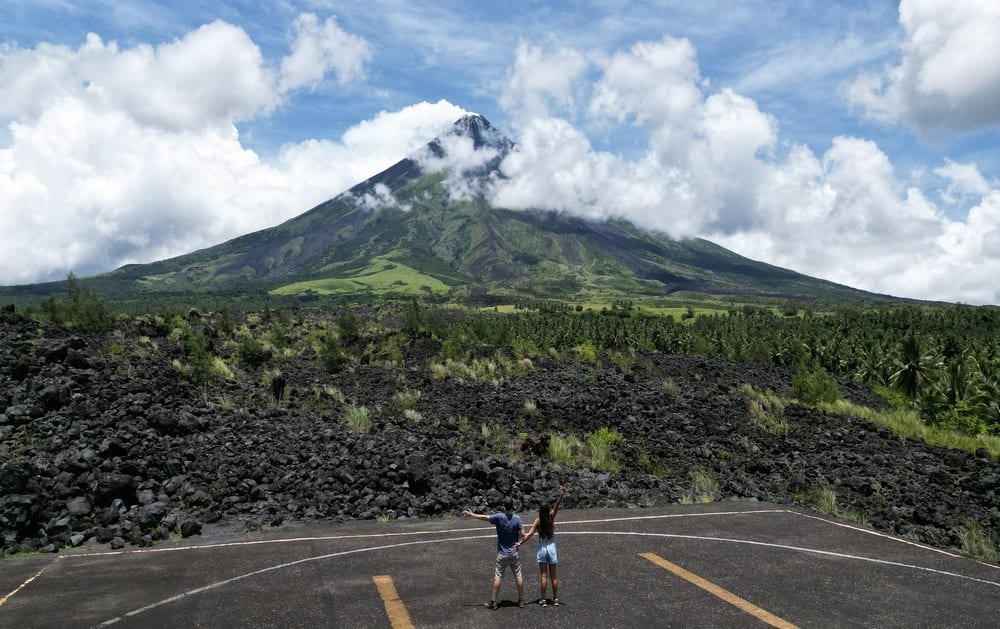
It’s a point super close to the volcano (6 kilometers away) where you can contemplate the black lava flow caused by the 2006 eruption and a spectacular helipad surrounded by vegetation that contrasts with the dark color of the rocks. They’ve also set up a zipline here (300 pesos), which doesn’t make much sense to us, as you slide in the opposite direction to the volcano and don’t get any view.
Zipline or not, this is, for us, the best place to visit in Legazpi because you’ll feel like you’re almost touching the volcano and you’ll enjoy epic views of it, Legazpi City, and the sea.
Heads up: there’s no shade at the top and it’s quite hot. Remember to bring sunscreen and water. The guys who collect the entrance fee also sell bottles of water, soft drinks, and instant noodles at a good price.
Price: 50 pesos per person.
3. ATV tour around the volcano (quad)
Something very fun to do in Legazpi, affordable and almost unique in the Philippines (except for certain places like the Chocolate Hills in Bohol), is to take an ATV or quad ride. They make it easy because you’ll see companies of this kind everywhere, especially next to the Cagsawa Ruins, and because there are pretty cool routes that head to the foot of the volcano, crossing streams, dirt flats, and slightly more challenging terrain.
Don’t worry! It’s neither dangerous nor do you need any experience. After a brief explanation of how the vehicle works, within two minutes of riding you’ll have got the hang of it and feel on top of the world. Plus, you’re accompanied at all times by a guide and, usually, another person who takes all the photos and videos you want and rides right behind him.
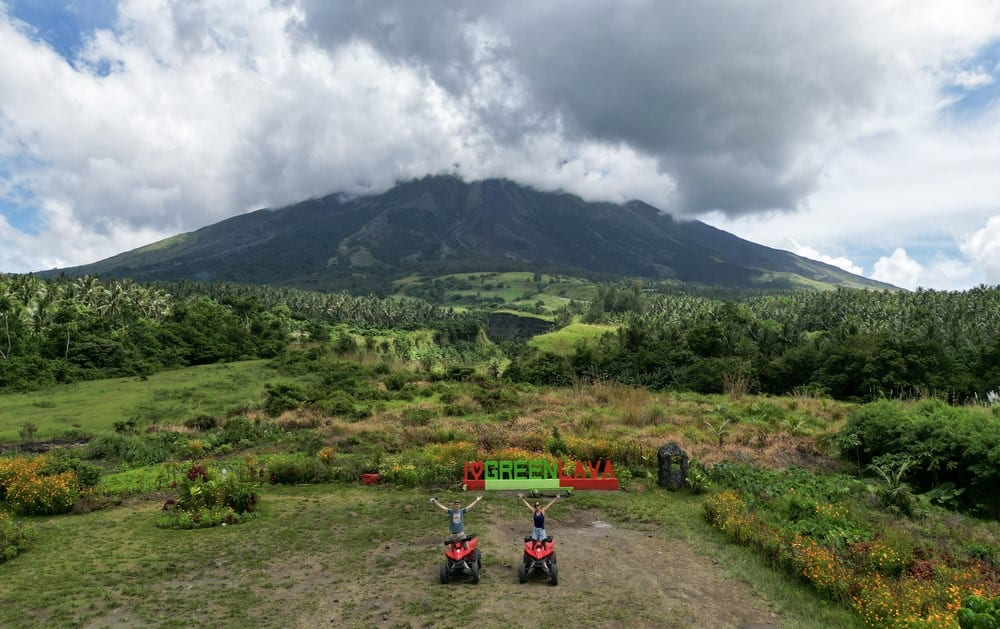
Which ATV route to choose? The best‑known one to do in Legazpi is the Black Lava Trail. In our case, since on the first day we had already reached the same point by motorbike (in fact, we saw a group arriving by ATV), we opted for one of the longer routes that takes you to a point known as Green Lava. It’s not that you’re going to see green lava, but rather a part of the slope where extensive vegetation has grown over a flow and from which you get other uninterrupted views of the volcano, just 6 kilometers away.
The price of the activity depends, logically, on the length of the route. So don’t be surprised if they start offering it to you for 200–300 pesos, which is basically a 15‑minute route of 1.5–2 kilometers that’s fine if you want to try it and take some photos. In our opinion, the Green Lava Trail, which lasts 1.5–2.5 hours depending on how long you spend at the viewpoint and how fast you go, is great and we had a wonderful time. Budget between 1,200 and 1,500 pesos per person and, note, even if one rides behind the other, you pay the same.
You can negotiate prices at the different places around the Cagsawa Ruins, although keep in mind that some are a bit “piratey” in the sense that they don’t do the full route (as happened to us), so our recommendation is to go for the two best‑known companies, which offer online deals through KLOOK. The only one that does the Green Lava Trail is this one.
For the Black Lava Trail, because of its location, it’s this one. It was the first to start offering this activity in Legazpi and has built quite an empire, including a restaurant and a hotel.
Keep in mind that you have to add 100 pesos in environmental fees to the ATV price. On the other hand, we highly recommend scheduling it for 7–8 in the morning, as you’ll have a better chance of seeing the volcano clear and, in addition, it will be less hot.
4. Take photos at Sumlang Lake
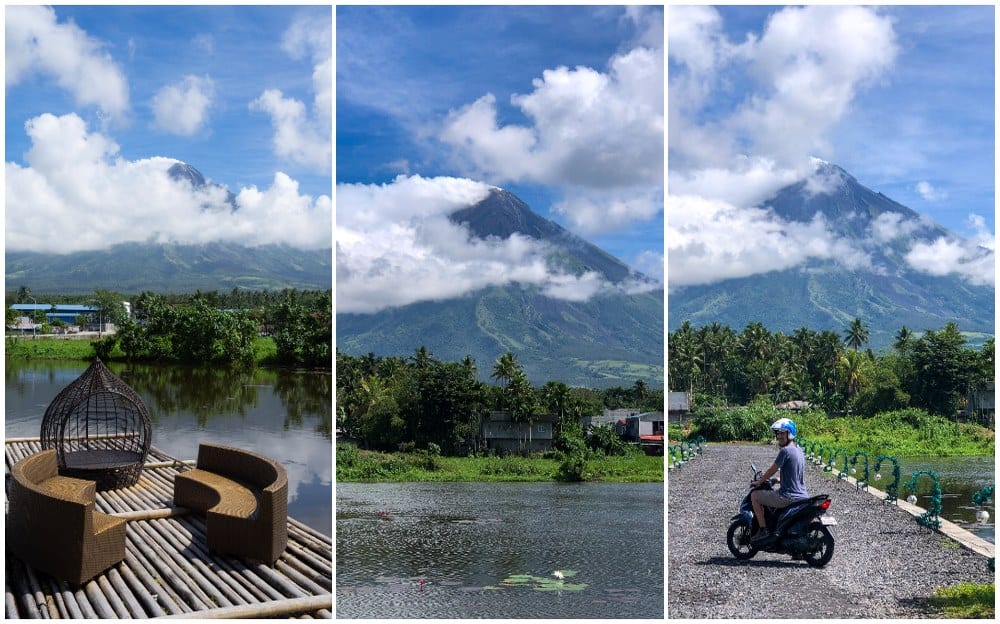
Just 10 minutes by motorbike/car from the Cagsawa Ruins is this well‑known lake in the area, because you also have direct views of Mayon, whose shape is reflected in the water, making for a stunning postcard. Depending on the season—and to the delight of photography lovers—it can be found full of lotus flowers.
The thing is that what used to be a completely natural setting has become a recreational complex with a restaurant, a shop, and a stand to rent kayaks (100 pesos/30′), bamboo rafts (80 pesos/30′), and other props to take photos, which, from our perspective, takes away a bit of its charm—especially considering that you have to pay 100 pesos for entry + 10 for the motorbike.
That said, we had it to ourselves and, as volcano nuts, we liked the perspective it gave us. Even so, if you have little time to visit Legazpi, it could be skippable.
5. Enjoy the views from Quitinday Hills and Nature Park
Another great thing to do in Legazpi that couldn’t be missing from this guide is Quitinday Hills. These pointed hills, which reminded us of the Chocolate Hills in Bohol and Osmeña Peak in Cebu, make up a very beautiful natural landscape that, once again, becomes sublime when combined with views of Mayon.
The road to get there is well paved and the climb won’t take you more than 10 minutes and is suitable for all audiences. Upon reaching the top, you can go to the left and to the right, climbing to the highest point of two hills. If you want a cracking shot with the volcano in the background and there are two of you, the photographer can head to the one on the left and the other to the right.
We decided to go by motorbike and it took us roughly an hour, which flew by thanks to the scenery we saw along the way, so we recommend you don’t miss it.
Price: 40 pesos per person.

6. Watch the sunset from Legazpi Boulevard and its letters
From almost any corner of Legazpi City you can make out Great Mayon, but although we missed a cool skybar or rooftop to enjoy a San Miguel at sunset, the best panorama is from Legazpi Boulevard.
This modern, well-kept seafront promenade is full of bukohans (stalls selling bukos or coconuts) and the odd carinderia for cheap eats, and it also ends at a kind of pier (Puro Boulevard) from which you’ll get wonderful views of the volcano, the city, and the sea. This is also where you’ll find the typical letters of Legazpi for a photo, and we saw some people taking a dip at the so‑called Puro Beach. We don’t know how the water is with a port next door, but it didn’t look very appealing.
On another note, if you’re curious, very close by there’s a monument to Miguel de Legazpi. Embarcadero, a modern area with shops, restaurants, and bars, is also nearby if you want to stop by after sunset.

7. Grab a drink at Highlands Park
The leisure spot for Legazpi locals isn’t bad at all. This kind of “food court” or simply a cluster of bars and little stalls in the highest part of the city seemed amazing to us, as it gives you sublime views of Mayon and its surroundings. Plus, like any self‑respecting Filipino place, there are tons of photo spots: a heart, a hand, Christmas decorations…
We visited at midday and everything was closed, but it’s the perfect alternative if you want a place for sunset and then to stay for dinner when it’s livelier. On weekends there’s usually live music.
A heads‑up: it’s a bit hard to get there by public transport unless you’re willing to pay quite a bit. If you feel like going, the best thing is to rent a motorbike for 24 hours. We were lucky that a friendly local we met around Legazpi Boulevard gave us a lift in his car.
Price: 30 pesos per person from Monday to Thursday and 40 pesos from Friday to Sunday and on holidays.

8. Visit the Church of Daraga – Daraga Church
Located in Daraga, just a few kilometers from Legazpi, the Church of Our Lady of the Gate, better known as Daraga Church, is also one of the places you can’t miss.
It’s a religious building erected by order of the Franciscans in 1772, after many citizens moved to Daraga fearing another eruption of the volcano. The façade is Churrigueresque, from the Baroque period, and was made with locally available volcanic rock. You can also see a hexagonal bell tower with images of the 12 Apostles.
Nowadays it’s a bit deteriorated, as a layer of lime was applied that has gradually fallen off, revealing the original rock again and giving it a somewhat abandoned look despite having been declared a National Cultural Treasure in 2007.
In our opinion, the free visit is worth it not only for its history but because Mayon looks beautiful from here.

9. Take a stroll around downtown Legazpi — what to see
Except for certain areas of some, Filipino cities aren’t known for being pretty or pleasant to walk around. We can’t say Legazpi City is a big exception either, but having been to many already, the truth is that it’s a quiet city with a few spots that aren’t bad for an hour’s walk. Highlights include:
- Peñaranda Park or Freedom Park: this is what we’d know as the “town square.” It’s the center of the Old Albay district and a gathering place when it starts to cool down. It was named in honor of Jose Mª Peñaranda, Albay’s first governor, whose statue can be found there. Next to it there’s a modern building where you’ll find a Mcdonald’s, a Yellowcab (pizza), and a Ministop. You’ll also find city hall, with a tourist office, in case you need to ask anything.
- Legazpi Cathedral or St. Gregory the Great Cathedral: the original wooden chapel ordered built by the first Spanish friars was devastated by an eruption of Mayon; what we see today is a somewhat eclectic construction whose oldest parts date from the 19th century. Although it’s not especially beautiful, admission is free and it’s right next to the previous park.
- Legazpi Museum: next to the park, admission is free and you can easily spend about 20 minutes (under the air‑conditioning) learning about the city’s history. For Spaniards, we think it might be a must‑see. Curiously, the ground floor of the museum is dedicated to Pope John Paul II’s 1981 visit to Legazpi, which was quite an event.
- New Albay Public Market: very close to the two above, this public market has cheap places to eat, fruit and vegetable stalls to explore, and some little shops with souvenirs and typical local products like pili nuts, which we’ll talk about below.
- Casa Hermanas Legazpi: one of the so‑called ancestral houses to see in Legazpi, dating from the early 1950s. It’s now a hostel/restaurant and you can pop in (for free) to snoop around both the structure and the old furnishings.

10. Try Bicolano cuisine
In Food in the Philippines we talk in detail about the country’s cuisine, but each region has particularities that make it special. In Bicolandia there’s something very evident in its most typical dishes: the use of the coconut milk or gata and chili or sili. In fact, around Sumlang Lake you’ll even find a bus stop shaped like a chili pepper (yes, these Filipinos…).
Therefore, another thing to do in Legazpi is to try some of its typical foods, the most renowned being the following:
- Bicol Express or sinilihan: one of our favorites (as long as you’re a fan of spicy food). It’s a kind of meat stew (usually pork) with coconut milk, shrimp paste (bagoong), and plenty of long chili peppers (siling haba).
- Laing: another stew with lots of coconut milk made with taro leaves (gabi), labuyo chili (siling labuyo), and shrimp paste (bagoong). Sometimes it also includes meat.
- Pili nuts: a type of nut native to this part of the Philippines, so it’s sold everywhere—raw, toasted, caramelized, or in different sweet products. It’s quite expensive.
- Sili icre-cream: yes, there’s ice cream made with chili. It sounds awful, but it’s not as bad as it seems because they make it with coconut milk, which softens the flavor, and because you can choose the level of spiciness. We tried level 2 at the place where it was supposedly invented, 1st Colonial Grill, and let’s just say it was a “curious” experience. They have tons of ice-cream flavors with quirky tastes, if you want to explore.

11. Make a getaway to Donsol
Finally, we couldn’t leave this Legazpi guide without telling you about a place just an hour and a quarter away that can be the ideal complement—or the deciding factor—for exploring this area of the Philippines: Donsol.
In 1998 it came to light that whale sharks spent the season in Donsol Bay, and WWF implemented an ecotourism program to regulate their observation. Therefore, it has been for decades one of the places to swim with whale sharks in the Philippines in an ethical way. As in other places where they’re observed naturally, this can only be done in season, roughly from November to June, with February–April being the months with the best luck for sightings, as also happens in Pintuyan.
Donsol, meanwhile, is a pleasant place to spend a couple of days. Although its beaches have black sand, it’s a quiet spot to relax, take a firefly-watching tour, and, if you’re certified and experienced, do some dives. As we tell you in Diving in the Philippines, from here they do dives to Ticao Pass, where, with luck, you can see mantas and whale sharks.
☀️ All this and much more (accommodation, transport, activities…) is explained in our Donsol Guide.
More things to do in Legazpi (if you have more time)
If you’ve read a bit of Viajar por Filipinas, you’ll know we don’t like filler and we always talk about experiences we’ve had ourselves. In the case of Legazpi there are certain places we didn’t manage to visit mainly because of their distance, but other travelers recommended them and we think they could be good if you have more time and motivation. They are the following:
- Waterfalls: Vera Falls (about an hour and a quarter from Legazpi City) and Busay Falls (approx. 40 minutes). The first ones are more or less on the way to the second, so you could explore them in one day.
- Mayon Skyline Viewdeck: you can see Mayon spectacularly from all over Legazpi, as well as from Black Lava, but if you have time and want to see it from even closer, there’s that viewpoint in Tabaco.
- Japanese Tunnels and Quituinan Hill: relatively close to Sumlang Lake there are tunnels dug by invading Japanese soldiers during World War II that can be visited. If combined with the postcard views from Quituinan Hill (with a meadow where there are often horses), you can spend some interesting hours.
- Sawangan Park (Sleeping Lion Hill or Kapuntukan Hill): there’s no shortage of viewpoints in Legazpi! Another one is the “Sleeping Lion Hill” located near the city and just steps from the sea. Locals often come here to exercise early in the morning or at sunset.
- Ligñon Hill Nature Park: one of the most attractive places to see in Legazpi because it’s right in the center and gives you a close panorama of Mayon. We didn’t go because the road was closed for works, but it’s a very popular spot among Albayanos and there’s also a zipline (currently under maintenance). You can walk up or go by motorbike up to a certain point.
- Jovellar Underground River: roughly near Quitinday Hills (25 minutes further by road), it looks promising. It’s a set of caves, waterfalls, and pools where you can cool off. The entrance fee is 50 pesos, but you also have to pay for a guide (200 pesos) and to enter the cave (300).
- Camping: if you like hikes and this type of adventure, there are several campsites such as Mt. Masaraga Campsite. We’re not very up to speed, but if you’re interested, we can pass along a contact.
- Hoyop-Hopyapan Cave and Solong Eco Park: caves more or less on the way to Quitinday Hills. This tour combines these places.
Tours in Legazpi
You know we always choose to travel independently, but if you’re short on time, don’t want to or can’t drive, or you’re in a group and want someone to arrange everything, Legazpi is one of the few destinations where you can organize tours online through an agency called KLOOK.
In case it doesn’t ring a bell, this is the most important excursions agency for the Philippines and the rest of Southeast Asia. To put it bluntly, the Asian Civitatis—so you can 100% trust booking with them and you can also read other travelers’ reviews. Here are the tours we think are most interesting to do in Legazpi:
- Mayon Skyline Tour (full day)
- Ultimate Legazpi City Half Day Bicol Tour (half day)
- Sumlang Lake Tour (full day)
- Sumlang Lake + Cagsawa Ruins (half day)

Practical information for visiting Legazpi in the Philippines
After seeing everything there is to see and do in Legazpi, here’s some practical information to help you organize your trip:
Where to stay in Legazpi
If you look at the map, Legazpi is a city that’s quite spread out, with a “historic” center (Old Albay), a more modern area where the shopping malls are, and another part closer to the port. For this reason, and also because the value for money leaves a bit to be desired, we went a little crazy when looking for where to stay in Legazpi.
To make things easier, here we’re going to tell you the place we chose and give you the options we think are the most advisable after having spent quite a few days there:
- Anchorage Appartelle: this is where we stayed. A modest option but perfect for its location, quietness, and price. Opened at the end of 2021, it’s a small hotel with a few small rooms, but clean and modern. Two of the rooms on the top floor have direct views of Mayon, as does the rooftop. The internet connection works so well that the TV even has Netflix. Nearby you have several restaurants and a 7-ELEVEN, as well as a very cheap laundry. You can take a tricycle to SM/the bus station for 25 pesos per person. Send our regards to Blanca, the owner, from us. She’s lovely! Click here to see prices and available dates.
- JDL Residences Hostel: if you’re traveling solo, this is your place. You have shared rooms for 6 people for little money and a rooftop with epic views of the volcano. It’s also a great option for couples and families or groups of friends. It’s not very far from the bus station. Click here to see prices and available dates.
- Alinchlo Hotel: if you’re definitely going to rent a motorbike during your visit to Legazpi (which we recommend), the value for money of this hostel is unbeatable. Click here to see prices and available dates.
- Hotel Sentro Legazpi: if you’re looking for something higher-end, this is one of the best hotels in Legazpi not only for the service and rooms, but because it’s located near the bus terminal and several shopping malls. Click here to see prices and available dates.

How to get to Legazpi
We’ll tell you everything in detail in How to get to Legazpi, but we’ll tell you in advance that you basically have two ways:
- Search for flights to Legazpi: the city has a very modern airport (Bicol or Daraga International Airport, IATA code: DRP) located about 11 kilometers from the center. It mainly receives flights from Manila and Cebu (with connections from other destinations in the Philippines). If purchased in advance, they can be found for less than €20. From the airport, transfers are indeed expensive. Upon exiting, on the right-hand side you’ll see shared vans organized for about 200 pesos per person. Private transport to your hotel usually doesn’t go below 500 pesos. Click here to search for cheap flights to Legazpi.
- Search for flights to Naga: if flights to Legazpi are very expensive, you can also look at flights to Naga, although they’re usually pricier. From Naga you have buses and vans to Legazpi (approx. 3 hours). Click here for cheap flights to Naga.
- Search for buses from Manila: travelers who want to save money can also go by bus from Manila, but keep in mind the journey takes between 10 and 12 hours and they’re often mobile freezers. These arrive at the Grand Central Terminal, next to SM City. By clicking here you can see information on the buses from Manila.
You can also get there easily from Donsol by van, bus, or jeepney (approx. 1 hour), or, as we did, from Caramoan via Naga.
Where to eat in Legazpi
We’ve hinted at a few things above, but here are the places we tried to eat in Legazpi that we liked:
- 1st Colonial Grill: an institution in Albay with several branches, even in Manila. It’s not cheap, but it’s not super expensive either. We ate at the one in Daraga, where we tried the famous chili ice cream. They have some vegetarian/vegan options.
- The Spice Rack Food House: we stumbled upon this by chance and it was a discovery—it was one of the best meals in months. This restaurant is owned by a very kind Pakistani gentleman who has lived in Legazpi for decades and offers top-quality Indian/Pakistani food. The thali seems to us to have unbeatable value for money. Perfect for vegans/vegetarians.
- Aroy Mack: we don’t know how many pad thai we ended up eating here… While they can’t be said to be identical to Thailand’s, we liked them a lot and they even do home delivery with the Food Panda app for when you don’t feel like going out for dinner. The mango sticky rice isn’t bad either.
- SM City: here you have a very nice food court with views of Mayon, as well as several well-known restaurants such as Mesa (traditional Filipino food) and Army Navy (burritos and burgers).
- Small Talk Café: one day the power went out across the whole city and this was the only place with a generator so we could work. Whether the same happens to you or you just want a nice café with a student vibe, here’s a reference. They also have snacks, sandwiches, and pasta dishes.
- Angel’s Pizza: if you’re craving Domino’s-style pizza, this franchise location always has good 2-for-1-type deals. Nearby you also have other similar spots like Jollibee or, right next door, Figaro Coffee.
- New Albay Public Market: the city’s market—if you’re looking for where to eat cheaply in Legazpi, this is your spot. There are inexpensive carenderías and some shops to buy the famous pili nuts.
How to get around Legazpi
Since the main thing you’ll probably come to do in Legazpi is see Mayon, our recommendation is that you rent a motorbike (as long as you have a license and experience). Rental runs around 400–600 pesos for 10 hours, depending on the motorbike type. If you want a trusted contact, leave us a comment and we’ll gladly send you the info.
If you don’t feel like driving, as we mentioned above, you can join one of the many tours around the area visiting different viewpoints. It’s a good way to also meet Filipino travelers like you (who, by the way, are always super nice). You have this half-day option (with or without the ATV tour) or this full-day one.
Within the city, if you want to get from one place to another, there are jeepneys and tricycles everywhere. Tricycles are cheap (about 25 pesos per person), so we used them a lot, especially to go to SM City to eat/shop or to the terminal nearby.

Tips for visiting Legazpi
Here are the tips for visiting Legazpi that we learned from our experience:
- Best time to go to Legazpi: this matters because you wouldn’t want to come all the way here and have the volcano covered all day, right? Since it’s the main attraction… The best time is summer, roughly from February to May. That’s when you have the best chances of seeing it clear, although you know that at sunrise and sunset it almost always is. Avoid, if possible, the rainy season months (June–September), although we went in the middle of September and had a blast. You never know!
- Money: as in almost all of the Philippines, you’ll need cash. There are several ATMs near Peñaranda Park. There’s a BPI ATM that charges a 250-peso fee but at least lets you withdraw 20,000 pesos instead of 10,000. We talk more about this in Money in the Philippines.
- Internet: you have a very good connection both on mobile networks and in hotels, which can even have fiber. We had no problem working and even watching Netflix. More info in Internet in the Philippines. By the way, don’t miss our stories visiting Legazpi.
- Make the most of it: since you’re in the area, there are lots of interesting, little-visited corners to go to, like Caramoan, Calaguas, or Donsol.
- Health: hopefully you won’t need it, but there’s Legazpi Hospital in the center. For something more serious, you’ll have to be transferred to Manila. That’s why it’s important to always travel with good travel insurance for the Philippines that even covers emergency evacuation. We don’t want to be doomsayers, but accidents happen (a fall on the scooter… wouldn’t be the first time for us). Click here and get 5% off the one we use.
Map with the best things to see and do in Legazpi
You can see this guide to everything to do in Legazpi isn’t short, but, in addition, so you don’t get lost, we’ve made a map to make everything clearer:
We hope you liked this list of things to do in Legazpi and that you’re encouraged to discover this part of the Philippines that still doesn’t receive much foreign tourism. If you have any suggestions or questions, we’ll be happy to hear from you in the comments.