
If you have seen a couple of photos, you already know the Philippines has overwhelming nature. And, although its beaches are famously spectacular, if there is something that mesmerizes many travelers (us included), it is the volcanoes in the Philippines.
Located on the Pacific Ring of Fire, the archipelago is home to impressive volcanoes of all kinds. From volcanic cones so perfect they look like something any child would draw when prompted with the word “volcano,” to eroded mountains with a heart of lava. In the Philippines you can see calderas ruled by a peaceful lake, while in others you will see gases rising from the depths of the earth. For this reason, we believe that one of the most interesting things to do in the Philippines is to visit one of its volcanoes.
Below you will find useful information about volcanoes in the Philippines, which ones are the most active, which ones you can visit and how to do it. From traveler to traveler.
Why are there so many volcanoes in the Philippines?
The Philippines sits on the so‑called Pacific Ring of Fire, that is, where some of the planet’s most important subduction zones are concentrated, causing intense seismic and volcanic activity. It is said that around 75% of the world’s volcanoes lie within it.
Specifically, the Philippines rests between two tectonic plates: the Eurasian and the Philippine Sea Plate. In addition, there are smaller plates separated by minor subduction zones and transform faults. The current volcanoes of the Philippines are found in several volcanic arcs, which can be simplified into two: the Luzon Volcanic Arc and the Central Mindanao Volcanic Arc.
Furthermore, on the eastern and western coasts of the archipelago you will find major oceanic trenches, such as the Philippine Trench, the Manila Trench, and the Cotabato Trench.
How many volcanoes are there in the Philippines?
At present, according to the Smithsonian Institution, there are more than 100 volcanoes in the Philippines. Of these, 20 are classified as historical and 59 as Holocene or post‑glacial. In any case, we have also read in other sources that there may be as many as 355 inactive volcanoes in the Philippines.
Of course, the existence of so many volcanoes in the Philippines comes with significant risks. Eruptions are often accompanied by earthquakes and tsunamis that have caused major damage to the population in the past. Even so, with new technological advances in monitoring and the creation of PHIVOLCS, the Philippine Institute of Volcanology and Seismology, it is now possible to predict movements in advance and warn the public. Likewise, Filipinos have lived with them all their lives and are more accustomed to such phenomena.
Active volcanoes in the Philippines in 2020
According to PHIVOLCS, in 2020 there are 24 active volcanoes in the Philippines. These are the ones that have erupted within the last 600 years and are therefore considered active. They are as follows:
- Luzon (13): Babuyan Claro, Banahaw, Bulusan, Cagua, Camiguin de Babuyanes, Didicas, Iraya, Iriga, Isarog, Mayon, Pinatubo, Smith, and Taal.
- Central Visayas (3): Biliran, Cabalian, and Kanlaon.
- Mindanao (7): Hibok‑Hibok, Leonard Kniaseff, Makaturing, Matutum, Musuan, Parker, and Ragang.
- Sulu Archipelago (1): Bub Dajo.
Of these, which are the most active volcanoes in the Philippines? The following:
- Mayon (Legazpi, Luzon): since 1616 it has erupted 47 times. In 2018 there was a fairly powerful phreatic eruption. In February 2020 glows were observed in the crater, indicating a rise of magma.
- Taal (Luzon): since the 16th century it has erupted more than 30 times, most recently in 2020.
- Kanlaon (Negros): it has erupted 30 times since 1819.
- Bulusan (Luzon): it has erupted 15 times since 1885.
- Hibok‑Hibok (Camiguin): it has erupted 5 times in historical times. Those between 1948 and 1951 caused serious damage.
- Pinatubo (Luzon): it erupted in 1991 after having been dormant for 600 years. Since June 12, 1991, it has erupted 4 times.
You can check more information here.
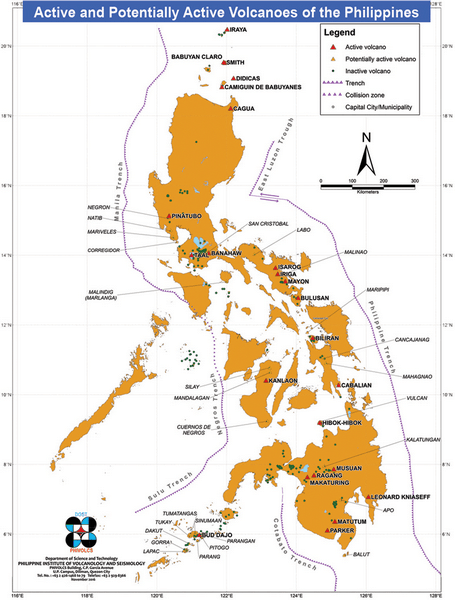
© PHILVOLCS
Volcanic eruptions in the Philippines in 2020
The most important 2020 eruption of a volcano in the Philippines was that of Taal Volcano, located relatively close to Manila. The phreatomagmatic eruption of its main crater occurred on January 12, 2020. Ash went on to cover much of the island of Luzon, with flights and economic activity canceled for days. People living on the volcano island itself and in the surrounding areas were also evacuated. We closely followed this eruption and even saw lava running down the volcano’s slopes.
PHIVOLCS declared Alert Level 4, which indicated a hazardous explosive eruption was imminent. However, on January 26 the volcanic activity decreased and the alert was lowered to 3. On February 14 it was lowered to level 2 and at the moment it is only at level 1.
You can see the latest updates on Philippine volcanoes here.
The volcanoes in the Philippines you can visit
As you can see, you won’t be short of volcanoes in the Philippines—but which ones are really worth visiting? Whether reaching the summit is an adventure or simply contemplating them takes your breath away, we’ve gathered the 6 best volcanoes in the Philippines you can experience as a traveler.
1. Mayon Volcano (Legazpi, Luzon)
If we had to choose just one volcano in the Philippines, we would have no doubt—it would be Mayon. As soon as you see a photo, you’ll understand. With a peak reaching 2,462 meters above sea level and a perfect conical shape, it’s exactly what comes to mind when we think of a volcano. It is said that its name comes from the Bicol word “magayon,” which means beautiful. It’s also one of the most popular Instagram spots in the Philippines.
Discover everything about this destination in Things to do in Legazpi
Even so, Mayon is far from a calm volcano—quite the opposite. As we mentioned above, it is one of the most active volcanoes in the Philippines and you can still see activity today. For this reason, reaching the very summit has not been possible for several years. Still, with a guide and if everything is calm, you can do the so‑called “Farmer’s Trail” up to Camp 2, which takes 2 or 3 hours of hiking.
Mayon can be seen from almost anywhere in Albay and it clearly dominates the city of Legazpi, but the best thing to do is head to one of its impressive viewpoints. Here are the best ones and how to reach them:
- Cagsawa Ruins: this colonial‑era church, specifically from 1587, is almost in ruins due to an eruption, but it forms a glorious picture with the volcano behind it. You can go on your own or on a tour from Legazpi.
- ATV rides: if we had to choose just one thing, this would be it. Pick from 8 routes you can do by ATV (quad). You’ll see the volcano on all of them, but the one we like most is the 2018 Mayon Lava Trail. You can book here.
- Quitinday Green Hills: these hills, similar in appearance to the Chocolate Hills, offer several superb panoramas of Mayon Volcano.
- Ligñon Hill Nature Park: this hill in Legazpi offers very cool views and it only takes about 30 minutes to reach the top.
- Sumlang Lake: the perspective of Mayon behind this peaceful lake, usually full of water lilies, is one of the most iconic postcards of the Philippines. You can book this tour, which also combines this visit with Daraga Church, a fine example of colonial architecture.
Being such a high mountain, Mayon is often capped with clouds. If you want a better chance of seeing it clear, it’s best to visit between March and May and stay at least one night so you can get up early the next day. At sunrise you have the greatest chance of a cloudless sky.
Recommended hotels: Casa Roces Bed and Breakfast and Casa Simeon (wonderful colonial house).
How to get there?
Legazpi has a domestic airport with flights from Manila and Cebu, so this is the most convenient way to get there.
Flights from Manila to Legazpi here
Flights from Cebu to Legazpi here
Another option is to take a bus from Manila to Legazpi. The trip is usually overnight, as it takes around 9 hours. Companies such as Cagsawa, DLTB, and Penafrancia cover the route. It’s a fairly popular journey, so we recommend booking in advance and paying close attention to the exact departure point in Manila, as there isn’t a single central station. You can book here:
Buses from Manila to Legazpi here
See this post on Instagram
2. Pinatubo Volcano (Luzon)
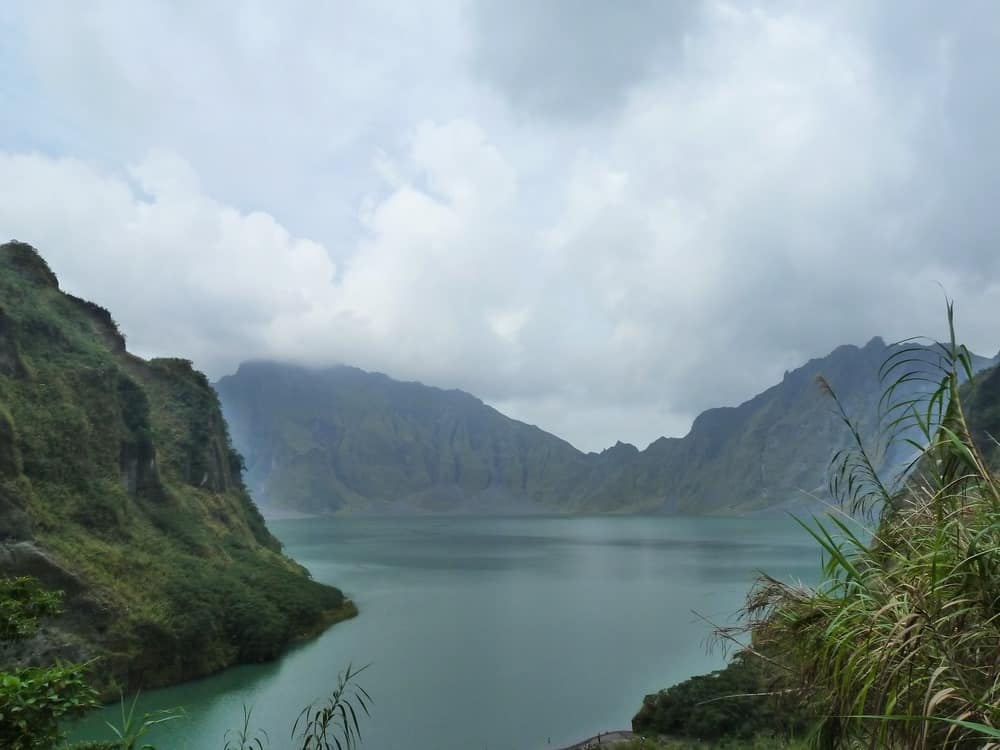
After Mayon, the next volcano in the Philippines we recommend visiting is Pinatubo. It will be a totally different experience, since you can reach the interior of its “peaceful” crater, where there is a huge lake.
This is another of the great volcanoes on the island of Luzon. At the moment it is “asleep,” but its last eruption was enormous. In 1991 it was classified as the 2nd largest volcanic eruption of the 20th century. That was when the deep blue lake you can see today was formed.
Even so, the entire excursion is a very interesting experience. To get there, you first have to hop in a 4×4 in the town of Santa Juliana. For about an hour you’ll cross a landscape that looks Martian, fording streams and passing between towering walls of sand, mud, and rock. Look up to the top of them; you can sometimes spot the Aeta watching—the region’s indigenous people, recognizable by their dark skin and curly hair.
When the vehicle can no longer continue, you’ll need to walk for between 1.5 and 2 hours, depending on ground conditions. The route is quite cool and suitable for most people. It culminates at the crater, where bathing used to be allowed but is currently not permitted.
The best thing is to book something organized; you can do so here
Recommended hotel: Mount Pinatubo Base Camp at Casa Hermogina.
How to get there?
The first thing you’ll need to do is get to Manila. Once there, we recommend reading all the steps we detail in How to get to Pinatubo. If you don’t want any hassle, you can book this tour with KLOOK (the Philippine version of Civitatis) or with Civitatis itself:
Mt. Pinatubo day tour from Manila with KLOOK
Mt. Pinatubo day tour from Manila with Civitatis
3. Taal Volcano (Luzon)
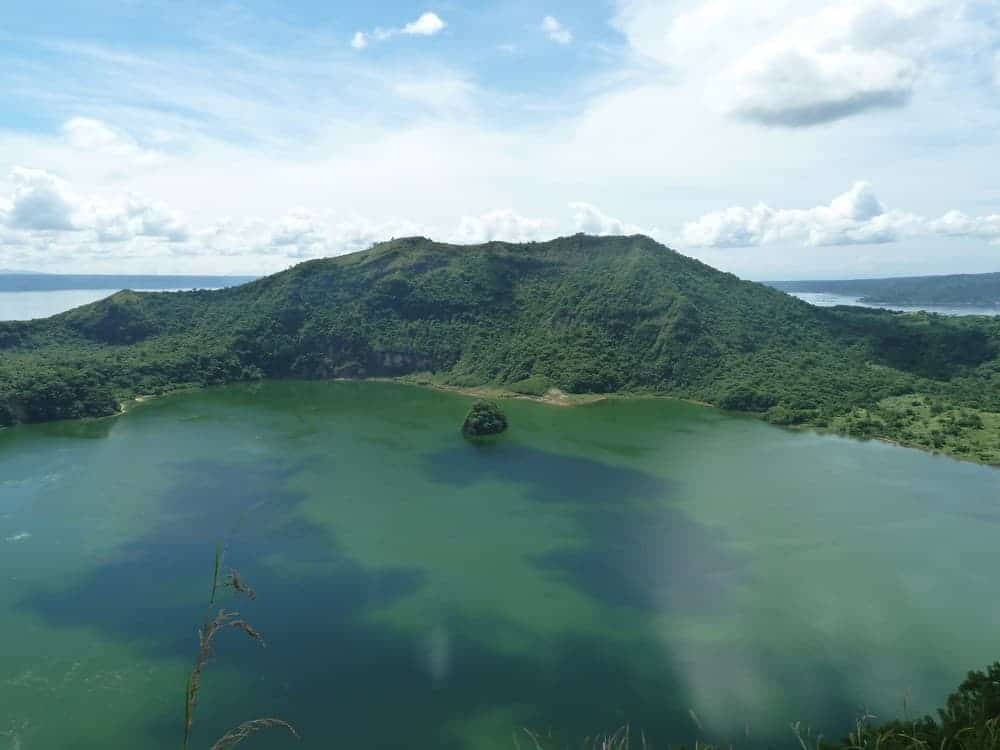
There is an island in a lake, on which there is an island, in which there is a lake, in which there is an island. One of those lakes is the crater of Taal Volcano, one of the most impressive volcanoes in the Philippines. It is located in Batangas, 50 kilometers from Manila.
Just by heading to the city of Tagaytay, the weekend getaway for many Manila residents, you can already appreciate its volcanic cone. But the most recommended thing is to do the full excursion: cross over by boat to the volcano and hike up to see the caldera. This usually holds a greenish lake, although depending on the volcano’s composition at the time, yellowish tones are also common. Remember to look for the little island within the lake to complete the “island‑within‑a‑lake” loop. The ascent is relatively easy; please do not use the donkeys and horses there, as they are in a lamentable state.
As we mentioned above, Taal Volcano last erupted at the beginning of 2020 and many nearby residents had to be evacuated. Since, at the time of writing this article, some earthquakes are still being recorded in the surroundings—signs of activity—it is likely that visiting may still not be possible. Even so, we recommend checking PHIVOLCS, as this can change from one day to the next.
Recommended hotels: The Lake Hotel Tagaytay and Taal Vista Hotel. If you plan to stay in Manila, don’t miss Best hotels to stay in Manila.
How to get there?
As in the previous case, you will first have to get to Manila and, once there, head for Tagaytay. Everything is explained in detail in How to get to Taal Volcano. To avoid any hassle, you can also book a tour:
Book your Taal Volcano tour here
4. Hibok‑Hibok Volcano (Camiguin)
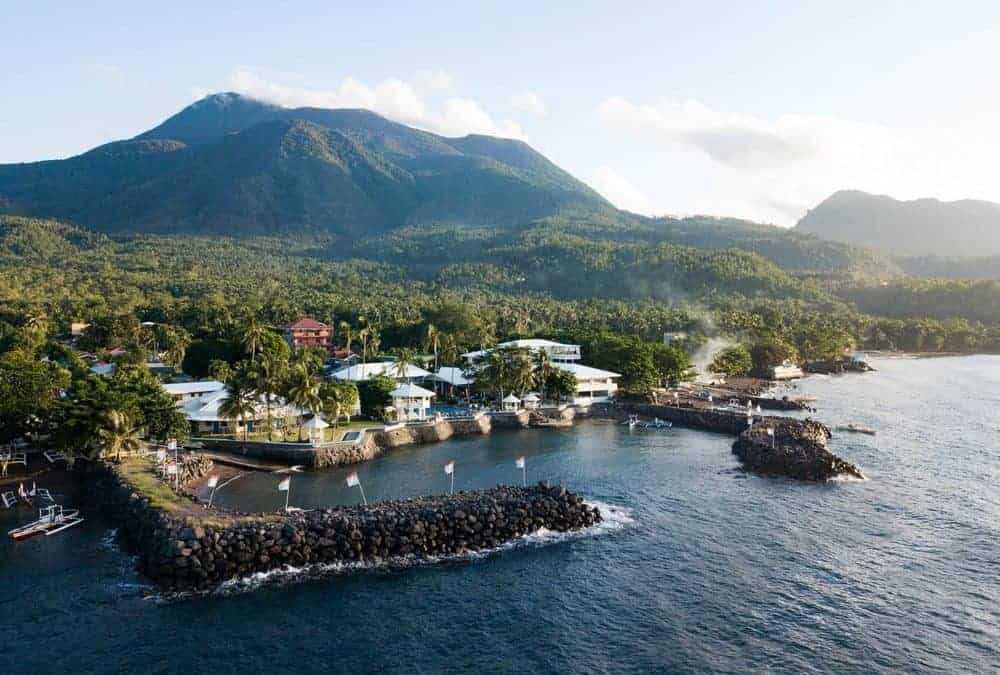
Another volcano in the Philippines we have summited is Hibok‑Hibok. This is also one of the most popular among travelers, as it is located on the beautiful island of Camiguin, which is gaining more and more prominence.
It is a stratovolcano whose summit is at 1,332 meters above sea level. It is one of the active volcanoes of the Philippines and has erupted 5 times. The last one was in 1951 and caused the deaths of almost 3,000 people. Interestingly, it is said that 69,000 people lived on the island at that time, but so many emigrated afterward that the population fell to 34,000.
Hibok‑Hibok has 3 craters: Kanangkaan (eruption in 1948), Itum (eruption in 1949), and Ilihan (eruption in 1951). The last one has become a green lake surrounded by lush vegetation and is the one you will see if you decide to climb to the summit.
You can see the volcano from almost any angle on Camiguin, but the clearest way to view its summit is from White Island. This tongue of white sand is only a few kilometers off the coast and offers wonderful views of it and Mt. Vulcan—another peak that makes the island the place with the most volcanoes per square kilometer in the world. You’ll find more information about this outing in Island hopping in Camiguin.
However, if you want to enjoy it to the fullest, the best thing is to hike one of the trails that take you to the top. You’ll enjoy its humid forests, the crater, and a panorama of Camiguin. As an active volcano, you’ll need a guide and a permit from the DENR to go up. You can read about this topic in Trekking to Hibok‑Hibok.
Recommended hotels: Mountain View Cottages and Pabua’s Cottages. More info at Best hotels to stay in Camiguin.
How to get there?
The island of Camiguin belongs to the Mindanao region. It has a small airport with flights from Cebu and a few from Manila. It also has two ports, with boats arriving from Bohol and Cagayan de Oro (Mindanao).
You’ll find all the information in How to get to Camiguin.
5. Mt. Apo (Davao, Mindanao)
The highest mountain in the Philippines is also a volcano. Mt. Apo, at 2,954 meters high, is located on Mindanao island, specifically in Davao del Sur. It is a stratovolcano teeming with biodiversity. It is said that 270 bird species live there, of which 100 are endemic. The best known is the Philippine eagle, one of the largest raptors in the world and the national bird of the Philippines.
The mountain has several peaks and, at the very top, there is a volcanic crater about 500 meters in diameter with a small pond. As a curiosity, its name translates to “Grandfather of all mountains.”
To climb Mt. Apo you need to obtain a permit, and there are several trails. The most common is a 3‑day/2‑night trek along the Kidapawan‑Kapatagan trail. Each day you will walk between 8 and 10 hours, and there is a particularly tough boulder section, as well as quite steep areas where you will need to use ropes. Therefore, we only recommend it if you are physically prepared and have the proper gear.
Recommended hotels: Capital 461 Asrodel Hotel and Faircrown Suites.
How to get there?
The access point to this Philippine volcano is the city of Davao, one of the country’s most important. It even receives international flights at its airport.
Once there, you’ll have to go to Santa Cruz, about 45 kilometers from Davao, where permits are processed. If you don’t want much hassle, you can negotiate with a white taxi outside the airport and it shouldn’t cost more than 700 pesos. Another option is to take a taxi to the Ecoland Transport Terminal and, once there, take a bus to Santa Cruz (1 hour/45 pesos).
6. Mt. Kanlaon (Negros)
For those who are ready, Mt. Kanlaon offers some of the most popular trails in the Philippines and is a bit more accessible than the previous mountain. The volcano’s summit is at 2,435 meters above sea level, making it the highest peak in the Visayas.
The ascent—while not the easiest—is super rewarding. The reason? In addition to traversing spectacular humid forests, you will enjoy views of Margaha Valley, where there is an extinct crater. At the summit you’ll find another imposing crater 400 meters deep and 100 meters in diameter, from which gases normally rise from the earth’s heart.
There are 4 routes to reach the top: Wasay, Mananawin, Mapot, and Guintubdan. Except for the last one, all the others require two days and, therefore, an overnight stay at one of the camps. The most beautiful part of the climb is usually from Pagatpat Ridge to the summit, as you’ll be able to see Margaha Valley from above and, on a clear day, Bacolod in the distance.
To climb this Philippine volcano, you must request a permit (1.000 pesos) from the DENR in Bacolod, but keep in mind that there is often no availability even if you request it 3 months in advance. We suggest emailing this address for more info. It is also mandatory to hire a guide (500‑700 pesos, depending on the number of people). As it is an active volcano, the DENR will also tell you whether the trails are open or not—they have even been closed for several years at a time.
Depending on the route you choose, you will need to go to Canlaon City, 3 hours by bus from Bacolod, or you can start from Mambukal Resort, about 1 hour away. If you don’t want to complicate things, there are also companies in Bacolod that run trips to the summit.
Recommended hotels: Sukro and Seda Capitol Central.
How to get there?
To reach this Philippine volcano, you will first need to travel to the city of Bacolod, on the western side of the island of Negros. Since it has a domestic airport, the simplest thing is to fly to Bacolod.
Another possibility is to fly to Iloilo and then take one of the frequent boats to Bacolod. There are fastcrafts (fast boats) that will drop you at the port in about an hour.
You can also get to Bacolod by bus from Dumaguete (which also has an airport receiving domestic flights), located on the eastern side of Negros. From there it will take you about 4 or 5 hours to reach the starting point. You can get to Dumaguete by boat from Siquijor or from Cebu island. It’s all explained in How to get to Dumaguete.
Finally, you can also take one of the buses from Cebu North Bus Terminal to Bacolod South Bus Terminal.
General recommendations for visiting volcanoes in the Philippines
- As you can see, there are many active volcanoes in the Philippines and, as they are part of nature, their status can change at any time. Therefore, before deciding which one to visit, we recommend checking the latest news and the website of PHIVOLCS. On the latter you’ll find a very useful “Volcano Bulletin” and “Volcano Advisory.”
- What to bring? If you plan to do any trekking around volcanoes in the Philippines, we especially recommend wearing good footwear. While many guides use flip‑flops (yes, it’s wild), there can be quite slippery sections. Although the climate is hot, keep in mind that at altitude it can be cold at night and first thing in the morning. Don’t forget a rain jacket. You can read more about gear in The Philippines Packing List: What to bring.
- If you want to camp, most guides or accommodations near volcanoes rent out tents and everything you need. Just ask.
- Bring snacks and plenty of water. As the day goes on, so do the heat and humidity.
- For most ascents of these volcanoes in the Philippines you need to request a permit from the relevant authority, usually the DENR (Department of Natural Resources). There is almost always a nearby office for well‑known treks. This not only helps preserve these natural paradises, but also ensures you are informed about the volcano’s situation and therefore face fewer dangers.
- The best time to visit these Philippine volcanoes is the summer, that is, between March and May. This is especially important if you want to see the summits clear, as, being several of them so high, they tend to fill with clouds as the day goes by. On the other hand, if you plan to visit Pinatubo during the rainy season (June to November), we recommend checking with the authorities in advance to see if it’s open, as it sometimes closes due to potential landslides.
- Travel safely and please take out a good travel insurance for the Philippines that covers adventure sports. You never know what could happen on an excursion like this and a good policy can save your life. If you purchase through this link, you’ll get a 5% discount.
Location of the Philippine volcanoes we recommend
Here you can get an idea of where these Philippine volcanoes we’ve discussed are located on the map, so you can see where and when to include them in your itinerary:
Frequently asked questions about volcanoes in the Philippines
Which volcanoes are active now?
In 2020 there are 24 active volcanoes in the Philippines. Those that have shown the most activity in recent years are Mayon, Taal, Kanlaon, Bulusan, Hibok‑Hibok, and Pinatubo.
What is the highest volcano in the Philippines?
While Mayon impresses the most thanks to its perfect conical shape, Mt. Apo is the highest volcano in the Philippines and also the country’s highest point. It is 2953 meters high and is located on the island of Mindanao, in the south.
Which volcano in the Philippines do you recommend visiting?
If you don’t have much time on your trip to the Philippines and want to see a perfect volcano, we recommend visiting Mayon, in Legazpi. It can be appreciated from the city itself, which you can reach by plane, but the best thing is to head up to one of its viewpoints or take an excursion by buggy or 4×4. If you’re not leaving Manila, you can also do a day trip to Pinatubo or Taal. Climbers will love Mt. Apo.
Ready to enjoy these wonderful volcanoes in the Philippines? We hope we’ve provided all the information you need. If you have any questions or suggestions, we’d be happy to read you in the comments.