
On a trip through the Philippines the beaches are usually the main attraction, but with such lush nature there’s much more to explore. If you’re more of a freshwater person, take your adventure to the next level and discover the beauty of the best waterfalls in the Philippines. Sit down, surround yourself with thick vegetation, and listen to the sound of the water and birds flitting about.
The Philippines is lucky to have thousands of majestic waterfalls scattered throughout the archipelago. Most are in remote places and hard to access, but others are within easy reach and you shouldn’t leave them out of your route. Here we’ve gathered some of the best waterfalls in the Philippines. We’ve tried to make sure they’re more or less accessible and we’ll tell you how to get there. Of course, this is only a selection—you could spend a lifetime visiting waterfalls in the Philippines!
1. Kawasan Falls (Cebú)
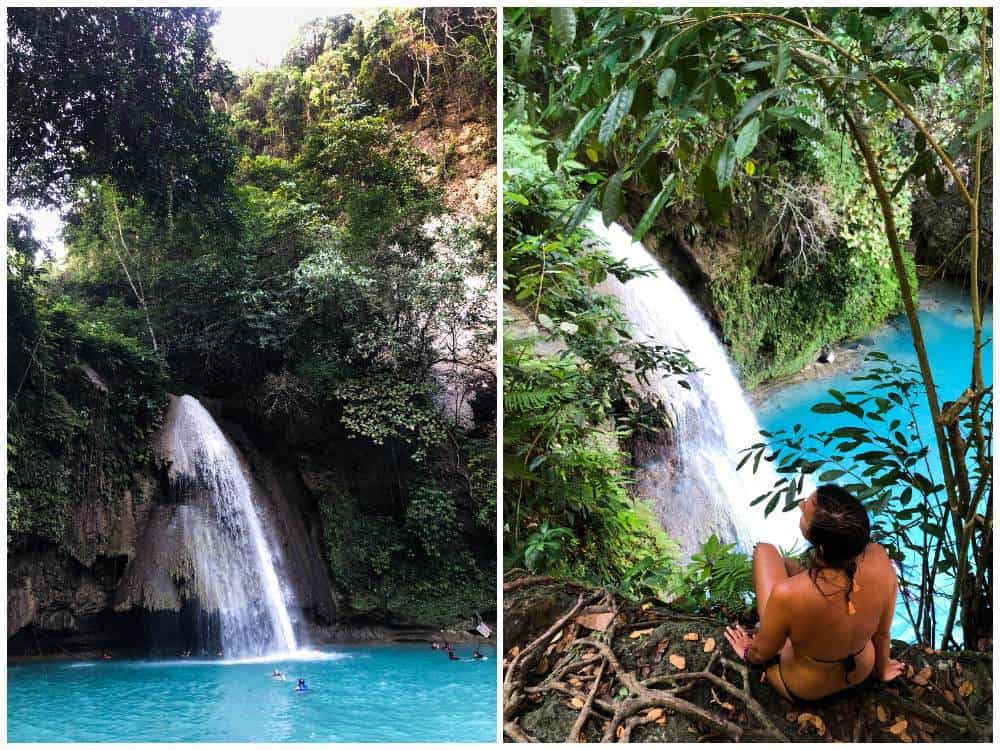
When we talk about waterfalls in the Philippines, the image of Kawasan Falls is probably what comes to mind. They’re the best-known in the country and their photos have gone around the world. What defines them most are the turquoise waters—so much so that they’re known as “Gatorade Falls” for their resemblance to the drink’s color.
Kawasan Falls are south of Cebú, in Alegria. In reality, they’re a set of waterfalls of different sizes along the Badian River. Even so, the most famous and photographed tier is the last one, as the water crashes down with great force from a height of 40 meters into a huge pool surrounded by vegetation. Unfortunately, as they’ve become so famous, the area has been urbanized and there’s even a restaurant with lots of tables which, in our opinion, spoils it quite a bit.
Our recommendation is not to limit yourself to just seeing the falls, but to really enjoy them by doing Canyoneering at Kawasan Falls. As you’ll read, it’s a simple activity in which you’ll enjoy beautiful canyon landscapes and, if you feel like it, jump into the different pools. The highest jump is 12 meters, but if you don’t want to, you can just keep walking.
If canyoning isn’t your thing or you don’t have time, try not to stay only at the first waterfall. You can climb 2 or 3 more levels, where you can jump or take a dip. You’ll also find the spot where one of the most famous Instagram photos in the Philippines is taken.
️ By the way, if you’ve come by motorbike or car, we suggest combining these falls with a visit to Lambug Beach. This is, without a doubt, the most interesting beach in the area.
How to get there?
If you’re not on the island, have a look at How to get to Cebú. Once there, you have several options:
- Go to Moalboal and ride from there by motorbike. To do so, read How to get to Moalboal and then rent one (350 pesos). It takes about 30 minutes. Once in the Alegria area, you can either do the canyoning activity or just visit the falls.
- Go by bus from Cebú: any bus heading to Santander/Liloan passes the entrance to Kawasan Falls. It’ll take around 3,5 hours. You’ll pay about 180 pesos. If you’re in Moalboal, you can also wait for any bus on the road and go to Kawasan.
- Go with a rented car from Cebú or hire a car with a driver. For the latter, we have a contact.
- Go on a day trip from Cebú. You can join a canyoneering tour, do a private canyoneering tour, or do a canyoneering + island hopping tour in Moalboal.
Don’t miss our Moalboal Guide for more information about this area.
2. Katibawasan Falls (Camiguin)
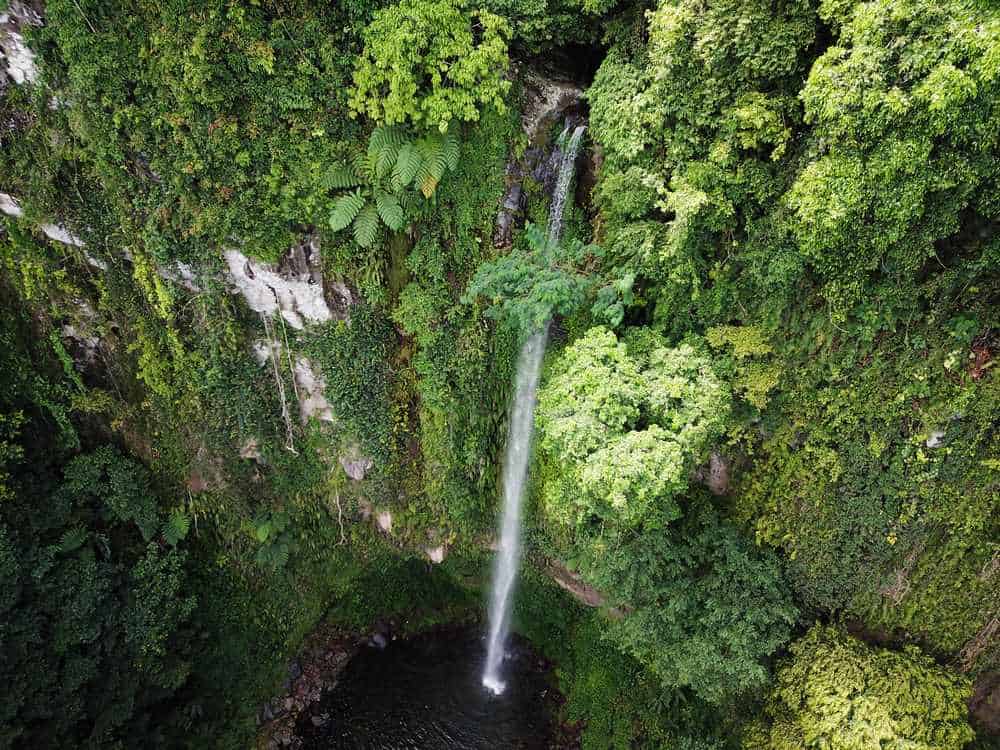
Camiguin is an island with special topography. Being the place on Earth with the most volcanoes per square meter, you can already imagine how mountainous it is. Because of this, it can boast some of the most beautiful waterfalls in the Philippines. Our favorites are Katibawasan Falls, a few kilometers from the capital, Mambajao.
These Philippine waterfalls are the island’s tallest. At 70 meters high, the flow might not impress you, but the setting will. Almost in a closed circle, they’re surrounded by huge walls packed with vegetation. You can also take a dip in the pool calmly—just be warned the water isn’t warm.
Katibawasan Falls have been urbanized a little in recent years to accommodate the growing number of tourists who visit, but it doesn’t seem as excessive to us as in the case of Kawasan Falls.
Avoid visiting from Friday to Sunday, when there are more local tourists. Also, if you plan to swim, it may be better to go between 11:00 and 13:00, when the sun is higher and the rays reach the pool.
The entrance fee to these Philippine waterfalls is 50 pesos per person.
How to get there?
First you’ll need to reach the island, so we suggest reading How to get to Camiguin. To reach this waterfall, the easiest way is definitely with your own rental motorbike (250–300 pesos per day). Depending on the area you’ve chosen to stay in Camiguin, it’ll take more or less time. Most people stay around Yumbing, so it takes about 30 minutes. It’s hard to get lost—just follow Google Maps or Maps.me and you’ll reach the entrance.
Another possibility is to take one of the motorelas (like tricycles but bigger) heading to Mambajao (around 8–12 pesos per person) and there take a private ride or a tricycle to Katibawasan. As this isn’t a common route and you won’t find others to share with, you’ll need to negotiate a price.
Check our Camiguin Guide for more information about this spectacular island, including other beautiful waterfalls in the Philippines.
3. Pahangog Falls (Bohol)
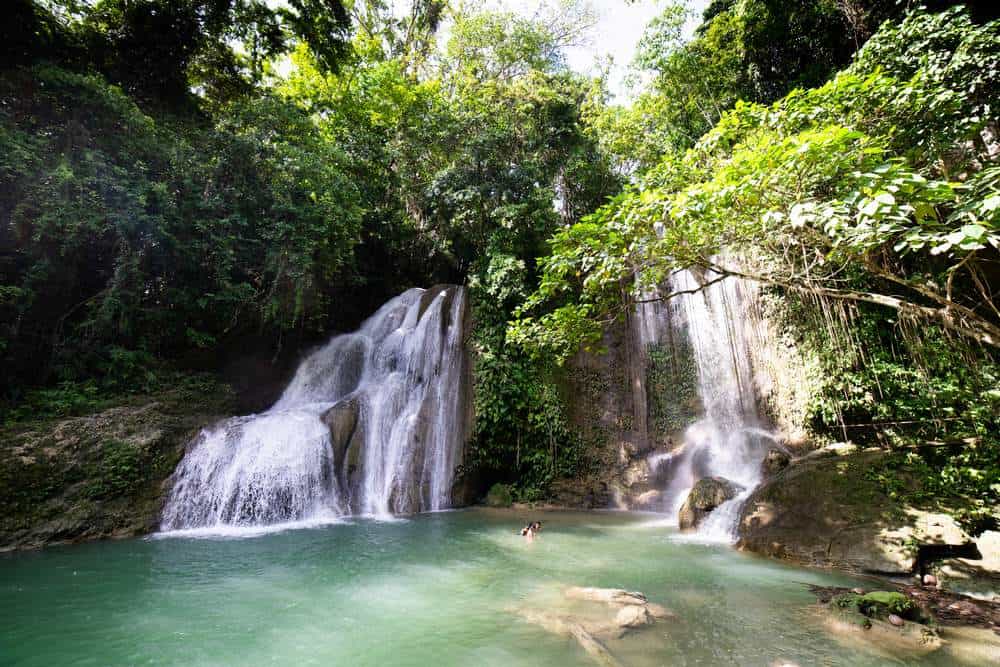
Bohol is a very large island and you’ll find plenty of waterfalls there. Among them, our favorites are Pahangog Falls, also known as Dimiao Twin Falls because they’re actually two almost twin cascades.
Located in the Dimiao area in southern Bohol, they’re little known and quite far from the island’s tourist hubs, so we’re sure that if you go Monday through Thursday you’ll have them almost to yourself.
The scenery is truly beautiful. You’ll find two waterfalls about 25 meters high falling into a pool with that Gatorade color we love so much. Of course, you can take a dip and cool off after walking down the stairs. It’s also common to see kids jumping from different points of the falls. If you want to do it, make sure there are no shallow rocks, as the pool is somewhat rocky.
In the parking area there’s a small stall selling drinks and snacks, but you can also bring your own food and eat peacefully in one of the cabanas by the waterfall. Renting them costs 50 pesos for the whole day, though we weren’t charged.
The entrance fee is 20 pesos per person. You can read more about them in our article Best waterfalls in Bohol.
The best plan is to combine these with Ingkumhan Falls, which are very close. It’s a cool day trip from Loboc if you have at least a couple of days in the area. In the morning you could visit both and in the afternoon kayak along the river or get your adrenaline pumping on the zip line. In Things to do in Loboc we tell you everything.
How to get to Pahangog Falls?
First you need to get to the island, so be sure to read How to get to Bohol for more information.
To reach the waterfalls, in our case we decided to go by motorbike (350 pesos per day) from Loboc. It took about an hour. We suggest you trust Google Maps and drive along the southern road, the one by the sea, until you reach the Dimiao area. From there you can easily find your way, but do heed the locals. There’s a point where the road becomes almost impassable, especially if it’s rained, because it turns into a real quagmire and can be dangerous. Therefore, we suggest hiring a habal-habal, which will take you to the drop-off point for 100 pesos. Once there, you’ll need to go down some stairs for 5–10 minutes; it’s very easy.
Another option is to hire a tricycle with driver or a car with driver from Loboc. If you don’t want to look for one on site, leave us a comment and we’ll send you some trusted contacts. We don’t think it’s possible to get there by public transport.
Finally, you can also combine these waterfalls with Can-umantad Falls, which we’ll talk about later, or with Ingkumhan Falls on a day trip from Panglao with KLOOK. You can book here:
Pahangog Falls + Can-umantad Falls + Canawa Cold Springs
Pahagong Falls + Ingkumhan Falls
Don’t miss our Bohol Guide to learn everything about this island.
4. Tappiya Falls (Batad)
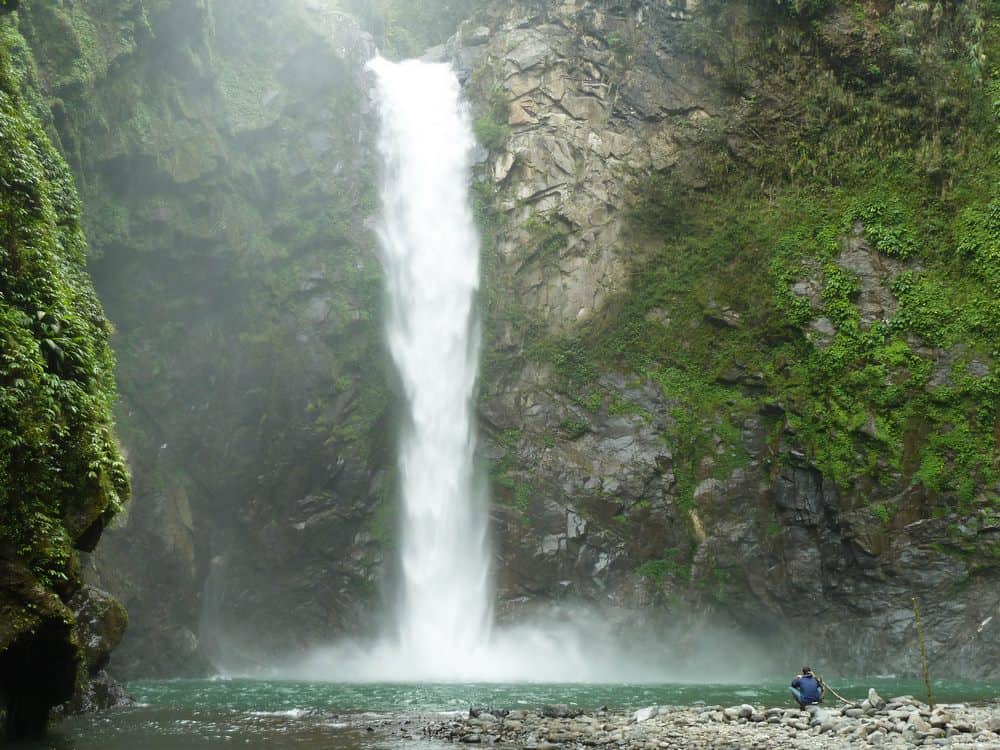
Imagine walking through rice terraces and suddenly a steep descending staircase rises before you. You start going down and, as if by magic, an impressive 70‑meter‑high sheet of water appears, crashing into a pool that seems protected by huge rock walls. These are Tappiya Falls, one of the most beautiful waterfalls in the Philippines.
We’re sure you’ll love seeing this powerful curtain of water, and after the hike you’ll want to take a swim. Still, keep in mind the water is quite cold and try not to get too close to the waterfall. The flow is so strong that two men have drowned there. Locals even say there’s a mermaid who lures people and drags them into the “depths”…
If you stay overnight in Batad, you can visit first thing in the morning. It’s common that before 8:00 you can see Tappiya Falls with a lovely rainbow.
How to get there?
Just follow the steps in our article How to get to Batad and, once there, open Maps.me and take one of the two trails that lead to these waterfalls. Although it isn’t very difficult, you can also hire a guide to take you and give you practical insights into Ifugao culture. They usually charge around 800 pesos for a group of four people. The higher trail takes you through several viewpoints to contemplate the amphitheater of Batad’s rice terraces.
Even if you’re not used to walking, don’t worry—getting there isn’t too hard. The only thing to keep in mind is that the climb back up is a bit tough and will take about 90 minutes.
Read our Batad Guide, where we give you more detail about this spectacular part of Luzon.
5. Can-umantad Falls (Bohol)
We’ve already told you about Pahangog Falls, but if we had to choose one waterfall on the island of Bohol, we’d pick Can‑umantad.
At almost 45 meters high, these are the tallest on the island. The clear water feeds the Cadapdapan rice terraces, some of the most beautiful in the Philippines and which you can also visit, and it makes a two‑stage free fall before resting in a turquoise pool where you can take a dip. Don’t hesitate—it’s a wonderful way to cool off and discover the small cave behind the curtain of water.
Along the river you’ll also see several more small cascades and pools where there’s usually hardly anyone. If you have time, you can easily spend a couple of hours.
Access costs only 20 pesos and is well worth it.
How to get there?
Our advice is to make Anda your base to reach them, because from Tagbilaran, Loboc, or Panglao it’s almost three hours away—but not impossible.
If you decide to stay in Anda, you can read how to get there in How to get to Anda. After that, the most convenient thing is to rent a motorbike (350 pesos per day) and drive to the falls. The road isn’t amazing, but it’s doable. Do not take the Canawa Cold Spring route; go by the lower one. Another possibility is to go with a car and driver. We can give you a trusted contact in Anda.
For those in Loboc, you can get to these waterfalls by motorbike. Drive along the coastal road and you’ll avoid terrible roads that end up taking longer. Keep in mind the trip takes a couple of hours.
If you’re in Panglao or Tagbilaran, we would never go by motorbike, since it’ll take you more than three hours. The best option would be a car with driver. You can ask us for a contact or book this excursion directly:
When you reach the Can‑umantad area, you can choose between getting to the base by car or motorbike, or a slightly more adventurous option: descending the stairs behind the Cadapdapan rice terraces. This will take about 20 minutes, but keep in mind the climb back up is tougher.
Finally, if you’re in Panglao, you can also do tours to these waterfalls combined with other places. Book here:
Pahangog Falls + Can-Umantad Falls + Canawa Cold Springs
Anda + Can‑umantad Falls + Cadapdapan Rice Terraces
Learn more about them and this area of Bohol in Things to do in Anda.
6. Pagsanjan Falls / Cavinti Falls (Laguna)
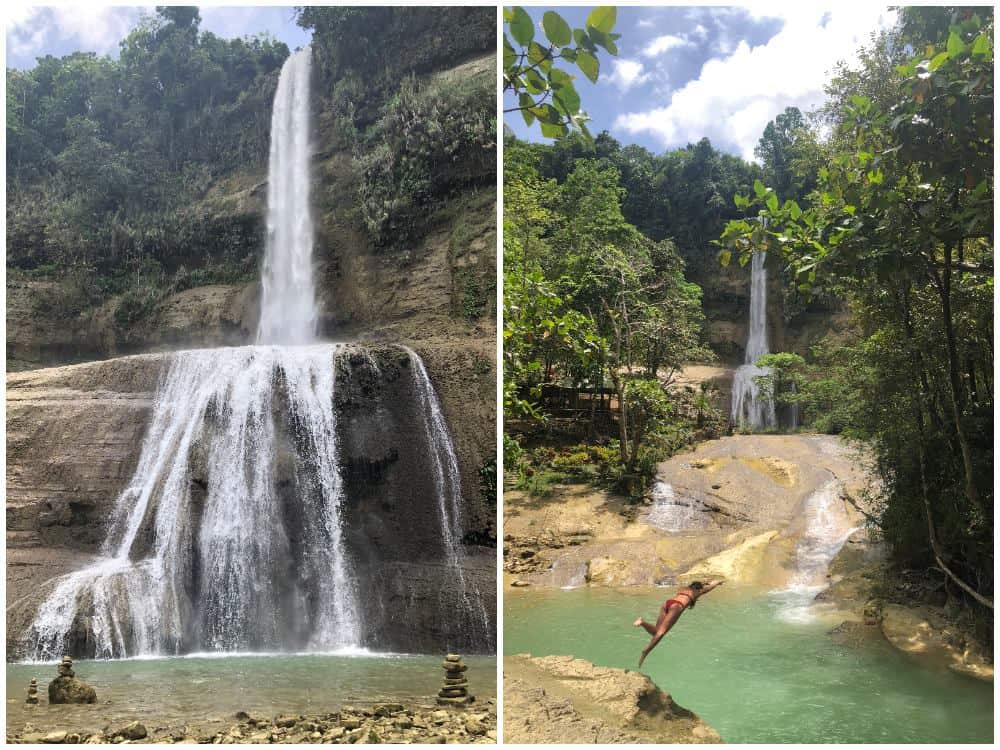
If you’re in Manila, you have tons of alternatives to explore some of the best waterfalls in the Philippines. When we lived there, our favorites were Pagsanjan Falls, also called Cavinti Falls or Magdapio Falls.
As we explain in Day trips from Manila, these are imposing waterfalls of 91 meters high that fall with tremendous force. If you manage to cross the curtain with the bamboo raft, you can explore “Devil’s Cave”.
In addition, the canoe trip to reach them is wonderful. You’ll go in a small two‑person boat through rapids and discover landscapes that appear in Francis Ford Coppola’s film Apocalypse Now.
How to get there
If you’re not in Manila, you’ll be interested in reading How to get to Manila. To go to the waterfall, if you have a car or plan to rent one, just drive to Cavinti or Pagsanjan. This will take about three hours, depending on traffic.
If you’re going by public transport, which is what we did, the best thing is to take a bus to Santa Cruz (Laguna) from Buendia very early in the morning to avoid traffic. If there aren’t many cars, it’ll take at least two hours and tickets cost around 140 pesos, depending on the bus type. Once in Santa Cruz, you’ll need to take a jeepney to Cavinti or Pagsanjan. There are two routes to visit:
- Pagsanjan Route or “Shooting the rapids”: the one we mentioned above and the one we took. We loved it and it made the visit more meaningful. If you choose it, you’ll go by canoe through a canyon and navigate some rapids. It costs 1.250 pesos per person.
- Cavinti Route: you’ll walk about an hour from Pueblo El Salvador (Cavinti). You’ll reach a point where you must descend to the waterfall by rappelling. In this case they charge 270 pesos per person, and you can return by heading toward Pagsanjan by canoe for 360 pesos. To reach Pueblo El Salvador from Cavinti you need to take a tricycle (100 pesos/four people).
Since we’re talking about waterfalls in the Philippines, don’t miss the chance to visit its little sister: Kipot Falls. It’s about 30 minutes from Pueblo El Salvador.
If you want zero hassle, you can book a tour from Manila with KLOOK:
Pagsanjan Falls day trip from Manila
7. Asik-asik Falls (North Cotabato)
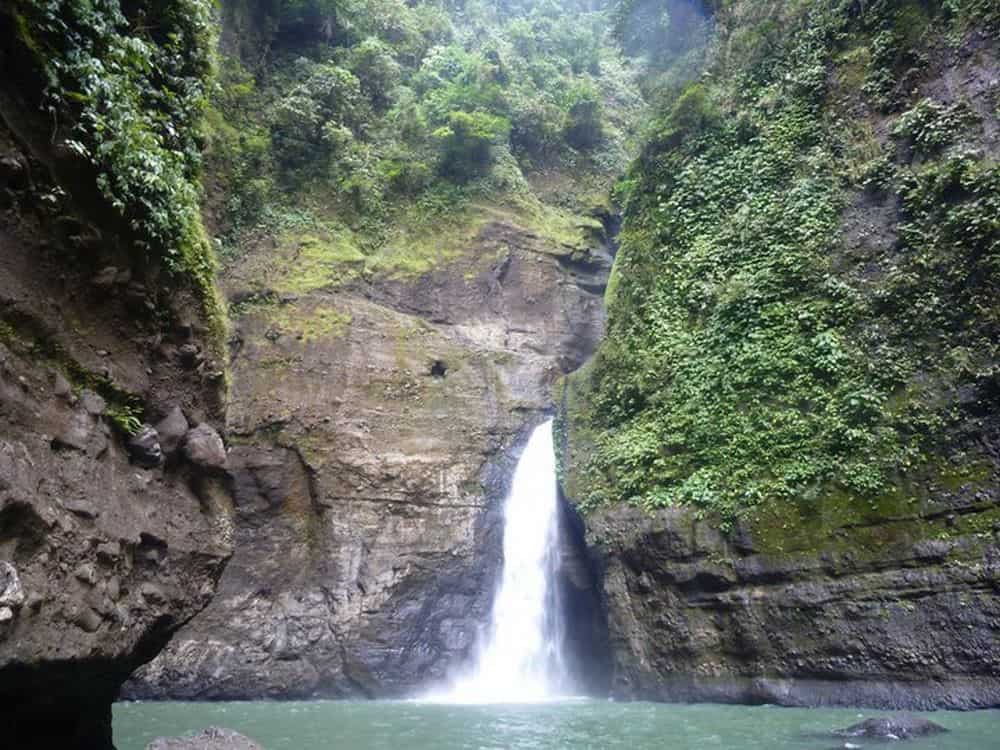
We’re eager to visit these Philippine waterfalls and will do so on our next trip as soon as possible. “Asik” means drizzle in Ilongo, and they’re known as “curtain waterfalls”; these falls look like a true veil of water dropping down a stone wall of lush vegetation. At about 200 meters high and 140 wide, they have a mystical air—especially considering they’re in a remote area, on a gentle hill of Mt. Ragang.
The site is still almost untouched because it’s quite complicated to reach and due to the safety recommendations for this area of the Philippines. Therefore, we recommend checking the consulate to learn about the situation at that time.
How to get to Asik-asik Falls?
You’ll need to get to Cotabato, so the most convenient thing is to take a direct flight. Once there, hop in a van to Midsayap (about 1,5 hours). After that you’ll have to take a tricycle or habal‑habal to the falls (30 minutes).
If you’re exploring the area, don’t miss other attractions such as Lake Sebu, the Blaan Cultural Village, or the Hot Sulphur Spring Resort.
8. Cambais Falls (Cebu)
As we mentioned, south of Cebú City you’ll find some of the best waterfalls in the Philippines. Kawasan Falls are the most famous, but you could spend a week touring the area without repeating others. Among our selection, one of our favorites is Cambais Falls, which remain very unspoiled and off the tourist radar.
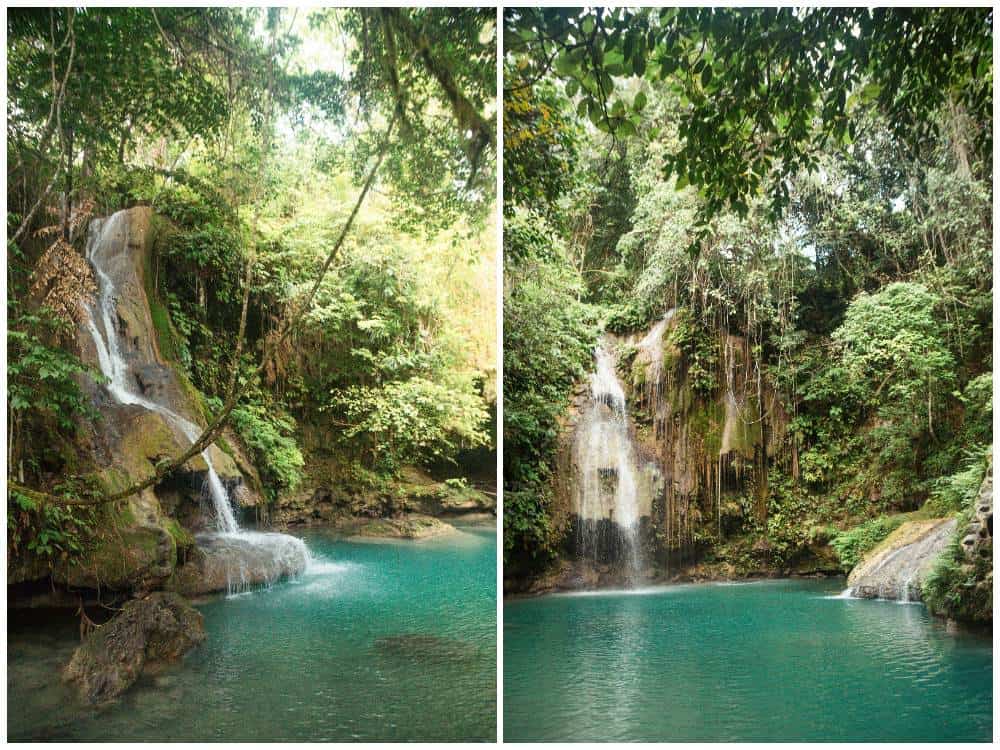
These waterfalls have three lovely tiers where you can take a dip. In our opinion, the prettiest is the first, with two beautiful falls dropping into a large, clean pool surrounded by vegetation. The more adventurous can climb a path on the left side of the higher fall and jump into the pool.
On the right side you can access the second tier, where there’s also a small pool, and you’ll easily see a wooden ladder that takes you to the third. This is the smallest but the wildest, with two small yet powerful drops.
If you go Monday through Thursday, we’re sure you’ll have them to yourself. You’ll have to pay 50 pesos to access.
You’ll find all the information in our article Cambais Falls, Cebú.
Are you in love with waterfalls and looking for the best in the Philippines? Then we suggest setting aside a few days to explore this area. Other interesting ones around here are: Aguinid Falls, Dao Falls, Montpellier Falls, Inambakan Falls…
How to get there?
What we did was go by motorbike from Moalboal. We got one in good condition for 350 pesos per day and it took about an hour. We strongly recommend taking the road called Alegria Barangay Rd and not the one Google Maps suggests (Brgy Valencia Road), which is absolutely crazy. Once there you’ll see a small parking area that’s usually guarded (you can leave a few pesos) and you’ll have to walk 5–10 minutes. It’s very easy—don’t worry.
We don’t know if there’s public transport to reach them, and it doesn’t look like it. You could catch any bus heading toward Santander and get off on the main road. From there you’d need to hire a habal‑habal, but keep in mind it’ll be expensive, as it’s quite a long stretch.
9. Cambugahay Falls (Siquijor)
Siquijor is one of our favorite islands because there’s so much to do despite its small size. In addition to the beautiful beaches of Siquijor, viewpoints, and colonial remains, what defines it most are its lush turquoise‑water waterfalls. While Lugnason Falls are very cool, the ones that deserve a spot on this list of Philippine waterfalls are Cambugahay.
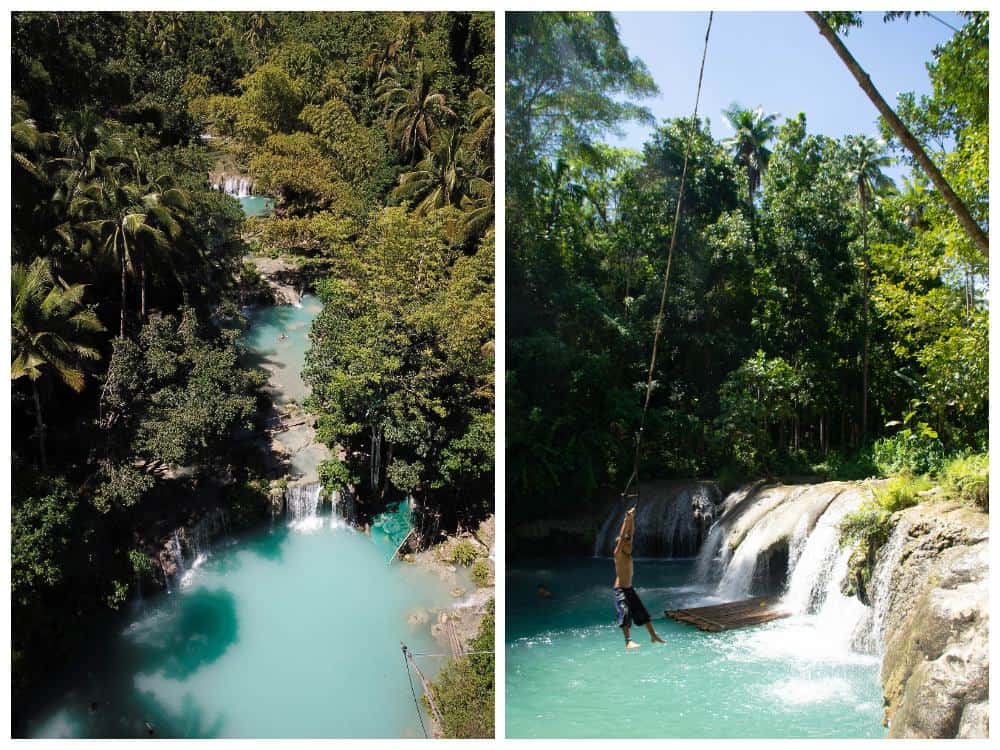
Besides the intense color of the water, what will win you over is the lush vegetation surrounding them. There are three swimming levels, the most popular being the first. Unfortunately, these Philippine waterfalls have become quite touristy and a few shops have been built, as well as platforms to swing in on a rope. Even so, they’re still truly wonderful.
If you want them to yourself, the best time is first thing in the morning, but we suggest going between 11:00 and 13:00. At that time, the sun is highest and the water color is at its best.
The entrance fee is only 10 pesos, but if you want to swing on one of the ropes you’ll have to pay 50 pesos. You can jump all day—it’s unlimited!
Need more freshwater? In addition to Cambugahay and Lugnason, in Siquijor you can visit other waterfalls such as Lagaan Falls, Locong Falls, or Kawasan Falls.
How to get there?
First, you’ll have to get to the island. You can find all the information in How to get to Siquijor.
Public transport in Siquijor is almost nonexistent and getting there that way is pretty tedious. The most common way to reach them is by motorbike (around 300–350 pesos per day) from the San Juan area, where most places to stay in Siquijor are found. From there it takes about an hour.
Another way is to hire a tricycle to take you to this and other spots on the island on a day tour. Prices are around 1.200 pesos for up to four or five people, depending on how many you are.
Discover everything about this island in our Siquijor Guide. You’ll find all the information about these falls in our article dedicated to them: Cambugahay Falls.
10. Maria Cristina Falls (Iligan)
We’ll finish with the one known as the “Queen of the Philippine waterfalls”. Maria Cristina Falls are very close to Iligan City, in Mindanao. At 98 meters high and with a flow that reaches 130 cubic centimeters per second, the sight is almost glorious. In the rainy season, the water falls in two streams separated by a rock, so they’re also called “Twin Falls”.
In fact, the legend says that María and Cristina were twin sisters who lived in Iligan and fell in love with the same man. He, in love with both, didn’t know which to choose, and they were willing to sacrifice for each other. So María, the younger one, went to the falls and jumped. When Cristina found out, she did too. The man buried them there, decided never to marry, and named the waterfalls in their honor.
These Philippine waterfalls are along the Agus River. The drop is so strong that it generates 60% of Mindanao’s electricity thanks to the hydroelectric plant at the base.
Unfortunately, for safety reasons, it isn’t possible to swim or fly a drone, but you can sit and enjoy them in the picnic areas or the restaurant. If you want more activity, there’s even a zip line.
They usually open to the public only on Saturdays, Sundays, and holidays, when the hydroelectric plant isn’t operating.
By the way, if you’ve come all the way to this corner of the Philippines, don’t miss the nearby Tinago Falls and lesser‑known ones like Mimbalot Falls, Dodiongan Falls, or Kalubihon Falls.
How to get to Maria Cristina Falls?
You’ll need to look for flights to Iligan City. Once there, take a jeepney to barangay Buru‑un and tell the driver to stop at the Maria Cristina/NPC eskina (12 pesos/20 minutes). From there, there’s a shuttle service to the viewpoint.
Map of the best waterfalls in the Philippines
Here you’ll find the locations of the best waterfalls in the Philippines so you can get an idea when planning your itinerary.
Did you like this selection of Philippine waterfalls? If you have any questions or recommendations, we’d love to read you in the comments.