Beaches, waterfalls, volcanoes… But food is an important part of any trip to the Philippines, which is why many travelers ask us: what can you eat in the Philippines? What is Filipino cuisine like? What are the typical drinks? To answer all these questions, here we are—we’ve created a mega‑guide with everything you need to know about eating and drinking in the Philippines.
Keep reading and discover everything about Filipino cuisine so you can enjoy your Asian adventure even more.
What is Filipino cuisine like? Characteristics of food in the Philippines
Before we start talking about typical dishes, we’d like to give you a brief summary of the traits that define Filipino cuisine.
Like cuisines around the world, the Filipino table is a blend of different influences and, unlike others in the region, it has a very important Spanish component. The almost four centuries of colonization are evident not only in the churches you’ll see on your trip or in many of the Tagalog or Bisaya words you’ll hear, but also in many dishes. That’s why you’ll notice Filipino food has a lot of traditional Spanish stews or cozidos such as menudo, kaldereta, pochero or even paella, which also has its Asian version. The vast majority of them begin with a sofrito, just as we do at home, so you’ll notice that familiar flavor. In addition, Filipinos quickly embraced preparations of embutidos (cured sausages) like logganisa or morcon, which they don’t hesitate to grill almost every afternoon.
What’s more, the Spanish and the trade with Latin America (the so‑called Manila Galleon route) also introduced ingredients and crops that weren’t used here before. This includes chocolate, corn, potato, tomato, pineapple, bell pepper, avocado and peanuts, which you can now find in any Filipino kitchen.
Meanwhile, trade with China brought ingredients like soy sauce, tofu and fish sauce. Dishes such as pancit (Filipino noodles), lumpia (the Filipino version of spring rolls) and siopao (meat‑filled buns) also took root.
Ties with other Southeast Asian countries can also be seen in Filipino food. This is the case with bagoong, a shrimp paste, or the use of tamarind in dishes like siniggang, which came from Malaysia.
Finally, the Americans popularized ice cream, fried chicken, sausages, hamburgers, evaporated milk, and the ultra‑popular instant coffee. You’ll quickly notice it in the number of American‑style chains in almost every city.

What do Filipinos eat?
Looking at its influences, you could say that food in the Philippines is rich in oils, fats, and sauces. Flavors are often a combination of sweet, salty, and sour, and the ever‑present component is rice, eaten at almost every meal and the basis of any household’s diet. Here chopsticks aren’t used; people eat with kutsara and tinidor or directly with their hands, especially at fiestas.
Besides rice, another foundation of Filipino cuisine is meat. Pork and chicken are most common, though you’ll also find dishes with beef and, of course, fish. Tilapia, mackerel, shrimp, tuna, clams, squid… are all common. Most stews include carrot, cassava, camote (sweet potato) or potato, and many incorporate coconut milk and jackfruit (jackfruit). Ginger, soy sauce and vinegar are widely used, and many meat dishes are served with chili, although, with a few exceptions, Filipino food isn’t spicy at all.
Filipinos also typically eat three meals a day: breakfast, lunch and dinner. Even so, they love to snack, and it’s not unusual to have a merienda or look for some pulutan, that is, something to eat with the hands between meals.
On special occasions, what’s known as a boodle fight is served: a huge, spectacular spread arranged on banana leaves where kamayan—the art of eating with your hands—is practiced. There’s no shortage of rice in large quantities, all kinds of meats and fish, and some fruit arranged very decoratively. If you want to try it, in tourist areas like El Nido or Bohol you’ll find restaurants that organize boodle fights. Some island hopping companies in Siargao, Coron and El Nido do it as well.

How much does food cost in the Philippines?
Food prices in the Philippines depend a lot on where you choose to sit down to eat, but in general we can tell you it’s very affordable. If you go to local restaurants, the carenderias or eateries, you can get a hearty plate of food for 40–70 pesos, depending on what you decide to try that day.
If you order à‑la‑carte dishes, prices can rise to 150–200 pesos, even more if you plan to order fish or seafood.
As for drinks, many restaurants offer free potable water. If you want a soft drink, it’s common to pay 15 or 20 pesos (40 or 50 if it’s in a can). Beers are around 70 pesos and you can find cocktails for 120–150 pesos, even cheaper if you take advantage of “happy hour”.
On the other hand, the Philippines also has loads of restaurants of all qualities and prices. In tourist areas and big cities you’ll find gourmet spots where dish prices can exceed 400 or 500 pesos. You decide what you want to spend.
If you’re interested in budgeting, be sure to check out our article How much does it cost to travel to the Philippines?

Where to eat in the Philippines?
We encourage you to try as much as possible by eating at a carinderia or eatery. These are the traditional places to sample Filipino food. You’ll find plenty of little pots or trays with the day’s dishes. You just have to lift the lid or ask what’s on the menu; they’ll kindly tell you what it is. Order a serving of rice and the dishes you want to go with it.
Carinderias open early in the morning, since Filipinos are used to eating rice with fried egg, sausages or even a stew or soup.
You’ll also be surprised to see bakery shops almost everywhere in the country. Filipinos love sweets and these countless little buns are their downfall. For 2 or 3 pesos you can buy a pandesal, a kind of sweet roll you can have for breakfast. It’s not unusual for them to sell donuts, ensaymadas, their own version of “French bread” or “Spanish bread”, as well as other delights like coconut bread and banana or pineapple cakes. For just 20 pesos you can feast any time of day.
Of course, the Philippines also has restaurants serving Western food and other Asian cuisines. In addition, it’s one of the countries with the highest number of fast‑food chains. It’s rare for even the most remote cities not to have their own McDonald’s or KFC, as well as Filipino chains like the famed Jollibee (burgers and fried chicken), Chowking (Chinese food), Mang Inasal (grilled meat and unlimited rice) or Greenwich (pizza). Many of them are even open 24 hours.

Can you drink tap water in the Philippines?
No, tap water isn’t potable, and Filipinos don’t drink it either. In almost any restaurant and hotel you’ll find huge containers of drinking water, which is what they drink and therefore perfectly fine for human consumption. In many cases it’s free or you’ll pay a couple of pesos to refill your glass or bottle.
Of course, bottled water is also available in the Philippines, but we encourage you to be a responsible traveler and bring your own bottle and refill it, thus avoiding plastic consumption. We have a stainless‑steel bottle like this one, which we refill and which keeps our water cold for almost 8 hours.
Basic dictionary for eating in the Philippines
You’ve already seen some interesting words related to Filipino cuisine, but if you want to get by a bit better, here are a few that will help you:
- “Baso”: glass
- “Mesa”: table
- “Tinidor”: fork
- “Kutsara”: spoon
- “Kutsilyo”: knife
- “Plato” y “platito”: plate and small plate
- “Masarap”: it’s delicious!
- “Merienda”: a snack you can have mid‑afternoon or mid‑morning
- “Walang carne”: no meat; very useful if you’re vegetarian
- “Kain tayo”: let’s eat!
- “Tagay”: cheers! Used for toasting
- “Pila? (in the Visayas) or “Magkano? (for Luzon and Palawan)”: how much?
If you use them, you’ll get more than one smile from a Filipino, you’ll see. Remember that Filipinos use the same words as we do when counting (uno, dos, tres…).
Also, when asking for the bill, Filipinos have a different gesture. Unlike us, here you make a rectangle using both hands to indicate a receipt or a bill.
Typical Filipino dishes
Now that we’re into it, you need to know what’s most interesting to eat in the Philippines. So we’ve put together a small selection of typical Filipino dishes. Of course, this isn’t everything, but by trying them you’ll get a feel for Filipino cuisine.
1. Pancit canton or bihon
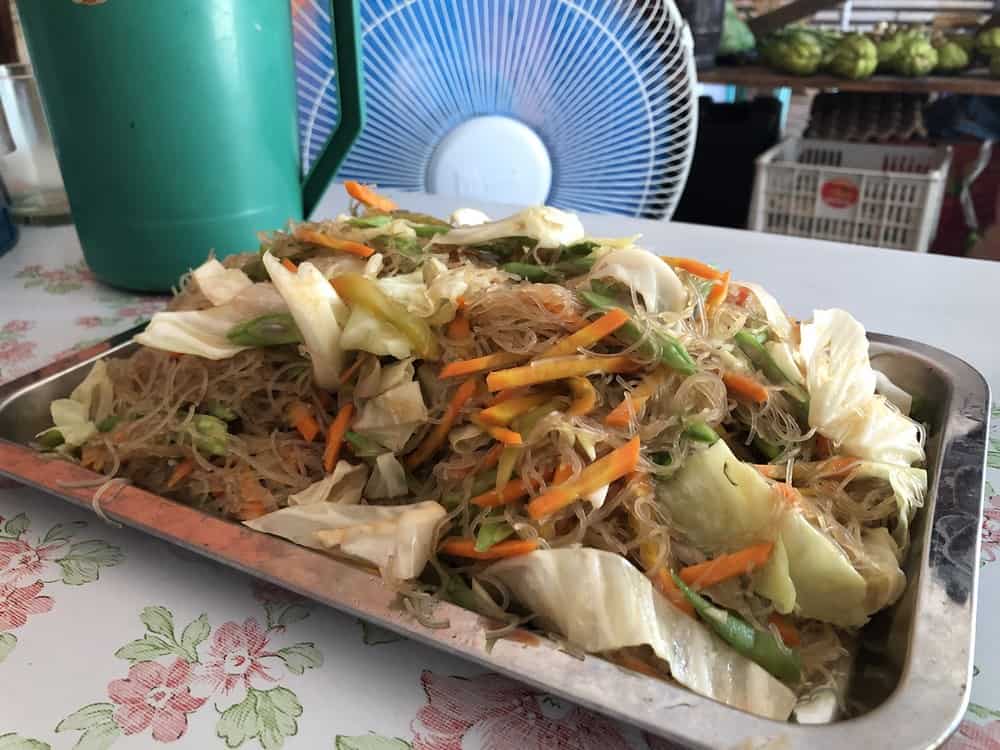
We start our tour of typical dishes in the Philippines with one of the simplest and tastiest: pancit. It’s the Filipino version of noodles, introduced by the Chinese community back in the 7th century.
Pancit has many variations, but the best‑known are canton and bihon, which differ by the type of noodle used. Canton uses thick, egg‑based noodles, while bihon is made with thin rice noodles and usually has more sauce, hence why it’s sometimes called pancit bihon guisado.
The noodles are accompanied by vegetables (usually cabbage, carrot, bell pepper, onions and green beans), garlic, soy sauce, a bit of meat and sometimes patis (fish sauce). Of course, it can be made in a vegetarian version if you ask them to hold the meat and fish sauce.
2. Lumpia
As we mentioned above, Filipinos adopted many cooking techniques and dishes during the heyday of trade routes with China. One of the clearest legacies of this is lumpia, the pinoy version of spring rolls.
They’re made with a thin, crêpe‑style egg wrapper that encases a filling usually made of vegetables. It’s fried and typically crisp, so it’s common to dip it in sauces like agre dulce (sweet and sour), soy sauce or banana ketchup. In some parts of the Philippines it’s also served fresh—that is, not fried—using a thinner rice wrapper.
If you get the chance, don’t hesitate to try the sweet version of lumpia, turon. In this case, the filling is Saba banana, so it’s often eaten as dessert or a snack.
3. Adobo, an essential to eat in the Philippines
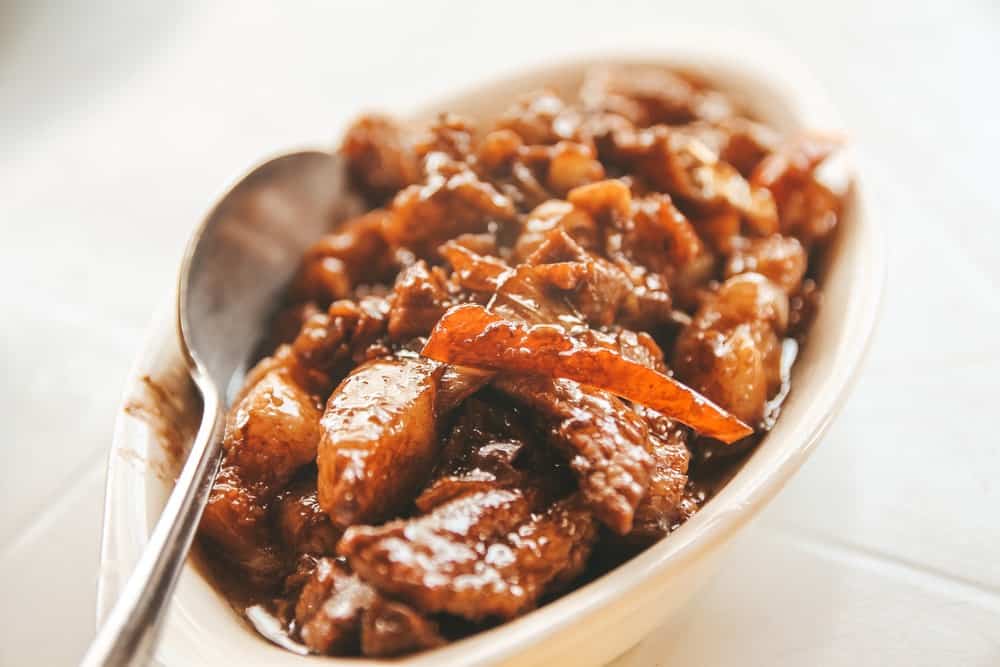
Descended from Spanish tradition, adobo is one of the most common dishes to eat in the Philippines. In colonial times, Spaniards exported this way of preserving meat and fish in an era without refrigerators.
Although it can be made with many meats, the most popular stew is chicken adobo, in which chicken is marinated with soy sauce, vinegar, pepper, garlic and bay leaves. Unlike Spanish adobo, the Filipino version blends sweet and salty and, of course, is always served with rice.
4. Sinigang, the most typical soup to eat in the Philippines
Filipinos are big “soup‑lovers”, and the best example is sinigang. This typical Filipino dish is usually made with fish, though it can also feature seafood, pork or chicken. Whatever it includes, what sets sinigang apart is that it’s sour, since it’s cooked with unripe tamarind, calamansi, guava or green mango. Vegetables such as onion, radish, tomato, kankong, eggplant or bell pepper are added to the meat and fish, along with a touch of chili.
5. Lato
Filipino cuisine also has a notable sea component: seaweed. Lato is one of the most common types and is known as “sea grapes” because it looks like tiny green beads. Lato is rich in iodine, magnesium and calcium, and it’s also delicious; it’s commonly eaten in salads or as a side for fish or seafood such as kinilaw. It can also be eaten with tomato, onion, vinegar and salt.
6. Kinilaw
Did you know that one of the typical dishes of the Philippines is very similar to ceviche? In fact, it’s believed that the recipe for kinilaw traveled along the Manila Galleon route to Mexico and Peru and that ceviche’s origin is actually Filipino.
Kinilaw is made with raw fish (usually mackerel, swordfish, tuna or milkfish) marinated with vinegar (often coconut vinegar), calamansi juice, tamarind, green mango, starfruit (star fruit) and other citrus like dayap or biasong. Onion, ginger, pepper, chili, coconut milk and a bit of sugar are added to temper the acidity.
There are different variants of kinilaw depending on the main ingredient. It’s also common to find kinilaw made with shellfish, sea urchins, seaweed or even worms (tapilok) and other critters. It can be made with vegetables too, usually eggplant. Meanwhile, kilawin is the term used for meat “kinilaw”, where the meat is briefly cooked before marinating.

7. Tortang talong — a must‑try in the Philippines
Tortang talong is a staple of any carenderia at any time of day. It’s one of our favorite things to eat in the Philippines and is also perfect if you’re vegetarian.
“Talong” means eggplant, so its literal translation is eggplant omelet. It’s made with long purple eggplants that are grilled until soft and easy to peel. They’re then flattened with a fork and dipped in beaten egg with salt and spices. It’s fried until golden and usually served with rice and a sauce like soy sauce or vinegar.
There are different variants known as rellenong talong, in which other vegetables and/or meat are added to the eggplant.

8. BBQ and chicken inasal
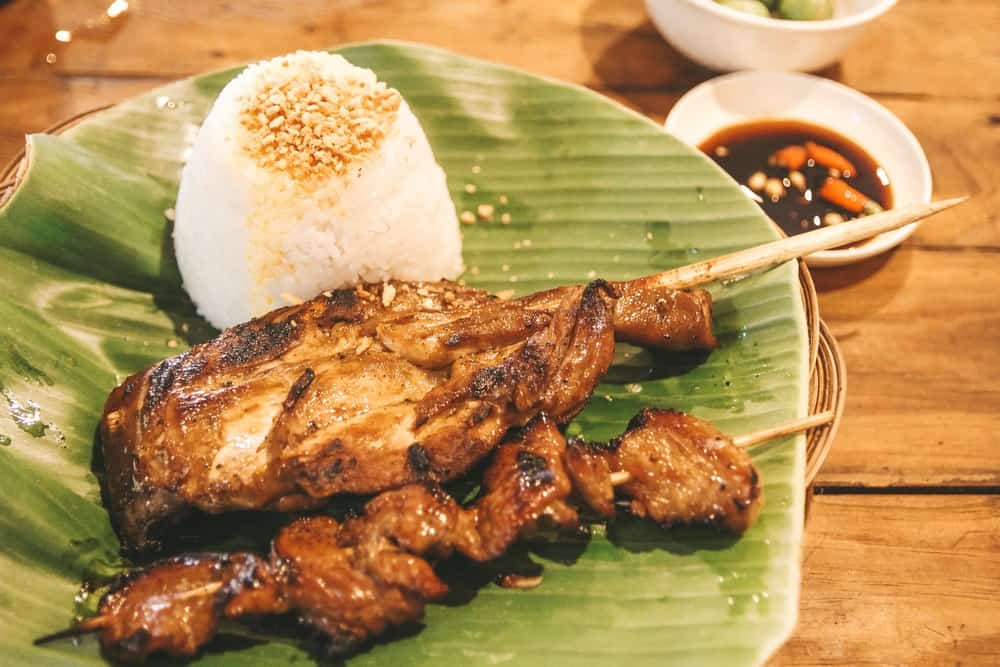
We always say the smell of the Philippines is that of the grills that almost any house or restaurant sets out on the street as soon as the sun starts to set. The love for pork bbq (skewered barbecued pork) is almost total—not only for the flavor but also because it’s cheap. The meat is marinated with soy sauce, garlic, calamansi juice, sugar, chili and even ketchup. Once it’s well seasoned, it simply goes on the grill until nicely charred—and then, time to eat!
Of course, any kind of meat or animal part can be used, so it’s not unusual to find liver, intestines or heart skewers.
On the other hand, chicken inasal is another star of Filipino cuisine. It’s a traditional way of cooking chicken from Bacolod (Negros), but nowadays you can find it almost anywhere in the Philippines thanks to the Mang Inasal chain. The meat is marinated for at least an hour with soy sauce, calamansi, vinegar, ginger, garlic, salt and brown sugar, and then grilled. The best way to eat it is alongside garlic rice and sawsawan, a dip you can make yourself in a platito (saucer) by combining vinegar, soy sauce, calamansi and crushed chili.
If you have time in the capital, as we mention in Best restaurants to eat in Manila, go have pecho at JT’S Manukan Grille—you won’t regret it.
9. Sisig
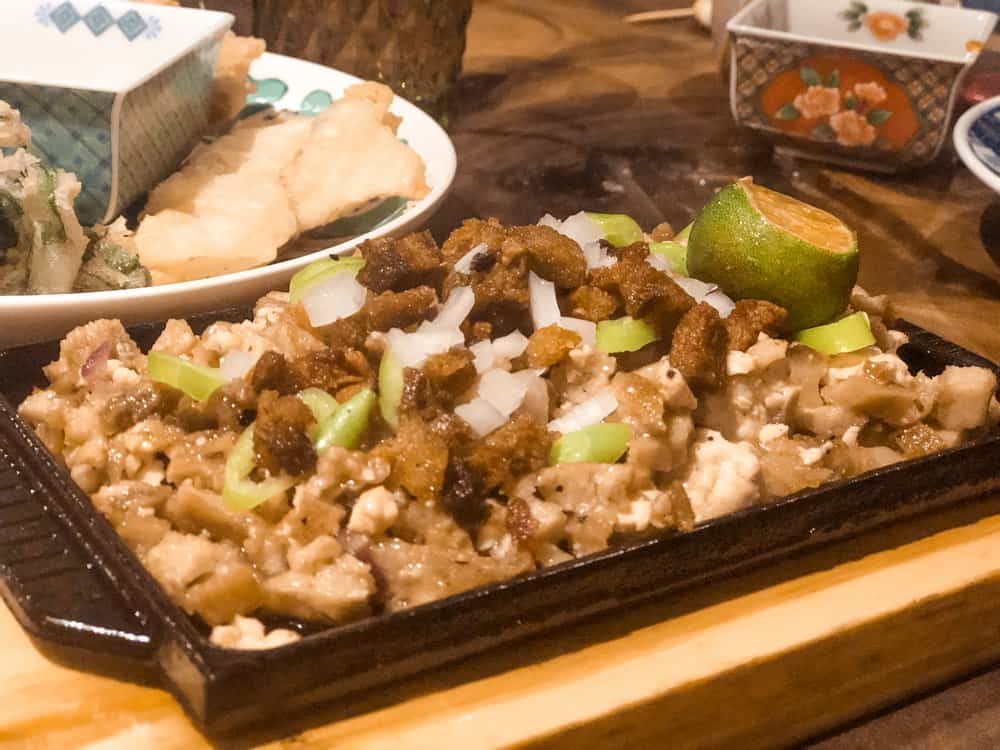
Sisig is one of the most typical Filipino dishes and therefore easy to find all over the country. Traditional to Pampanga, it’s considered a hangover‑buster since it basically combines various cuts of meat that are boiled, then grilled and served piping hot and sizzling on a platter. Typically a whole pig’s head is boiled first (including EVERYTHING: ears, snout, brains…), then chopped and grilled. Liver is often added, along with soy sauce, vinegar, calamansi juice, bay leaves, pepper, chili, onion, ginger and, finally, a raw egg that cooks in the residual heat.
As you can see, it’s a hearty, no‑waste dish that uses absolutely everything. There are many variants of sisig and it can also be made with other meats or fish. Vegan or vegetarian restaurants also serve tofu sisig.
10. Afritada
Derived from the Spanish word “fritada”, this dish is first prepared by frying or sautéing meat (chicken, pork or beef) with onion and garlic. Tomato sauce, carrot, potato and bell pepper are then added to make a tasty stew.
Sometimes it’s cooked hamonado‑style, that is, using chunks of pineapple for an even sweeter touch.
11. Kaldereta
The name is already a big clue: kaldereta is one of the dishes most similar to its Spanish counterpart. It’s usually a beef stew (goat is also common) that never lacks a sauté of onion and tomato, plus potatoes, bell peppers and peas. Of course, in the Philippines it’s always served with rice instead of bread for dipping.

12. Kare‑kare
Filipino food also has Indian influences, and the best example is kare‑kare, a take on their curries. It’s a stew cooked with vegetables, garlic, onions, calamansi, peanuts and meat, usually oxtail and some offal. In many cases bagoong (shrimp paste) is added as well.
13. Silog
Strictly speaking, silog isn’t a dish but rather a way to name traditional Filipino breakfasts. The word “silog” comes from sinangag (fried rice, though often it’s just plain white rice) plus itlog (fried egg), to which one or more ulam—that is, viands or sides—are added. Depending on what you add, silog takes on different names such as:
- Tapsilog: with tapa, meat cured with salt and spices and then fried or grilled. It usually comes with atchara, a pickled papaya side.
- Longsilog: with logganisa.
- Hamsilog: with “ham” or, more commonly, spam (canned pork slices).
- Cornsilog: with corned beef, very salt‑cured beef that usually comes canned.
- Hotsilog: with hot dog.
- Daingsilog: with daing, dried fish.
14. Bicol Express
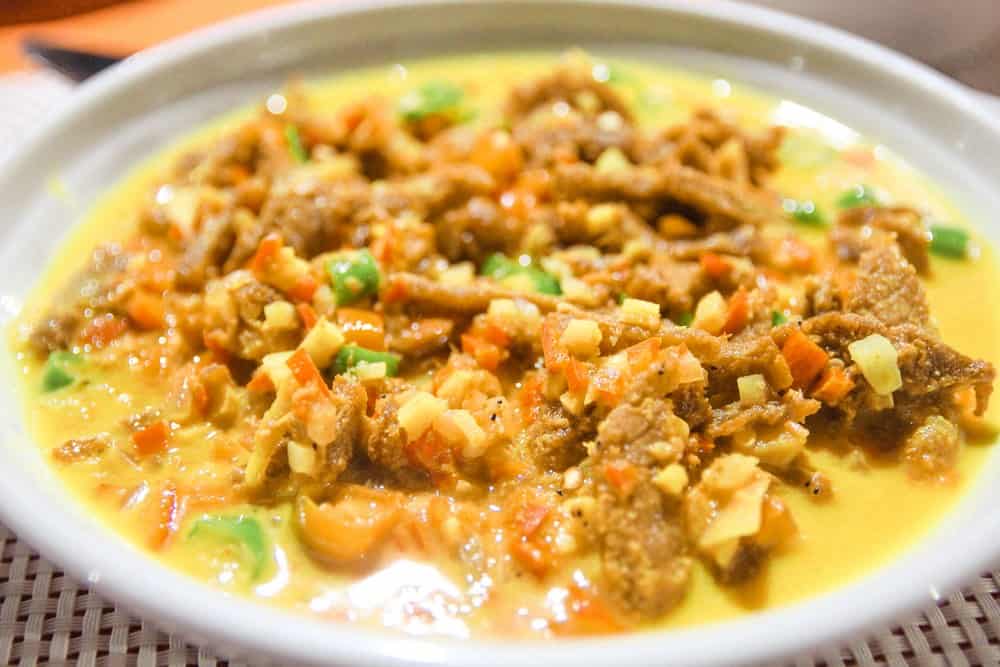
This is one of our favorite typical Filipino dishes—and it’ll be yours if you like spice. Traditional to the Bicol region, it’s a stew with coconut milk, shrimp paste, onion, garlic, pork and generous amounts of green chili. It’s not very common in carinderias, but you’ll find it in many restaurants that serve à‑la‑carte dishes.
15. Bonus track to eat in the Philippines: balut
We finish our tour of typical Filipino dishes with a snack you might not want to try. Balut is a source of pride for many Filipinos and is credited with many nutritional powers, including sexual vitality. It’s a fertilized duck egg, that is, an embryo allowed to grow for 2 or 3 weeks and then boiled. As you can imagine, the duck is already somewhat developed and you may even notice a few bones when you eat it…
It’s usually sold by street vendors, and the technique is simply to open a hole, sip the “broth” and then add the seasonings—usually salt, vinegar, garlic and chili. Let us know what you think…
Typical Filipino desserts
Time for something sweet! Filipinos love anything sugary, so the variety of desserts is huge. Here’s a selection of typical Filipino desserts to try during your trip:
1. Halo‑halo
It might not look very appetizing, but halo‑halo is the flagship dessert of the Philippines and we recommend giving it a chance. As the name suggests, it’s a wild “mix” of ingredients that vary by whoever makes it, but it’s usually shaved ice with evaporated or condensed milk plus sweet red beans (yes!), corn, leche flan, coconut cream, ube (a purple tuber), tapioca, various ice creams, gulaman (gelatins), pinipig rice (toasted‑style rice), different fruits (such as jackfruit) and sweet potato.
It may sound odd, but it has its charm and tastes better than it looks. Give it a try!
2. Leche flan — our favorite dessert to eat in the Philippines
This is our favorite Filipino dessert. It’s a richer, denser version of custard, since it includes condensed milk and uses even more egg yolks. Only for those with a serious sweet tooth.

3. Puto
Despite the name, puto is one of the most common desserts in the Philippines. It’s a steamed rice cake to which ube, pandan, cheese or coconut milk is often added. There are many varieties, such as puto bumbong (made in bamboo), puto manapla (steamed in banana leaves) and puto mamón (which isn’t made with rice and combines egg yolks, salt and sugar).
4. Banana or camote cue
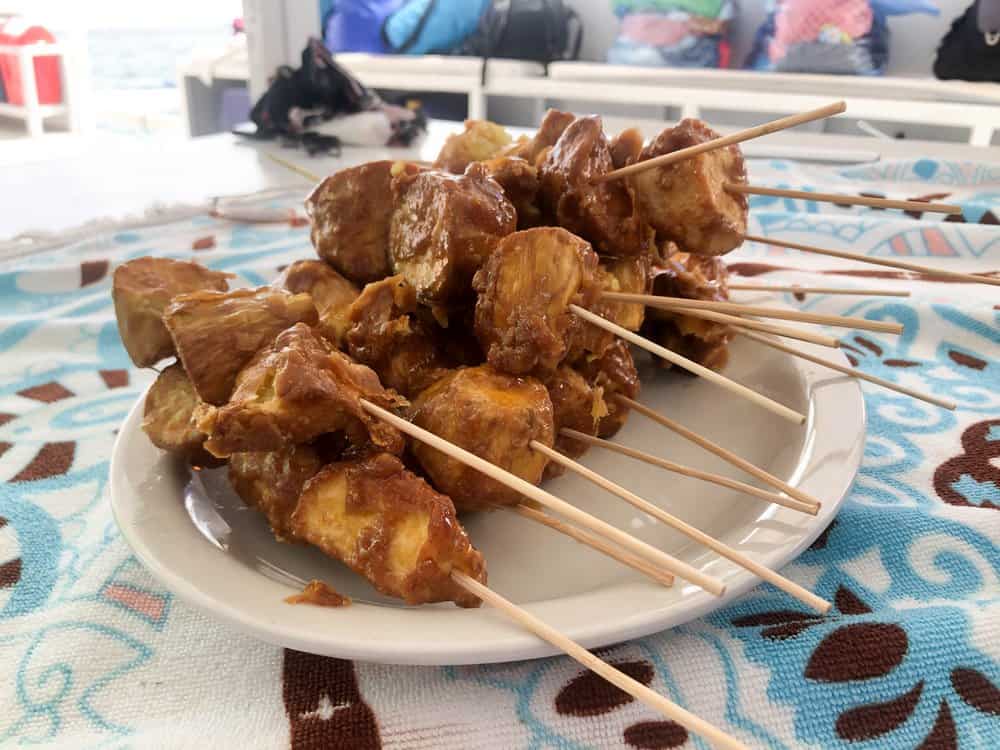
This is one of the most famous Filipino street foods. It’s basically a skewer of banana or camote (sweet potato) cooked on the barbacue—hence the “cue”. The banana used is usually “Saba”, which is a little firmer than what we know. They’re fried in brown sugar until soft, giving them a delicious texture perfect any time of day. Plus, it’s rare for a cue to cost more than 5 pesos—a bargain!
5. Taho
Another staple of Filipino street markets—and even beaches, where it’s not unusual to see vendors carrying two huge aluminum buckets. One contains soft, fresh tofu and the other arnibal (syrup) and sago pearls (similar to tapioca).
The magtataho (taho vendor) serves it in plastic cups of two or three sizes. With a ladle they scoop thin layers of tofu and then add sago and syrup. You’re in charge of mixing it and eating it with a spoon or drinking it directly. On your quest to discover what to eat in the Philippines, this can’t be missed. Masarap!

6. Mango float
Runner‑up among our favorite desserts to eat in the Philippines is mango float, a kind of cake that features the country’s delicious mangoes. It tends to include industrial amounts of condensed milk, Graham crakers (a type of cookie) and cream, layered up. The mix goes into the freezer, so it usually has the consistency of an ice‑cream cake.
Eating vegetarian in the Philippines — is it possible?
The Philippines has a pretty bad reputation among vegetarians and vegans—but is it entirely deserved? As vegetarians ourselves, we can tell you that in large part it is, but things aren’t that bad (on our first trips to the Philippines we still ate meat, so we can speak about the cuisine from experience). Although it’s not the friendliest country for those of us who don’t eat animal products, surviving isn’t mission impossible—we say this because we spend much of the year traveling here.
In tourist areas and big cities there are more and more vegetarian restaurants where you can eat in the Philippines—for example, the Shaka chain (El Nido, Moalboal, Siargao and Bohol), Green Bar (Manila), Planet Vegis (Cebu) and Ver De Plant‑based Café (Puerto Princesa). It’s also possible to eat vegetarian at Filipino carinderias, as long as you ask and make sure about each dish’s ingredients. Many Filipino foods are 100% vegetarian, but many others include small bits of meat, bagoong (shrimp paste) or patis (fish sauce), so we recommend double‑checking. Many Filipinos also assume vegetarians eat seafood or fish.
You’ll find a great selection of restaurants in our article Best vegetarian restaurants in the Philippines.
We do have to admit that eating vegan in the Philippines is quite a bit harder. Although dairy (except in desserts) isn’t that common, quite a few dishes include egg. Even so, you can always focus on salads and fruit, and pop into shops to get legumes (you can buy chickpeas almost anywhere) or soy milk (our beloved Vitamilk Energy doesn’t contain cow’s milk).
Here are some vegetarian dishes to eat in the Philippines: pancit bihon (canton uses egg‑based noodles), adobong kangkong (a sort of water spinach), pinakbet (make sure it doesn’t include bagoong), monggo (Filipino mung beans; make sure it doesn’t include meat), lumpia, latik (a stew with coconut milk and squash), chopsuey, ensaladang talong (a sort of eggplant kinilaw), tortang talong (pumpkin omelet), ampalaya (a very bitter vegetable; often includes egg), banana cue, taho and kuchinita (a sweet made with cassava and rice).
You can also use these phrases to indicate you’re vegetarian or vegan:
- “Ako ay Vegan/Vegetarian”: I am vegan/vegetarian
- “Walang Mga Produkto Ng Hayop”: No animal products
- “Walang karne/isda/itlog/gatas/keso”: No meat/fish/egg/milk/cheese

Typical drinks of the Philippines
You need something to wash the food down, right? These are the typical drinks of the Philippines:
1. Filipino beer
Filipinos love beer, and you’ll often find them at night gathered around liter bottles. Maybe it’s just because it means we’re in the Philippines, but we really like the beer here. The two major brands are San Miguel Pale Pilsen and Red Horse, both from San Miguel Brewery.
Both are pale, lager‑style beers with a bitter taste. Be especially careful with Red Horse because, besides mostly being sold in half‑liter bottles, it has an alcohol content of almost 7%—and it creeps up on you. There are also other varieties such as San Mig Light (not less alcohol—just fewer calories and lighter), flavored San Mig (apple and lemon), Cerveza Negra and Gold Eagle Beer.
Of course, in big cities or tourist spots there are more and more craft beers. In some places you’ll also find Brew Kettle, which we love and is Belgian‑style.
Beer prices are usually 40–80 pesos, depending on where you drink. Many shops and restaurants also sell “liters” or big bottles of San Miguel and Red Horse, which work out cheaper.
If you’re Spanish, this name surely rings a bell, right? Today’s brewery descends from La Fábrica de Cerveza San Miguel, founded in 1890 by Enrique María Barreto. Today’s Spanish San Miguel (now owned by Mahou) resulted from the Filipino brewer’s expansion when it decided to try the Spanish market in 1953. The so‑called “Manila Agreement” was signed, under which San Miguel allowed its beer to be brewed in Spain by La Segarra. However, in 2000 the company was bought by Mahou and the Mahou–San Miguel group was formed, leaving the relationship with today’s San Miguel in the Philippines almost nil.

2. Buko juice or simply a buko
Buko is the word Filipinos use to refer to coconut, more specifically the green, not‑yet‑mature coconut, which has lots of water inside. Drinking the water is super refreshing, highly nutritious, helps prevent dehydration and improves digestion. When you finish, ask the vendor to open it so you can eat the white flesh.
You’ll also find plenty of stalls selling buko juice. This typical Filipino drink is basically coconut water with ice, though it’s often served with a little coconut milk or condensed milk. A cup usually costs no more than 15 pesos.
3. Shakes and juices
The Philippines is rich in fruit, so in almost any restaurant or carinderia you can order a shake, that is, a smoothie. Since Philippine mangoes are the best in the world—no debate—our advice is to drink as many mango shakes as you can. You’ll find the ripe variety and also the tangier green mango shake.
Most of these Filipino drinks include sugar or condensed milk, so if you want just fruit, you’ll need to say so.
You also shouldn’t miss calamansi juice. The juice of this small lime is a must‑try on your trip, and it’s packed with vitamin C.
Worried about the ice in shakes and juices? In our experience, we’ve never had any problems drinking these in the Philippines. Filipinos don’t drink tap water either, and the ice they use is made from purified water. If you’re not used to the water, it might upset your stomach a bit, but that’s not common.

4. Tanduay
We wrap up our look at typical Filipino drinks with the omnipresent rum: Tanduay. Sweeter than any rum you’ve tasted before, it’s so inexpensive it’s hard to resist. For under 100 pesos per bottle, it’s common to drink it with Coca‑Cola and a slice of calamansi. But be careful! Like Red Horse, it seems harmless—but it’s a strong spirit, and the next morning can be rough…
If you want something a bit classier, try Don Papa, the best rum brand in the Philippines. Tagay!
Did you like this article about food in the Philippines? Do you have any suggestions or questions? We’d love to hear from you in the comments!