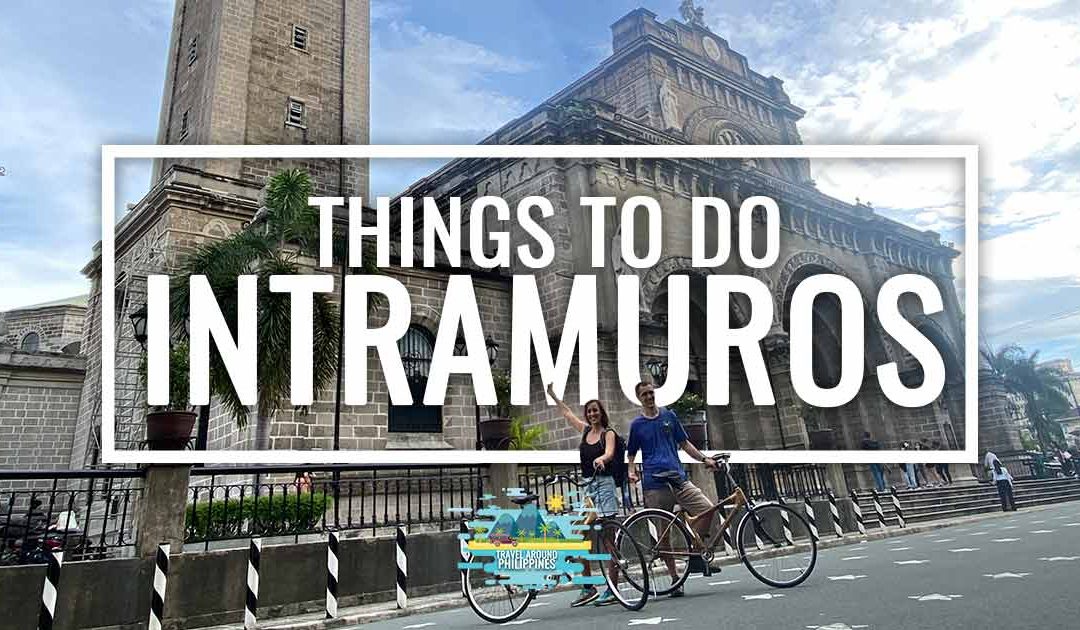
If you’re going on a trip to the Philippines, it’s very likely that at some point you’ll pass through Manila, its capital. While it isn’t the most amazing city in the world and many travelers run away terrified, the capital of the Philippines has several attractions that we consider reason enough to devote at least a few hours. If you don’t have much time, the essential one is Intramuros, a small walled district where you’ll find the most important remains of the city’s colonial past, once known as “The Pearl of Asia”.
Therefore, as acknowledged lovers of Manila (we’ve been lucky to live there and pass through several times each year), today we want to tell you about the most important places to see in Intramuros and how to create an itinerary that helps you experience the best.
By the way, if you’re going to spend at least a day in the city, we recommend reading our guide Things to do in Manila, where we give you all the tips to make the most of your time.
What is Intramuros? A bit of history
On June 24, 1571, the Spaniard Miguel López de Legazpi declared Manila the new capital of the Spanish colony. King Philip II named it “Distinguished and Ever Loyal City,” and Intramuros became the political, military, and religious seat of government of what were called the Spanish Philippines.
The district was planned with a grid layout, in which large squares, such as today’s Plaza de Roma (formerly called Plaza Mayor), served as leisure spaces for the Spaniards and mestizos who populated it for centuries. Monumental buildings, such as the Governor’s Palace, convents, churches, and beautiful colonial houses were located within a several‑meter‑thick wall adorned with dozens of cannons. The wall and its bastions served as defense against multiple pirate attacks and the rebellious population.
However, this wall did little to protect Intramuros from its near‑total destruction on several occasions, especially during World War II. In 1945, during the so‑called Battle of Manila, in which Filipinos and Americans fought the Japanese, Intramuros was reduced to rubble. The only building left standing—and still visible in Intramuros—was San Agustín Church.
In 1951 Intramuros was declared a national monument and reconstruction work began. Although the efforts are evident and, more recently, changes such as the opening of the Intramuros Museum in early 2019 have been seen, the truth is that there is still a long way to go. The goal is for Intramuros to be declared a UNESCO World Heritage Site at some point, but many families settled in the district years ago, building substandard housing that contrasts with the elegant stone colonial mansions and palaces undergoing restoration.
As Spaniards, we think that visiting Intramuros is essential on a trip to the archipelago, as it will help you better understand the history of the Philippines. You’ll feel many ties as you walk streets like General Luna St., Real St., or Anda St. So, keep reading and discover with us what to see in Intramuros, Manila.
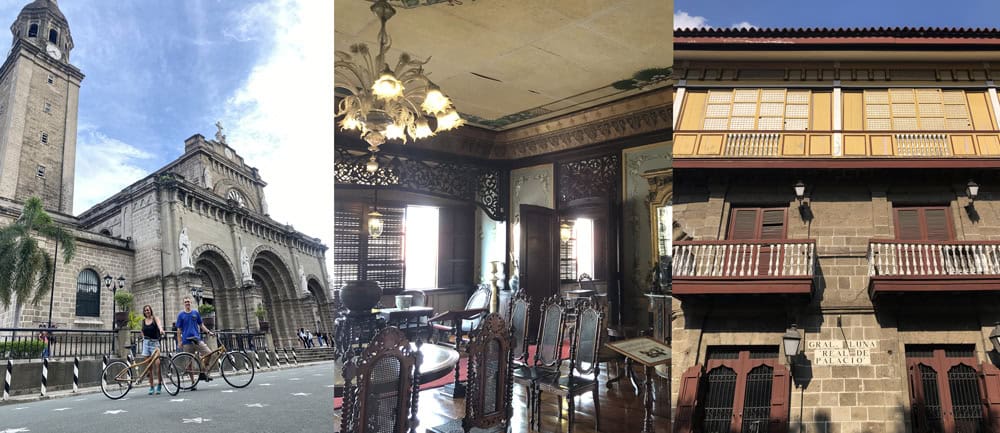
Manila Cathedral – Casa Manila
How much time to spend in Intramuros?
If you’re a history lover, you could spend a full day in Intramuros, but 3 or 4 hours should be enough to see the main points of interest.
You can walk the district on your own, but we advise you to get a guide or join a guided tour. This way you’ll understand much better what you’re seeing and the visit will be far more worthwhile. We recommend choosing one of these four:
Free tour of Intramuros and Chinatown (English)
Guided tour of Intramuros (English)
Afternoon/evening walking tour of Intramuros (English)
Alternative bicycle tours (English)
The last one, the one done by bicycle, struck us as really interesting and enjoyable. It departs from Casa Manila and lasts 1.5–2.5 hours (depending on the option you choose). The guides are super well prepared, and it includes a visit to Fort Santiago, which is one of the basics to see in Intramuros.
By the way, walking around Intramuros is totally safe. Although you hear real falsehoods about safety in Manila and in the Philippines in general, you can stroll around completely at ease. As in any city, be careful with absent‑mindedness and, please, be a responsible tourist and do not ride a kalesa, the horse‑drawn carriages. The animals are in terrible condition and the extremely high temperatures they have to endure every day are an outrage.

Tour of Intramuros in Manila
What to see in Intramuros
These are the main points of interest to see in Intramuros, Manila.
1. Fort Santiago
Fort Santiago is the first must‑see in Manila. It is a citadel ordered to be built by the conqueror Miguel López de Legazpi over the remains of a palisaded fortification belonging to a Muslim rajah who was defeated. The current construction, although renovated, dates from 1593 and is part of Intramuros’s defensive complex.
It is a site of great importance for Filipinos, as this is where José Rizal, the national hero who advocated for Filipinos’ rights in his writings and novels, was imprisoned until he was executed in 1896 by the Spaniards for rebellion, sedition, and conspiracy. Therefore, in Fort Santiago you will find a Rizal memorial where you can learn about his history, find objects related to his life, and see the cell where he spent his last days, in which he wrote the famous poem “Mi Último Adiós.”
As a curiosity, you can also see throughout the entire complex the last footsteps of José Rizal, from his cell to the site of his execution, in Luneta Park.
What can now be visited at Fort Santiago also includes the lovely Plaza de Moriones and ruins of what were barracks and military quarters. In addition, you’ll also find a bar and a souvenir shop.
- Price: 75 pesos for adults and 50 pesos for children and students. You can buy it on KLOOK (Southeast Asia’s answer to Civitatis) from THIS LINK at the same price, so you don’t need to use more cash. They also sell an Intramuros pass, which combines several visits we will talk about below, saving you some money.
- Opening hours: Monday to Friday from 8:00 to 22:00 and Saturdays and Sundays from 6:30 to 22:00. The ticket office closes at 20:00, so from 20:00 to 22:00 they only let you in if you have the ticket purchased on KLOOK.

2. Manila Cathedral and Plaza de Roma
The Metropolitan Cathedral–Basilica of the Immaculate Conception of Manila, or simply Manila Cathedral, is another spot to see in Intramuros. What you see now is far from the original construction, which was established in 1571 by Friar Juan de Vivero, who traveled on a galleon from Mexico under the mandate of Alonso de Montúfar (archbishop of Mexico) to establish Christianity in newly colonized Philippines.
After several constructions of nipa, wood, and bamboo and, later, of stone, the current building dates from 1958 and has been renovated several times. Don’t miss the chance to take a look at its interior—it’s very common to come across a wedding. Entry is free.
On the other hand, the cathedral is located in Plaza de Roma, formerly called Plaza Mayor of Manila and the city’s epicenter during the Spanish colonization. In it you can find two important buildings: the Palacio del Gobernador and the Casas Consistoriales (also called Manila City Hall). Very close to it was also the Royal Audiencia of Manila. In the center of Plaza de Roma there is a statue in honor of Charles IV of Spain, who sent the first smallpox vaccine to the Philippines.
- Opening hours: 6:00 to 17:30 Monday to Friday and 6:00 to 19:00 Saturdays and Sundays
- Price: free entry

3. The Customs House and the statue of Philip II
The Customs building (also known as the Intendencia), although badly damaged by the bloody battles of World War II, is another corner to see in Intramuros. The first building was completed in 1829 but was badly damaged by an earthquake in 1963. The current neoclassical building was erected in 1876 and housed the functions of the Customs, the General Treasury, the Exchequer, and the Mint.
Right in front, in the small Plaza de España, stands the statue of Philip II, the king after whom the Philippines takes its current name. It was inaugurated during Queen Sofía’s visit in the year 2000. As a curiosity, you can read the plaque in Spanish.
It can only be seen from the outside.

4. San Agustín Church and the museum
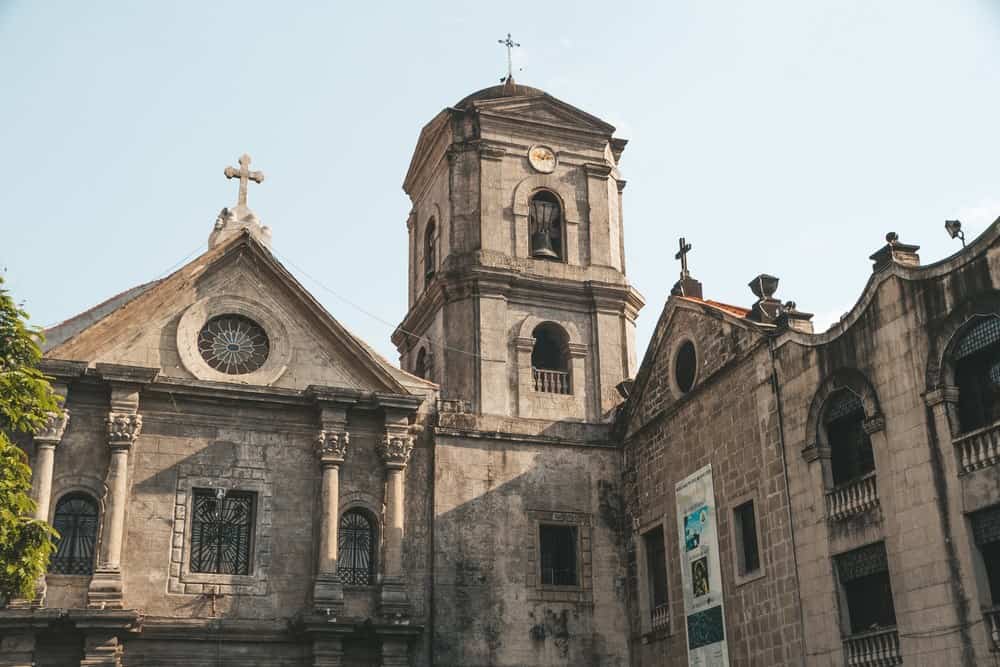
San Agustín Church, a UNESCO World Heritage Site since 1993, is the oldest church in the Philippines still standing. Built in 1607 in adobe and stone to replace the earlier bamboo and wooden structures, it was the only building to withstand the multiple earthquakes and the bombings during World War II. It contains the tombs of the Spanish conquerors Miguel López de Legazpi, Juan de Salcedo, and Martín de Goiti, as well as the painter Juan Luna.
The adjoining monastery, which was destroyed in the Battle of Manila, was restored and now houses a museum that is well worth entering. You’ll not only be able to see the cloister but also part of the heritage that survived and objects donated or moved from other places. You’ll find paintings, altarpieces, ivory carvings, encyclopedic treatises of interest (such as the one that talks about the islands’ flora in the 19th century), and objects from the period of trade with China. For us, it’s one of the most interesting museums in Manila and offers the opportunity to learn about the history of the Philippines.
- Price: 200 pesos
- Opening hours: 8:00 to 12:00 and 13:00 to 17:00 every day
5. Casa Manila, a must-see in Intramuros
Casa Manila is, without a moment’s doubt, one of the places to see in Intramuros without fail. It isn’t an original building, but one commissioned by Imelda Marcos (widow of the dictator Ferdinad Marcos and a very controversial political figure in the Philippines) in the 1980s. Even so, it’s the best example of a bahay na batoThere is an interesting section that details the district’s planning and development, along with maps, scale models, and objects. On the upper floor, there are more religious sculptures, but also an exhibition on traditional costumes, mainly during the colonial period., that is, a “stone house” that was built during the Spanish colonial period. These were the evolution of the typical Filipino house, the bahay kubo, made mainly of nipa (a type of palm).
Bahay na bato incorporated the Spanish style (but with Chinese influences as well) adapted to the climate and materials available in the Philippines. In them you can see a sturdy ground floor, usually made of stone blocks or bricks, and an upper floor made of materials such as nipa, wood, or bamboo that allowed more ventilation. The roof could be tile or made with materials such as nipa, rice chaff, or sago palm. These mestizo architecture buildings mainly belonged to the upper class. If your curiosity has been piqued, you’ll find much more info here.
At Casa Manila you can enjoy this architecture and a beautiful courtyard that will make you think you’re in some corner of Spain. In addition, in the museum—please don’t skip it—you can get an idea of what colonial life was like thanks to loads of period furniture. A MUST!
- Price: 75 pesos for adults and 50 for students. You can buy the ticket on this page.
- Opening hours: 9:00 to 18:00 (last admission at 17:00), closed on Mondays.


6. The walls of Intramuros
As its very name indicates, Intramuros was the city “within the walls,” so one of the things to see in Intramuros no matter what is its wall. These defensive stone walls were 2,4 meters thick and could reach 6,7 meters high. Surrounding the perimeter there was a moat and a counterscarp. In addition, on the wall you can find some defensive structures such as bastions, ravelins, and redoubts of medieval design.
In Intramuros you can find 7 bastions, the oldest being the Bastion or Baluarte de San Diego, from 1587. Admission to this costs only 75 pesos per person and it’s open from 8:00 to 17:00 (last entry at 16:00) every day. You can buy the ticket HERE.
To get a feel for what the walls were like, we recommend visiting the Baluarte de San Francisco de Dilao. Entry is completely free and you can walk and enjoy the views.

On the other hand, Intramuros had 8 gates that allowed access: Puerta Almacenes, Puerta de la Aduana, Puerta de Santo Domingo, Puerta Isabel II, Puerta del Parián, Puerta Real, Puerta Santa Lucía, and Puerta del Postigo. These usually had drawbridges that remained closed from 23:00 to 4:00 until in 1852 their continuous opening was established. Many of these gates were demolished during the fighting of World War II or by earthquakes; even so, several have been rebuilt. At the moment you can see:
- Puerta de Isabel II: you can find a statue of Queen Isabel II there.
- Puerta del Parián
- Puerta del Postigo
- Puerta Real
- Puerta de Santa Lucía

Puerta Real
7. Views from the Bayleaf Hotel
It’s not that there are very tall buildings in Intramuros, but going up to the hotel’s rooftop will help you better understand where you are and enjoy the wall from another perspective. Although the terrace doesn’t open until the sun goes down, you can go up at any time; it won’t cost you anything.
As we’ll tell you later, in the itinerary that covers the main places to see in Intramuros, the restaurants at this hotel can be a good stop for lunch. The last time we ate at 9 SPOONS and we can tell you it’s not bad at all.

8. Bahay Tsinoy (Chinese Immigration Museum in the Philippines)
The Chinese Immigration Museum in the Philippines documents the history, lives, and contribution of the Chinese people to the Philippines. In it you can find Chinese ceramics from the 10th to the 17th centuries, important vestiges of maritime trade between the two countries during this time. In addition, you’ll also be able to better understand the tsinoy people, that is, Filipinos descended from the Chinese who migrated to the Philippines.
- Price: 200 pesos
- Opening hours: 10:00 to 17:00, closed on Mondays
9. Intramuros Museum and Intramuros Tourist Center
This museum is located in the reconstructed San Ignacio church and convent, which were built by the Jesuits. It opened in May 2019 and houses more than 500 religious objects and traditional costumes (mostly from the colonial era) belonging to the ecclesiastical buildings of Intramuros. There is also a very interesting section detailing the planning and development of Intramuros, where you can find maps, scale models, and other objects.
The good thing is that at certain times a guided tour (in English) is offered and included in the ticket price, which adds a lot more. The best thing is to stop by as soon as you arrive in Intramuros to see when they are, as they vary.
On the ground floor of the museum is the Intramuros Tourist Center, where you can go to consult everything you need to visit the area. This part is free to access.
- Price: access to the first floor is free, but the rest of the visit is paid and costs 150 pesos for adults and 120 for students. You can buy the ticket in advance from this link.
- Opening hours: 9:00 to 18:00 (last entry at 16:30), closed on Mondays.
Walking route around Intramuros
Do you want to know how to maximize your time covering this list of places to see in Intramuros? Don’t worry, we’ve designed a circular itinerary that will take you to see them and also enjoy its most important streets.
- We start by taking a look at one of the gates of the wall, the Puerta Real. This is the one closest to Rizal Park.
- From here we walk along General Luna Street, one of Intramuros’s arteries. If the heat is on and you want to browse, you can make a stop at Silahis, which is a store of antique furniture, handicrafts, and souvenirs.
- We continue walking until we reach the San Agustín Church; here we recommend entering the museum.
- Right in front is Casa Manila. For us, this museum is one of the must-sees in Intramuros (along with Fort Santiago).
- Keep walking along General Luna St. and you’ll pass the Memorial to the Victims of the Battle of Manila.
- A few meters ahead you’ll see the Intramuros Cathedral, located in Plaza de Roma, where the Palacio del Gobernador is also located.
- You can keep walking straight or turn onto Beaterio or Postigo Street to see the Archbishop’s Palace of Manila. Then continue along Arzobispo St. until you reach Fort Santiago.
- Visit Fort Santiago carefully and the José Rizal Memorial.
- Turn left onto Soriano Avenue and you’ll reach the remains of the old Customs House and the statue of Philip II.
- Continue along Solana St. If you have time, turn left onto Anda St. to see the Chinese Immigration Museum.
- Hunger will be kicking in; you can eat at one of the 2 restaurants at the Bayleaf Hotel, which has beautiful views of the Intramuros wall. If you don’t want to eat, you can go up to see the views from the rooftop; you don’t need to be a guest or buy anything.
- Right in front is the Baluarte de San Francisco de Dilao; you can go up and enjoy the views.
- Return to the starting point by walking along Muralla St.
That said, if you don’t want complications and want an expert to give you an introduction, we highly recommend signing up for this free tour of Intramuros. It won’t cost you anything to book it and, at the end, you can decide what tip to give the guide according to how their work was.
Some extra things to see in Intramuros
If you have more time or you’re staying overnight near Intramuros, we recommend exploring the following spots:
- Silahis: a shop for handicrafts, furniture, and souvenirs that’s not bad at all for a browse.
- Puerta de Santa Lucía: in the Intramuros wall you could find 7 gates; Santa Lucía’s is at the end of Real Street and was built in the late 18th century. Unfortunately, what you can see now is a reconstruction, since the original was destroyed by U.S. tanks in 1945. Very close by you have the Santa Lucía Barracks, also from the colonial period. It was destroyed during World War II and, although the Philippine police restored some of its walls, the interior was not. Right now it’s a park and one of the things to see in Intramuros.
- Destileria Limtuaco Museum: located in a bahay na bato (stone house, colonial style), in this museum you can find the oldest rum and whisky distillery in the Philippines. Admission costs 200 pesos with 6 tastings (100 if you don’t drink) and it’s open Tuesday to Sunday from 9:00 to 17:00.
- Barbara’s and Ilustrado: these are the two best-known restaurants in Intramuros, both with colonial-style décor and serving Filipino food and Spanish dishes like “bacalao a la vizcaína” or “callos a la madrileña,” but at fairly high prices. The first one usually puts on themed shows. It’s not that we’re big fans of this kind of place, but there are the suggestions.

Nearby visits to Intramuros
If you have a full day to visit Manila, we recommend extending your route to places like these:
- Luneta Park and the Rizal Monument
- National Museum of the Philippines
- Binondo, the oldest Chinatown in the world
- Manila Baywalk
- Escolta Street: one of the most important streets of the colonial era, where some buildings in the Art Deco style are also preserved, the best being the First United Building. Here you have cafés and some interesting design shops.
In our article Things to do in Manila you’ll find lots of information about them so you can plan well.
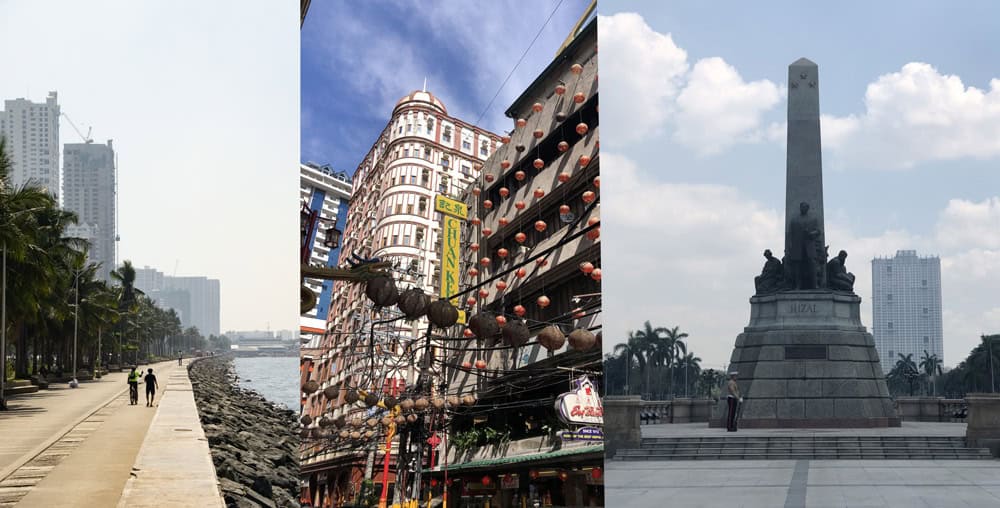
Manila Bay – Binondo – Rizal Monument
Staying overnight in Intramuros: yes or no?
Many travelers, seeing that it’s Manila’s most interesting tourist area, consider staying overnight in Intramuros. In our opinion, it’s not the most advisable. Why? Because when the sun goes down, though it’s not dangerous, it’s not a pleasant area nor one with much life and, unfortunately, we think it’s still many years away from that.
From our experience, we’d recommend staying in Makati and, more specifically, in the Poblacion neighborhood, much more pleasant and with lots of restaurants and bars. This, in addition to offering you more comforts, will give you the chance to appreciate other sides of the city. There we suggest the following accommodations:
- Lub-d Makati: it has both dorms and comfortable private rooms (double and family), very pleasant common areas, and even a rooftop bar with great views. It’s close to where you catch the little boat to Intramuros that we’ll talk about below.
- City Garden Grand Hotel: a hotel with a pool in Manila and a rooftop with views—your best option. Also an excellent location, with lots of restaurants around.
You have more options in our guide Where to stay in Manila.
If you don’t have much time and prefer to stay near the airport, here are two more alternatives:
- Savoy Hotel: right next to terminal 3 of the airport, which you can reach via a bridge from the terminal itself. Everything is new and comfortable.
- Belmont Hotel: a bit more expensive than the previous one, but even closer to T3.
All of this is explained in much more detail in Best hotels near Manila airport.
With all that said, if you wanted to stay overnight in Intramuros, it’s crystal clear to us: THE BAYLEAF INTRAMUROS. We’ve already mentioned it when talking about its bar with views, but it’s also a modern and quite pleasant hotel.
How to get to Intramuros
Now that you know exactly what to see in Intramuros, you still need to know how to get there the easiest way. Unless you’re staying in Malate or in one of the hotels near Manila airport that we recommend, it’s usual that you’re staying in the Makati neighborhood, which is the best place to stay in Manila. From here, the options are:
- Grab: the company that bought Uber in Southeast Asia. It’s the best way to avoid the headaches that taxis in Manila usually cause (they’re quite piratical). You just have to download the app and request a car to wherever you are. Depending on traffic, the cost will vary. Normally, a ride from Makati is around 400–500 pesos, but it will also depend on traffic and the time of day.
- Pasig River Ferry Service: not many people know this alternative, but it saves our lives every time we go. It’s a service of small boats that run along the Pasig River. If you’re staying in the Poblacion area of Makati, it’ll work out perfectly. You just have to go to Hulo stop and wait for one to pass. They operate from 6:30 to 17:30. It’s free and the journey takes about 40–50 minutes to Escolta (the Plaza de México stop is the best, but it’s still under construction). From Escolta you can walk to Intramuros in 5 minutes.
- Public transport: although we’ll talk in detail about public transport in Manila, the first thing we can tell you about it is that it’s a real mess. Basically there are 2 metro lines and a hodgepodge of buses and jeepneys that you won’t be able to figure out unless you ask a local. Our advice is to ask at your accommodation to see if it works for you to get to the LRT Central Terminal, which is about a 20-minute walk from Intramuros.

Frequently asked questions about Intramuros
To finish, here are answers to the questions we are most often asked about visiting Intramuros:
Is it worth visiting Intramuros?
Yes, it’s the historic part of Manila and, without a doubt, the most important thing to visit if you’re passing through the city.
What to see in Intramuros?
Our proposal is a route that includes at least Manila Cathedral, Fort Santiago, San Agustín Church, the Intramuros Museum, Puerta Real, Baluarte San Diego, Baluarte de San Francisco de Dilao, the Customs House, and the Bayleaf Hotel rooftop.
Can Intramuros be visited at night?
You can, but most places of interest (such as Casa Manila or San Agustín Church) are open during the day, so it doesn’t make much sense. It’s not a particularly pleasant or well-lit area for walking at night, unless it’s with a guided tour.
What is the best itinerary for Intramuros?
We would do a route starting at Puerta Real, along General Luna Street until reaching San Agustín Church and Casa Manila. Then visit Manila Cathedral and Fort Santiago, detour to see the Intramuros Museum. Pass by the Customs House and then go up to the Baluarte de San Francisco de Dilao. Enter the Bayleaf Hotel to enjoy the views from the rooftop. If you want, visit the Baluarte de San Diego.
How to get to Intramuros?
From our experience, the best thing is to order a Grab car, as Manila taxi drivers don’t tend to be very reliable. If you’re in Makati, you can also go by the free ferry service along the Pasig River, but keep in mind that it’s not very fast.
Is it recommended to sleep in Intramuros?
We don’t think so. The hotel offer isn’t large and it’s also not an area that offers much when the sun goes down. We advise you to stay in Makati or near the airport.