Island hopping and the Philippines? It’s impossible to imagine a trip to the Philippines without these boat tours that take you from one island to another. These excursions are the hallmark of a country made up of more than 7,000 islands with no shortage of white-sand beaches, clear waters, and reefs teeming with life.
Here, we’ll share all the secrets of island hopping in the Philippines. What the tours are like, what they include, how to arrange them, tips, and the best places to hop from island to island.
What is island hopping? What does it involve?
Island hopping literally means “hopping from island to island”, so you probably already have a pretty good idea of what this activity involves.
Island hopping is simply a tour that takes you to explore different islands. You hop on a boat, usually a bangka, the archipelago’s traditional boat, and go with the flow. The crew will help you explore different spots, give you tips, and, in almost every case, prepare a delicious lunch for you.
Some island hopping tours in the Philippines use speedboats or yachts, like this one in El Nido or this one in Coron.
These tours usually include several stops at beaches, sandbars, and spots for snorkeling. There are usually 5 or 6 stops, depending on the destination and the type of island hopping tour. If you take a private tour, you can choose which places to visit and in what order based on your preferences. That way, you can also decide how long to stay at each one.
In destinations like Coron and El Nido, the kings of island hopping in the Philippines, there are also several preset tours that group together places that are fairly close to one another. In El Nido, for example, they’re called A, B, C, and D.
How long does an island hopping tour in the Philippines last?
An island hopping tour in the Philippines usually lasts about 8 hours. You typically leave around 9:00 a.m. and return around 4:00 or 5:00 p.m., before sunset.
That said, there are plenty of possible variations. If you’re taking a private tour, you can leave earlier (which we highly recommend) and return a little later. You can also take island hopping trips lasting several days, which gives your Philippines itinerary a very different feel.
This way, you can sleep on uninhabited islands and wake up in little slices of paradise with hardly anyone else around. You can have this experience in lots of places, but our favorites are the trip from El Nido to Coron over 3 or 4 days with a stop in Linapacan (you can read all about this one in Coron – El Nido Expedition) and the expedition to Balabac.
The best time to go island hopping in the Philippines
Since you’ll be spending quite a bit of time on a boat, it’s best to go when the sea is reasonably calm. That way, you’ll not only be less likely to get seasick, but you’ll also see the beaches at their best and be able to snorkel comfortably.
The best time to go island hopping in the Philippines depends a lot on where you’re going, since, as we explain in Best Time to Visit the Philippines, the archipelago has several climate zones. Still, broadly speaking, if you want to visit Palawan and the Visayas, the sea is much calmer between March and May. January through June is usually a good time, too.
For Mindanao, particularly Siargao, which also has a really fun island hopping tour, or Dinagat, July and August are better, as that’s the dry season.
⛈️ All of this comes with the understanding that the Philippines has a tropical climate, which means the weather can be somewhat unpredictable at any time of year.
Private or shared island hopping?
We’ve already hinted at this, but yes, in our opinion, private island hopping in the Philippines is absolutely worth it, especially in places as popular with tourists as El Nido, Coron, or Port Barton.
The main difference from “shared” tours is that you pay for the entire boat, which means you can choose both the itinerary and how much time you spend at each spot. You can also leave a little earlier to avoid the crowds and change the order of the stops so you run into far fewer tourists. You’ll be more comfortable, too, since shared tours usually carry 15-20 people, while private tours rarely have more than 8, and you can, of course, take one on your own or as a group of 2.
If, for whatever reason, you can’t find other travelers and have to decide which island hopping tour in the Philippines to take privately, our choice is clear: we’d take Coron’s Ultimate Tour with our trusted contact.
How much does island hopping in the Philippines cost?
Sounds great, but how much is it going to cost me? Well, in our opinion, very little for what you get. We think island hopping in the Philippines offers incredible value for money because you spend a whole day going with the flow and enjoying gorgeous beaches for just over $32, including lunch.
As a general rule, an island hopping tour in Palawan (Coron, El Nido, and Port Barton) costs around 1,200-1,500 pesos per person. If you go privately, that can rise to 2,000-2,500 pesos, but it depends on how many passengers there are.
In Siargao, it’s much cheaper, as the 3-island hopping tour costs 1,500 pesos for the entire boat (maximum 6 people). It’s super cheap in Camiguin, too.
If the crew has done a good job, don’t hesitate to leave them a tip. Wages in the Philippines are low, so it will mean a great deal to them.
If you’re thinking of taking a trip lasting several days between Coron and El Nido, the price goes up quite a bit, since accommodation, food, and drinks are included. A 3- or 4-day expedition typically costs between 18,000 and 34,000 pesos per person, depending on the company and the quality of the services (the differences are obviously significant).
Food on island hopping tours in the Philippines
With all that activity, you’re bound to get hungry at some point. There’s no need to worry, though, because the vast majority of island hopping tours in the Philippines include lunch.
If you book through an agency, meaning you join a shared tour, this will be the case almost 100% of the time. Otherwise, you’ll be responsible for buying the ingredients (there’s always a market nearby; don’t worry), and in places like Coron or El Nido, the crew will cook them for you. In Siargao, on the other hand, locals cook your food on Daku Island for a small fee. That’s why it’s important to ask about this when you book the tour.
When lunch is included in the price of the island hopping tour, it usually consists of:
- Rice (lots of it)
- Tomato and cucumber salad
- Some kind of meat
- Grilled fish
- Some shellfish (usually shrimp)
- A delicious sauce made with soy sauce
- Ensaladang talong (eggplant salad)
- Assorted fruit cut into very photogenic shapes
- Water and soft drinks (usually Coca-Cola)
The amount served will depend on the number of travelers and the agency, but it’s unlikely you’ll go hungry.
As you can see, the menu usually includes a couple of dishes that are vegetarian, but if you don’t eat animal products, it’s best to let them know in advance so you can have more variety. The same goes for any food intolerances or allergies.
Lunch on island hopping tours is usually served at a table on one of the islands, but depending on your group’s preferences or the pace of the tour, it can also be served on the boat itself at a table set up for that purpose.

Where can you book island hopping tours in the Philippines?
This depends a lot on the destination, but generally you have 4 options:
- Booking through a tour agency with a physical office.
- Booking online through agencies like Civitatis or KLOOK, where you have the advantage of being able to read other travelers’ reviews and where tours are usually cheaper.
- Directly at the port, where there’s usually a small booth run by an association or organization. This depends a lot on the destination, though, as it isn’t always the case.
- Contacting a recommended guide. With plenty of island hopping tours under our belts, we have several contacts in the main destinations around the Philippines. Feel free to ask us about them in the comments.
Tips for enjoying your island hopping tour
Here are some tips from our own experience to help you enjoy island hopping in the Philippines:
- Try to leave earlier than everyone else. This isn’t always possible because the coast guard has to give boats the OK to depart, but in most cases, it is.
- Make sure you understand what’s included in your island hopping tour and what isn’t. That way, you won’t get any surprises. Are the fees included? Do I have to pay for lunch? Will I need to rent a kayak or pay for snorkeling gear?
- Don’t try to tick off as many places as possible. 5 or 6 per tour is plenty and gives you time to enjoy them.
- Don’t choose based on price alone. Sometimes you see amazing deals advertised on the street and sign up for any old agency tour, but have you really come all this way just to avoid paying an extra $5 or $10 and miss out on doing it properly?
- If you travel to the Philippines at Christmas, during Holy Week, or at Chinese New Year, it’s best to book in advance. If you want to go with a highly recommended guide, it’s best to book at least 2 weeks ahead, whatever the time of year.
- Get good travel insurance for the Philippines and avoid any nasty surprises.
- Look for a place to stay that’s fairly close to the departure point. Search engines can sometimes be a little misleading, especially if you’re searching for El Nido: you could end up staying somewhere that’s 1 hour from where the tours leave. Each guide on our website includes recommended places to stay. For example: Where to Stay in El Nido, Where to Stay in Coron, or Where to Stay in Siargao.

What to bring for island hopping in the Philippines
The gear you bring is an important part of island hopping in the Philippines. It makes a real difference to how comfortable you are, so take note:
- Water shoes: these shoes are lifesavers, as some areas are rocky or have lots of coral, and you don’t want to cut yourself. A pair like these [affiliate link] will be just what you need.
- Dry bag: even on a large boat, water can splash aboard, or you might want to take your phone or camera somewhere that requires getting a little wet. They’re sold in almost every tourist spot in the Philippines, but from experience, we recommend buying a good-quality one like this [affiliate link] if you don’t want your important belongings (like your phone) to get wet.
- Snorkeling gear: it’s usually included on almost all island hopping tours in the Philippines, but it’s often not in the best condition. We also prefer to bring our own for hygiene reasons. This set [affiliate link] is great.
- Sunscreen: bring sunscreen because the sun is strong. Ideally, choose a biodegradable one so it won’t harm marine plants and animals. If you burn easily, it’s a good idea to bring a sun-protective shirt like this one [affiliate link].
- Camera: you wouldn’t want to miss the chance to capture this experience, would you? We bring our GoPro, drone, camera, and phone. You can see what photography gear we use in What to Pack for the Philippines.
- Cash: you usually pay for the tour at the end, but bring some small bills and change as well in case you want to buy an extra drink (usually only water and a soft drink are included), pay any fees, or rent a kayak.
- Stainless steel bottle: we ask that you keep your use of plastic bottles to a minimum, as the Philippines has a serious waste management problem. We have a bottle like this one [affiliate link] that we refill from the drinking water tanks you’ll see almost everywhere. It also keeps your water cool for hours.
- Towel: although some island hopping tours in the Philippines include towels, most don’t. It’s nice and warm in the Philippines, but when the bangka picks up speed and you’re soaking wet, sometimes you’ll want to wrap up. We always bring a quick-drying one like this [affiliate link].
The best places to go island hopping in the Philippines
Now you know almost everything about island hopping in the Philippines and can’t wait to try a tour, but where? Here are the best places to take these fabulous excursions.
1. El Nido
El Nido is the birthplace of island hopping in the Philippines. After all, there’s no other way to explore the wonders of the Bacuit Archipelago than by taking to the sea and stopping at one island after another.
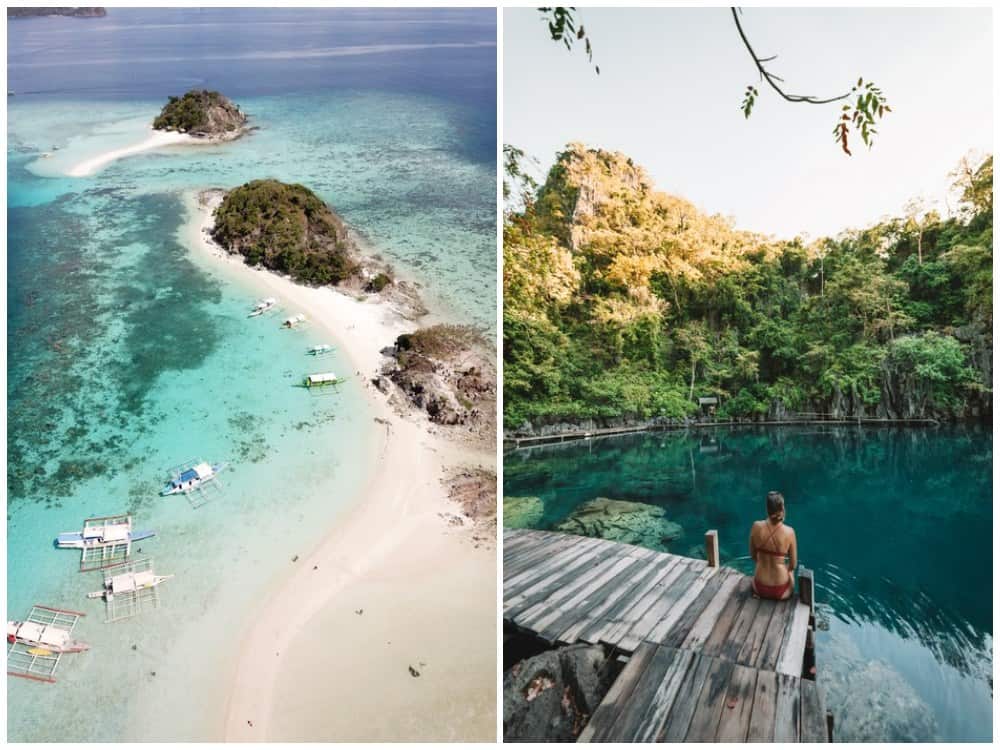
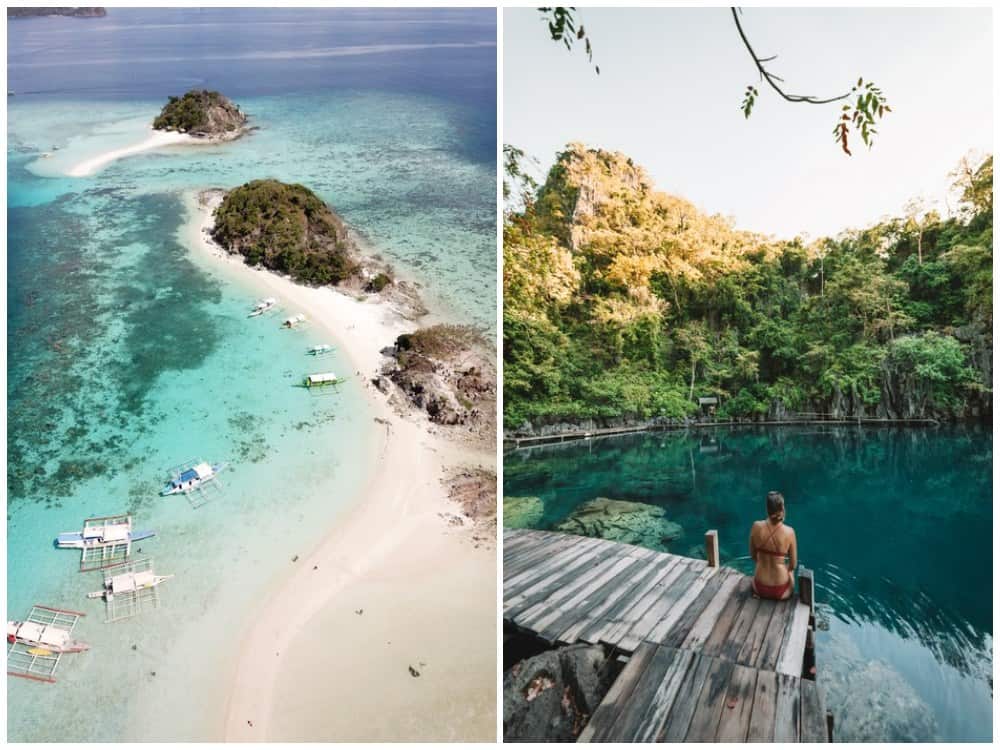
There are 4 tours in El Nido: A, B, C, and D. They group together places that are fairly close to one another, combining beautiful lagoons flanked by huge limestone walls, beaches with white sand and slender palm trees, and snorkeling spots. The most popular are A and C, but we’re sure you’ll come back happy from any of them. If you can, take them all, but if you have to choose, we recommend setting aside at least 2 days.
You’ll find all the information (prices, the best tours, agencies, and much more) in our article Island Hopping in El Nido.

2. Coron
Giving El Nido some serious competition, Coron’s island hopping tours are truly spectacular. The Ultimate Tour focuses on the most spectacular spots on Coron Island, including lagoons and lakes surrounded by towering black limestone walls, shipwrecks, and idyllic beaches.
From Coron Town, you can also visit other picture-perfect islands such as Malcapuya, Maltatayoc, or Pass Island (on what’s known as the Escapade Tour) and arrange to spend the night on one of them. That’s why we recommend planning at least 2 days of island hopping.
As if that weren’t enough, the island of Busuanga has other little-known places where you can base yourself for more of the best island hopping in the Philippines. We’re talking about Concepcion, Salvacion, and Ocam Ocam Beach. From these spots, you’ll have islands like Black Island, North Cay, or Pass Island within reach.
For all the details, don’t miss our article Island Hopping in Coron.
3. Coron – El Nido Expedition
As we mentioned earlier, this expedition lasting several days completely won us over. We traveled from Coron to El Nido, but you can also go in the opposite direction, depending on which way you’ve decided to travel.
These trips visit a few spots in Coron and El Nido, but focus on the islands between them, namely those near Linapacan. You may never have heard of them, but we can tell you they’re incredible, and this video will have you drooling:
There are expeditions lasting 3 days and 2 nights or 4 days and 3 nights. We chose the latter, and honestly, we wished we’d had another day. We had such a great time and loved the experience of sleeping in small cabins on uninhabited islands so much that we could have stayed much longer. We also completely relaxed because we could forget about everything for several days. We didn’t have to think about where to sleep, what to eat, what to see… It was a fantastic vacation.
You can read all about it in our article El Nido – Coron Expedition.
4. Siargao
Although the scenery is a little less impressive than in the places above, Siargao also has several really lovely island hopping tours. The best-known is called Tri-island, meaning the 3-island tour. It takes you to the islands of Guyam, Daku, and Naked, though we recommend adding Mam’om to round out the experience. All of them are white-sand islands surrounded by turquoise waters, where you can enjoy the natural treasures of the Philippines to the fullest.
To the west of Siargao, you’ll find Sugba Lagoon. This lagoon reminds us a little of those in El Nido, and a visit here is combined with visits to Kawhagan Island’s beautiful sandbar and the mangroves of Del Carmen.
It doesn’t end there, as from Siargao you can also visit Sohoton Cove, Corregidor Island, or the little-known islands of San Benito.
You can read much more about these tours in Island Hopping in Siargao.

5. Camiguin
OK, we may be cheating a little here because this isn’t strictly island hopping, but we couldn’t leave it out of this guide to island hopping in the Philippines.
Camiguin’s beaches aren’t particularly spectacular because of the island’s volcanic origins, but there are 2 little slices of paradise less than 15 minutes away by boat that you’ll fall in love with. You can’t visit them together; you’ll need to go to 2 different ports. So, while it’s not impossible to visit both in one day, we recommend giving each one plenty of time.
White Island is a huge sandbar of white sand surrounded by clear waters, with views that show just how spectacular Camiguin is with all its volcanoes. Meanwhile, Mantigue is oval-shaped, with vegetation at its center, and is surrounded by a reef that’s home to dozens of turtles.
Find out all about them in Island Hopping in Camiguin.

6. Port Barton
We’re heading back to Palawan for another of the Philippines’ most popular island hopping experiences, this time in the charming village of Port Barton. Several tours depart from here, taking you to beautiful nearby islands and various snorkeling spots.
Although we left feeling a little disappointed on our last visit because of the crowds and the damage to the reefs, you’ll enjoy this day trip, especially if you book it privately and choose where you go yourself. Plus, if you’ve never seen turtles, you’re almost guaranteed to spot one here.
More information in Island Hopping in Port Barton.

7. Cuatro Islas, Leyte
One of the lesser-known island hopping tours in the Philippines is the one around Leyte’s Cuatro Islas, but we didn’t hesitate for a moment when we had the chance to go.
Departing from the small town of Inopacan, you’ll visit 4 islands, the best-known of which is Digyo, with its spectacular sandbar.
Although the scenery isn’t as dramatic as in El Nido or Coron, we really enjoyed this island hopping tour, especially because we saw only one other boat doing the tour. It’s one of those places in the Philippines that hardly any tourists visit and you can’t help falling in love with.
You can read much more in Cuatro Islas Tour.

8. Islas de Gigantes
Accessible from Panay Island, this is a group of islands we discovered a few years ago and loved. You can base yourself on Gigantes Norte or Gigantes Sur and take a great island hopping tour from there to sandbars, Tangke Lagoon (similar to those in El Nido), and the most photogenic island of all, Camugao Gamay.
Islas de Gigantes is still a largely undeveloped area, and although more and more domestic tourists are visiting, it remains off the radar for foreign travelers, which makes it even more appealing. You can read all about it in our Guide to Islas de Gigantes.
9. Caramoan
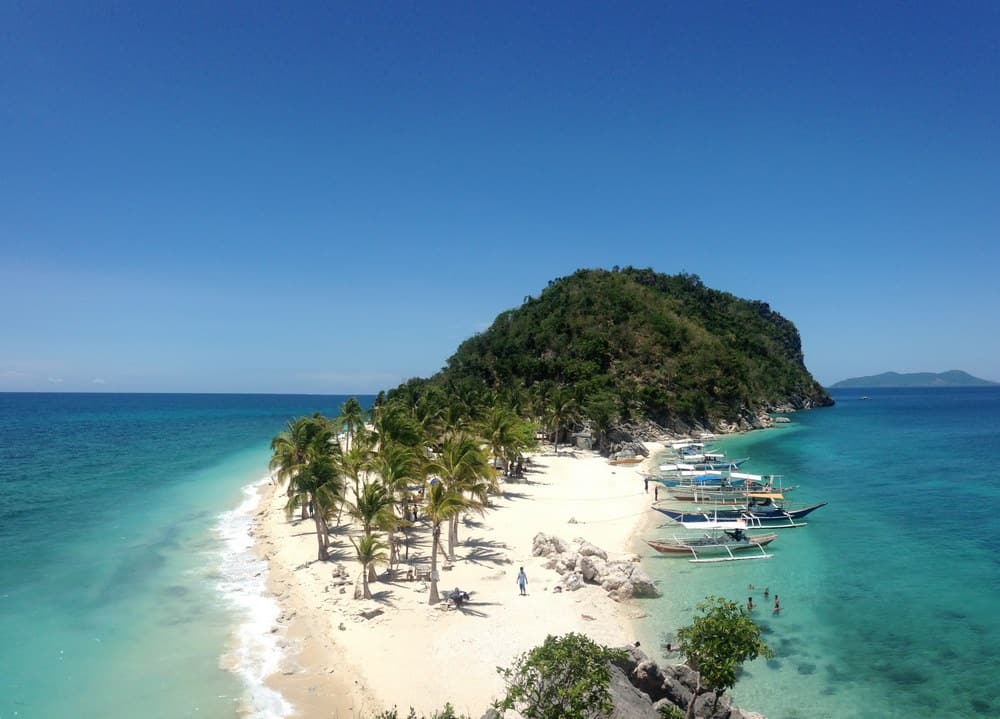
Caramoan is a mini-El Nido with fewer tourists. Located in eastern Luzon, it offers a big island hopping tour and a small island hopping tour. Both feature sandbars, white-sand beaches, limestone islands, and limestone islets that look very much like those in Palawan.
Our Guide to Caramoan has all the details.
10. Balabac, the shining star of island hopping in the Philippines
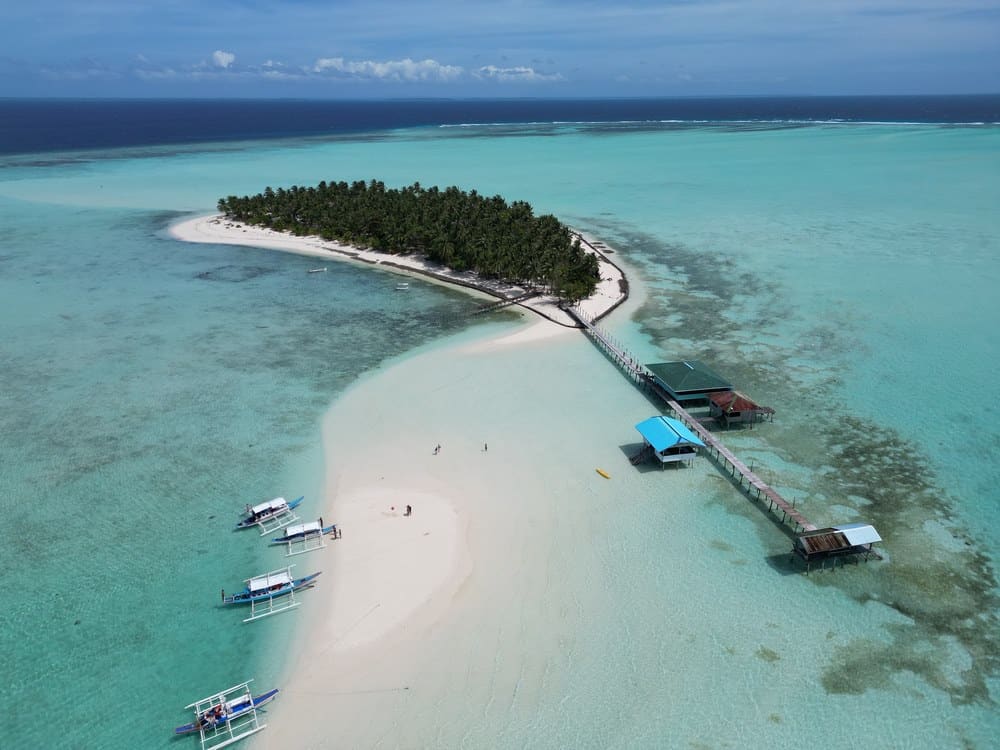
Rapidly rising through the ranks of the country’s most famous island hopping tours, those in Balabac have a star attraction called Onok Island. This absolutely jaw-dropping island is surrounded by clear waters kept calm by the reef around it, and those waters are also home to lots of sea turtles.
The usual option is a 4-day, 3-night tour departing from Puerto Princesa that takes you to other beautiful islands such as Sicsican, Canimeran, or Patawan. Almost 100% of the tourists who come here are Filipino, but we’re sure tourism will continue to take off in the coming years.
You can read all about this corner of the Philippines in our article Island Hopping in Balabac.
11. Dinagat, island hopping in the Philippines or travel between March and October
To wrap up this selection of island hopping tours in the Philippines, here’s a little gem in the south of the country that’s easy to reach from Siargao but still flies under the radar. Just look at the scenery in the photos below: very similar to that in El Nido or Coron, but completely untouched.
Because of its location, Dinagat, like Siargao, has its dry season roughly between March and October, making it a great destination if you’re thinking about Traveling to the Philippines in July or Traveling to the Philippines in August.
From San Jose in Dinagat, you can visit the main sights around Libjo (known as “Little Palawan”) and Basilisa (with its incredible white-sand beaches), but it’s even better if you spend at least 2 days and stay overnight in a cabin on a little island. That way, you’ll have a memorable experience. As with all the tours above, we also have a great contact who can organize everything for you.
Discover it in our guide to Island Hopping in Dinagat.

Other island hopping tours in the Philippines you’ll love
We’ve rounded up the 11 places we find most interesting for island hopping in the Philippines, but the list could really be endless. Almost every tourist destination has a boat trip you can take, for example:
- From Malapascua, you can visit Kalanggaman or Carnaza.
- From Bantayan, you can visit Virgin Island and Kinatarcan.
- From Panglao, you can take the snorkeling trip to Balicasag Island. You can also escape to Pamilacan.
- From Boracay, you can take a bangka tour around the island, stopping at snorkeling spots like Crocodile Island, or spend the day on Carabao Island.
- From Romblon, you can go island hopping to Cobrador, Alad, and Lugbung.
- From Tablas, you can also take the Calatrava island hopping tour.
- From Puerto Princesa, you can take the Honda Bay tour.
- From Bulalacao (in Mindoro), you can visit little-known places like Aslot, Tambaron, Target, or Suguicay.
- Island hopping in Guimaras.
- Island hopping around the Concepcion Islands north of Iloilo (Panay).
- Island hopping around the Hundred Islands from Luzon.

We hope this guide to island hopping in the Philippines has helped you plan your next adventure. If you have any questions or need more information, we’d love to hear from you in the comments.