
Is traveling to the Philippines in July crazy? Is it monsoon season? Could it be dangerous? These are probably just some of the questions you’ll ask yourself if you have time off in July and want to travel to the Philippines.
We get it—it’s normal to have doubts about the weather. Although we’ll go into much more detail below, we can tell you upfront that it’s perfectly possible to travel to the Philippines in July without the rain ruining your trip. And we’re not just saying that: we’ve been living and traveling around the Philippines since 2010, so we’ve experienced quite a few Julys in the country.
Read on as we explain everything you need to know about traveling to the Philippines in July.
What is the weather like in the Philippines in July?
We’ve already covered the weather in the Philippines in July in detail in our articles Best time to travel to the Philippines and When to travel to the Philippines?, but the first thing you need to know is that the archipelago has several distinct climate zones. There are no fewer than six climate zones and, to make things even more complicated, although general weather patterns suggest that some months are rainier than others, the Philippines has a tropical climate, which makes the weather something of a lottery. In a single day, you might experience a downpour followed by blazing sunshine.
So you might be wondering: is it a good idea to travel to the Philippines in July? To put it simply, much of the Philippines experiences the rainy season in July. Between June and November, the areas of Palawan, Luzon and much of the Visayas are affected by the Habagat, or southwest monsoon. At this time of year, showers are generally more frequent in these parts of the Philippines. There’s also a much higher chance of tropical depressions, cyclones and typhoons moving in from the Pacific.
It’s important to remember that this is only a general weather pattern. Traveling to these areas of the Philippines in July does not mean it will rain every single day or that your trip will be ruined.
In the Philippines, as in many Southeast Asian countries, the most common pattern is a couple of hours of heavy rain, usually in the afternoon. Even so, there is another factor that can affect your trip: tropical depressions (low-pressure areas) or typhoons. In these cases, the wet weather can last for three or four days, and ferries or flights may be canceled. We’ll talk about this later.
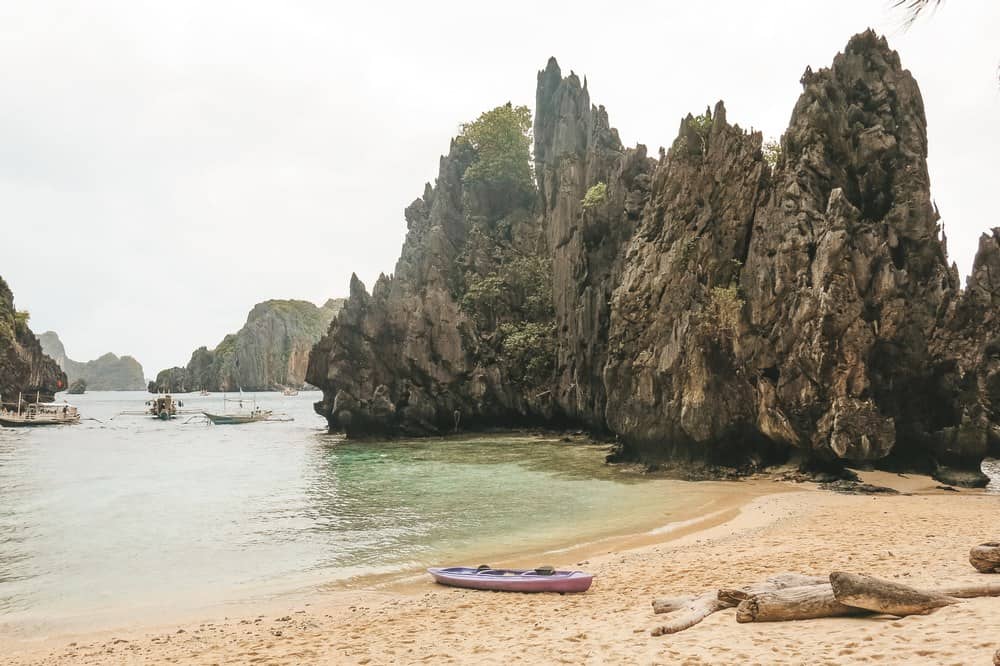
Are there parts of the Philippines where it is less likely to rain in July?
Yes! Traveling to the Philippines in July doesn’t necessarily mean visiting during the rainy season. As we mentioned above, there are different climate zones, and in the south of the country, mainly in the Mindanao region, it’s the dry season.
So, if you’re particularly concerned about the weather when traveling to the Philippines in July, our advice is to plan your trip around two beautiful islands in this region: Camiguin and Siargao. You could also add the lesser-known Dinagat Islands or nearby Bohol, where the weather also tends to be good.
Does that mean it won’t rain there in July? Not necessarily. As we’ve said, the Philippines has a tropical climate, so a shower is always possible, but the chances of that happening are much lower. In fact, during our last two-week visit to Camiguin in November, people on the island told us that the best time to visit is in March and April—proof that the weather really can be unpredictable.
So, what has our experience been? We’ve lived and traveled in the country at every time of year, and the usual weather patterns often haven’t held true. For us, the Philippines is a year-round destination.
For example, we were stuck in Coron for three days in February (supposedly the dry season) because strong winds prevented flights and ferries from departing. The same thing happened to us in Romblon, in the Visayas, in March. On the other hand, we’ve also traveled around both Bohol and Malapascua during the rainy season and enjoyed glorious sunshine. We were also very unlucky with the weather in Palawan in December (dry season) and the sun only came out for a single day. We’ve experienced typhoons and tropical depressions in Manila, Siargao and the Legazpi area without any serious problems. As you can see, we’ve experienced just about every kind of weather!
What we can tell you is that the weather was very favorable across the country in both July 2023 and July 2024.
Honestly, we’d love to tell you that you’re going to travel to the Philippines in July and it won’t rain at all, but just as we can’t guarantee rain-free weather in Europe, we can’t guarantee it in the Philippines either. What we can do is share a few tips to help your trip run more smoothly.
If you’re worried about the weather, take a look at this 2-week itinerary for the Philippines in August. It also works for July.

What is it like to travel to the Philippines in July? Our top tips
We’ve already shared our main tip for traveling to the Philippines in July—focus on the south of the country—but we have a few more useful suggestions.
If you still want to include Palawan or other parts of the Philippines in your itinerary, consider starting your itinerary in Siargao or Camiguin, where it’s dry season, and keep an eye on the weather once you’re there.
Does this mean I shouldn’t book any flights or accommodation if I travel to the Philippines in July? In our opinion, not necessarily. If your trip is shorter than 20 days, we recommend organizing most of your trip in advance so you don’t waste time making arrangements while you’re traveling around the country. A good tip is to book hotels with free cancellation on Booking so you don’t risk losing the money you’ve paid, while also avoiding properties that offer poor value for money, which is unfortunately common in places like El Nido, Coron and Siargao.
As for flights, you’ll need to decide what makes sense. Of course, traveling solo or as a couple is very different from traveling as a family. You’ll need to weigh up the cost of booking flights just one, two or three days before departure against the risk of there being no seats left. Unfortunately, domestic flights in the Philippines aren’t cheap and when you book less than two or three weeks in advance, fares often double. Ultimately, you’ll need to decide whether flexibility or savings matter more to you.
On the other hand, because July falls during the rainy season, it is also part of the low season in the Philippines. This means fewer people travel around the country (especially locals) and hotel prices tend to be cheaper than at other times of the year.
Even so, more and more international travelers are choosing to visit the Philippines in July, so it’s not unusual for hotel prices to remain fairly stable or even rise on islands with better weather, especially Siargao.
It’s true that there are certain activities you won’t be able to do in the Philippines in July. For example, you won’t be able to dive at Tubbataha Reefs Natural Park, which is closed to visitors at this time of year, and you’ll need to check in advance whether hiking trails on Mount Pinatubo are open. As for multi-day expeditions, such as the Coron–El Nido Expedition (or vice versa) or a Balabac expedition, some companies don’t operate and, if you decide to book one, you should be aware that cancellations due to rough seas are much more frequent than at other times of the year.

Traveling to the Philippines in July 2026 — YOUR OPPORTUNITY
We’re writing this from the Philippines after returning several times since the borders reopened and falling in love with the country all over again. We’re staying here for a while, enjoying the country while visitor numbers are still relatively low, prices are good and it remains just as unspoiled as before—if not more so. There are no restrictions on travel between islands, hotels and restaurants are open, transport services are operating normally again…
For us, traveling to the Philippines in July 2026 is a real opportunity to enjoy the country’s natural beauty and experience a quieter, less crowded side of the Philippines. Now is a great time to visit! From what we’ve seen, more and more travelers have been visiting the Philippines since 2022 and we’re sure visitor numbers will continue to grow in the coming years, so we wouldn’t wait too long to discover the unspoiled Philippines we love so much.
In our experience, the Philippines is a safe destination and one we wholeheartedly recommend. Of course, you should always travel with good travel insurance for the Philippines and, as always, take the usual precautions.
Take a look at the current requirements for traveling to the Philippines
Tips for traveling to the Philippines in July
So, what will the weather be like in the Philippines in July? Is it worth traveling to the Philippines in July? We can’t answer the first with certainty, but we can answer the second with a resounding yes. Even so, as with any other trip, it’s always best to plan ahead and do your research. So here are a few more tips if you want to travel to the Philippines in July:
- If you’re particularly worried about the rain, include Camiguin and Siargao in your itinerary. The weather there tends to be better and, as a bonus, both islands are gorgeous! Check out Things to Do in Camiguin or Things to Do in Siargao and fall in love before you arrive. If you have more time or are looking for an adventure, we highly recommend going island hopping in the Dinagat Islands—they’re very close to Siargao and have scenery very similar to El Nido’s.
- If possible, avoid planning a trip of only 10–15 days. The shorter your trip, the less chance you’ll have of avoiding the rain. Most importantly, allow more time between destinations, as delays and cancellations are more likely and could disrupt your trip.
- Closely related to the above, don’t plan your trip to the Philippines in July down to the last detail. Trying to cram too many destinations into your itinerary and spending too little time in each one will not only cause stress but also increase the chances of something going wrong. Flight delays are more common than usual in July; if you haven’t allowed much time before your next connection or transfer, it can trigger a chain reaction of problems.
- If you’re traveling for 20 days or more, you can be more flexible. As we mentioned above, if you don’t want to spend much time searching for decent hotels and want to secure good prices, book accommodation with free cancellation. On Booking.com, you can see which properties offer it and the deadline for canceling free of charge. This is especially important in places like Siargao, Coron and El Nido, where accommodation often offers poor value for money. You’ll find our accommodation recommendations in Best hotels to stay in Siargao, Where to stay in El Nido and Where to stay in Coron.
- Weather apps often show rain throughout the day—don’t panic! This doesn’t mean it will definitely rain. PAGASA’s satellite imagery can give you a better idea of the weather over the coming days. We know it can be a bit hard to interpret, but if a typhoon or a significant low-pressure area is approaching, PAGASA will issue an advisory. These kinds of weather events don’t happen overnight; they can usually be tracked several days in advance, giving you time to adjust your itinerary. The Windy app is a more intuitive and generally reliable alternative.
- If your flight or ferry is canceled or rescheduled, don’t worry. Airlines and ferry companies in the Philippines will usually rebook you on another service or offer a refund.
- Severe weather events can happen, but they can usually be tracked several days in advance. With this in mind, to travel safely to the Philippines in July, it’s essential to have good travel insurance for the Philippines like the policy we always travel with.

You’ll find more information about other times of year in the Philippines if you’re considering alternative dates:
Traveling to the Philippines in August
Traveling to the Philippines in September
Traveling to the Philippines in October
And if you’re now completely convinced (we hope so!), you can start planning your trip with these two guides:
How to plan a trip to the Philippines
Things to Do in the Philippines: 30 Unmissable Places and Experiences
Do you have any questions about traveling to the Philippines in July? We’ll be happy to answer them in the comments.