Traveling around the Philippines means discovering incredible landscapes, from beaches and waterfalls to mountains, reefs, and rice terraces. While beaches are, for many travelers, the main draw of a trip to the Philippine archipelago, island hopping is the most popular way to head out and discover several of them in a single day. An island-hopping tour, in short, involves being picked up early in the morning and letting your guide take you to different islands or beaches, each seemingly more beautiful than the last, before being taken back to the starting point so you can return to your hotel and rest.
But what if you want something beyond that—if you want one adventure after another without returning to land to rest? Then what you’re looking for is a multi-day expedition—and this one, the Coron to El Nido expedition, is our favorite.
What is a Coron to El Nido expedition (and vice versa)?
As you may have already discovered in our guides to Island hopping in Coron and Island hopping in El Nido, these are the two quintessential island-hopping destinations in the Philippines, with their enormous limestone karst formations and remote “lost” islands creating truly paradise-like scenery.
A Coron to El Nido expedition—or the reverse, from El Nido to Coron—takes you to secluded spots that lie far from these more popular destinations. This means, among other things, that you’ll visit lesser-known places and, of course, ones that are much less crowded. Beaches are a major part of the experience, but so is snorkeling, because these areas receive relatively few visitors and their reefs remain in good condition. It’s not unusual to spot the occasional turtle and, with luck, even dugongs.
Just to be crystal clear, as many of you have asked us about this: on the Coron–El Nido expedition (and in the opposite direction) YOU DO NOT VISIT ANY OF THE STOPS INCLUDED ON EL NIDO’S ISLAND-HOPPING TOURS, and, as for Coron’s island-hopping tours, YOU ONLY VISIT SOME OF THE STOPS ON THE ESCAPADE TOUR. In other words, this is not an experience that replaces those tours (which are must-dos if it’s your first time in the Philippines) but rather COMPLEMENTS THEM.
Therefore, even if you do the expedition, in our opinion, Coron’s ULTIMATE Tour and El Nido’s Tours A and C are essential. You might be able to skip one tour in El Nido but, if it were up to us, we wouldn’t. You’ll find all the information about these island-hopping tours in our guides to both destinations.
But there’s much more! Two things are essential for an epic journey like this. First, there’s the accommodation. You’ll sleep in small beachfront camps where you can enjoy mind-blowing sunsets. There you’ll experience the laid-back island vibe we love so much, with relaxed dinners, breakfasts by the sea, and, if you feel like it, a bit of classic Filipino karaoke.
Second, there’s the boat you’ll be sailing on. Because it’s such a long route and at times takes you across open water, standard Filipino bangkas aren’t really up to the task. Therefore, you need to hop aboard a supersized bangka that will carry you throughout the Coron to El Nido expedition. If you choose the company well, you’ll have all the comforts you need to enjoy an experience like this.
With a bit of luck, you’ll meet other travelers like you who are eager for adventure and great conversation. Groups usually consist of around 20 people. Plus, if you choose a good company, the crew will go above and beyond, playing an active role throughout the journey and becoming true travel companions. This also gives you the chance to gain a deeper insight into Filipino culture by talking with them.
Now that you more or less know what the epic Coron to El Nido expedition is about, we’re going to tell you in detail about our experiences so you can see why we consider it a must-do in the Philippines if you’re looking for an experience that goes a step further.
To give you an idea, we’ve been traveling around and living in the archipelago since 2010 and, after many adventures, the Coron to El Nido tour is one of the best things we’ve done.
It may sound obvious, but if you start the expedition in Coron, you’ll finish in El Nido. If you start it in El Nido, you’ll finish in Coron. In other words, the trip is one-way.
If you’ve made it this far but actually just want transport between the two destinations, we recommend you read our guide How to get from Coron to El Nido.
How long does the Coron to El Nido expedition last?
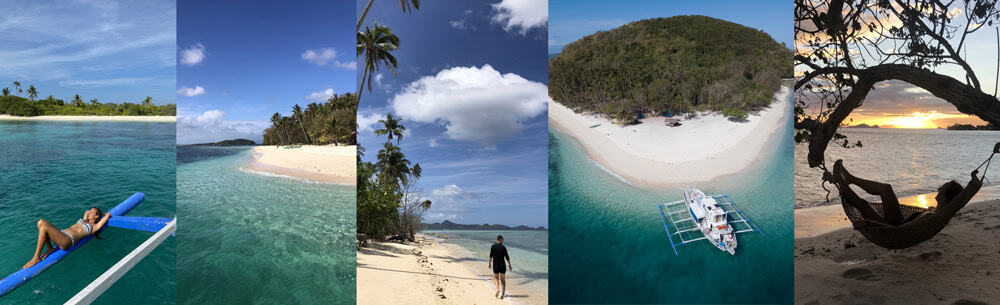
As we mentioned earlier, each company runs its expeditions differently. We’ve traveled with Big Dream Boatman twice, among other things because it’s one of the few companies that runs a four-day, three-night expedition.
Why do we think four days is better than three? Mainly because if you opt for a three-day expedition in Palawan, you’ll have to cover a long distance on the high seas and complete the entire route within that timeframe, which also translates into far fewer stops at those “lost” paradise islands.
Personally, since we were investing in an adventure like this, we didn’t want to come away feeling that we’d only experienced half of it.
At first, you may find yourself wondering, “Won’t it be too many days? Won’t I get bored?” That’s perfectly normal—it crosses almost everyone’s mind at some point. But believe us, the tears that welled up as we realized we were approaching El Nido weren’t just because of the beauty of its cliffs, but because we knew this unique experience was coming to an end. We would happily have carried on sailing for several more days!
That said, there are many other companies like this one (which we’ll talk about later) that do the route in three days and two nights. If you have less time or simply don’t want to devote as much time to it, it’s a good option too, of course.
What is the boat like for the Coron or El Nido expedition?
Several companies run this kind of expedition (we’ll talk about them later) and each has different types of boats for the Coron to El Nido expedition. Some are bigger and some smaller; some have loungers, while others have beanbags… After weeks of analyzing the pros and cons of each company, we chose Big Dream Boatman.
For the 2026 season, many dates in October and November are already fully booked. We recommend that, if you’re interested, you book as soon as possible. You can check the calendar on their website and select the expedition you’re interested in.
We’d seen some photos on their website but, until you see it in person, you don’t realize just how impressive the “super bangka” you’re going to spend the next few days on is. While we waited at a café near the port to be called for boarding, we had fun trying to guess from afar which one was ours. That little one over there? The one farther out to sea? And when, finally, we headed over with our luggage and, just a few meters away, were told that this was the boat for our Coron to El Nido expedition, we burst out laughing and had the same look of excitement as children on Christmas morning. Everything was far better than we could have imagined:
- There is a lot (A LOT in capitals) of space in the main area, so everyone in the group can be there without feeling like sardines in a can.
- On each side of the boat there’s a huge net you can stretch out on at any time and enjoy the journey in a different way.
- There are two huge waterproof mats to lie on comfortably. Plus, they clean them (the whole boat, really) constantly so they’re neither dirty nor wet.
- It has a small toilet that’s always kept clean, so you’ll barely miss having a proper bathroom on land.
- There’s a freshwater shower if you want to rinse off the salt after enjoying the different beaches you’ll visit.
- Both the bow and the upper deck (you read that right, there is an upper deck) have a sunny area and a shaded area.
- It has a kitchen where the chef will whip up dishes you’d never expect on a boat.
- Breakfast, lunch, and dinner are included, sometimes with a surprise snack too, as well as unlimited water and juices and almost unlimited beer and rum.
And if all that weren’t enough, the boat is equipped with two kayaks, a paddleboard, snorkel masks and fins, books, and balls to play with on the different islands.
Best time to do the Coron to El Nido expedition
Since July to September usually coincides with the rainy season in the Palawan area, the best time to take a Coron to El Nido expedition (or vice versa) and enjoy the best weather is between October and June.
In fact, the main companies that organize these adventures (such as BDBM) suspend operations from July to October, mainly because the sea is rougher and cancellations are more likely.
EXPEDITIONS IN AUGUST AND SEPTEMBER: It’s also possible to sign up for El Nido–Coron expeditions from June to September (as is the case with this company), but if you can, we recommend the period from November to May, when you have a better chance of good weather, can enjoy the experience more, and are less likely to face a cancellation.
If you decide to do the expedition between July and September, we very, very strongly recommend choosing a company with a suitable, properly licensed boat of a decent size. We’re not saying this lightly—we’re talking about an open-sea crossing where conditions can become challenging, and this is not a situation in which you want to take unnecessary risks.
Either way, the weather in the Philippines is not an exact science and you should always be prepared for a squall or a period of heavy swell. We were lucky enough to avoid any rain and only experienced a couple of hours of heavy swell, which, thanks to being on such a large and well-prepared boat, was easy to handle.
One thing to keep in mind: if the sea is rough, the Philippine Coast Guard decides whether boats are allowed to set sail. In other words, if they cancel, all sailings are suspended for safety reasons. Coast Guard advisories are usually issued at around 3–4 a.m., so anything is possible. If they give boats the go-ahead to set sail, it’s because it’s considered safe, even if a downpour is falling at that moment.

Which company should you do the expedition with?
Before choosing a company for our Coron to El Nido expedition, we took time to study the different options. We read hundreds of reviews and looked through articles, photos, and YouTube videos and, although TAO Expeditions is the longest-established operator, we quickly found ourselves drawn to Big Dream Boatman. It’s neither the most expensive nor the cheapest, but what they offer, together with the family-like atmosphere mentioned in so many reviews, convinced us.
Having done the Coron–El Nido expedition with them a couple of times, we can say first-hand that all that praise is justified—and still doesn’t quite do the experience justice. From the very first moment to the very end, their friendly, cheerful crew attends to your every need and treats you like family. You’ll miss them!
Obviously, other companies may also have good crews, but as we crossed paths with boats from other companies doing the same route or traveling in the opposite direction from El Nido to Coron, we realized we’d chosen well: none of the other companies’ boats could compare with theirs. They were all much less spacious and had fewer areas to hang out. Some had nowhere to sit in the sun, others had practically no shade; hardly any had kayaks; and only ours was spacious enough for you to have plenty of room to yourself if you wanted.

Big Dream Boatman’s boat compared with those operated by companies such as Tao Expeditions
BDBM will always be our top recommendation not only for the quality of their boats, their commitment to their staff—who, we understand, are among the best paid—their support for social and animal-welfare causes on the islands, and the quality of their service, but also because they’re among the few that run the Coron–El Nido route over four days and three nights.
If you’re looking for a shorter three-day, two-night and/or more affordable option, we recommend THIS OTHER COMPANY. They started operating in 2025 and have already enjoyed considerable success. We know they’re putting a lot of effort into offering a very good experience in terms of both service and the quality of their camps, so we wouldn’t hesitate to book with them (just take a look at their Tripadvisor reviews, in addition to the great feedback we’ve received from many readers).
If you decide to book, use our link and enter the code TRAVELPHILIPPINES to get a 1,000-peso discount.
Heads up: it looks like they’re having issues with the website. You can message them on WhatsApp (+639525516226) and mention our discount code there so they can apply it.
Price of the Coron to El Nido expedition (or the other way around)
Okay, it all sounds great, but how much does the expedition cost? Well, as you can imagine, prices vary depending on the company. Factors such as duration (obviously, a four-day expedition isn’t the same as a three-day one), boat type, service, etc., come into play.
The price of the four-day, three-night Coron–El Nido expedition is around US$600, which works out at approximately $150 per day, including accommodation, meals, all drinks, including alcoholic drinks, transport from Coron to El Nido, what essentially amounts to four days of island hopping, all the gear included on the boat (kayaks, masks, fins, paddleboard…), all beach and island fees, and an epic experience that will take you to wonderful places you’ll never forget.
With our link and the code FACEBOOK10 you get a 10% discount on BDBM expeditions.
For a three-day, two-night expedition, prices are around 16,000–18,000 Philippine pesos ($250–300) and they usually don’t include drinks (water only) or fees. Check exactly what’s included so you don’t get any surprises.
With our link and the code TRAVELPHILIPPINES you get a 1,000-peso discount on Sea Nomads’ expeditions, which cost 17,000 pesos.
You know we like to recommend companies and experiences we know provide good value because we want you to enjoy the Philippines as much as (or more than) we do, but whether you choose these companies or not, we strongly advise you to check other travelers’ reviews before booking. Keep in mind we’re talking about a multi-day experience with many factors involved (boat, food, camps, crew…). We’ve received terrible feedback about several companies and we don’t want a poor choice of company to ruin the experience for you.
If none of the options above suits you, you can also book this option through GETYOURGUIDE, which also has lots of positive reviews.

Camps: cabins, arrival, beach, and bathrooms
What is the food like during the expedition?
Another question we had was what the food on board would be like during the Coron to El Nido expedition. Island-hopping tours usually include food that, while varied, tends to be rather basic. That’s fine for one day, especially when you know you can choose whatever you like at a restaurant that evening, but three or four days like that could get rather repetitive.
On both occasions when we did the Coron–El Nido expedition, we were lucky that the chefs on board treated us to delicious, varied, and generous meals throughout the journey. No one ever went hungry!
Lunch is usually served at the boat’s huge central table while it’s anchored off a beach, whereas dinner and breakfast are served at the overnight camps.
Lunches and dinners usually include a variety of Filipino dishes such as adobo, pancit, lumpia, rice, kaldereta, and barbecued food, alongside international options such as pasta and pancakes. Everything is prepared with great skill, giving you the chance to enjoy some truly delicious local dishes.

On a couple of occasions, the boat’s crew also fished and served the freshly caught fish to anyone who wanted some. Seafood such as shrimp and crab is also commonly served.
If you’re vegan or vegetarian, don’t worry: if you let them know when you book, they’ll take it into account and cook up some genuinely delicious vegetable dishes—including excellent tofu! We always brought a few cans of chickpeas and beans just in case, but we never needed them.
Breakfasts include the kind of food you’d typically find at a Filipino hotel, such as coffee, tea, jam, eggs, fruit, rice… And the afternoon snack is always a surprise, with the chef preparing something tasty—like, for example, deliciously sweet camote cue or fried plantain—both popular Filipino snacks.
On the last night there’s a mouth-watering farewell dinner whose details we won’t reveal, so we don’t spoil the big moment for you. Just get ready to enjoy a tasty Filipino tradition.
What the camps are like on Coron to El Nido tours
Where am I going to sleep? Will I be comfortable? Will I have a mosquito net? It’s normal to ask yourself these questions, but don’t worry—we’re here to answer them.
The camps used on El Nido–Coron tours are fairly basic. They’re not hotels—there aren’t any here, and we hope that doesn’t change anytime soon—and usually consist of several cabins on an otherwise uninhabited island, looked after by a local family who keeps everything well maintained and spotless. In addition to the cabins, you’ll usually find a dining or chill-out area (hammocks are common) where dinners and karaoke nights take place.

As for the cabins, they usually sleep two people and are quite Spartan: a bed with a mosquito net and little else. In some cases there’s a tiny balcony with a hammock and, with luck, a fan or two, but the truth is it’s rarely hot. Since they’re right by the sea, you may even find yourself pulling up the sheet provided or putting on a light layer to keep warm.
Are there mosquitoes, spiders, or other bugs? Yes. You have to keep in mind that you’ll be in nature and it’s normal to run into them. While you’re outside the cabin, use repellent and, when you’re inside, your mosquito net will keep you protected. It’s really nothing too extreme, and it certainly doesn’t feel like sleeping deep in the jungle.
Finally, the camps on the Coron–El Nido expedition have one or more toilets and showers. Bear in mind that you shouldn’t expect a conventional bathroom, but rather something more modest. Generally there’s no hot water, and in some cases not even running water, so you’ll have to wash using buckets filled from a freshwater tank. Is that a problem? Considering the type of experience it is, that it’s only a few days, and that the water is unlikely to be very cold, we don’t think so—and, in fact, we consider it part of the experience.
Obviously, some camps are better than others (better maintained, with better facilities, on prettier beaches…), so the company you choose can make a real difference here too.

What to pack: recommended luggage
Another big question that can come up when deciding to do a Coron to El Nido expedition is what to do with your luggage. We had exactly the same question before our first expedition, so here’s the most useful information you need.
Will my luggage be safe?
When we wondered whether our luggage would be safe during the Coron to El Nido expedition, our concerns had nothing to do with the possibility of theft by the crew. Just look at the reviews of Big Dream Boatman’s crew to see that everyone comes away loving them, with zero complaints and endless praise.
Our concern was that our valuables might get wet in the swell or during a storm, as we had read about this happening to other travelers who did the El Nido–Coron expedition with TAO Expedition.
We had zero problems, even on the day we had a couple of hours of heavy swell. In the central part of the boat there’s a large compartment covered by waterproof mats and a large wooden board that serves as a lid. All the main luggage you won’t need during the journey is stored there and then covered with a large waterproof tarpaulin.
We also always travel with a couple of laptops, a drone, and a camera. Thanks to the boat’s design, very little spray reaches the interior, but during the roughest moments we stored laptops and cameras in the captain’s wheelhouse, an even safer place where not a single drop of water gets in.
What should I bring on the Coron to El Nido tour?
Once you sign up for an El Nido to Coron or Coron to El Nido expedition, any reputable company will send you a document with everything you need to know. In it, they’ll ask you to divide your luggage into two separate bags.
One should be a standard backpack or dry bag containing everything you’ll need during the expedition; the other should contain your main luggage, which will be stored in the compartment we mentioned in the previous point. They’ll tell you that you won’t have access to anything you store there until the expedition ends but—between us—you can ask the crew to open the compartment if you need to retrieve something important. Even so, try to keep everything you’ll need with you from the outset. We recommend keeping the following in the backpack you’ll have with you during the trip:
- Sunscreen: essential, since you’ll want to sunbathe and enjoy the different areas of the boat. If it’s also a reef-safe sunscreen like this one, even better. It’s also a good idea to bring a sun-protective shirt, since you’ll spend a lot of time snorkeling and, in general, in the sun. It’s healthier and can save you money on sunscreen too.
- Towel: you can bring a microfiber one, although you’ll actually be provided with a clean, high-quality towel to dry off after swimming in the sea or showering at camp.
- Clothes: you’ll spend practically the whole day in a swimsuit, so you won’t need much clothing beyond sleepwear and comfortable clothes to wear at camp after your well-deserved shower. Bring only as much underwear and clothing as you need so everything fits in the bag you’ll keep with you. As for footwear, flip-flops will be more than enough. On an expedition like this you won’t need hiking shoes or water shoes.
- Toiletry kit: a compact toiletry kit containing the essentials. Toothbrush, toothpaste, a bar of soap, and shampoo, if you want to wash your hair.
- Camera and phone: you’re going to see wonderful places that you’ll want to capture, so don’t hesitate to bring your camera—and don’t worry about its safety. If you don’t have one or prefer not to fuss, your phone may be all you need. If you want to get online during the expedition, keep in mind that part of the trip takes place far from mobile phone towers and you’ll have no signal. Enjoy the journey and leave the digital world for later!
- Other extras: for example, we always travel with our own snorkel mask (you can check one here) since we like to use a good one that doesn’t fog up and to have a mouthpiece that no one else has used. Other travelers brought e-readers. Whatever it is, avoid bringing too many extras so your bag remains easy to carry.
- Dry bag: a useful companion that will come in handy more than once on your trip to the Philippines. We each have one, but on this expedition we only brought one to share. It’s ideal, for example, when you need to kayak from the boat to shore at a beach where it’s not possible to moor nearby because of the shallow water or tide conditions. We use one like this—take a look.
- Electricity: each camp has a charging point for electronic devices that is available only at certain times. Socket types may differ from those used in your home country, so we recommend bringing an international power adapter like this. We also travel with a power strip like this, which allowed us to charge all our devices at once. A power bank is also useful to charge phones or a GoPro without having to wait until you reach the camp.
Coron to El Nido expedition itinerary: our experience
Now that you’ve got an idea of what a Coron–El Nido expedition is like, you’re probably wondering what the itinerary is or which islands and beaches are visited. We’re going to tell you everything! But first, don’t miss this video where we show some of the best moments from our expedition:
Keep in mind that although Coron–El Nido tour itineraries are fairly standard, they are always subject to change for three main reasons: 1) sea conditions (there may be heavy swell in an area and the boat may be unable to reach or moor at a particular spot); 2) the camps available to the operator; and 3) whether the expedition lasts three or four days (obviously, a four-day trip includes more stops and gives you more time at the places you visit).
Because of this, it’s normal for a company not to tell you the exact route they’ll take. Rest assured: everywhere you visit will be beautiful and, if you can’t go to a specific spot, you won’t feel like you’re missing out. In reality, the best part of doing an El Nido–Coron tour is the overall experience.
The route is usually the same whether the expedition is from Coron to El Nido or from El Nido to Coron. The only difference is the order of the stops.
You’ll also usually receive departure instructions and other relevant information the day before. Don’t stress—if you book with a reputable company, you won’t be left stranded. Just be patient; in the Philippines not everything runs like clockwork, as you’ve probably realized by now.
Finally, in general, El Nido–Coron tours allow you to do activities like kayaking, paddleboarding, and volleyball, as well as cooking classes, visits to local communities, bonfires, and karaoke. In short, you won’t be bored.
Day 1:
The Coron to El Nido expedition begins with all participants meeting at a restaurant near the port, where you can settle any outstanding balance if necessary and everyone gets to meet the crew for the first time. Then, without much delay, you head to the boat and everyone’s eyes widen when they see how huge and well prepared it is.
After a welcome drink, an explanation of how everything works on board, and introductions from each crew member and participant, the adventure begins!
Atwayan Coral Garden
Generally, over the course of this day you’ll visit some of the stops included on Coron’s Escapade Tour and, depending on the company, some stops from the Ultimate Tour. In some cases Twin Lagoon or Kayangan Lake are included, but it’s not common, which is why we always recommend adding an extra day before or after the expedition to take Coron’s Ultimate Tour. You have all the details in Island hopping in Coron.
During the Coron–El Nido expedition (and vice versa) you’ll make several snorkeling stops and, generally, one of the first (or last, depending on direction) will be Atwayan Coral Garden, located close to Atwayan Beach and rarely included on standard tours, so it’s usually very quiet. It’s one of our favorite coral gardens in the Philippines. Believe us—it’s incredible!
CYC
This small island near Coron Town has a lovely stretch of golden sand and is perfect for swimming. It is occasionally included on the Ultimate Tour, although this is uncommon.
Bulog Dos
By this point, you’re well into the journey. The scenery changes, and you start to see the gorgeous islands you usually find on the Escapade Tour. Bulog Dos is a perfect example, with two spectacular sandbars bathed in turquoise water, and it sits right next to Waling Waling, with another epic sandbar that you can reach by swimming.
Coco Beach
This is a truly postcard-perfect beach with white sand, coconut trees, and some picturesque raised cabins with a hammock below. With a bit of luck (especially if you travel with one of the top El Nido–Coron expedition companies), this may be the base camp where you spend the night, allowing you to make the most of the beach once everyone else has left.
Coco Beach has several types of cabins (some more enclosed than others), dining tables, bathrooms, and other basic facilities. In short, it’s a great base for this kind of adventure.
If Coco Beach isn’t available, many Coron–El Nido expeditions stop at Banana Island, which is equally wonderful.

Bulog Dos (left) – Coco Beach (center and right)
Day 2
Given the great distance between Coron and El Nido, much of day 2 will be spent sailing (which is why we mentioned earlier that three-day expeditions can feel rushed). Wake up, take a stroll around the island, have breakfast, and get back on the boat to continue the adventure.
Ditaytayan Island
The first stop of the day is Ditaytayan Island. This paradisiacal place is known for its vast, beautiful stretch of fine white sand where you can relax and sunbathe. Don’t leave the island without putting on your snorkel mask and discovering the rich marine life found there.

Araw Beach
Located on Culion Island itself, it’s another jaw-dropping white-sand beach lapped by crystal-clear waters. It’s also full of palm trees, and expeditions usually spend a good while here.
Inapupuan Island or Inapupuan Reef
As we mentioned earlier, you’ll have plenty of opportunities for great snorkeling on the expedition, and the reef beside Inapupuan Island is a perfect example, as it remains in excellent condition. If the weather is good and there’s enough time, the itinerary may also include a stop on the island itself.
Linapacan Cliff
This stop is only for the brave and those who love an adrenaline rush. Before reaching the next stop, the boat stops by a cliff and the crew jump into the water and climb the cliff face to set up safety ropes. Then those who dare can climb up and jump from the cliff into the sea. The current was strong when we visited and we preferred to watch from the boat, but we’re sure it must be an awesome experience.
Belemben Guest House
We fell in love with the second night’s camp as soon as we spotted it from the expedition boat. Don’t expect luxury or extensive amenities, but those cabins right on the shoreline with views of an epic sunset were everything we were looking for in a trip like this. In fact, we can say that sleeping here was one of the coolest experiences we’ve had in all our years of traveling around the Philippines.
If you arrive early enough, don’t hesitate to take a stroll along the nearby beaches before sitting down with everyone else on the trip to have dinner and share stories.

Day 3
By the third day, as you’re closer to the final destination, you can pack a lot into the day. Get up early, enjoy the silence on the beach at dawn, and have a good breakfast to fuel up for what’s to come.
Cagdanao Island
The first stop is a stone’s throw from where you spent the previous night. Cagdanao Island is a gorgeous, postcard-perfect island, with fine sand and turquoise waters that will win you over before you even step on it. Here you can have fun playing volleyball with the other travelers on the expedition, enjoy snorkeling among a wide variety of marine life, go kayaking or paddleboarding, or, obviously, just lie on the sand and take a dip in these idyllic waters.

Snorkeling spot with the possibility of kayaking to Ginto Island
This was an unusual stop. The boat stopped offshore, and the crew told us it was a good snorkeling spot. The interesting thing was that Ginto Island—a magnificent island we were really eager to visit—lay just a short distance away. We highly recommend grabbing one of the available kayaks and paddling over to Ginto.
Ginto Island is a fantastic island with a long beach flanked by huge palm trees, ideal for a relaxing stroll followed by a swim at its eastern end.

Turtle Point (Bulawit Turtle Spot) and Bulawit Village
A little farther west, they’ll take you to a small bay home to one of the area’s so-called Turtle Points, a spot where turtles are often spotted. After waiting a few minutes for someone to spot the first turtle, we jumped into the water and saw a couple of huge turtles that didn’t even flinch at our presence and kept calmly eating the seagrass they love so much.
Responsible traveler: Please, when you have the honor of swimming alongside one of these beautiful animals, always keep a respectful distance. Don’t get closer than 3 meters, don’t chase them and, above all, never touch them.
Before or after snorkeling, anyone interested can visit the neighboring village of Bulawit, located on Linapacan Island. It’s a chance to learn how people live in such an isolated area. If you feel like it, you can take the opportunity to buy some snacks or drinks and contribute to the local economy.
Kala Kala Island
You’ll also find it as Cala Cala Island or Lacalaca Island, and for many travelers on the Coron to El Nido tour it’s one of their favorites. Besides its lovely beach, it has some interesting rock formations.
Cobra Island (Manlihan Island)
The last stop of the third day of the Coron–El Nido expedition (though sometimes it’s the first of the fourth, depending on how the previous day went; as we said, it can change) is every bit as impressive as the day’s earlier stops and brings you to Cobra Island. This elongated island of fine white sand is ideal for a relaxing walk, sunbathing, or swimming on whichever side is sheltered from the wind. Keep in mind that it’s an island with little shade, so we recommend applying plenty of reef-safe sunscreen.
If you bring your drone (in this guide we tell you about the best drones for travel), you’ll really enjoy seeing the island from above. It’s called Cobra Island because they say it looks like a cobra, but doesn’t it look more like a seal to you?

Linapacan Tourist Camp
You’ll spend the final night at a camp consisting of cabins with a small terrace and a communal area with chairs and hammocks, ideal for watching the sunset. Once you’ve showered and settled in, it’ll be time for the farewell dinner. We won’t say much about it because we want it to surprise you as much as it surprised us, but we assure you that you’ll never forget this “traditional” dinner.
As we’ve already mentioned, the camps used may vary depending on the operator and availability, so bear in mind that you may stay somewhere else.

Day 4
Sadly, the final day arrives and the expedition sets course for El Nido. Make the most of everything this wonderful boat has to offer, as the adventure is drawing to a close.
Takling Island
Another uninhabited island where a Survivor-style TV show could easily be filmed. It’s relatively close to the camp where you spent the night, so it’s only a short sail away. It’s also perfect for snorkeling.
Darocotan Island
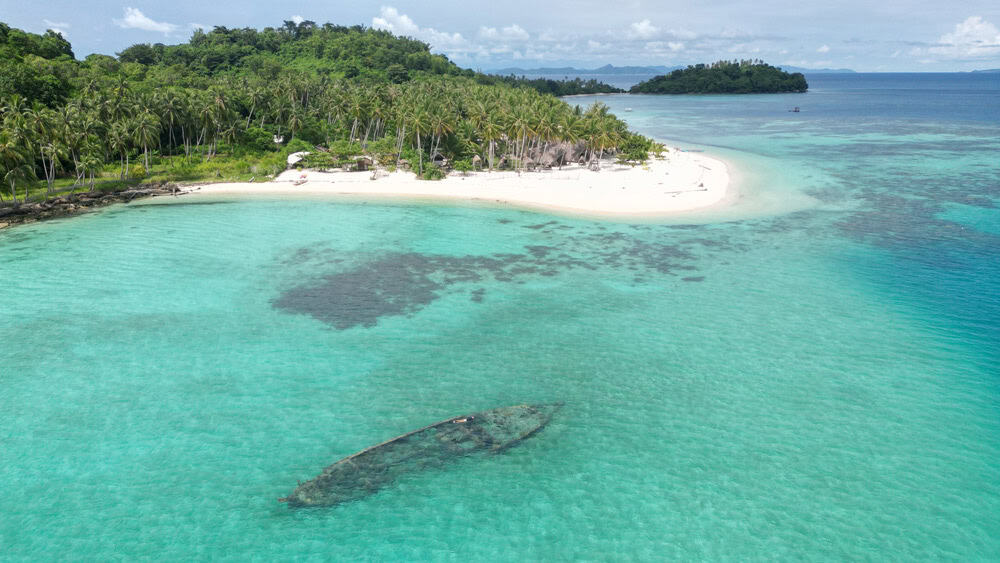
This little island located east of Palawan provides the perfect finale. It wasn’t previously included on El Nido–Coron expeditions, but thanks to its location along the route, wonderful beaches, excellent snorkeling around the shipwreck (you can easily make it out in the photo), and growing popularity, it is now commonly included as the first or last stop of the Coron–El Nido tour.
If you’d like to extend your stay—or decide not to do the expedition after all and want to have a special experience—you’ll be pleased to know that there are three or four small cabin-style resorts where you can stay for a few days. We talk about it in our Darocotan Guide.
El Nido (San Fernando)
Expeditions used to end in El Nido Town, but as the number of boats has increased and the port is small, they now finish at the port of San Fernando, which lies farther north on Palawan Island. Onward transport to El Nido Town is generally included, since there’s no regular transport from this point.
Don’t worry, once you reach the port, the expedition crew will take care of offloading your luggage. Give them a big hug, take a few final photos and—sorry—the journey will be over.
Remember, these stops may vary depending on the company and sea conditions. Due to the swell, it may not be possible to moor somewhere because of the boat’s draft or safety concerns. Don’t worry if you miss a particular island; the crew will probably take you somewhere else that is just as beautiful, if not more so. What really matters here is the experience.
Remember that with our link and the code FACEBOOK10 you get 10% off BDBM expeditions.
With our link and the code TRAVELPHILIPPINES you get a 1,000-peso discount on Sea Nomads’ expeditions, which cost 17,000 pesos.
If you prefer, you can also book this option through GETYOURGUIDE, which also has lots of positive reviews.
Frequently asked questions and tips for the expedition between Coron and El Nido
As we bring this guide to a close, we want to answer the questions travelers ask us most often about the El Nido–Coron tour. That said, if you have any other questions, you can leave them in the comments and we’ll reply as soon as possible.
You say there’s almost unlimited beer and rum—does that mean it’s a party boat where everyone parties and gets drunk?
Not at all. Someone who signs up for an adventure like this does so to experience it to the fullest. Although alcohol was available throughout the day on our BDBM expedition—this may differ with other operators—people only drank at dinnertime and in moderation. At the farewell dinner on the last night, some people had a few drinks, but nothing out of the ordinary.
One couple chose to spend their honeymoon on the expedition, so the vibe has nothing to do with a party boat. It’s also worth considering that the BDBM expedition is a bit more expensive than other options because it is longer and offers a higher-quality experience, which may also attract a more diverse mix of travelers.
Are there any expeditions besides the Coron–El Nido and El Nido–Coron routes?
Yes. There’s also the so-called Coron to Coron Expedition, which, starting and ending in Coron, takes you to stunning islands like Black Island. It’s an expedition we wholeheartedly recommend! It’s a little cheaper and the experience is awesome. BDBM is not currently running this expedition, but YOU CAN BOOK IT PRIVATELY WITH SEA NOMADS (you can also use our discount code).
Do I have to pay anything else? Do I need to carry cash during the expedition?
With BDBM, nothing at all. Everything is included. You don’t need to worry about paying island and beach access fees—they’re already included. On the last day, once the boat has docked in El Nido, you can buy one of their T-shirts if you want and tip the crew, but beyond that you won’t need money. If you go with another company, it’s best to ask in advance to avoid surprises.
How many people go on these expeditions?
There were 14 travelers and 10 crew members on our expedition. There was still plenty of space for several more travelers. In general, groups are limited to 20 travelers, although whether an expedition fills up depends on the dates.
What age range is an expedition like this recommended for?
Most travelers on our expedition were between 25 and 30. Everyone was traveling as part of a couple, except for a woman in her sixties traveling with her daughter, who enjoyed it as much as everyone else. There were no teenagers in our group, but the expedition can also be a good option for teenagers.
Will I have hot water and electricity at all the camps where you stop to sleep?
We can speak from our experience. Of the three camps we visited, only one had proper hot water. At the other two, the water wasn’t heated, but the tanks had been in the sun all day, so it wasn’t particularly cold either. Honestly, it wasn’t something we missed.
As for electricity, all the camps had charging points in the common area. We never had any concerns about theft. At all three camps, electricity was only available during certain hours, but it was more than enough to charge cameras, phones, power banks, drones, and any other devices you bring.
Coron to El Nido expedition or El Nido to Coron tour, which should I do?
There’s no real difference—choose whichever direction fits your Philippines itinerary best. That said, if you also plan to take island-hopping tours in El Nido or Coron (which we recommend), keep in mind the stops included on the expedition and choose tours that don’t revisit places already included on the expedition. In short, avoid the Coron Escapade Tour, as some of its stops are already included on the Coron–El Nido expedition.
Does the Coron to El Nido expedition replace the traditional island hopping?
In our opinion, to avoid doing too many similar boat tours, we’d do El Nido Tour A and/or C (if possible, both) and a private Ultimate Tour in Coron. That said, sometimes BDBM includes Twin Lagoon, Kayangan Lake, or 7 Pecados, but it’s not common. The Coron–El Nido tour doesn’t replace island hopping tours; it complements them.

Where to stay before and after the expedition: recommended accommodation
Whether you do the El Nido to Coron expedition or the other way around, you’ll most likely need to spend at least one night in each of these destinations. To make things easier and help you plan the whole adventure from start to finish, here are some of the places we recommend.
Accommodation in Coron
In our guide to Where to Stay in Coron, you’ll find detailed information to help you find the accommodation that best suits your needs. Here are three options to help you start narrowing down your choices:
- Bay Area Lodge: a highly recommended mid-range hotel where we stay on almost every visit to Coron. It’s right in the center, with clean, well-equipped rooms and one of the best restaurants in the area. A great choice! Click here for more information about the hotel.
- Hop Hostel: Coron’s quintessential hostel. It offers affordable rates, lockers, and a fantastic rooftop for socializing and watching the sunset, with plenty of restaurants nearby. You can check it out by clicking here.
- The Funny Lion: a highly recommended resort in Coron with a hot tub, an infinity pool offering amazing views, and beautiful rooms. Check availability here.
Accommodation in El Nido
Likewise, in our guide to Where to Stay in El Nido, we’ve included everything you need to know to find the right place to stay. Read the full guide or consider these three suggestions:
- BaleCabugaoCottagesRental: if you’re looking for a budget-friendly option, book well in advance because it sells out fast. Check availability and book here.
- Frendz Hostel El Nido: a popular modern hostel with very well-kept facilities, a great vibe, and an infinity pool with awesome views of Bacuit Bay. Check prices here.
- Sea Cocoon Hotel: located in the heart of El Nido, with all the amenities you might need. It has well-kept rooms, fast Wi-Fi, a pool, and a breakfast buffet included in the rate… Always a great choice! Click here to find out more about the hotel.
What do you think—does this adventure sound like your kind of trip? Are you ready to book your Coron to El Nido expedition? If you have any questions, write to us in the comments and we’ll be happy to help.