Are you thinking about traveling to the Philippines at Christmas and wondering what to expect? Don’t worry—we’re about to tell you everything you need to know about this celebration in our favorite country in Southeast Asia, which we’ve spent more than 15 years exploring. Discover what the traditions are like here, what the weather is like at this time of year and, most importantly, what it’s like to visit the Philippines at Christmas so you can plan your next vacation.
How is Christmas celebrated in the Philippines?
If you’ve done a little research for your upcoming trip to the Philippines, you can probably already imagine why this is the Asian country where Christmas is celebrated most enthusiastically. In a country of more than 100 million people, 92% of whom identify as Christian, you certainly won’t be short on Christmas spirit if you’re spending Christmas in the Philippines.
Christmas in the Philippines, the longest in the world
As soon as August ends, Filipinos rush to bring out their Christmas decorations. You read that right: as soon as September—the first of the months ending in –BER—begins, don’t be surprised to see a Christmas tree or hear Christmas carols in shopping malls—Christmas in the Philippines has officially begun. It usually lasts until around the first week of January, but don’t be surprised to see decorations well into the month (or much later), when they start blending into the Valentine’s Day decorations.
But why does it last so long? Besides the fact that they love anything involving a celebration, it also stems from the values of their society. Filipinos are extremely family-oriented, but many of them also live outside the country or their home provinces, so they start preparing for their “trip home for Christmas” well in advance.
Christmas traditions in the Philippines
Here are some of the most popular Christmas traditions in the Philippines:
- Misa del Gallo or Simbang Gabi: the masses held in the early morning (between 3:00 and 5:00) for 9 consecutive days (novenas), beginning on December 16 and continuing through the 24th.
- Panunuluyan: on the evening of the 24th, people reenact the moment when Mary and Joseph are said to have journeyed in search of shelter before the birth of baby Jesus. After being turned away from many homes, they arrive at the church, where they stay and the Misa del Gallo begins.
- Noche Buena: as in many other countries, Christmas Eve (known as Noche Buena in Tagalog) is also celebrated in the Philippines on the evening of December 24. After a midnight mass, the family gathers for a feast. Many people also exchange gifts at this time.
- Christmas Day: on December 25, Filipinos commonly visit their relatives, especially older family members. They perform the Pagmamano, a gesture that is traditional at any time of year. It is a sign of respect in which the younger person places the back of the older person’s hand against their own forehead while saying “mano po.” The older person usually gives a blessing; at Christmas, they also usually give an aguinaldo—a sum of money. A lunch and, sometimes, a special dinner are also common, followed by karaoke sessions, conversation and games.
- Christmas decorations in the Philippines: in many homes, businesses and other buildings such as churches, it’s common to see a parol (derived from farol). This is a colorful representation of the Star of Bethlehem that is usually lit up at night. It’s also common to find a nativity scene.
- Christmas carols: did you think you were getting out of them this year? Christmas in the Philippines wouldn’t be complete without music, and people sing Christmas carols here too. Many children go from house to house singing in hopes of receiving a cash gift. Here is one of the most popular songs, by Jose Mari Chan, the Filipino singer-songwriter best known for his Christmas songs:
Christmas food in the Philippines
Since many Christmas traditions in the Philippines came about as a result of the Christianization begun by the Spanish, many of the dishes commonly found on tables at this time of year were inherited from them. For example, Noche Buena typically features a feast that includes hamon (Christmas ham), queso de bola (yes, the traditional ball-shaped cheese), lechon, pancit, chicken galantina or relleno (chicken stuffed with other kinds of meat and egg), turrones, castanas, Filipino fruit salad (made with condensed milk and cream), ensaimada and fruitcake.
However, rice-based dishes from the pre-Christian era are also included. The most popular is bibingka, a rice and coconut milk cake made in clay pots and covered with banana leaves. It’s very commonly sold outside churches, especially after the novenas we mentioned earlier. Christmas in the Philippines wouldn’t be the same without puto bumbong, another rice-based sweet cooked in bamboo tubes that has an unusual purple color.
If you’re curious about the cuisine, don’t miss our article What to eat in the Philippines: 25 traditional dishes and drinks.
Unusual places to visit in the Philippines at Christmas
For us, spending Christmas in the Philippines means celebrating it in the most tropical way possible: staying on a beautiful island where we can enjoy the beach, sit down to dinner by the sea and, ultimately, enjoy what the country has to offer. However, if you’re looking for something a little more unusual that oozes the Christmas spirit you’re after, here are some ideas:
- San Fernando, Pampanga: north of Manila lies what is known as the “Christmas Capital of the Philippines.” This is where the most beautiful parols are made and where you’ll see the most impressive decorations. In fact, the Giant Lantern Festival, or Ligligan Parul, is held every year. There are also processions of lubenas—lanterns shaped like biblical figures—before each novena.
- Manila: the city becomes a little quieter, and the Christmas decorations soften its edges. The most interesting spots are Policarpio St. in Mandaluyong, where all the residents decorate their homes beautifully, and the Ayala Triangle Gardens in Makati, which hold a light show every 30 minutes from 6:00 p.m. to 10:00 p.m. If you want to buy gifts or traditional decorations, nothing beats Divisoria Market.
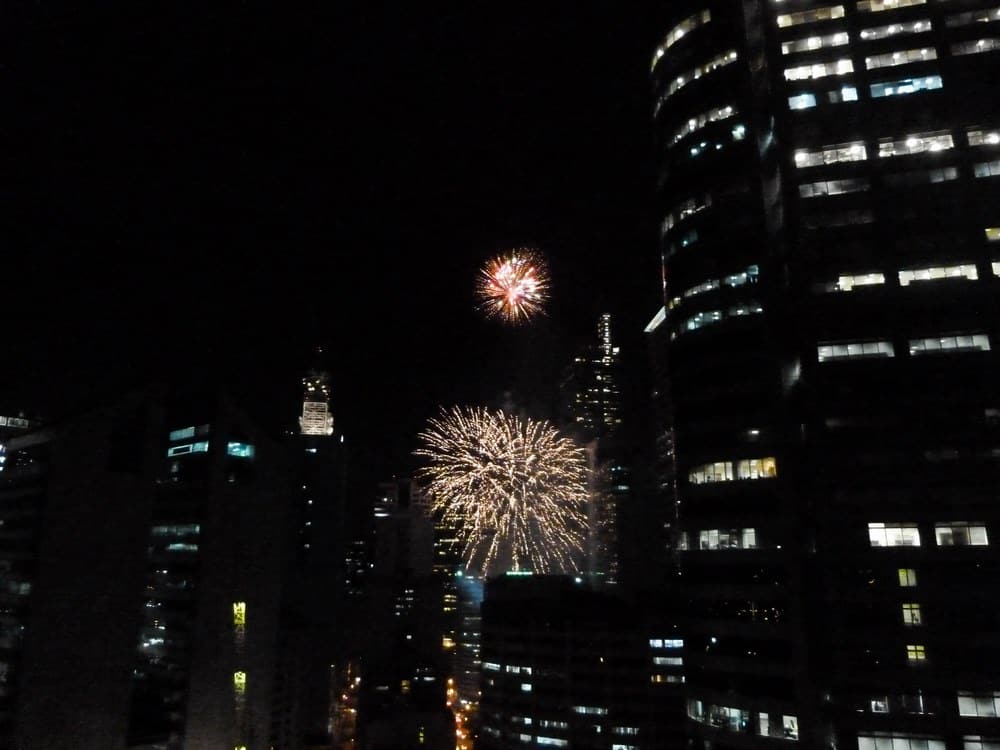
Fireworks in Manila
New Year’s Eve in the Philippines: how is it celebrated?
Are you planning to spend New Year’s Eve in the Philippines? Then you may be curious to know how this night is celebrated here.
The Media Noche celebration also has many Spanish influences. That’s why people usually have a dinner similar to the one they have on Noche Buena, but with ingredients that bring good luck for the coming year. In some places, for example, you’ll often see a plate with 12 round fruits (a circle has no end, implying that wealth will be infinite), noodles (because they lengthen life) and “sticky” desserts (because they keep the family together).
Although these traditions aren’t as widely observed as the Christmas ones, many Filipinos also tend to wear polka-dot clothing (for the same reason they have 12 round fruits), encourage children to jump at midnight so they’ll grow taller, set off firecrackers and fireworks to scare away evil spirits, and leave doors, windows, closets and drawers open to let positive energy in.
In the vast majority of tourist destinations such as El Nido, Port Barton, Bohol and Siargao, it’s not unusual to find a very festive atmosphere. There are usually fireworks, special dinners at many restaurants and hotels, and parties that last well into the night.
Meanwhile, Manila is where you’ll see the most spectacular fireworks, and many restaurants and bars at the top of skyscrapers offer special dinners and a place from which to enjoy the fireworks. Okada Manila hosts a lavish countdown with fountain shows, live music and, of course, fireworks.
Even so, our favorite place to spend New Year’s Eve in the Philippines will always be Malapascua. This is where we have close friends and many memories, and we like its slightly more intimate atmosphere. We always look for a cool place to have dinner, then make sure we’re at the countdown on Bounty Beach, where you can also usually see fireworks near Ocean Vida, which has thrown a great party with DJs in recent years. Afterward, we end up dancing with the entire village at the “Disco Party” on the basketball court.

New Year’s Eve in Malapascua
The weather in the Philippines at Christmas
One of the things we love most about spending Christmas in the Philippines is the weather. We’re tropical-weather people through and through, so we love spending the holidays in shorts and flip-flops.
As we explain in When to travel to the Philippines, December marks the beginning of the dry season in much of the country and is also one of the “cooler” months. Average temperatures sit within a comfortable range of 22°C to 32°C, so it’s warm, but sleeping is more comfortable. If you’re planning to visit the Baguio and Cordillera area on Luzon, bear in mind that this is the coldest time of year and temperatures can therefore drop below 10°C.
You already know that the weather in the Philippines is unpredictable, but if you want a lower chance of rain, focus on areas of the country outside the south. In Siargao, for example, Christmas falls during the rainy season.
You’ll find much more information about all of this in The Philippines in December and The Philippines in January.
What is it like to visit the Philippines at Christmas?
As you’ve seen, Christmas in the Philippines is celebrated enthusiastically and the weather usually cooperates, so there’s a very good chance you’ll thoroughly enjoy your trip and have a vacation unlike those you’re used to.
The exotic appeal of being outside your home country and taking in very different landscapes comes with the chance to see traditions typical of this time of year and beautiful decorations. What’s more, Filipinos are even happier to welcome you and won’t hesitate to wish you a maligayang pasko or malipayong/maayong pasko—Merry Christmas in Tagalog and Bisaya, respectively.
Whether you’re traveling solo, as a couple, with friends or with family, you’ll always find something to do and a great atmosphere. What you feel like doing is up to you, because no two trips to the Philippines are the same. You can choose better-known or more remote places, enjoy the beach, climb a volcano or a mountain, take a dip in a waterfall, delve into the history of the Philippines, go scuba diving… Things to do in the Philippines will give you a good idea of the variety the archipelago has to offer.
The main difference when traveling around the Philippines at Christmas is that more people are on the move than usual. Those traveling include international and domestic tourists and, above all, Filipinos returning home to visit their families. It’s high season, so accommodation and flight prices go up and, in many cases, hotel rooms and seats on planes, boats and buses sell out as well. So, if you plan to visit the Philippines at Christmas, we always recommend booking your accommodation and transportation as far in advance as possible to make sure you don’t miss out.
Of course, this doesn’t happen in areas less frequented by tourists, and it’s worth remembering that the Philippines has more than 7,000 islands, so there are always options for a much more peaceful trip.

Yap-Sandiego Ancestral House in Cebu City
Where to go in the Philippines at Christmas
We’ve already given you a few pointers above, but it all depends on what you feel like doing while spending Christmas in the Philippines. We’re fans of laid-back places and don’t really like feeling overwhelmed by lots of tourists, so we always choose somewhere lesser-known or a happy medium like Malapascua.
If you want a huge party, we would choose Siargao, El Nido or Boracay. Port Barton and Bohol also have a lively atmosphere.
If you want to escape the crowds and, above all, high accommodation prices, nothing beats heading to less touristy places in the Philippines such as Romblon, Pagudpud or Caramoan, to name a few. Booking in advance in less touristy destinations that offer better value for money, such as Siquijor or Camiguin, also works very well. They won’t be empty, but they offer a more low-key Christmas atmosphere.
As always, we encourage you to read plenty about the different places (you’ll find tons of information on our website!) and see whether they match what you’re looking for.
In terms of weather, conditions tend to be better on Luzon, in the Visayas and on Palawan, and less favorable in Mindanao (Siargao, basically). However, you already know this isn’t an exact science.

Cresta de Gallo (Romblon)
Tips for visiting the Philippines at Christmas
Here’s the list of tips we wish we’d had the first time we visited the Philippines at Christmas:
- The most important one: book transportation and accommodation well in advance. Seriously, we don’t mean to sound alarmist, but we recommend doing so at least 6 weeks ahead of time. This is especially important if you’re planning to celebrate the main holidays in very touristy places such as Coron, El Nido, Boracay, Siargao or Bohol. You can take the risk of not booking, but don’t be surprised if you’re left with the worst and most expensive options. No complaining afterward! Learn more about these aspects in Hotels in the Philippines and Domestic flights in the Philippines. If you’re someone who changes their mind easily, you already know that many hotels on Booking can be booked with free cancellation.
- If you’re planning to visit Coron and El Nido, book your boat trip between them as soon as possible. The price is the same when you book online, and you’ll spare yourself the frustration of tickets selling out. You can find more information in How to get from Coron to El Nido.
- Book private tours, especially the island-hopping tours in El Nido and Coron. We already recommend them at other times of year, but at Christmas we 100% recommend them because there are far more tourists and you don’t want to feel like you’re being herded around like sheep. It’s not essential, but if you can, make arrangements with the boat operators at least a month in advance (we can give you the contact details of operators we recommend in all these places if you leave us a comment).
- Try to arrive at airports and ports a little earlier. With more travelers around, lines tend to be longer.
- Give your Philippines travel itinerary a little more breathing room than you would at other times. We always tell you that unexpected events can happen, but at Christmas you may need more flexibility, especially if you don’t want to book everything in advance.
- And whether you’re spending Christmas in the Philippines or not, please don’t travel without good travel insurance. This link gives you a 5% discount on the travel insurance we always use, which has never let us down.
You’ll find much more information in Recommendations and tips for traveling to the Philippines and Philippines travel guide.

We hope we’ve helped you understand what Christmas in the Philippines is like and prepare for your next adventure. Feel free to leave any questions in the comments, and we’ll get back to you as soon as possible.