Pamilacan is one of the islands near Bohol—one of the country’s most popular with tourists—yet it still flies under the radar on many travelers’ routes. Although it is similar to Balicasag in what it offers (good snorkeling or diving), the level of tourism is still far from being the same.
We’ve been lucky enough to visit several times. In some cases we went diving directly from Panglao (Alona Beach), and on another occasion we spent the night there. In fact, you can also do a round‑trip day tour both from Alona and from Baclayon (closer to Tagbilaran).
To help you decide whether to visit, if so, enjoy it to the fullest, here we’ll tell you everything about things to do in Pamilacan, how to get there, where to sleep, and those traveler‑to‑traveler tips we love to share. Keep reading and discover everything about this little island about 30 minutes by boat from Bohol.
Where is Pamilacan located?
If you take a quick look at the map included at the end of this Pamilacan guide, you’ll see that the island sits just 12.5 kilometers south of Bohol, in the Central Visayas. It belongs to the province of Bohol and is a barangay (similar to a small town) of Baclayon, the Bohol port from which the “public” boats to Pamilacan depart. The trip from Baclayon takes between 30 and 45 minutes, depending on sea conditions.
As we mentioned above, boats also leave from Alona Beach (Panglao) to Pamilacan. In this case, you should allow around an hour and a half, depending on the sea and the boat’s engine.
What to expect from Pamilacan and why go
We hate to compare, but we have no choice because they’re tough contenders and many people don’t have time to visit both islands. Pamilacan is similar to Balicasag in one specific thing: diving or snorkeling, since it has a lovely reef surrounding the island and the chances of seeing turtles are very high.
From our perspective, Balicasag’s reefs are better and the chances of seeing turtles while snorkeling or diving in Balicasag are a bit higher, and they’re usually at shallower depths or closer to shore.
So what’s good about Pamilacan? Because it’s off the typical tourist circuit (and in Bohol that’s saying a lot), it’s a much more peaceful island and its beaches are quite pretty. Spending the night there is also an ideal option for those seeking total relaxation and the experience of sleeping by the sea in a more “rural” place.
Pamilacan is located within what is known as the Bohol Marine Triangle (BMT), which comprises 112,000 hectares of marine ecosystems with incredible biodiversity. In the waters around Pamilacan, 13 species of cetaceans coexist, and it is fairly easy to spot short‑finned pilot whales, spinner dolphins, bottlenose dolphins, spotted dolphins, Fraser’s dolphins, sperm whales and even Bryde’s whales. In fact, we were told that, with a lot of luck, whale sharks are sometimes seen as well.
Fun fact, Pamilacan derives from pilak, a type of hook that was used to hunt different kinds of cetaceans. We were also told a slightly less sinister meaning: “resting place of mantas” (we saw a couple of huge ones jumping as we sailed toward the island).
The truth is that the inhabitants of Pamilacan were totally used to hunting whales, whale sharks and dolphins as a means of subsistence. However, in the late 90s, the Philippines Department of Tourism, the Department of Environment and Natural Resources, WWF and the local government unit developed an ecotourism plan that gradually evolved. Interaction with these animals was regulated, limits were set and the community was shown the income that tourism could bring.
On the other hand, Pamilacan is a small and sparsely populated island. According to the latest census, only 1,500 people live there and there are just small neighborhoods with sari‑saris, a church or two and a basketball court. You can cross the island from north to south in just 30 minutes and there are only a couple of paved “roads.” There are no cars, just a few motorbikes.
Forget about resorts or luxury hotels here—the 4 or 5 that exist have modest rooms or wooden huts. It’s quite normal that there’s no running water and that you have to bathe by scooping water (using the balde and tabo), and that a fan will be your best ally. So keep in mind that amenities are limited.
In short, Pamilacan is a top diving destination. If you’re thinking of diving in Bohol, we highly recommend it—you’ll need to go from Alona, since the island’s dive center is closed.
If you don’t dive, it’s also a great place for snorkeling—one of the best snorkeling spots in the Philippines—so if you have extra days here, we recommend doing a day trip, either from Baclayon or from Alona.
Finally, if you’re looking for alternative plans, staying overnight and slowing down for at least one night is ideal. Plus, this way you can also do the dolphin/whale‑watching trip, since they’re easier to spot at dawn.

How many days to spend in Pamilacan
The island is so small that with just a few hours in Pamilacan you can have covered it all. As we’ll tell you, the southern part of the island doesn’t have much going on, so sticking to the north and taking a short walk along the main “road” will be more than enough.
That said, if you like quiet places and want to take your time snorkeling and enjoying the beach, you can spend a full day or, of course, much longer. For us, one day and one night was more than enough.
Things to do in Pamilacan
Without further ado, here’s everything to see and things to do in Pamilacan.
1. Snorkeling in Pamilacan
For us, the main reason to visit Pamilacan is to snorkel. That’s the goal for most day‑trippers as well, since the island is surrounded by beautiful reefs where it’s not unusual to see the odd turtle, along with all kinds of tropical fish.
There are two main snorkeling spots on the island:
- Sanctuary (in front of Liwayway hotel): without a doubt the prettiest area, packed with corals in fairly good condition. This area, marked with buoys, is, in theory, only accessible if you pay the 250‑peso fee. We swam along the outside, farther from shore, because that’s where the “big stuff” is usually seen and we like the spots where the coral wall begins. Here we were lucky to spot a couple of turtles—though we did have to swim quite a bit.
- Turtles: in this area there’s seagrass—the turtles’ favorite food—so, with luck, they can be seen at shallow depth. To be honest, we didn’t see any here, but we did where it starts to get deeper. If you’re used to swimming, you’ll have no problem getting here on your own. In this case, there’s no fee to pay.
We’ve marked both on the map you’ll find at the end of this Pamilacan guide to help you get your bearings. Even so, you can ask anyone on the island and we’re sure they’ll gladly point you in the right direction.
As soon as you arrive, next to the watchtower (which we’ll talk about below), you’ll see a group of official snorkeling guides you can hire. They can take you by canoe/kayak if you don’t feel like swimming much or you’re afraid to be far from shore alone (this is useful if you want to see turtles, since we found them all along the reef “edge,” where the slope into the depths begins). The price is 250 pesos per person per area.
Our recommendation is that in your packing Lis for the Philippines you always carry your own snorkeling gear for hygiene reasons. If you can’t/don’t want to, you can rent it on the spot. We forgot to ask the price, although it would be rare for it to cost more than 100–150 pesos. We didn’t need fins.
If you don’t have time or don’t feel like staying overnight in Pamilacan to snorkel, another idea is to hire a private boat in Baclayon or Alona. You can also join our trusted dive center, which runs trips for divers and snorkelers. Leave us a comment and we’ll pass along the info.

2. Diving in Pamilacan
With such rich marine life, it won’t surprise you that one of the things to do in Pamilacan is to dive. As we mentioned, we’ve been lucky to go a couple of times from Alona with our trusted dive center and we’ve always loved it.
There are 3 dive sites on the island: Sanctuary, Spanish Tower and Dakit Dakit. The first two are on the north side of the island and are more or less the same ones we mentioned for snorkeling (at greater depth). They’re suitable for all levels and it’s relatively easy to find turtles, nudibranchs, pipefish, cuttlefish, frogfish… At Dakit Dakit, in the southeast, you can see schools of jacks and a beautiful underwater landscape of black coral.
Usually departures are around 8:00 and you do two dives in Pamilacan. After lunch, another is usually done around Panglao, at sites like Arco Point or nearby. Around 15:00 or 16:00 you’ll be back in Alona to watch the sunset.
Keep in mind that dive trips to Pamilacan aren’t as common as to Balicasag, since it’s not such a high‑demand destination. Therefore, it’s best to contact the dive center in advance and tell them you’d like to go so they can try to organize it and get more people to join. If you want our contact, leave us a comment and we’ll send it to you. After having tried all the schools with Spanish‑speaking instructors in Alona, we can confirm it’s the best by far.
Can you dive from Pamilacan itself? Unfortunately, the island’s only dive center remains closed. Even so, the prices we saw weren’t attractive at all (from 2,500 pesos per dive without equipment).

3. Pamilacan’s beaches
Although, in our opinion, they’re not the best beaches in the Philippines, Pamilacan’s beaches are pretty stretches of light sand washed by crystal‑clear water and are fairly clean—especially those in the north. They also have shaded areas and, best of all, it’s rare to find crowds. Add to that the fact that there are underwater wonders just steps from shore, and our rating is very positive.
Which beaches are there to see in Pamilacan? The following:
- The main one (north beach): it’s the one you’ll see as soon as you arrive. It’s the most enjoyable and also where all the accommodations are located. The area in front of a spot called “Pamilacan Island Vacay,” next to the little “Pamilacan” sign, is the widest and the one we like most because there’s shade as well.
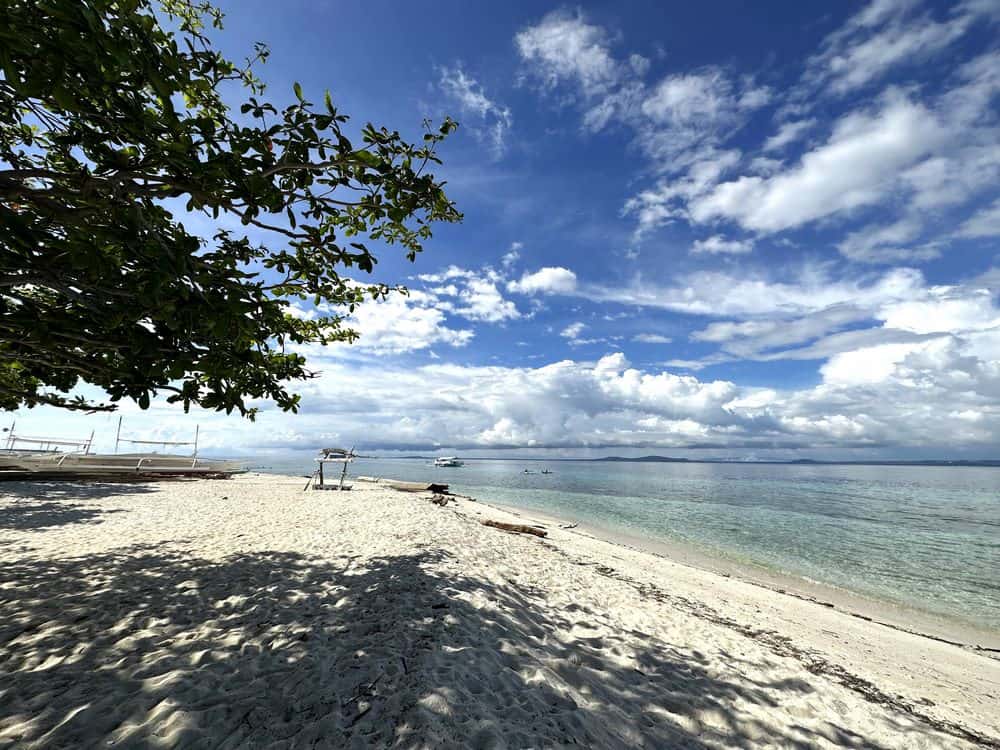
- South beach: if you cross the island’s main “artery” (about a 30‑minute walk), you’ll reach this beach full of fishing boats and a few little houses. It didn’t strike us as very interesting for hanging out.
- North beach: you can walk here by heading east from the previous beach. A small paved road begins here and, after passing the “Pamilacan Island Paradise Resort” point, there’s a huge open area full of palm trees (quite photogenic) that leads to the beach at several points. Although visually— as you’ll see in the photo below— it looks more paradisiacal, we found it dirtier and less comfortable for swimming, since it’s shallower and has more seaweed. But, you know, nature doesn’t always allow for generalizations.

4. The Spanish‑era watchtower
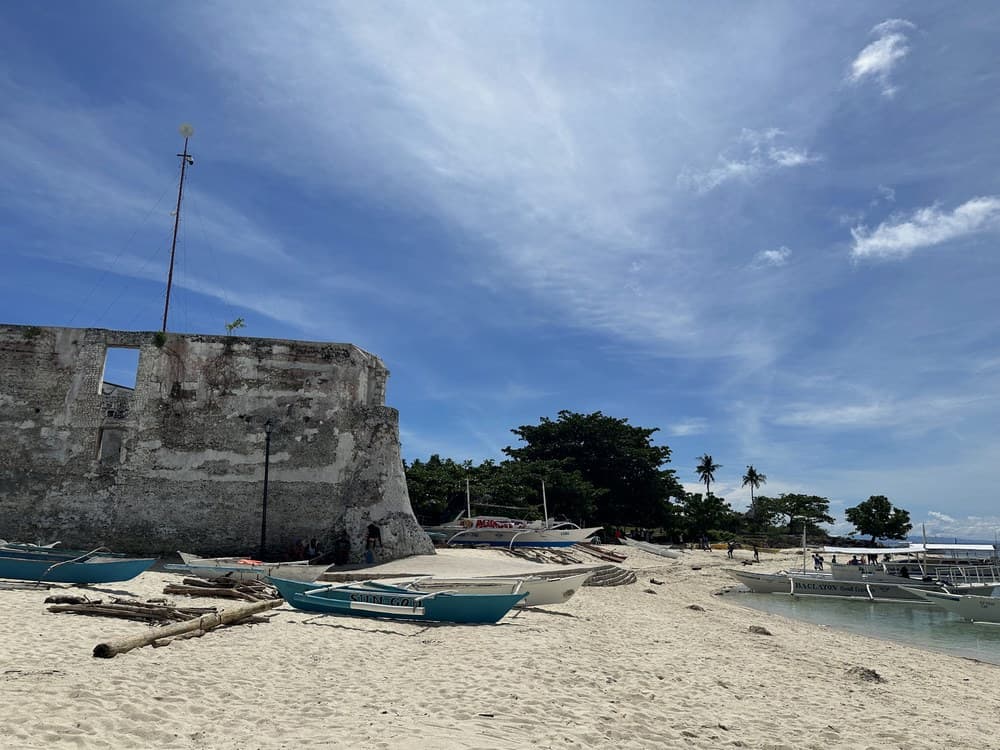
Another curiosity in Pamilacan is that you’ll find a Spanish‑era watchtower on the north coast. In fact, it’s one of the first things you’ll see when you arrive on the island, since it’s right on the beach, and after the latest restoration It was given a white finish, so it stands out from the other buildings.
It’s believed that this tower or fort served to spot invaders—especially Muslims coming from the south, referred to then as “moros.” It’s about 200 years old and is declared a National Cultural Treasure. That said, don’t expect much more than what you see in the photo.
5. Dolphin and whale watching
As we said at the beginning of the guide, around Pamilacan you can fairly easily see several types of dolphins and, with luck, whales (not the largest, but some up to 18 meters).
We were lucky to encounter a fairly large pod of dolphins on our way from Baclayon to Pamilacan, so we skipped this activity, but we saw that almost all accommodations organize early‑morning departures (between 6:00 and 7:00) or sunset trips for whales, depending on the lunar cycle. If seeing dolphins is a must for you, it’s better to stay overnight on Pamilacan; otherwise you’d have to leave very early to increase your chances.
The trip usually lasts between 2 and 3 hours and is around 600 pesos per person for dolphins and 1,000 for whales, although it depends on how many of you are on the boat. Junior and Nemesia’s Cottages says they only charge 200 pesos if you don’t see any whales.
Keep in mind that swimming isn’t allowed; you can only watch from the boat. Fortunately, everything is quite well regulated.
6. More things to see in Pamilacan
In addition to the above, here are a few more bits we can include in this Pamilacan guide as a catch‑all:
- Get a massage: an NGO apparently came to the island to teach massage techniques to a group of women, giving them an alternative source of income. They give massages on the beach, which makes for a cool experience. They usually charge 500 pesos per hour. Ask at your hotel or at Junior and Nemesia’s Cottages.
- Walk to the cemetery: as you’ll see on the map we’ve left below, there’s a picturesque seaside cemetery on the eastern side of the island. This is also where the sun sets.
- Cross the island from north to south: a fun thing to do when it’s not too hot is to walk the whole island, from where the accommodations are to the south beach. Along the way you’ll see the church, basketball court, school and a few little shops. As we mentioned, the beach itself isn’t particularly nice, but it’s a pleasant walk. It’s the only fully paved road, so you’ll see a few motorbikes.
- Surrender to relaxation: it sounds obvious (even silly), but sometimes we don’t devote enough time to simply doing nothing, chatting with people and enjoying where we are. In addition to enjoying its reefs, the main reason we see for coming to Pamilacan is its relaxed vibe, the near‑absence of tourism and, therefore, the calm. With all the differences noted, we felt something similar to when we were in Darocotan or Sibaltan.

Practical information about Pamilacan
Now that you know what to do in Pamilacan, let’s get practical with details that will make planning easier.
How to get to Pamilacan
As we mentioned above, there are two ways to reach Pamilacan: from the nearest port (Baclayon) or from Alona Beach in Panglao.
a) Getting to Pamilacan from Baclayon
Baclayon is a town located 7 kilometers south of Tagbilaran, the capital of Bohol. Getting here is super easy, either by negotiating a tricycle or taking any jeepney or bus that passes by (figure around 30 pesos). We went from Alona by negotiating a tricycle for 300 pesos; it took about 40 minutes.
Once in Baclayon, head to the port. Here you have two options:
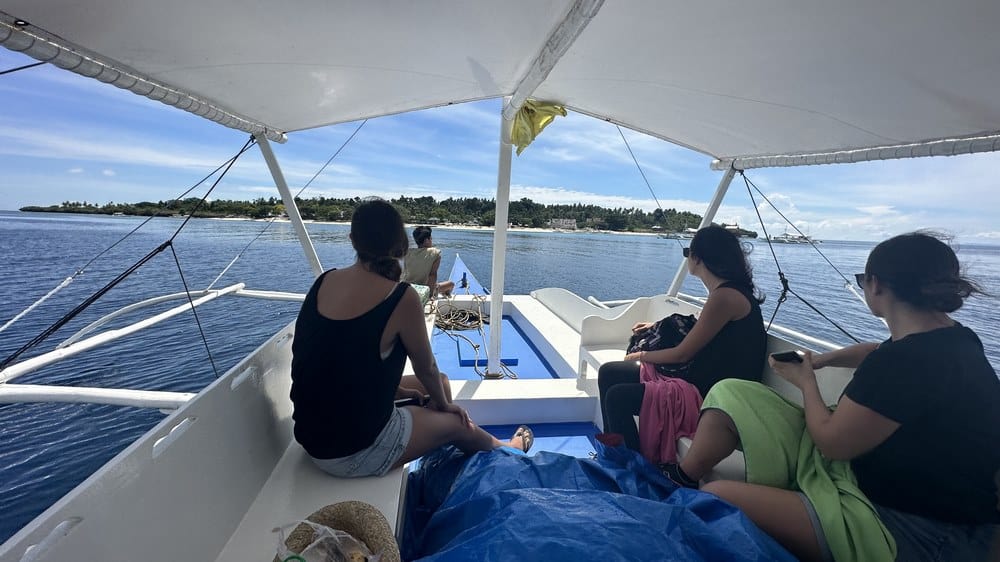
- Negotiate a private bangka: they usually charge 1,500 pesos for the whole boat, or 3,000 pesos round trip. To save money, you can wait for other travelers to come (as we did). You can also ask your accommodation to arrange it—maybe other guests will be going too.
- Wait for the public bangka: its schedule is a bit erratic and also depends on whether it’s market day or not… In our case, we arrived around 10:00 and that day it only left at 13:00. The cost is 200 pesos per person.
The travel time ranges from 30 minutes to 1 hour, depending on sea conditions and engine power.
Note: to return to Baclayon, it’s important to ask the day before what time the public boat leaves, otherwise you might have to pay for a whole boat yourself. If you’re only doing a day trip, you can also ask them to wait for you or pick you up at a set time—they’re used to it.
b) Getting to Pamilacan from Alona Beach
You can also reach Pamilacan from Alona in Panglao on a day trip or, if you like, you can ask them to let you stay overnight. For many travelers it’s an alternative to Balicasag (though you already know our opinion) or, if they have enough time, a complement.
Keep in mind that Pamilacan is quite far from Alona, so the sailing time is longer and, therefore, it will be more expensive than going from Baclayon. Expect the trip to take a little over an hour and a half, potentially up to 2 hours if the engine isn’t very powerful.
As for the price, it depends on your bargaining skills, since there’s no public transport. Reports from other travelers suggest 4,000 pesos round trip and others of 5,000 pesos. The best thing is to find more people to share so it’s worth it.
Where to stay in Pamilacan
If you search for places to stay in Pamilacan on the usual platforms, you’ll see there aren’t many options—because there really aren’t. It’s not an island that receives much tourism yet, so you’ll have to make do with what exists and not expect major comforts.
Running water is scarce or the pressure simply isn’t strong enough to reach the shower, so it’s very normal to bathe by scooping water. There’s no air‑conditioning, but a fan actually works fine.
Among the 4 or 5 places that exist, our top 3 are:
- Liwayway sa Bohol: this is where we stayed and we really liked it. It has decent double and family rooms with sea views, with mosquito nets and fans. The restaurant area opens right onto the beach and they offer good Filipino and international food. Prices may be a bit high, but there isn’t much choice on the island in general. The owner is a Filipina who lived a long time in Germany and has some interesting dishes from her adopted country. Room rates usually include a fairly complete breakfast. It’s right opposite the prettiest part of the marine sanctuary. Book here.
- Nitasnipahut Pamilacan island: another simple lodging along the island’s main beach. Other travelers told us the owner is charming. As the name implies, the rooms are made from nipa, a traditional palm. Book via this link.
- Shirley’s Cottage: near the previous one; this might have been our choice if we hadn’t been recommended the first. We stopped by to take a peek and it looks great. It’s in a nice stretch of beach and we were also told the owners are super friendly. Book here.

Where to eat in Pamilacan
If you’re imagining restaurants and carenderias, think again… To eat in Pamilacan you’ll need to go to the accommodations themselves, which is where food is prepared.
We had dinner and breakfast at our hotel and went to Junior and Nemesia’s Cottages for lunch, which is the closest thing to a restaurant on the island. In fact, it’s where most day‑trippers tend to go. Prices are around 250–350 pesos per person for a set meal (rice, a couple of shared dishes and fruit).
If you eat there, they let you use the loungers and umbrellas they have on the beach—the only place on the island that offers anything like that.

Tips for visiting Pamilacan Island
Here are some extra tips for visiting Pamilacan based on our experience:
- The best time to visit Pamilacan is from December to May, with March, April and May having the lowest chance of rain— but they’re also the hottest. The rainy season runs roughly from June to November, although, as you know, this is always relative.
- Don’t forget to bring cash; there’s no ATM in Pamilacan. It’s best to withdraw in Tagbilaran or Alona Beach. You’ll also find some decent exchange houses in Tagbilaran.
- Although it isn’t super fast, the internet connection with SMART wasn’t too bad. Forget about wifi. Read more on this in Internet in the Philippines.
- If you want to save a bit on food (e.g., breakfasts), there’s a fairly large market next to the port in Baclayon to buy fruit and some sari‑sari shops that are pretty decent. Accommodations usually provide drinking water, so you don’t need to buy it.
- Remember to bring a dry bag for your electronics, as they could get soaked on the boat.
- If you plan to go to Loboc or Anda afterward, you can connect to other transport from Baclayon; there’s no need to go back to Tagbilaran.
- Don’t forget to take out good travel insurance for the Philippines like the one we use. Unfortunately, we’ve had to use it several times in Bohol—even an admission for dengue in Tagbilaran (a $1000 bill we avoided…). Get it via this link and get 5% off.
Map of Pamilacan
To help you get your bearings, we’ve made this map of Pamilacan marking all the points of interest and accommodations:
This is just a small part of our Bohol Guide. It’s one of the islands we know best, as we’ve been here many times. Don’t miss it to make the most of your trip.
We hope we’ve helped! If you have any questions, leave them in the comments and we’ll get back to you as soon as possible.