Things to do in Batad? You’ve probably got it pretty clear already, because it would be very hard to see a photo of the spectacular rice terraces and not wish with all your heart to get there.
The Batad rice-terrace amphitheater is, without a doubt, one of the most magical and impressive places in the Philippines. The landscape is awe-inspiring and, on top of that, its history is millennia-old. Declared a UNESCO World Heritage Site in 1995, they are said to be over 2,000 years old and are a living example of the Ifugao tribe’s way of life.
If you want to give your trip to the Philippines a twist and explore beyond paradise beaches, don’t hesitate—Batad is your other paradise. Keep reading and discover what to see and what to do in Batad, as well as a bunch of details that will make your visit much more complete.
Where is Batad
Batad is a small village located on the island of Luzon. Specifically, it belongs to the Cordillera region and the largest and closest city is Banaue. This will be your jumping-off point to reach Batad.
To give you an idea, Batad is about 380 kilometers from Manila. Although it doesn’t seem very far, you’ll need to allow around 9–10 hours to get there.
In this article we’re going to focus on Batad because we find it a super pleasant place to use as a base, but it’s also possible to stay in Banaue and, from there, visit Batad. For more information, you have a super guide: Things to do in Banaue.
Brief history and importance of the Batad rice terraces
It is said that these imposing terraces were created by the Ifugao people more than 2,000 years ago. This tribe built them with their own hands and rather primitive tools in order to feed themselves despite living on such challenging terrain.
The word “Ifugao” comes from “ipugo,” which means “people of the mountains” or “people of the land,” “mortals” or “humans,” as a counterpoint to deities or spirits. Their culture revolves largely around rice, and for that reason many of the celebrations and rites they still observe (albeit to a lesser extent) are linked to the different cycles of the harvest.
Unlike other producers in the Philippines, the Ifugao usually follow one or two growing cycles a year. This is due to the elevation. Located between 1.300 and 1.500 meters above sea level, the climate is cooler. This means most families produce for their own consumption or it’s sold at much higher prices than other types of rice. In fact, a large part of the rice production is 100% organic.
The Batad rice terraces at risk
Known as the 8th Wonder of the World, many of these terraces are made of mud, but stones also began to be used to make them more resistant. Even so, and despite technical advances, the rice terraces require a great deal of maintenance and face the risk of disappearing. Due to how tough the work is, many younger generations choose to make a living in big cities like Metro Manila or try their luck in the blossoming tourism industry.
Other studies indicate that, in reality, the terraces originated around the year 1.500. It’s believed that, with the arrival of the Spanish colonizers, many Filipinos fled to the mountains. In search of food, existing plantations—likely taro—were expanded, creating the breathtaking landscape you see today. Be that as it may, whether they are 500 or 2,000 years old, to us they are among the essential things to see in the Philippines.

Best time to visit Batad—when are the rice terraces at their prettiest?
Chances are what led you to search for things to do in Batad was a photo of those gorgeous green rice fields. However, the amphitheater of terraces will be in one state or another depending on when you visit, as it all depends on how grown the rice is.
As a general rule:
- Between December and March: this is the coldest time in Batad and most of the rice terraces are pure mud or pools of water. By mid-March it’s common to already see some green.
- Between April and July: April and May are usually planting season (though it may start in March), so you’ll see green even if the plants aren’t super tall yet. June is when they look their showiest, but keep in mind that during this month and July is when it rains the most. You can read more about this in Travel to the Philippines in July.
- Between August and November: this is when they’re tallest. August and September are the rainiest months, so there can be some landslides. By November they usually turn yellow and you risk finding them already harvested. Read Travel to the Philippines in August, Travel to the Philippines in September and Travel to the Philippines in October for more information about these months.
Keep in mind this is only an approximation, since the terraces will be more or less green depending on when planting took place or due to climate phenomena such as El Niño or La Niña.
So… when will they be the greenest?
So when is the best time to visit Batad? It depends a lot on how you want to see them, but we’d say: in all seasons. If you want to see them green, April and May are great and there’s less chance of rain. Another good moment would be October, when they’re super tall and the weather starts to improve.
Don’t worry if your trip to the Philippines doesn’t coincide with these moments. The Batad rice terraces are beautiful too when they are flooded, as the sky reflects in them, creating a stunning effect, especially at sunrise and sunset.
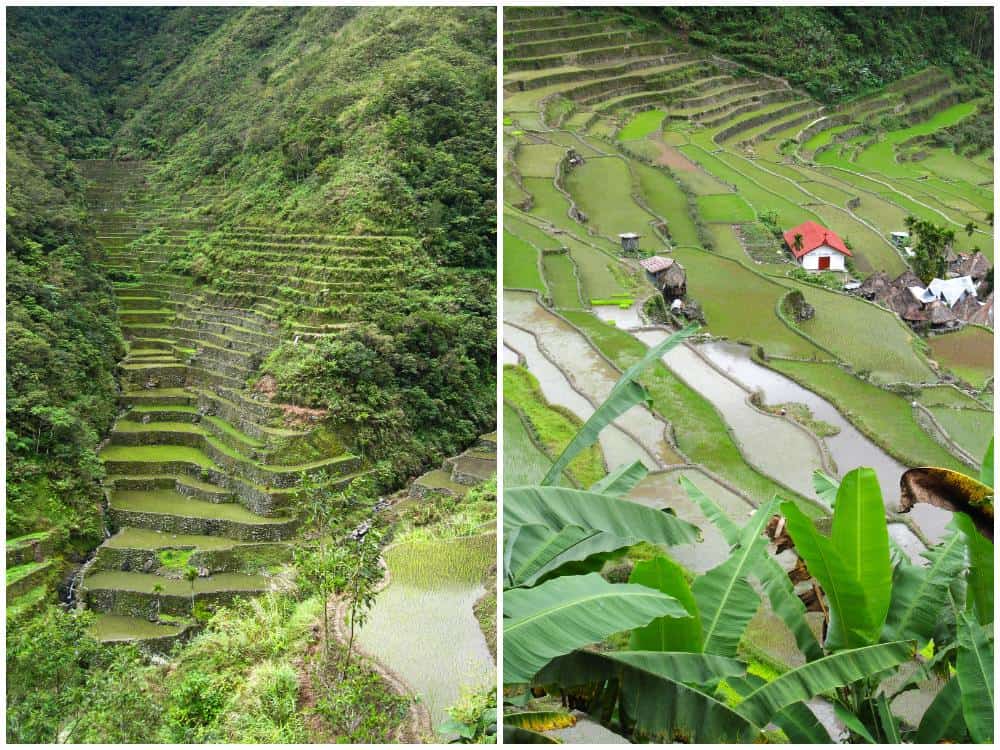
These photos are from mid-March, which gave us the chance to see the terraces both ways
How many days to spend in Batad?
Some people visit Batad on a one-day excursion from Banaue or only spend a few hours because they’ve done a multi-day trek through Cordillera. We’re in love with the village, so we recommend spending a night.
Considering that most travelers wake up in Banaue after an overnight bus from Manila, a good idea would be to spend that whole day, sleep in Batad, and return to Manila the next day on a night bus or continue your trip to other areas of Luzon.
Of course, if you want to truly enjoy it, do several trails or simply relish the views from your hotel or immerse yourself fully in Ifugao culture, you can stay much longer.
Recommended itinerary for Batad
To give you an idea, this could be your itinerary for visiting Batad:
Day 1: Arrival in Batad, stroll through the terraces, and Tappiya Falls
6:00/8:00 – Arrival in Banaue and payment of the environmental fee (50 pesos)
8:15 – Breakfast at a cool spot with views such as Sanafe Lodge, People’s Lodge, 7th Heaven’s Café, or Native Village Inn (ask for local coffee!)
9:00 – Departure by tricycle to Batad
10:00 – Arrival at the parking area and walk to Batad
10:15 – Arrival in Batad and hotel check-in
10:45 – Walk to one of the viewpoints and to Tappiya Falls (if you can, bring something to eat)
15:00 – Back to the hotel, shower, and relax (perhaps a restorative massage?)
17:00 – Your date with sunset and the changing colors in the sky from the terrace (time for a San Miguel)
19:30 – Dinner
21:00 – Time to sleep!
Day 2: climb to the Awa View Deck, return to Banaue, visit the viewpoints, and head back to Manila
6:00 – Wake up!
6:30 – Breakfast
7:30 – Start the ascent to the Awa View Deck
9:30 – Arrival at the viewpoint
10:30 – Descent
12:00 – Lunch in Batad
13:30 – Return to Banaue
14:30 – Tour different viewpoints in Banaue, visit the Cordillera Sculpture Museum or Tam-Am Village
17:00/17:30/18:00/19:00 – Return to Manila by bus
What to see and do in Batad
By now you’ve got a rough idea of everything you can do in Batad, but of course there’s more—and you can also take it slower.
1. Wander the rice terraces without much of a plan
It would be unforgivable to come all this way and not take a stroll through the terraces. The best thing to do in Batad is simply to get a little lost and enjoy the different perspectives this historic amphitheater offers.
Don’t be afraid—it’s not hard to find your way. Just follow the pilapil, that is, the stone or concrete paths, and take a bit of care, since they’re not all the same and the little stairways aren’t always the safest. If you’re a bit afraid of heights, be more cautious, as it’s not unusual for the difference in height between terraces to be over 1,5 meters.
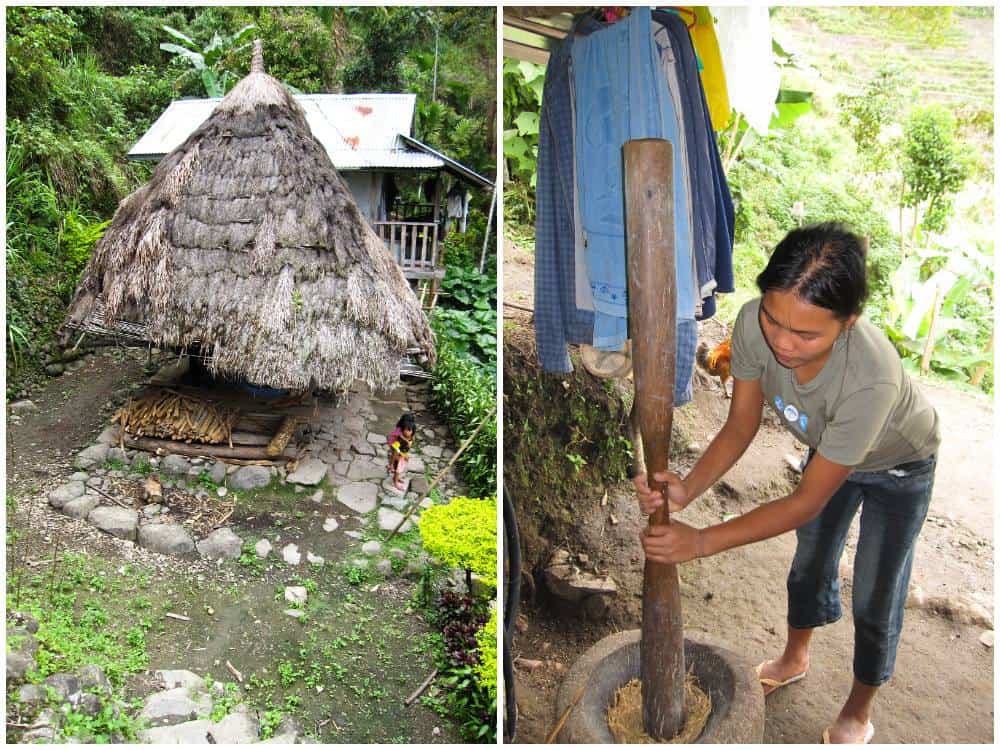
Either way, it’s worth it. This way you’ll come across interesting nooks and scenes like Batad locals milling rice grain in the traditional way or plowing the land with a water buffalo or carabao.

2. Peek into traditional Ifugao houses and get to know their culture
Although many of the homes in Batad are newly built, you can still enjoy the beautiful traditional Ifugao huts.
The “nipa huts” are, besides pretty, homes designed for the temperature swings in this region of the Philippines. When it’s cool they keep you warm, and when it’s hot they help you stay cooler.
These houses are made with wood and nipa leaves, a type of palm. They’re structures that require quite a bit of maintenance and the roof has to be replaced roughly every 15 years. Because of this, it’s becoming less and less common to see them, and locals have opted to use ugly metal roofs, which are more practical for them.
Even so, you’ll still see them and, as we tell you in Where to stay in Batad, even sleep in one.
The structure of Ifugao huts
Ifugao houses have 3 “floors”. As you’ll see, the hut itself is elevated, that is, on pillars. This not only helps avoid damage from possible flooding, it also provides a ground level used for house chores. This is where animals are kept (mostly pigs, roosters, and hens), laundry is done, and cooking happens. The latter is particularly important, since the smoke makes the hut’s wood more resistant and free of termites.
You access the main part—the interior—via a staircase. It’s said that they used to remove it to sleep and thus avoid being killed by enemies while resting in pre-colonial times. Inside there’s an open space used according to the time of day. Although current huts often have modern beds for hosting guests, it was customary to place the mattresses on the floor only at bedtime and put them away the next morning. You’ll also usually find a small kitchen for light meals or heating water.
Old Ifugao houses had no electricity, and many still don’t. Lighting was done with candles.
Finally, it’s normal to have an attic for storing the harvest of rice for months.
In addition, nipa huts were decorated with animal skulls and skeletons (and sometimes people’s) that were hunted or sacrificed for rituals.
3. Visit and take a dip at Tappiya Falls
One of the musts in Batad is visiting the spectacular Tappiya waterfall. This imposing drop of about 70 meters always flows powerfully and is one of our favorite waterfalls in the Philippines. Beyond the force of the water, the setting will win you over, as you’ll feel embraced by the high walls that surround it.
If you’re feeling energetic, try taking a dip. That said, it certainly isn’t warm. Be careful and don’t get too close to the waterfall because the force of the water is so strong that a couple of men have drowned. In fact, some locals say there’s a mermaid who seduces and drags you to the “depths.”
How to get to Tappiya Falls
It’s actually really easy. Our advice is to download Maps.me (one of the apps for traveling to the Philippines we recommend) and follow one of the two paths suggested. You can’t miss it. If you’d rather not worry and want someone to guide you and tell you a few tidbits about the terraces, you can hire a guide. They usually charge 700–800 pesos for up to 4 people if you take the most direct route. They charge more if you want to be taken to more viewpoints or told about the village.
You could say there’s a lower trail and an upper trail. The second will take you past several cool viewpoints (marked on Maps.me), so that’s the one we recommend.
The difficulty level of this trek is quite moderate. Although you’ll have to be careful because there are more complicated stretches and the stairs aren’t perfect, you don’t need to be an experienced hiker—not by a long shot. It usually takes between an hour and 90 minutes to get there, depending on how often you stop. Even so, keep in mind that the way back is uphill, so it’s not unusual for it to be harder and for your legs to get a bit (very) heavy.
Depending on how much time you’re spending in Batad, you’ll do this route at one time of day or another, but if you can, try to time it for first thing in the morning. Besides finding fewer people, it’s common to find a rainbow over Tappiya Falls before 8:00. To do this, you’d need to leave your hotel around 6:00.
If you go at midday, try to head back no later than 15:30/16:00 so it doesn’t get dark on your way back.
Bring water and some snacks, although you’ll also find small little shops along the way.

4. Hike up to the Awa View Deck
We’ve already mentioned that there are quite a few viewpoints in the rice terraces and that you can easily find them with a map. In fact, you can see some signs pointing the way.
Even so, if you have more time, another thing to do in Batad is to climb to the Awa View Deck. Located on the opposite side, this spot will give you a bird’s-eye perspective of the Batad amphitheater.
The climb takes a couple of hours, since you first have to descend and cross the river over a photogenic bridge and then go up. The elevation ranges from 710 to 1.170 meters above sea level. If it has rained or there has been a lot of humidity (which is common), it can be quite slippery, as it’s pure mud.
Since the trail isn’t marked on any map, you might be interested in hiring a guide. They usually charge 1,000–1,200 pesos for 4 people.
5. Hike to nearby villages or summit mountains
If you haven’t had your fill of walking, from Batad you can also head to different villages or mountains. In some cases you can go and return in a day; in others you’ll have to spend the night.
As with the walk to Tappiya Falls, you can do these excursions on your own or with a guide. For example, the route to Bangaan usually costs 1,200 pesos, and to Kinakin and Cambulo it’s around 1,500 pesos (up to 5 people).
6. Enjoy the views from your hotel terrace with a San Miguel
It sounds cliché, but really, one of the best things to do in Batad is simply to do nothing. The views from the hotels and restaurants are glorious, so we encourage you to grab a book or a beer/tea (or both) and just drift.
We fondly remember the conversations on our hotel’s basic terraces as the sun went down, dyeing the terraces and houses in different colors. With luck, the family will join you and share their traditions and secrets.

7. Rest at one of the hostels with amazing views of Batad
We’ve already mentioned it above, but for us it’s essential to spend the night in Batad. Despite how basic the place is and the cool nights, this village has given us some of the most magical nights of our travels through the Philippines.
Waking up in a room with epic views of the Batad rice terraces is a true luxury within anyone’s reach, as accommodation is very affordable.
?️ Discover our recommendations in Where to stay in Batad.
By the way, if your legs are wrecked after so much walking, most hostels offer massage service for 200–300 pesos per hour. Take advantage and fight off the soreness!
8. Visit the Banaue rice terraces
Banaue or Batad—what should you visit? You’ve likely gotten a bit confused while researching. As you can see, we’re in favor of spending the night in Batad, but that doesn’t mean Banaue isn’t worth it. In fact, there are spectacular rice terraces scattered throughout the Cordillera region. That’s why we encourage you to include at least a quick visit to Banaue on your list of things to do in Batad.
If you open Maps.me and zoom in on the road that connects Banaue with Bontoc—that is, to the north of the city—you’ll see there are a bunch of viewpoints. Some of them charge an entrance fee (something really anecdotal) and others are free, but at most you’ll find souvenir shops and many elderly people dressed in traditional Ifugao attire. These are now only used for celebrations, so these people are there to take photos with tourists in exchange for a few pesos.
Among the viewpoints, the best known is the Banaue View Point (here), as it’s the one that appears on the 20‑peso bills. A good idea is to hire a tricycle to take you here and visit a few more. If you have more time, there are trails through these rice terraces that end in Banaue. Consider that this will take you about 4–5 hours.

The view on the 20‑peso bill of the Philippines
Tips for visiting Batad and enjoying it to the fullest
As you can see, Batad is quite a special place in the Philippines. Since it isn’t a beach destination and not as touristy as others, it has its “quirks.” So here are the tips for visiting Batad we would have liked to receive the first time we went:
- Nights in Batad are cool, so one of the essential tips is to go well prepared with the right clothing. You don’t need a super thick coat and three fleeces, but it doesn’t hurt to bring long pants and something warm. Also, don’t forget a rain jacket and shoes with soles that won’t make you slip too much. In Backpack for the Philippines you have our recommendations.
- Remember there’s a 50‑peso fee when entering Batad.
- Although you no longer have to walk as much as before to reach the village, if you want to be more comfortable or if you’re staying in one of the more distant hostels, you might be interested in leaving your heaviest backpack in Banaue. Almost all hotels will store it for a few pesos.
- There are no ATMs in Batad. You can find some in Banaue, but they’re sometimes out of order. Since everything is paid in cash, we recommend carrying enough money with you.
- Cell coverage in Batad is almost nil, so you can pretty much forget about the internet. Send any messages you need from Banaue and disconnect—you’ll thank us later!
- Keep your electronic devices charged. Most hotel rooms in Batad don’t have outlets and you have to charge them at reception. Many of them charge a fee, so it never hurts. If you can, bring your power bank charged.
- Drinks in Batad are quite expensive because they have to be brought from Banaue. If you want to save a bit on water, bring your own bottle from Banaue. Even so, spending in the village helps locals make a decent living.
- Both in Batad and Banaue you’ll find lots of typical local handicrafts. In our opinion, those from this part of the Philippines are the prettiest in the country—take advantage! As a curiosity, they sell many items shaped like a penis as a symbol of fertility… Please don’t haggle like a pirate and contribute to the community.
- Walk along the pilapil, that is, the concrete paths between the terraces, and try not to walk on the mud ones. This way we help preserve these age-old terraces.
- Ask people for permission before taking photos. This is responsible tourism, too.
- Order food in advance. If you already know where you’re going to have dinner, it’s better to place your order in the morning or at midday. That way they buy what’s needed and you don’t have to wait so long.
- And speaking of food, you can’t leave Batad without trying their rice, pinikpikan, their local coffee, and a little glass of rice wine.
- Travel with a good travel insurance like the one we use. Keep in mind there aren’t good hospitals or clinics in this area, so in case of an accident you’ll have to be transferred to Manila. Since it isn’t an easy task, it’s better to go prepared with a policy that includes hiking. Here’s a 5% discount on your policy.

How to get there
As we explain in How to get to Batad, the village is only accessible from Banaue, from where a daily jeepney departs at 15:00 (150 pesos). If you want to arrive at another time, you’ll have to take a tricycle (300–400 pesos). These will drop you at a parking area and you’ll then have to walk 15–20 minutes to Batad.
The jeepney departs back to Banaue at 9:00 every morning.
WARNING: scams for getting to Batad or tours
Some readers tell us that sometimes, when getting off the bus from Manila or those coming from Sagada or Bontoc, there are people waiting with signs for certain accommodations. Usually the hostels haven’t sent anyone to pick you up, so they’re opportunists who say you need to pay astronomical amounts to get to Batad or try to sell you things at sky‑high prices.
Therefore, unless you’ve arranged something explicitly with your hotel, don’t pay them any mind. As you’ve read above, you can reach Batad on your own by jeepney or tricycle.

Map of Batad
Here are all the points of interest we’ve mentioned in this article about what to do in Batad:
Do you have any questions about Batad? We’ll be happy to answer in the comments.