The time has come for your big trip to the Philippines and, among the many things you want to do in the country, one of them is to swim with the whale shark in Oslob. Picture the epic shot and the ensuing rain of likes on your social media: you next to the largest fish in the world. Incredible, right?! Now imagine that, as a consequence, you were putting the life of this already endangered animal in serious danger. Cuts, blows, infections, malnutrition, disruption of its migratory and reproductive cycle. Is your photo worth all that? Do you want to be part of the problem? Then you’ll want to read everything we’re going to tell you in this article about swimming with the whale shark in Oslob.
Why you shouldn’t swim with the whale shark in Oslob
After this section, which we consider vital, we’re also going to tell you the story of how the business of swimming with the whale shark in Oslob began, but first we want to explain its consequences. We’re sure that once you read this you’ll understand why it’s important to avoid this place for this activity.

1. Massive interaction
In the Philippines there are other places where it is possible to swim with whale sharks at different times of the year when they naturally pass through during their migratory process. In these destinations (Donsol, Pintuyan/Padre Burgos, Puerto Princesa…) there are a series of rules and regulations that help ensure interaction with this beautiful animal is as respectful as possible. A minimum safety distance, a number of people proportional to the area where it is seen, and even penalties for those who do not comply with the rules.
In Oslob you can see whale sharks practically all year round, not because it is a different species that does not migrate, but because they are lured with junk food that makes them feel no need to go elsewhere.
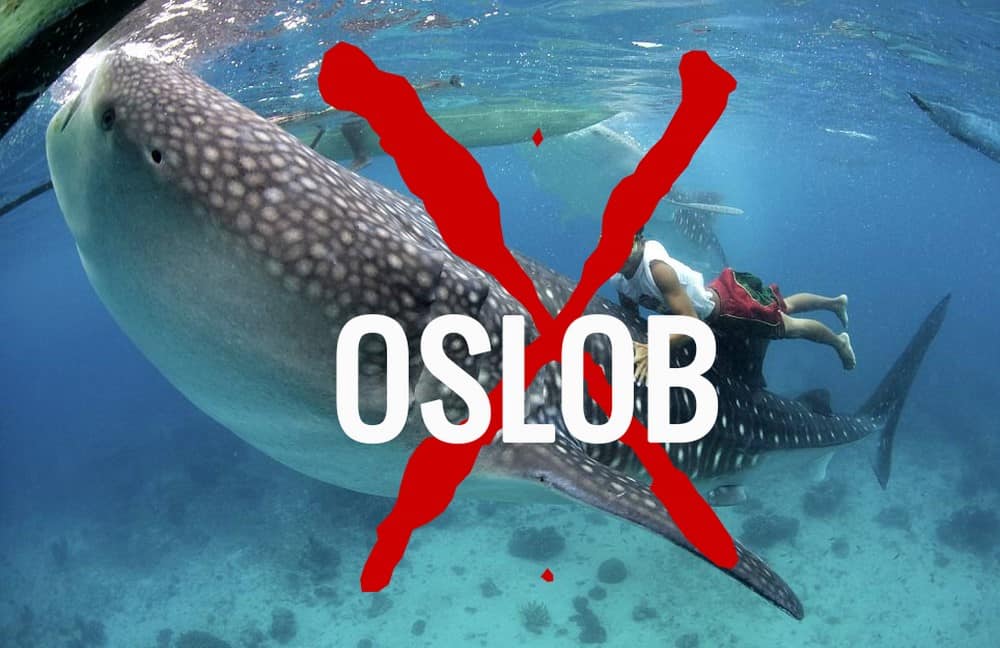
This unfortunately attracts more than 1,000 tourists, uninformed and/or irresponsible, who every morning jump into the waters of Oslob to see it up close. Instead of watching them pass by, as happens in other parts of the country, here the shark stops to eat and tourists take the opportunity to get close to it. This means that, with no safety measures or rules being enforced, swimmers very frequently hit the whale shark in Oslob.
LAMAVE Foundation, which protects and works hard for the conservation of this species, has conducted different studies in which they have counted up to 29 hits per hour to the animal. Another of their studies showed that more than 90% of swimmers do not respect the already scarce safety rules that exist in this activity.

Instead of going out to open sea to look for the places along which they usually migrate, in Oslob they go every day to the same spot, 50 meters from the coast, and lure them with human-mixed feed. Swimmers are not the only ones who hit the animal, as there have often been reports of kicks from the boatmen who feed them to prevent them from getting too close to their boats and capsizing them while trying to ask for more food.
2. Fatal change in whale shark behavior
Whale sharks naturally feed on plankton and tiny organisms. Since it is not a predator, its brain has not evolved in relation to its large size as, for example, the great white’s has. That, among many other things, means that it is possibly not the ocean’s most intelligent animal.
They quickly tend to associate boats with an easy food source and, after spending some time swimming in Oslob, it is very common for them to lose part of the instinct that keeps them safe from vessels, thus suffering severe and dramatic cuts from the engines and propellers of boats (tourist, fishing…), which are outside the Oslob interaction zone.

3. Dire nutrition
A whale shark usually spends about 8 hours a day feeding. This is based mainly on zooplankton, phytoplankton, and tiny fish and crustaceans, since it feeds by suction and engulfs everything that crosses its path up to its filter.
Due to the large amount of food needed to attract the whale sharks of Oslob on a daily basis, fishermen must bring uyap (a mixture of small shrimp and other tiny marine animals) from towns that are sometimes hundreds of kilometers away. For this, this junk food that contains far fewer nutrients than what the shark consumes naturally must be frozen and treated, losing even more of its already meager nutritional value.
Since the whale shark in Oslob knows that the feeding lasts for a set time, it rushes to eat as much as it can while it lasts. At times, due to the number of sharks that gather, some do not manage to get enough food and those that do so do it under great stress, expending energy for which they are not prepared.

4. Severe harm to the whale shark in Oslob
In addition to being hit daily and the possibility of cuts from snorkel fins and the engines of other boats, whale sharks suffer serious skin diseases due to the bacteria that humans naturally carry and products such as non-eco-friendly sunscreens. If the bacteria, for which they have no defense, and the chemicals are already very harmful, when added to the cuts they suffer, the possibility of infection is exponentially higher. It is not uncommon to see whale sharks in Oslob with infections.
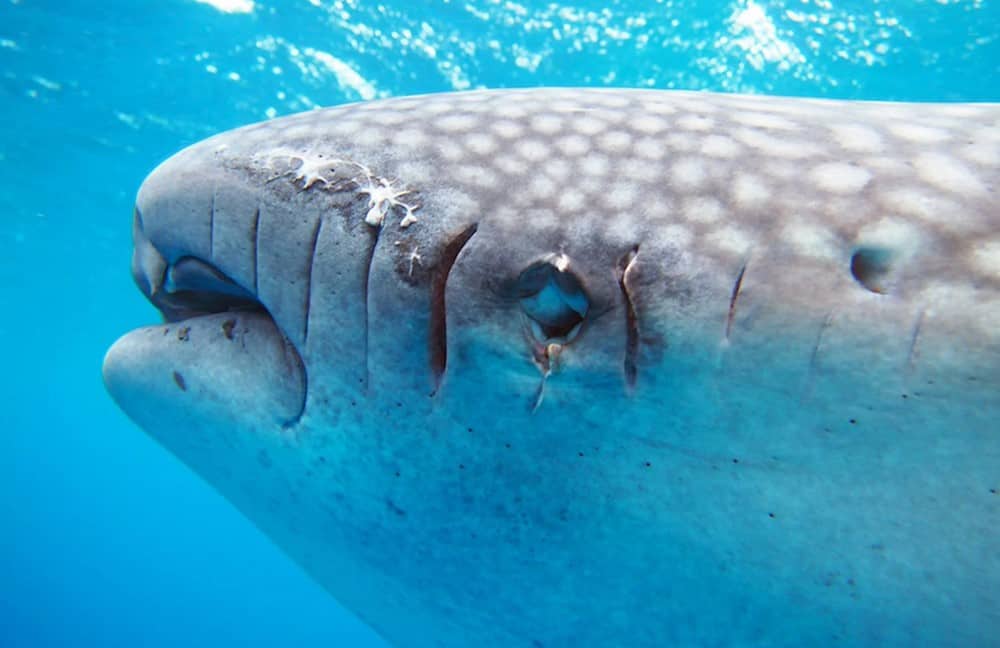
Whale shark in Oslob badly injured by propellers
5. Changes in the migratory route
Under normal conditions, the whale shark is a migratory animal that travels thousands of kilometers every year, feeding on different types of plankton. Feeding it this way makes it feel no need to follow its natural route because, with food guaranteed every day, why leave? This has different and serious implications—from the reproductive problem of always relating with the same individuals, while it is already in grave danger of extinction, to the knock-on effects on other species with which it should interact along its long journey.
6. Destruction of the coral reef in Oslob
The whale shark is not the only one suffering from the bad practices of irresponsible tourism in Oslob. These are also affecting the coral reef.
Due to the blows received from tourists who rest on them or hit them, and the anchoring of the boats that run this circus, the coral in Oslob has been totally destroyed in some areas. Beyond the incalculable environmental damage this entails, many reef fish now also feed on uyap, thus breaking the food chain and no longer maintaining the seagrass that keeps the water’s oxygen levels up, among many other functions.
7. You can get sick, too
If everything we have just shown you does not seem terribly serious, we may convince you not to go swim with the whale shark in Oslob by appealing to your self-interest. Recent reports speak of a decline in water quality where the whale shark encounter takes place in Oslob. It is not only harmful to the animal, but it can also cause reactions and allergies on swimmers’ skin.
False arguments you shouldn’t use about the whale shark in Oslob
We have been informing thousands of travelers for years about what happens with the whale shark in Oslob, and we know that, no matter how much information is provided, there is always some irresponsible traveler who prefers to go get the photo with the whale shark even if they are promoting its extinction. If any of these arguments crossed your mind to feel less bad should you finally choose to be part of this circus, we’ll save you the trouble below:
– “Before, they killed them to sell their meat; this is better.”
Totally FALSE. The whale shark circus in Oslob started in 2011, whereas it was in 1998 when the Philippine government prohibited by law: the capture, sale, or transport of whale sharks, whether alive or dead, as well as injuring or killing them. It is punishable by a fine and by up to 4 years in prison. In Oslob, whale sharks were never actually killed; people only tried, by feeding them, to keep them from eating the fish from fishing nets. No, the Oslob circus does not help solve a problem that took place in the 1980s.
– “Yes, yes. I’ve done my research and I’m totally against what’s happening there… but I’d rather go see it for myself.”
Frankly, you’re an idiot—and the worst kind: the one who knows the problem but still goes and justifies it in the dumbest way. There are countless scientific reports at your disposal to understand the problems, causes, and consequences of swimming with the whale shark in Oslob, but do you think you really need to go check it yourself? Are you then going to check whether cyanide kills or whether it’s okay to jump off a high bridge? That would be the logical next step following that reasoning.
– “Look, if they eat it, it must be good. Who would know better than a shark?”
Well, a marine biologist would know better than a shark. If people who eat junk food every day get sick, how do you think it might affect an animal like this? Unfortunately, the whale shark has no doubts when it comes to choosing between junk food delivered to its mouth or not.
– “Well, if you do it in Oslob you are helping people who previously had nothing to eat.”
False as well. Those who now work in this circus used to be fishermen, not unemployed people. In fact, many of them still fish and use the feeding as extra income. On the other hand, many of the people who are exploiting the area for tourism come from other places; they are not former residents who had no work. And most importantly: if you feel a wonderful urge to be altruistic and help the Filipino people, there are hundreds of NGOs and projects through which you can do so. Don’t hold back—contact them. Could it be that this isn’t the real reason that’s taking you to Oslob? It could. Not to mention that there are other places in the country, such as Pintuyan, where things are done right.
– “Yes, at the beginning things were done badly in Oslob, but now they’ve regulated everything.”
The fact that at the beginning there was no regulation and now there is poor regulation (which is not enforced either) does not mean that things are done well now. The distance is still not respected, it is still being hit, we are still making it sick with our bacteria and chemicals, it is still being fed junk food, its migratory and reproductive cycle is still being altered… etc.
Where to swim with the whale shark in the Philippines
No, everything we have just told you does not mean that you must give up your dream of seeing the world’s largest fish live during your trip. There are different places in the Philippines where you can swim with it responsibly and without threatening its future as happens with the whale shark in Oslob. Depending on the time of year you visit the country, there is a recommended place for this wonderful encounter. The adrenaline of going out to look for it, finding it, and swimming with it is wonderful and totally incomparable to doing it in Oslob’s “dirty fish tank”.
In our guide “Swimming with the whale shark in the Philippines” we tell you in detail where, when, and how. Now you have no excuse to go to Oslob!

History: how did the whale shark circus in Oslob start?
Local fishermen from Tan-awan, the town where the feeding takes place, used uyap as bait. This attracted whale sharks that came daily to get it, notably reducing the fishermen’s chances of success. After trying to drive them away in different ways—even by throwing stones—they realized they could use that same bait to lure them to another area different from the one used for fishing, thus being able to continue with their work.
At that moment someone realized that they could make money by paying fishermen to attract the whale shark so people could swim with them. Word of mouth spread and a report by the British tabloid “Daily Mail,” in which a swimmer was seen riding the animal, finished unleashing the madness, turning Oslob into the hub of irresponsible tourism that it is today.

Useful links about the whale shark
We invite you to share this information with all those travelers who plan to head to Oslob to take part in this sad circus; your grain of sand can help a lot. In addition, we want to share with you some useful links with studies on the subject and related news:
- News item discussing the poor state of the water in Oslob
- Interesting article about whale sharks’ brains and behavior
- Extensive study on interaction with the whale shark in Oslob
- Comprehensive scientific article on shark tourism in Oslob
- LAMAVE page about the whale shark in the Philippines
- 10 facts about the whale shark
- Scientific news about a whale shark slashed by propellers in Oslob
- English-language blog that talks about Oslob’s problem
- Travel blog in English that discusses the problem of swimming with the whale shark
Please, if you think this information can help other travelers avoid being part of this problem, share it with them to help them understand what is happening there. On the other hand, if you still plan to go after reading this, we invite you to tell us why so we have one last chance to show you what a big mistake it is.