On a trip to the Philippines, Cebu City often shows up on the itinerary. Not precisely because it’s an attractive place that draws many travelers’ attention, but because it’s frequently used as a connection to other destinations in the country. As the second most important city in the Philippines, it has an international airport offering direct flights both to other countries and to the main points of the pinoy archipelago.
If you’re passing through the city and want to discover things to do in Cebu City, this list will surprise you both for its variety and its length. Historic places, picturesque spots, shopping paradises, or centuries-old monuments are just a sample of what you’ll be able to see in Cebu if you’re thinking of giving it a chance.
Keep reading and discover what to see and what to do in Cebu City.
Is Cebu worth visiting? How many days should you spend?
Before getting into it, we want to answer two of the questions travelers ask us the most (and with good reason).
Is Cebu worth visiting? Well, it’s hard to say. From our perspective, as you’ll see throughout this guide, Cebu City is a place for a few hours if you’re interested in sites with history. It’s not a city you could label as beautiful or pleasant, and that makes many travelers’ first impression that it’s dangerous. Assuming you’re not going to be at any risk, it is indeed scruffy and, so to speak, a bit ugly, so it’s better to go straight to the point and visit the places that interest you most.
Is the island of Cebu worth it? Well, that also depends. In this article we’re focusing on the capital, Cebu City, but besides it there are a couple of places on the island that many travelers visit: Moalboal (from where people usually go to Kawasan Falls and other nearby waterfalls) and Osmeña Peak. From our perspective, both are great if you have 3 weeks or more of travel and if you like diving, snorkeling, and hiking, but we wouldn’t say they’re essential things to see in the Philippines.
With all that said, from our experience, 5–6 hours is more than enough to see Cebu. With this you can visit the Basilica del Santo Niño and Magellan’s Cross, the ancestral houses (Yap Sandiego and Gorordo), and Fort San Pedro. If you’d like to go to different viewpoints, the Taoist Temple, and the gardens, a full day would be fine. After that, continue your trip through other, more interesting places in the Philippine archipelago.
What to see in Cebu
1. Visit the Basilica del Santo Niño
If you’re short on time in the city and can only choose one thing to do in Cebu, visiting the Basilica del Santo Niño is a great choice. Founded in 1565, it’s said to be the oldest church in the Philippines (although some say the one in San Agustín in Intramuros, Manila, actually holds that title).
This important religious building was erected exactly where, after more than 40 years in the hands of the natives, the image of the Holy Child Jesus was recovered. This sculpture belonged to the first Spanish expedition that reached the Philippines in 1521, led by Ferdinand Magellan, who gave it to the Rajah of Cebu at his baptism. The image was lost track of in the Battle of Mactan, in which Magellan died, and it wasn’t discovered again until 1565, when a sailor from the expedition of Miguel de Legazpi found it intact. From that moment, the Santo Niño of Cebu came to be venerated throughout the Philippines and especially in Cebu.
In the Basilica, baroque in style and partly rebuilt after the strong 2013 earthquake, inside you can see the famous image in person. If you want to see it very close up, keep in mind you’ll have to wait in a line that usually exceeds an hour. Still, you can see it from a distance and entry is free.
Keep in mind that since mid-2024 a strict dress code is required to enter. You’ll need to cover shoulders and knees.

2. See Magellan’s Cross
Once you leave the Basilica del Santo Niño, you can’t continue your visit without heading to another of the must-sees in Cebu City: Magellan’s Cross, located just a few meters away. This is a true symbol for the city—indeed it’s the image that appears on its coat of arms—and it attracts thousands of fervent Filipino Catholics. It’s the first Christian symbol that arrived in the country, when Ferdinand Magellan landed on the neighboring island of Limasawa (Leyte) with his expedition.
Since different stories about Magellan’s Cross attribute miraculous powers to it, for a long time visitors would constantly chip off splinters to carry a bit of protection with them. Therefore, it was decided to protect it inside what is now the base where a replica is displayed. Even so, many claim that the original Magellan’s Cross was destroyed after Ferdinand Magellan’s death, so it’s possible neither of the two is the original.
On the ceiling of the chapel that protects Magellan’s Cross you can see beautiful frescoes depicting the conversion to Catholicism of Humabon, the rajah of Cebu at the time.
Interesting, right? Discover other facts like this in our Summary of the history of the Philippines.

3. Enter the Cebu Metropolitan Cathedral
The Cebu Metropolitan Cathedral, to be honest, isn’t exactly the top attraction to see in Cebu. But as it’s just two blocks from the previous two spots on the list, it’s well worth a quick visit.
Of colonial architecture, construction began in 1565 but, due to interruptions caused by funds being diverted to the fight against the Muslims, it was considerably prolonged over time. During World War II, when Cebu was taken by Japanese troops, much of the Cebu Metropolitan Cathedral was bombed and destroyed.
4. Stroll around Fort San Pedro
Fort San Pedro in Cebu is another of the most interesting historic places to see in Cebu City. Built in the 16th century under the command of Miguel de Legazpi as the first Spanish defensive settlement, you can visit it for the modest price of 30 pesos. The original Fort San Pedro was made of wood, but around 1740 it was rebuilt in stone to withstand constant attacks from Muslim pirates, and this is the structure that has survived to the present.
Inside you can learn more about the history of the first Spanish settlers, as well as enjoy old photographs of Cebu’s past, paintings of the main protagonists of the time, and even original cannons that were used to repel attacks on this interesting triangular fort. We think it’s an enjoyable visit that’s worth it.

5. Visit Yap Sandiego Ancestral House and Casa Gorordo
Another historic place worth seeing in Cebu is the Yap Sandiego Ancestral House, or, more simply put, “the old house of the Yap–Sandiego family.” Its location close to both Magellan’s Cross and Fort San Pedro, in an area known as Parian—that is, where Chinese immigrants mainly settled—means you’ll have no excuse not to pop in and snoop around this old house-museum built in 1675.
Going inside is an incredible trip back in time to what Cebu’s houses were like in the 16th century. The décor, the lighting, the wooden construction, the religious images, details like tablecloths and cutlery… Everything was restored in 2008 thanks to one of the descendants of the house’s first owners! Such is the affection they have for the Yap Sandiego Ancestral House that Val Sandiego and his wife Ofelia say they have no intention of selling it for all the money in the world. In fact, they say they sleep there every weekend.
It’s open to visitors from 9:00 to 19:00 and the 100‑peso admission fee goes toward its conservation and restoration.
By the way, right in front of the house is the Heritage Monument of Cebu. This massive monument depicts some of the most important moments in the city’s history. Entry is free, so it’s worth a look.

This house is fantastic, but if we have to choose one, we’d go for Casa Gorordo. Located less than a minute’s walk from the former, it’s another of the Philippine ancestral houses and, in our opinion, the best preserved. Even more interesting than Casa Manila in Intramuros, it dates from 1850 and was owned by Isidro Gorordo, a Basque merchant who settled in Cebu. The house is an example of balay nga tisa, that is, a house with a tiled roof, but combining elements of colonial and Chinese architecture, as can be seen at the ends of its roof.
Acquired by the Aboitiz family (one of the richest in the Philippines) and turned into a museum, the visit is a delight. You’re accompanied by a guide who gives you context, you watch an explanatory video, and then you head up to enjoy the different rooms of the house, where you can see original furniture.
For us, the best place to see in Cebu, if you only have a few hours, is Casa Gorordo. We loved the visit and left more than happy to have discovered another little piece of Philippine history. Admission is 100 pesos, which helps with its conservation and seems more than deserved to us.

6. Be amazed by the Cebu Taoist Temple
Continuing the route through Cebu, we go from the center to the outskirts of the city, specifically to the upscale residential neighborhood “Beverly Hills.” Here you’ll find another interesting religious building to see in Cebu, the Taoist Temple.
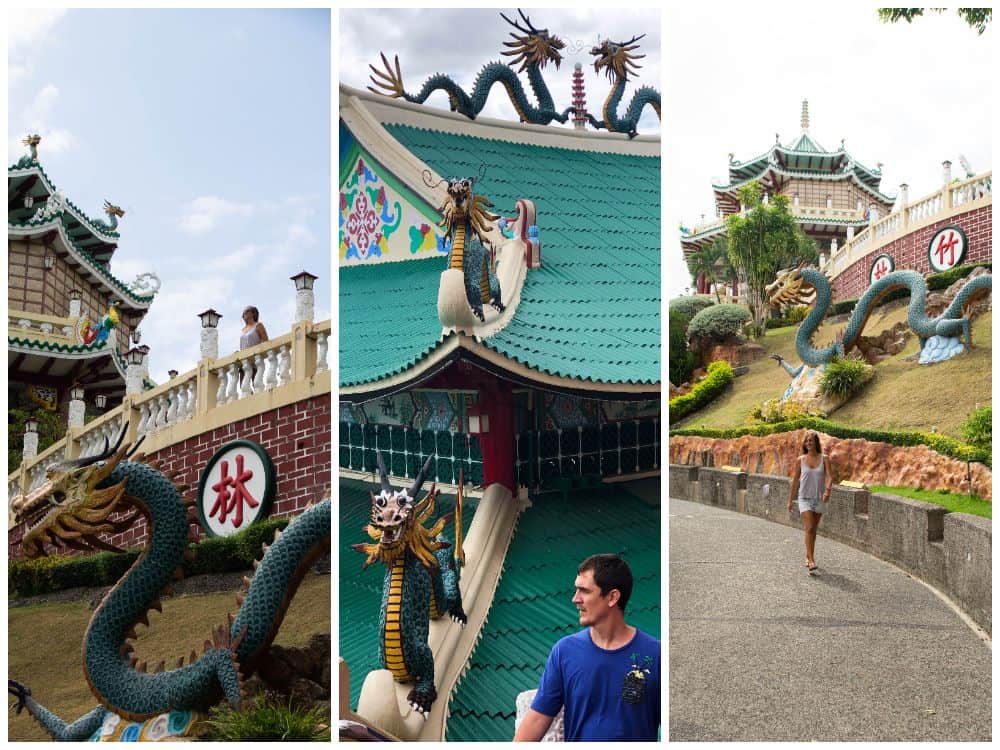
Built in 1972 by Cebu’s Chinese community, it offers great views of the city and a colorful stroll among huge dragons, Chinese architecture, and even a small replica of the Great Wall of China. If at this point you feel you have an existential doubt or a wish only a god can answer, you can try your luck with Taoist tradition here. Inside the main temple you’ll find two kidney-shaped wooden blocks for this.
After washing your hands and lifting the two pieces to the sky, you should drop them while thinking of your question. If both concave sides land facing up, your wish won’t come true; if one concave side and one flat side land facing up, your wish will come true; and if the flat sides land facing up… it means not even the gods know the answer! In that case, you should simplify your question and try again. If you get a bit confused, since it’s a religious rite and respect is due, don’t worry—you can ask the gentleman who’s always there and he’ll kindly help you complete it.
Entrance to the Cebu Taoist Temple is free and access is allowed between 6:00 and 17:00 (last entry 16:30). To get there, we recommend taking a white taxi or a car via the Grab app. Note that a mask is required to enter (yes, we’re talking 2024).
You can read all about the temple in Visiting the Cebu Taoist Temple.
7. Go shopping at Ayala Mall
If you’re in Cebu on a layover to another part of the country and need to buy something to continue your trip, or you’re leaving the Philippines and want to do some last-minute shopping, this is your place. The Ayala Mall shopping center is the largest in Cebu City and, in addition, the most modern in terms of infrastructure and décor. Electronics, beauty products, clothing, souvenirs, a large food court, and even a cinema where you can have fun watching the latest Filipino releases are just a sample of what you can find there.
If you’re in Cebu and want to exchange euros or dollars for Philippine pesos, here you’ll find one of the currency exchange offices with the best rates. It’s the one next to the Rustans supermarket. Also next to it is the HSBC ATM, the only one that doesn’t charge for cash withdrawals. In addition, in our article on Money in the Philippines we tell you which other ones we recommend in Cebu.
Even so, this isn’t the only mall in Cebu. If you’re into handicrafts, you’ll be interested to know that in the new and gigantic SM Seaside City Cebu and in SM City Cebu (downtown) there’s a branch of Kultura Filipino, a chain of stores where, in addition to typical souvenirs, you’ll find loads of handicrafts. Unfortunately, Ayala Mall doesn’t have such a wide variety.
If you need inspiration, find it in What to buy in the Philippines. Here we suggest what to take home from the country and also give you lots of store recommendations in Cebu and other corners of the archipelago.

8. Explore Mactan Island
If you’re going to arrive in or leave Cebu by plane, you’ll pass through Mactan Island no matter what, as the airport is located there. Almost as large as the city itself, it’s separated from it by a couple of bridges barely a kilometer long and offers a few interesting plans for those who want to fill gaps in their Philippines itinerary.
In Mactan you can enjoy beaches like Banban Beach or Tonggo Beach which, far from being on the level of the best beaches in the Philippines, can still give you a refreshing dip at any time. In addition, near the airport stands the imposing statue of Lapu Lapu, the famous native Filipino hero who stood up to and defeated the Spaniards in the bloody Battle of Mactan. It won’t be unusual to find a Filipino there taking a selfie while striking his combative pose.
To wrap up the day, you can head to the terrace at Scape Skydeck restaurant and enjoy some top‑notch dishes with panoramic views of Mactan’s harbor.
9. Take a Guided Tour of Cebu
If you feel like discovering everything there is to see and do in Cebu—and you want to do it in a super comfortable way that includes transportation and information about each site you visit—you might be very interested in taking a guided tour of Cebu. This will take you to, among other places, Magellan’s Cross, the Basilica del Santo Niño, Fort San Pedro, the Yap House Museum, and the Cebu Taoist Temple, all sprinkled with curious and interesting facts about the city, along with air‑conditioned transport and a guide.
Here you have different options for guided tours around Cebu:
More information about the 4‑hour Guided Tour of Cebu
More information about the 7‑hour Guided Tour of Cebu + Mactan
More information about the Shared Guided Tour of Cebu in English (cheaper)

10. Experience the Sinulog Festival
Is your visit to Cebu in January? Then you might be in luck! On the third Sunday of that month, one of the biggest festivals in the Philippines is held every year: the Sinulog Festival. This huge celebration in honor of the Santo Niño is a total explosion of color, music, and dance that you definitely shouldn’t miss if you have the chance.
The streets fill with dancers in their finest attire parading to the beat of the drums, resembling the current (Sinulog in Cebuano) of what used to be Cebu’s Pahina River. This spectacular party connects the country’s pagan past with its conversion to Catholicism and attracts Filipinos from all corners—as well as tourists—in search of one of the biggest events of the year in the Philippines.

What to do around Cebu City
If you have more time to dedicate to the city, here are a few extra plans that are worth it:
11. Visit Sirao Flower Garden and the Temple of Leah
An activity that became super trendy in Cebu City in 2019 was visiting Sirao Flower Garden. It’s a spot in the mountains surrounding Cebu that mimics the Netherlands, full of flowers. No wonder it’s known as “Little Amsterdam,” keeping, of course, a very wide distance.
Heads up, there are 2 Sirao Gardens: one called “Sirao Flower Garden” on Google Maps and another that’s “Sirao PGSC” (Pictorial Garden and Camping Site). The second one is Instagram’s favorite because it has a hand statue that’s all the rage on the platform. It also has various Bali‑style photo spots. However, the first has better‑tended flowers and is usually less crowded—your call!
Admission to Sirao Flower Garden is 120 pesos, while Sirao PGSC is 100 pesos.
And from Amsterdam we head to what they say is the “Taj Mahal of Cebu.” The Temple of Leah was an act of love by Teodorico Soriano Adarna for his late wife, a majestic building that emulates a Roman temple with columns featuring Doric‑style capitals and statues of Roman gods. Yes, as it sounds, it’s a bit kitschy, but it’s an interesting place to visit in Cebu and can be combined with a visit to Sirao Garden. Admission is 150 pesos per person.
How to get to Sirao Garden? As they’re a little far, it’s possible to get there by taxi, but you’ll have to negotiate if you want them to combine the 2 places and wait for you. Most taxi drivers and Grab cars even have a little sign offering this possibility, but prices tend to be a bit crazy (around 2,000 pesos). So we suggest you put your bargaining skills to use. Another option is to go to the Ayala Cebu PUV Terminal and from there take a van to Sirao (50 pesos per person). Tell the driver to drop you near the gardens and then take a habal‑habal (motorbike with driver) for about 30 pesos per person. You can also go to JY Square Mall in Cebu and catch a habal‑habal there for 2 people. They usually ask 400 pesos for the round trip plus 100 or 200 pesos per hour of waiting.
How to get to the Temple of Leah? As above, you can negotiate a taxi or go to JY Square Mall and grab a habal‑habal. This usually costs 150 pesos per ride (2 people).
Another possibility, to save yourself the hassle, is to book directly with KLOOK (the most important agency in the Philippines), which offers a combined tour with the Simala Shrine, the Temple of Leah, and Magellan’s Cross. You can book it here. Civitatis also offers a combined tour of the Temple of Leah and Sirao Garden, or better yet, this one that combines a guided tour of Cebu with the Temple of Leah and Sirao.
If you have several days in Cebu, you can do day trips from the city and explore loads of interesting places. You can read much more in Best day trips from Cebu City.
12. Do a day trip to Bohol
Although we usually recommend spending more time in Bohol, if you don’t have it and don’t want to miss its main attractions, we suggest booking a day trip to Bohol from Cebu.
Among the many highlights there you’ll find the oldest stone church in the Philippines, a visit to the tarsier recovery center, a boat ride with buffet lunch along the Loboc River, and—of course—a visit to the famous Chocolate Hills, a true symbol of the country. Unlike the guided tour of Cebu, this one is in English. But dont’ worry! To enjoy everything it includes, you won’t need much language.
More information about the guided tour to Bohol from Cebu with Klook

13. Hike to the top of Osmeña Peak
If, besides loving beaches, you enjoy hiking and nature walks, one of the most popular excursions to do in Cebu is the one that takes you to the highest peak on the entire island: Osmeña Peak. The so‑called “Chocolate Hills of Cebu” are a set of sharp peaks covered with a green layer of vegetation and surrounded by small villages and plantations of all kinds of vegetables.
The views from the 1,013 meters of elevation at the summit make the 80‑kilometer journey from Cebu well worth it. The trek to the top of Osmeña Peak is really easy; once you reach the access area you can complete it in half an hour.
How to get to Osmeña Peak from Cebu
First you’ll need to head to Cebu South Bus Terminal to catch a bus to Santander/Li-loan or Argao. The price of this air‑conditioned bus is about 120 Philippine pesos and the journey takes around 3 hours. You should tell the driver to drop you at the Dalaguete junction for Osmeña Peak. When you get off, you’ll easily see habal‑habal (motorbike taxi) drivers waiting. The ride costs 200 pesos per motorbike, so if you’re traveling with someone, it’ll come to 100 each, as they accept up to two passengers. In about 50 minutes they’ll drop you at the Osmeña Peak Tourist Center and, once you’ve paid the 50‑peso entrance fee, you can start the walk. The path is easy and straightforward, but you must hire a guide, which costs 100 pesos per group.
If you want, Civitatis also has a tour to Kawasan Falls to which you can add Osmeña Peak. You can book it HERE.

14. Escape to Moalboal
We’ve left it for last, but it’s no less important—in fact, we think it’s the most important thing to do on Cebu “island.” This town in the southwest of Cebu Island is the one we find most appealing, and more and more visitors are coming here attracted by its great snorkeling and diving and its waterfalls.
Literally right off Panagsama’s shore there’s a school of millions of sardines you can swim with for free, the diving on Pescador Island is awesome, and from Moalboal you can visit the famous Kawasan Falls. In our article Things to do in Moalboal we tell you all the details.
Can you visit Moalboal in a day from Cebu? You can, but keep in mind it’s 3–3.5 hours each way, so our advice is to stay 1 or 2 nights. In any case, if you want to make it more comfortable, we can give you the contact of a taxi driver who can take you comfortably from your accommodation in the city.
You can also book this excursion from Cebu, which includes a visit to the beautiful island of Pescador (great snorkeling) and snorkeling with the sardine run. Another option we like is this tour that includes Kawasan Falls plus the option you choose (snorkeling, Osmeña Peak, or the zipline at Kawasan itself).

What to do in Cebu in 1 day
If you decide to spend a day in Cebu, this would be the route we’d take:
- Basilica del Santo Niño and Magellan’s Cross
- Fort San Pedro
- Cebu Metropolitan Cathedral
- Yap–Sandiego Ancestral House and Heritage of Cebu Monument
- Casa Gorordo
- Cebu Taoist Temple
- Dinner at Ayala Mall
Useful information for visiting Cebu
- The best time to visit the city is between December and May, which is the dry season. In our opinion, January and February are the best months, as it isn’t so hot.
- You have all the information on how to get here in How to get to Cebu.
- There are loads of places in Cebu where you can pay by card and, in addition, you’ll find an HSBC ATM next to Ayala Mall. It’s the only one that doesn’t charge a fee, as we tell you in Money in the Philippines. Take advantage to withdraw cash here and visit other islands.
- Getting around Cebu is easier than in Manila. Drivers of white taxis are usually quite honest and have no problem turning on the meter, so we use them frequently. Also, although it’s a bit more expensive, Grab works very well. If you’re traveling solo, you can use the services of habal‑habal (motorbikes with a driver), which you can request via the Grab, Angkas, Joyride, and Maxim apps. Cebu also has a good bus network (check the MyBus page) and, of course, jeepneys. The latter can be a bit chaotic, but this page can help.
- If you need to go to the hospital in Cebu, our advice is to go to Chong Hua in Mandaue. It’s new and we’ve always been treated very well. If you’re traveling with insurance for the Philippines (please do), you can ask them to send you directly there because almost all insurers have agreements.
- Is Cebu safe? Although there are some rather run‑down areas of Cebu, it can’t be said to be an unsafe city. We wouldn’t walk at night around the port area, for example, but neither do we think it’s essential. You can calmly explore Cebu’s historic center by taking basic care, as you would anywhere else. Petty theft sometimes happens, so don’t be overly trusting.
- If you need to work remotely or have a good internet connection for whatever reason, you’re in luck because you’ll find it in Cebu. Hotel Wi‑Fi is usually very good, as is 4G from Smart or Globe. You’ll find more information in Internet in the Philippines.
- Cebu isn’t a small city, so it’s important to choose where you want to sleep. Our recommendation is to do so according to your purpose because traffic is usually heavy. That is, if you need to be near the port, the airport, or one of the bus stations; if you’re going to immigration to renew your visa; or if you want to go shopping and have a quiet dinner, one place or another will suit you better. In Where to stay in Cebu you’ll find our personal recommendations.
Map of Cebu
To make it much easier for you to get around the city, we’ve prepared this map where you can easily locate all the places we talk about in Things to do in Cebu:
Where to stay in Cebu
Cebu has a wide range of accommodations for all types of travelers, from luxury beachfront hotels to hostels for backpacker budgets. Here are a couple of recommendations:
- Near the airport, good, nice, and cheap: Little Norway Guesthouse
- Near the port and with a pool: One Central Hotel
In this other article we tell you which are the most recommended ones, where they’re located, and their prices: Best hotels to stay in Cebu.
All set to make the most of Cebu?
If you have any questions about this Filipino city, we’ll be happy to help in the comments below!