Summarizing the history of the Philippines isn’t easy, but here we want to offer you a few brushstrokes of the past and present of this distinctive Asian country. Without being historians or trying to go into excessive detail (that would be madness!), we’ve gathered the most important facts about the history of the Philippines in a brief and simple way. At the end of this article, we’ll also give you some resources to help you dig deeper into the topic or get some visual context.
It’s highly likely that the beaches of the Philippines are the reason your next trip will be to these islands; but to make it complete, you’ll probably also want a global view of the country you’re about to visit.
One interesting idea is to visit big cities like Cebu or Manila, where you’ll find important traces of cultural heritage and see first‑hand the present of the millions who live there beyond the coconut‑tree paradises. Another is to drop by one of the festivals in the Philippines. And, finally, a good complement to all of the above is to read up on the history of the Philippines beyond the isolated fact of its Spanish colonial past.
Ready? Stick with us and learn a little more about the history of the Philippines.
The first humans in the Philippines
In 2018, stone tools were discovered in Rizal showing that humans were already in the Philippines 709,000 years ago. Likewise, in 2007 the Homo luzonensis or “Callao Man” was found in Callao Cave (near Tuguegarao, Luzon). These are the earliest human remains in the Philippines, 67,000 years old.
Both discoveries imply that humans already existed in the archipelago before the arrival of the so‑called Negrito peoples (ethnic groups living in isolated areas of Southeast Asia and the Andaman Islands, also called atis, aetas, or dumagats) and the Austronesians. It’s not exactly known when the former arrived, though estimates place it around 5000 BC. The first Austronesians may have arrived around 2200 BC from Taiwan and settled in Batanes and the northern part of Luzon island.
It’s believed that around 1000 BC the inhabitants of the Philippines could be divided into 4 categories:
- Tribal groups such as the aetas, hanunuo, ingolotes, and mangyan—hunter‑gatherers who lived in the forests.
- Societies of itinerant warriors like the isneg or the kalinga.
- The plutocracy of the ifugao in the Cordillera.
- Peoples living near rivers and coasts whose economies were based on maritime trade.
Between 300 and 700 BC, trade intensified with the so‑called “Indian world,” specifically with the Malay Archipelago (Indonesia, Singapore, Brunei, Malaysia, East Timor, and much of Papua New Guinea) and with East Asia, from which Buddhism and Hinduism influences arrived. These journeys were made in balangays (sailing boats), from which the word barangay—the villages/wards where Filipinos lived—comes.
Remains in caves such as Kalanay (Masbate) or Tabon (Palawan) confirm that the Sa Huỳnh culture, which originated in southern and central Vietnam, also formed part of Philippine history.
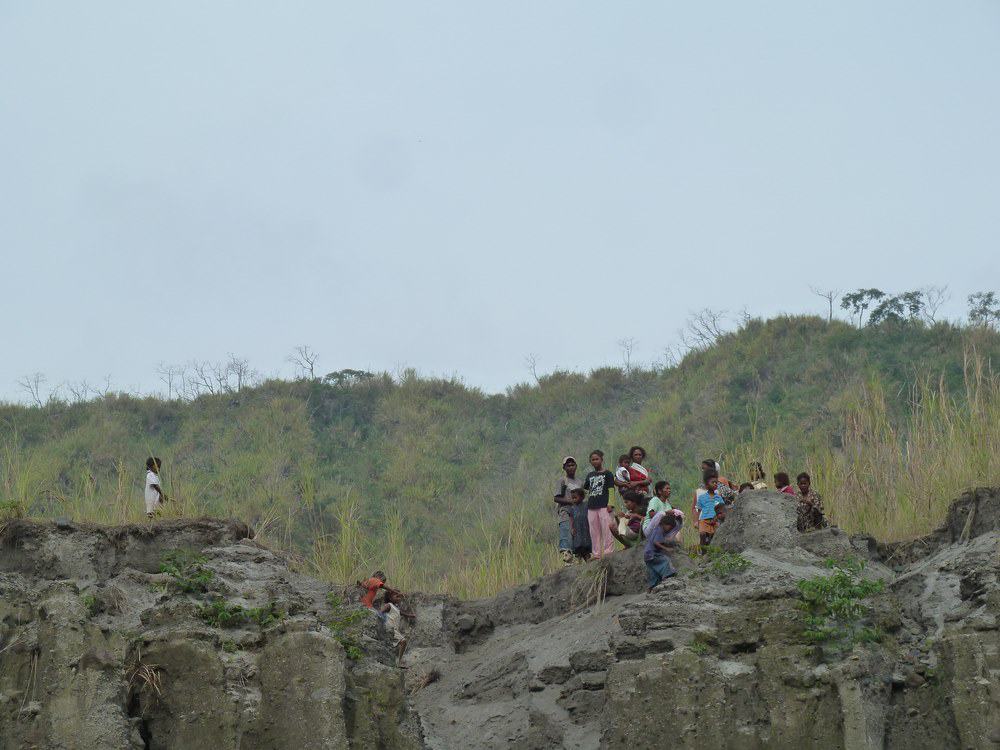
Aetas of Mount Pinatubo
The precolonial period
Around the year 1000 AD, you wouldn’t have found a unified state if you arrived in the Philippines. What you’d see were many semi‑autonomous states under the power of thalassocracies ruled by datus, wangs, rajahs, sultans, or lakans, or societies living in the mountains ruled by plutocrats or economic elites. These included the Kingdom of Maynila, the Kingdom of Taytay, the Kingdom of Tondo, the Rajahnate of Cebu, and the Sultanates of Maguindanao and Lanao.
Between the 14th and 16th centuries came what is known as the barangay period in Philippine history—i.e., the country’s sociopolitical organization into barangay states, nomadic in nature but turning into settlements or fleets depending on resources (mainly timber). They forged alliances with one another—or fought.
The earliest barangays were small communities of 30 to 100 families, with populations between 100 and 500 people led by a chief. They later grew larger, especially those by the sea. The most successful were those near a river delta.
It’s worth noting that during these centuries many immigrants and traders from Sumatra, Java, the Malay Peninsula, Japan, and China continued to arrive and settle in the Philippines. This led, for example, to Sanskrit influence on native languages (take a look at baybayin and you’ll see what we mean), the flourishing of Islam, the teaching of how to make certain weapons and tools, and the use of materials such as porcelain, lead, silver, and tin.
The arrival of Catholicism
On March 17, 1521, a Spanish expedition commanded by the Portuguese Ferdinand Magellan arrived—landing on Homonhon Island, southeast of Samar. The explorer began building relationships with local leaders such as Rajah Humabon, whom he later supported in the Battle of Mactan against Lapu‑Lapu, the island’s chieftain or datu. Magellan died in the fighting.
Even so, that wasn’t the end. In the following decades of Philippine history, several Spanish‑flagged expeditions reached the islands. As a curiosity, it was in this period when they were christened the Philippine Islands in honor of Philip II.
The most important expedition was in 1565, when Miguel López de Legazpi arrived from Mexico with five ships, 400 men, and five Augustinian monks with strict orders to colonize and Catholicize. He ordered the building of Fort San Pedro, which you can still see in Cebu.
From then on, Spanish settlements began to form, attempts were made to unify an archipelago fragmented into dozens of states, and, of course, to introduce Catholicism in a territory where Islam had spread in recent centuries. They went island by island until, in 1571, they reached Maynila, fought Rajah Sulayman to “found” Manila, and made it the capital of the Philippine Islands. Construction began on Intramuros, the original center of government, education, and commerce, where much of the elite would live for centuries.
The new colony was part of the Viceroyalty of New Spain, so it was administered from Mexico City until 1821, when Mexico gained independence. Although there was a governor, the reality is that outside Manila, friars wielded more power. During the friarocracy, friars tried to build larger pueblos and raised imposing stone churches. Some of these Philippine history vestiges can still be visited, such as San Agustin in Intramuros or Paoay in Ilocos Norte.

San Agustin Church, Intramuros
The consolidation of Spanish power
Throughout the 17th century, soldiers from Spain, Mexico, and Peru mainly arrived to defend the settlements already established across the archipelago. From their interaction with the islands’ first inhabitants arose the first mestizos and languages such as chabacano, which we discuss in Languages of the Philippines.
This period also saw the founding of colleges and universities such as the Colegio de Manila (later the University of San Ignacio) and the University of Santo Tomas, where, in addition to religion, subjects like physics, chemistry, and mathematics were taught. In smaller communities, missionaries taught Spanish and farming techniques for seeds brought from Latin America such as corn, chocolate, and pineapple. Schools and hospitals were built as well.
⛵ This was, of course, the golden age of the Manila Galleon. The route linked Manila with the ports of New Spain in the Americas, especially Acapulco, and provided an economic boost to the capital, which came to be known as the “Pearl of the Orient” for its beauty.
However, during the 18th century, conflicts with Muslims in the south, the long war with the Dutch to the west, and pirate raids from Japanese sailing down from the north—combined with the colony’s low profitability—greatly weakened Spanish power and paved the way for Manila to be invaded by the British between 1762 and 1764.
In 1821, with Mexico’s independence, the Philippines became part of the Kingdom of Spain. In fact, the 1870 Constitution classified the archipelago as an “Overseas province.” In the 19th century, there was significant investment in infrastructure and education. In 1863, Isabel II decreed the establishment of a public education system. And in 1851, the Banco Español‑Filipino de Isabel II was created to more orderly manage the economic boom brought by the cultivation of crops such as abacá and coconut.

Plaza Moraga (Manila) in 1901. Source: Wikimedia Commons
The Philippine Revolution
The independence of several Latin American countries from Spain increased distrust of latino and criollo army officers, who were replaced by the so‑called peninsulares, i.e., those born in Spain. This racist shift caused discontent among much of the army, which began to show in various uprisings.
Meanwhile, the desire for independence of Filipinos living in the Americas and Europe grew significantly at the end of the 19th century. The Cavite Mutiny in 1872 was the final spark: taking advantage of a failed uprising by about 200 soldiers and workers, the government ordered the death by garrote of several Filipino leaders and three famous priests, condemned for sedition. This further fanned anger and resentment against the colonial government.
At the same time, in Europe, the ilustrados (the “educated” class of Filipinos) began organizing protest movements. Among them, La Liga Filipina emerged on Philippine soil. This was a peaceful association seeking to defend Filipinos’ rights within Spain’s government, without clearly calling for independence.
Enter a pillar of Philippine history: José Rizal. An ilustrado, doctor, poet, novelist, painter, sculptor, and linguist, he was one of the founders of La Liga Filipina and is today considered a national hero. Although he did not seek to break the legal framework, in 1892 he was suspected of rebellion and exiled to Dapitan, Mindanao.
That same day, Andrés Bonifacio founded the Katipunan, or KKK. This secret society—of which José Rizal was not a member—did aim to achieve independence from Spanish rule. On August 6, 1896, when it had about 30,000 members, it was discovered by the Spanish authorities, marking the start of what is known as the Philippine Revolution.
On October 6, 1896, Rizal was imprisoned in Barcelona while en route to Cuba to care for yellow fever victims, in an attempt to show he stood with the colonial government. Accused of being part of the KKK and of sedition, rebellion, and conspiracy, he was immediately sent to Manila. He spent his final days in a cell in Fort Santiago, Intramuros, where he wrote his famous poem “Mi último adiós” (“My Last Farewell”) until, on December 30 of the same year, he was executed by firing squad at what is now Rizal Park. You can now visit the exact spot where it happened; you’ll find a representation of the execution.

After several months of revolt, the Katipuneros and the Spanish government signed a peace agreement, and General Emilio Aguinaldo, leader of the Magdalo faction of the KKK, agreed to go into exile in Hong Kong in December 1897. However, neither side kept the pact and tensions continued to rise as those between the United States and Spain escalated into the Spanish‑American War, which spread to the Philippines, where the Americans helped the rebels gain strength.
Spain was defeated by U.S. forces in the 1898 Battle of Manila Bay. A few months later, Aguinaldo returned to the Philippines with U.S. help, declared the archipelago’s independence and the First Philippine Republic. The Treaty of Paris, signed on December 10, 1898, ended the Spanish‑American War and Spain sold the Philippines, Guam, and Puerto Rico to the United States for the paltry sum of $20 million. This marked the end of more than 300 years of Spanish presence in the Philippines.
⭐ The only ones who seemed unaware of the withdrawal were the members of the Baler detachment, northeast of Manila. The so‑called “Last of the Philippines“ remained confined in the Church of San Luis de Tolosa until they surrendered on June 2, 1899.

The “Last of the Philippines” upon arrival in Barcelona. Source: Wikipedia
The Philippine–American War
Although the U.S. government had told the Katipuneros that its interest was to defeat the Spaniards and help them gain independence, in reality it didn’t take long to reveal other intentions. U.S. President William J. McKinley, heeding imperialists, declared that Filipinos “were not ready for self‑government” and needed to be “civilized.”
Realizing that U.S. troops were there to occupy the country, Aguinaldo set the capital in Malolos (outside Manila) and declared war at the beginning of 1899. Unfortunately, the size and poor equipment of the Filipino forces led to about 20,000 soldiers being killed. Nearly 200,000 civilians also died, mostly from a cholera epidemic brought on by wartime scarcity.
The Philippine president was captured in March 1901, but the war continued until July 4, 1902, when the United States declared victory. Even so, the U.S. government had already been busy organizing the political system to its liking.
The American occupation
A few years after dissolving the military government, the United States—albeit reluctantly—allowed a bicameral system. The Philippine Assembly was the elected lower house, while the Philippine Commission, whose members were appointed, was the upper house. They also publicly promised eventual independence for Filipinos.
In the early 20th century, significant reforms were implemented, especially regarding education. A public school system was established, and hundreds of U.S. teachers arrived to teach arithmetic, reading, writing, and, of course, English. It’s estimated that after 35 years of American occupation, 27% of the population could speak the language and 50% were no longer illiterate.
In 1935, the Commonwealth of the Philippines was established along with a new constitution and a president elected by its citizens—Manuel L. Quezon, leader of the Nacionalista Party. This would last until 1946, when the Philippines would become independent.
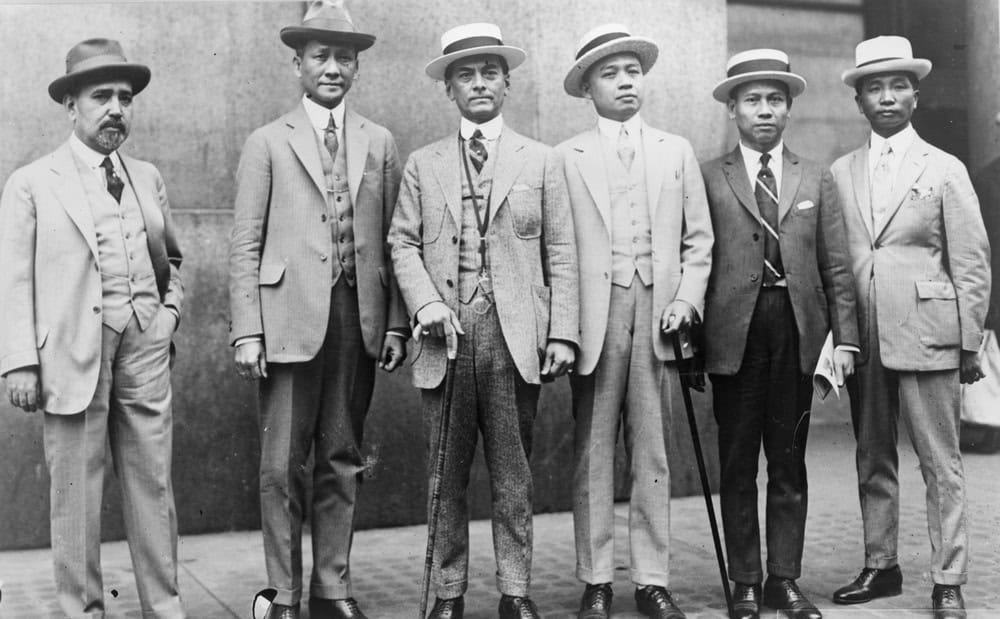
Manuel L. Quezon at center and the representatives of the Philippine Independence Mission. Source: Library of Congress
World War II in Philippine history
Unfortunately, what seemed to be a calm period turned out to be quite the opposite with the start of World War II. The Japanese attacked Clark Air Base in 1941, and U.S. forces, commanded by General MacArthur, had to surrender—not before declaring in his famous speech that he “would return.”
The Japanese occupation ended with MacArthur’s return via the island of Leyte, where the Battle of Leyte Gulf—the largest naval battle in modern history—took place. The decisive move, however, came during the Battle of Manila, which lasted almost a month and not only led to the near‑total destruction of the Pearl of the Orient but also the deaths of about 150,000 civilians. Manila became, alongside Warsaw and Hiroshima, one of the most devastated cities of the war.
More than a million Filipinos died during World War II. Poverty was rampant.

Pacific War Memorial on Corregidor Island
The independence of the Philippines
After President Quezon’s death in 1944 and a swift succession by Sergio Osmeña, elections were held in 1946 and Manuel Roxas was declared the first president of the now‑independent Republic of the Philippines. However, the devastation of the war meant that, de facto, it remained economically dependent on the U.S.
Several presidents fought for the country’s recovery, with varying success, while others were accused of corruption—something that, as you’ll see, has recurred throughout Philippine history.
The Marcos government
In 1965, Ferdinand Marcos of the Nacionalista Party was elected the 4th president of the Philippines after World War II. Under the slogan “This nation can be fabulous again,” the start of his term focused on some reforms to restore the country’s pre‑war economic standing. He became the first president to be re‑elected for a second term in 1969.
However, widespread poverty, rising inflation, increasing crime, rampant corruption, growing problems with the Moro National Liberation Front (MNLF) in Mindanao, and the creation of the New People’s Army by the Communist Party sparked a wave of protests in Manila.
? In response, Marcos declared martial law in 1972, which gave him the power to rule at will and shut down Congress. He imposed a curfew, restricted press freedom, banned international travel, and ordered the arrest of 50,000 opposition leaders and militant activists such as Senator Benigno Aquino Jr.
A new constitution also came into force in 1973 that, of course, allowed him to continue beyond two terms. The reason? According to Marcos, the goal of martial law was to create a “new society,” but the reality is that during his dictatorship, poverty continued to rise while his wife Imelda (an addict to expensive shoes) and he siphoned state funds from Malacañang Palace.
According to Amnesty International and other human‑rights watchdogs, his rule saw 3,257 extrajudicial killings (more than 2,500 of them carried out in public to instill fear), 35,000 documented cases of torture, 77 “disappearances,” and 70,000 imprisonments.
He lifted martial law in 1981, but corruption and nepotism continued with little effort to hide it. The economy kept suffering, and in 1983 the last straw was the assassination of Benigno Aquino Jr. at Manila airport after returning from a long exile.

Ferdinand Marcos and family in 1969. Source: Philippine Presidential Museum and Library
The People Power Revolution
Social discontent and U.S. pressure culminated in presidential elections in February 1986. Although the opposition included Benigno Aquino’s widow, Corazon Aquino, the results gave power back to Marcos. Local and international observers denounced electoral fraud, sparking a wave of peaceful civil uprisings known as the People Power Revolution.
Two million civilians and several political, military, and religious groups took to the streets unarmed to protest the regime’s violence and election fraud. With a festive atmosphere, most of the demonstration took place along Epifanio de los Santos Avenue in Manila, also called EDSA—hence the name EDSA Revolution.
On U.S. advice, Marcos was forced into exile in Hawaii (taking, of course, several million dollars), and “Cory” Aquino was declared the 11th president in Philippine history.
Her administration reinstated democratic institutions, protected civil rights, and drafted a new constitution; however, Cory did not have it easy. She faced up to six military coups, the communist insurgency, and economic setbacks caused by natural disasters such as the 1991 eruption of one of the volcanoes in the Philippines, Mount Pinatubo.
Meanwhile, the Philippine Senate rejected a treaty to extend the use of U.S. military bases in the archipelago. In December 1992, nearly 100 years of U.S. military presence in Philippine history came to an end.
Philippine history in the 21st century
After Fidel V. Ramos’s administration—which saw notable economic development and some political stability—film actor Joseph Estrada came to power in 1998. His promises to help the poorest were short‑lived: in early 2001, he was removed by the Supreme Court over bribery and corruption scandals. Thousands of Filipinos once again took to the streets, fed up with thieving presidents.
He was succeeded by Gloria Macapagal‑Arroyo, Estrada’s vice president and the daughter of former president Diosdado Macapagal. Re‑elected in 2004, her term ended in 2010 and was not free from corruption scandals, including the brutal Maguindanao Massacre, in which 58 people were gunned down by the opposing party en route to file a certificate of candidacy for elections in Maguindanao, Mindanao.
The son of Cory and Benigno Aquino, Benigno “Noynoy” Aquino III, won the elections with a resounding 42% of the vote over other candidates, including former president Estrada.
During Noynoy’s government (2010–2016), the Philippine economy grew considerably, above 7%, becoming one of the strongest in Asia. An attempt was made to achieve peace with the most radical groups in Mindanao and the Sulu archipelago by signing the Framework Agreement on the Bangsamoro, an autonomous region. Supertyphoon Yolanda devastated the Visayas region, and the management of aid packages was heavily criticized. Tensions with China also worsened over sovereignty issues in the South China Sea.
Battered by several political scandals, renewed problems with the Moro Islamic Liberation Front (MILF), and a lack of social and infrastructure progress, Aquino lost popularity. Rodrigo “Rody” Duterte, mayor of Davao City (Mindanao), at 71 years old swept the 2016 elections. His promises to end corruption and crime, improve relations with China, and the “legacy” he touted in Davao convinced a population hungry for change.

Rodrigo Duterte takes the oath of office on June 30, 2016. Source: Presidential Communications Operations Office
The Philippines today
Many analysts and academics describe Duterte as a populist, a nationalist, and even a fascist. The fact is that before becoming president he was known as “The Punisher”. His 22 years as mayor of Davao were defined by a zero‑tolerance policy on crime. He openly backed extrajudicial executions of criminals and drug users. Human‑rights groups documented more than 1,400 killings by death squads between 1998 and 2016.
Already on the campaign trail, Duterte promised he would kill up to 100,000 criminals if elected president. He didn’t take long to make good on his threat: in the first three months of his term, the “war on drugs” already had 3,000 dead. By October 2020 the count had surpassed 5,800, although human‑rights groups put the figure at over 30,000. Institutions such as the International Criminal Court have ongoing actions against him for crimes against humanity.
Meanwhile, although there was some rapprochement with the MILF and the MNLF, problems persist in the south. The same is true of the Filipino communist insurgency which, though now with fewer than 4,000 fighters, remains the oldest and deadliest in Asia.
Despite the controversies, the economic crisis, persistent inequality, the distancing from the United States, and the blow of COVID‑19 in the Philippines and its poor handling, other moves—such as making universities more accessible, legalizing “equal marriage,” or providing contraceptive pills to disadvantaged women—kept his approval around 91% of the population.
Analysts have long pointed to the populism of such measures—especially grants to the most disadvantaged—as a way to distract from less acceptable policies. Philippine politics is far more personalist than ideological.
Remember Marcos? Unbelievable as it may seem after his father’s reputation, it was his son, Ferdinand Marcos Jr. (known as “Bongbong”), who won the May 2022 elections. The vice president (surprise!) was Duterte’s daughter, Sara Duterte. What does the future hold? We’ll have to wait a little to see how this new term unfolds.
https://www.youtube.com/watch?v=-sOB5JsTAsI
Milestones in Philippine history
65,000 BC: It’s believed the first humans reached the Philippines by raft. The remains of Callao Man date from this era, although traces of human activity as old as about 709,000 years have been found.
100–200 BC: First trade exchanges with China.
100 BC–1000 AD: Many immigrants and traders from Sumatra, the Malay Peninsula, and the island of Java settled in the Philippines.
1200–1600: Trade with China flourished along with Chinese settlements. There were also exchanges with India, Japan, Vietnam, Cambodia, and Thailand. The country was divided into several sultanates and rajahnates.
1521: Ferdinand Magellan arrived on Homonhon Island (Samar) and claimed it for Spain. He died in the Battle of Mactan at the hands of Lapu‑Lapu, the tribal chief of Mactan Island.
1565: Legazpi arrived on an expedition from Mexico and brought the Philippines into the Viceroyalty of New Spain.
1571: After fighting the city’s rajah, Legazpi founded what is now Manila and began construction of Intramuros.
1565–1815: The golden age of the Manila Galleon—the route between Manila and the ports of New Spain (mainly Acapulco). Trade among Asia, Europe, and the Americas made Manila one of the richest and most beautiful cities in the region, becoming known as the Pearl of the Orient.
1762: The United Kingdom occupied Manila for two years. Popular rejection of Spain began to grow.
1821: Mexico declared independence and the Philippines came to be administered from Madrid.
19th century: Many cities were founded; investment went into infrastructure and public schools. An economic boom—driven by agricultural innovation and the tobacco and sugar industries—created a wealthy mestizo class. The ilustrados, middle‑class native Filipinos who mostly studied abroad, began sowing ideas of independence.
1872: The Cavite Mutiny was the definitive proof of the rise of Filipino nationalism. It ended with the death of Father José Burgos and two other priests, condemned for treason and sedition.
1892: José Rizal returned to the Philippines and formed La Liga Filipina, a civic movement seeking social reforms within the legal framework of the time. He was nevertheless deported to Mindanao.
1896: The Philippine Revolution began, and José Rizal was unjustly accused and executed. He became a hero in Philippine history, fueling nationalist sentiment against the Spanish government.
1898: The Treaty of Paris was signed, ending the Spanish‑American War and ceding the Philippines to the United States.
1901: U.S. forces captured revolutionary leader Emilio Aguinaldo in the Philippine–American War.
1935: The first national elections were held, and Manuel L. Quezon won. The Commonwealth of the Philippines—a commonwealth with the United States—was declared.
1942: 75,000 U.S. and Filipino soldiers were forced to surrender to Japan and retreat to Bataan.
1946: The Philippines gained independence, and Manuel Roxas became the first president of the independent republic.
1965: Ferdinand Marcos became the first president to be re‑elected to a second term, but the economy slowed and corruption ran rampant, stoking public resentment.
1972: Marcos declared martial law and jailed journalists and opposition leaders, including Benigno “Ninoy” Aquino Jr., who later went into exile in the United States.
1983: Upon returning from the U.S., Aquino was assassinated at Manila Airport. Protests against Marcos began.
1986: The EDSA or People Power Revolution was a peaceful uprising that led to Marcos leaving office. Ninoy Aquino’s widow, Corazon Aquino, became president until 1992.
1991: Mount Pinatubo erupted and Clark Air Base became unusable. The Senate did not renew the extension of U.S. bases in the country, ending the U.S. military presence.
2013: Typhoon Yolanda devastated the Visayas region, which was left almost destroyed.
2016: Rodrigo Duterte was elected president of the Philippines. His government was not without controversy—his “war on drugs,” which has resulted in thousands of extrajudicial killings, has been the most criticized by human‑rights groups and international bodies such as the UN.
2022: Ferdinand Marcos Jr. won the May 2022 elections.

Heritage Monument of Cebu historia de filipinas
Places of interest to visit and learn about Philippine history up close
Throughout this article we’ve already mentioned a few places where you can get a closer look at the history of the Philippines. Still, here’s a summary of those we find most interesting in case you want to include them in your trip:
- Manila: while the Philippine capital isn’t a pretty city (especially once you read about the damage from World War II), we recommend heading to Intramuros, where you’ll find, among other historic buildings, Fort Santiago, Manila Cathedral, and San Agustin Church. You can read more in our articles Things to do in Manila and What to see in Intramuros.
- Cebu: in the capital of the Visayas you can also learn about Philippine history in places like Fort San Pedro and the nearby ancestral houses. We tell you all about it in Things to do in Cebu.
- Vigan: this is the best‑preserved colonial city in the country. If you want to savor the Spanish atmosphere that can still be felt in the archipelago, don’t hesitate.
- Iloilo: this city on the island of Panay also played an essential role in Spanish times. Here you’ll find the Iloilo Museum and some interesting churches. In addition, 40 kilometers away is Miagao Church, built between 1787 and 1797 and declared a World Heritage Site.
- The Cordillera region: to delve into the tribal groups that populated the archipelago before Magellan’s arrival, we suggest an escape to Banaue, Batad, Sagada, and Kalinga country.
- Corregidor Island: this is one of the day trips from Manila you can take. The defense base of Manila Bay, it holds vestiges of World War II.
Some resources to learn more about the history of the Philippines
As you can see, this summary of the history of the Philippines didn’t end up being as short as we expected because—being honest—it’s a topic we’re passionate about. If you still want to go further, we’ve gathered a few literary and audiovisual resources you might find interesting:
Texts on the history of the Philippines
- Origins of the filipinos and their languages, Wilhem G. Solheim II
- Historia mínima de Filipinas, Paulina Machuca
- España en Filipinas, Instituto de Historia y Cultura Naval
- Filipinas, un país entre dos imperios, María Elizalde y Josep M. Delgado
- History of the Philippines: From Indios Bravos to Filipinas, Luis H. Francia
- Noli me tangere, José Rizal
- America’s Boy: A Century of United States Colonialism in the Philippines, James Paterson‑Hamilton
- Asia’s Cauldron: The South China Sea and the End of a Stable Pacific, Robert Kaplan
- El terror amarillo en Filipinas (Terror in Manila: February 1945), Antonio Pérez de Olag
- Atlas ilustrado Filipinas española, Roberto Blanco Andrés
- Filipinas es mi jardín, Manuel Legineche
Novels inspired by the Philippines
- Muerte en Manila, Álvaro del Castaño Villanueva
- Los olvidados de Filipinas, Lorenzo Mediano
- Copla al recuerdo de Manila, Jordi Verdaguer Vila‑Sivill
- Cartas desde Manila, Susana Cayuelas
- Mabuhay: Bienvenidos a Filipinas, Ramón Vilaró
- La última princesa del Pacífico, Virginia Yagüe
- La Pérdida de Filipinas Narrada por un Soldado Extremeño, Deogracias González
Documentaries and films about the Philippines
- Los Últimos de Filipinas. Regreso a Baler
- 1898: Los últimos de Filipinas directed by Salvador Calvo (on Netflix)
- Heneral Luna
- Goyo, the Boy General (on Netflix)
- Metro Manila (on Amazon Prime Video)
Podcasts related to the history of the Philippines
- Los Últimos de Filipinas, Memorias de un tambor
- El español en Filipinas, La ContraHistoria
- Manila, corazón de Filipinas, Nómadas
Social media profiles related to the Philippines
-
- Jorge Mojarro, professor at the University of Santo Tomas and the Instituto Cervantes in Manila
- Cartas desde Manila
- Filipinas Heritage Library
- Philippine Studies
- The Philippines History
We hope this summary of the history of the Philippines has inspired you. If you have any suggestions or questions, we’ll be happy to answer them in the comments!