Besides studying the Philippines Guide, creating an itinerary with the places you want to see, booking accommodation, flights, travel insurance, or making a list of the must‑do things you want to try, one of the most fun and entertaining parts of preparing an adventure like this is getting to know a little more about the country you’re going to visit. For that reason, we’ve put together this list of fun facts about the Philippines that will surely surprise you.
Whether you haven’t visited the country yet or you already have and want to learn a bit more, don’t miss this list of fun facts about the Philippines. Some might seem basic and you may already know them, but you’ll definitely be amazed by more than one.
Why is the Philippines called that?
Let’s start with a basic fun fact about the Philippines that many travelers don’t know: the origin of the country’s name. In the mid‑16th century, the era when the Spanish Empire “never saw the sun set,” the explorer from Málaga, Ruy López de Villalobos, reached what were then known as the “Islas de Poniente” with the intention of annexing them to the Spanish Crown. Once he had colonized them, he christened them the Islas Filipinas in honor of the then Prince of Asturias and future king, Philip II. From Felipe came felipinas, and from felipinas, Filipinas.
☀️ To learn a little more about this topic, don’t miss our article History of the Philippines: Brief Summary.
Where’s my knife?
If you’re eating at an international‑menu restaurant you might not notice this fun fact about the Philippines, but in carenderias (local Filipino eateries) it will surely catch your eye. The most common thing is that you’re always given a spoon and a fork. The vast majority of Filipino dishes include rice and it’s much more comfortable for them to eat it with a spoon, while they use the fork mainly to help push the food. Don’t worry! In many places, if you ask, they can give you a knife; but since you’re here, why not try the experience?
There’s a story we’ve heard from time to time that says Spanish colonists didn’t allow Filipinos to use knives so they wouldn’t rebel, but we haven’t been able to verify this information.

The bill, please
Although more and more restaurants recognize the classic gesture we use in the West to ask for the bill—the “signing in the air” motion—in the Philippines they have their own way of doing it. You can do it with one hand or with both, but the idea is to draw a rectangle in the air, as if miming the banknote you’re going to pay with. Give it a try—they’ll love that you know their customs!

One country, two official flags
Here’s another fun fact about the Philippines that leaves many people open‑mouthed. It’s one of the few countries in the world—along with Bolivia and its indigenous Wiphala flag—that has two official flags. Don’t expect a second flag that’s very different from the one you’ve already seen while planning your Philippines travel itinerary, because it’s basically the same but upside down. The one you’ve probably seen most often is the one with the red stripe at the bottom and the blue on top. That’s the Philippine flag in times of peace. When the Philippines is at war, the flags fly with the red stripe on top.
While we’re at it, here’s a bit more about the Philippine flag. Red symbolizes the blood and courage of those who fought for the country’s independence; blue, national unity; and white, purity and peace. The sun represents the rebirth of the new nation after independence, its eight rays are the provinces that rebelled against Spanish rule, and the three small suns are the three most “important” regions of the country: the Visayas, Mindanao, and Luzon.

Karaoke as a way of life
Saying that Filipinos like karaoke is an understatement. They love it; they’re crazy about it; they’re obsessed! Whether it’s in the middle of a city or in a house tucked away in a tiny mountain village, you’ll find a karaoke machine where you can drop in a few pesos, choose a song from the thousands on offer, and join them to sing and laugh almost anywhere. Don’t expect that just because it’s so popular the Philippines is full of great voices—far from it! It’s very normal to stroll through small islands and hear the howls coming from some homemade karaoke, which says a lot about the festive, carefree spirit of Filipinos.
And don’t the neighbors complain? Sometimes it’s normal for families to rent karaoke machines for 24 hours for parties—birthdays, for example. That means a noisy night, but neighbors understand a celebration is taking place and that they’ll be able to do the same when they have the chance.
One more tidbit. Although the invention of karaoke is usually attributed to the Japanese Daisuke Inoue, the Supreme Court of the Philippines granted the patent to Roberto del Rosario, a Filipino to whom many attribute the idea.

Photo by Ignacio Izquierdo, www.ignacioizquierdo.com
Do Filipinos speak Spanish?
After more than 300 years as a Spanish colony, many things have remained in the country as a “heritage.” So this might be one of the fun facts about the Philippines that surprises you most. Filipinos use many words of Spanish origin that you’ll recognize easily.
Don’t be surprised if a restaurant uses terms like “cuchara,” “tenedor,” “silla,” “mesa,” “cuchillo,” or “botella.” Or if you notice that to count they also use words like “uno, dos, tres, cuatro, cinco.” The list is super extensive, so on your trip to the Philippines you’ll come across “fiestas,” “concejales,” and lots of “guapitos y guapitas.” Many Filipinos don’t know the origin of these words and will be surprised when they see you using them in everyday conversation.
Spanish heritage goes further and, beyond the words themselves, you’ll find hundreds of names, surnames, and city names that will feel very familiar. Believe us, there’s surely a Juan Rodríguez living in Seville (Bohol).
☀️ Learn much more about this topic in Languages of the Philippines: What is spoken?.
So, what language do they speak in the Philippines?
In the Philippines, watch this, more than 170 different languages are spoken. The two only official ones are Tagalog (or Filipino) and English, but there are others such as Cebuano (with almost as many speakers as Tagalog, 20 million), Ilocano, or Bicolano.
As you’ve read, English is an official language, so if you speak even a little you’ll be able to communicate with practically anyone—from a child to an elderly woman.
In the Zamboanga area, more than two million people speak Chavacano creole and, if you drop by, you’ll be amazed by the enormous similarity to Spanish. They use 60% Spanish words! What do you think of this fun fact about the Philippines?
Cockfighting
Cockfighting in the Philippines is another of those Spanish “heritages,” and unfortunately it’s one of the few countries in the world where it remains legal. Not only is it legal, it’s also, along with basketball, a kind of national sport. You’ll see ads in newspapers, posters in the streets, and even live cockfights on some TV channels.
There’s a huge business behind it in the form of betting, supplements, and care, and some Filipinos make a lot of money from it. It’s truly shocking to see how they look after them and cradle them in their arms only to then strap two blades on them and set them loose to a gruesome death. From Travel Around the Philippines we ask you to refrain, however “cultural” it may seem, from visiting one of these fights. You’ll see nothing but people shouting and two animals suffering needlessly and excessively.
Obviously, since it’s such a popular activity, you’ll see hundreds of roosters tied up during your visit to the Philippines. During the day you’ll simply walk past them, but at dawn you might regret not having brought earplugs if you’ve got roosters near your hotel and they start crowing before 4:00… It’s never a bad idea to bring some if you’re a light sleeper!

The island‑lake loop (and the volcano)
We haven’t gone crazy, but another of the fun facts about the Philippines is that there’s an island with a lake, with an island, with a lake, with… guess what. Exactly! There’s an island.
Don’t believe us? Well, on top of that, there’s an active volcano in this story! Open the map and start zooming in on the island of Luzon and look for a lake just south of Manila. Keep zooming and you’ll see in the lake the island that forms Taal Volcano. Don’t stop zooming! In the volcano’s crater there’s a lake that contains Vulcan Point Island. How about that?
If you’re as in love with volcanoes as we are, don’t miss our article on Volcanoes in the Philippines.
The jeepney, Filipino transport Made In U.S.A
After Spain it was the United States of America that occupied the Philippines. They also left many things as “heritage,” such as basketball or the English language, but without a doubt one of the most eye‑catching were the Jeep Willy vehicles, those off‑roaders you’ve seen in so many American war movies. The army left behind—selling or donating in some cases—more than 180,000 of these vehicles, which Filipinos quickly modified to serve as buses. Much longer, with capacity for up to 20 passengers and with a roof that protects from the weather and also serves to carry cargo, the now‑so‑called jeepneys (pronounced “yip‑nee”) are one of the country’s main and cheapest means of transport.
The upside and the downside: Jeepneys also have their pros and cons. On the one hand they’ve become true works of art on wheels. Each one is unique, not only in its hand‑crafted build, but also in the extravagant paintings that decorate the exterior. On their sides you can see everything from religious motifs to superheroes, as well as landscapes, animals, or abstract shapes and colors. On the other hand, since they’re such old vehicles, they’re one of the main contributors to pollution in the country. There are different plans for their renewal and electrification, but for now they’re too ambitious for the resources available.

More fees but not more expensive
Another thing that many travelers find to be a fun fact about the Philippines is the fact that you have to pay “lots of” fees in some places. For example, when you take a ferry, besides the fare you also have to pay the port fee, just as happens at some airports. This occasionally leads some travelers to the mistaken comment that “the Philippines is expensive because they charge you fees for everything.” Wrong! It’s neither more expensive nor cheaper in that sense; they simply charge it separately. When you buy a ticket in Europe, it already includes the airport taxes. You pay them all the same, just in a different way.
Is it more convenient to do everything in a single payment and is unnecessary paper used? We totally agree. But don’t feel you’re being scammed by this—it’s simply their particular way of doing things, and at some airports (such as Manila and Cebu) they’re already starting to include it in the plane ticket.
Balut, the strangest dish in the Philippines
Compared with its neighbors, the Philippines is perhaps the Asian country that will seem the least exotic to you as far as gastronomy goes. As we explain in the detailed article Food in the Philippines: what to eat, here Spanish influence shows up in the form of stews, adobos, or breaded dishes—far from the surprising nature of, for example, Japanese sushi.
But heads up—if you want an exotic dish you’re going to get your fill with this one: balut.
Balut isn’t for every stomach, as it’s a fertilized duck egg, boiled and seasoned with salt and vinegar. “Fertilized” means that inside there’s already a small embryo that never became a duck but was maturing for up to 3 weeks. So, when you bite into the hard‑boiled egg, it will crunch in your mouth with its proto‑feet and beak. If you dare, we recommend eating it without looking too closely, since the image is anything but pretty.
You can find it at many street stalls, and many hawkers also advertise it shouted pelao. Supposedly it’s an aphrodisiac, but let’s see who wants to come near you with that in your mouth!

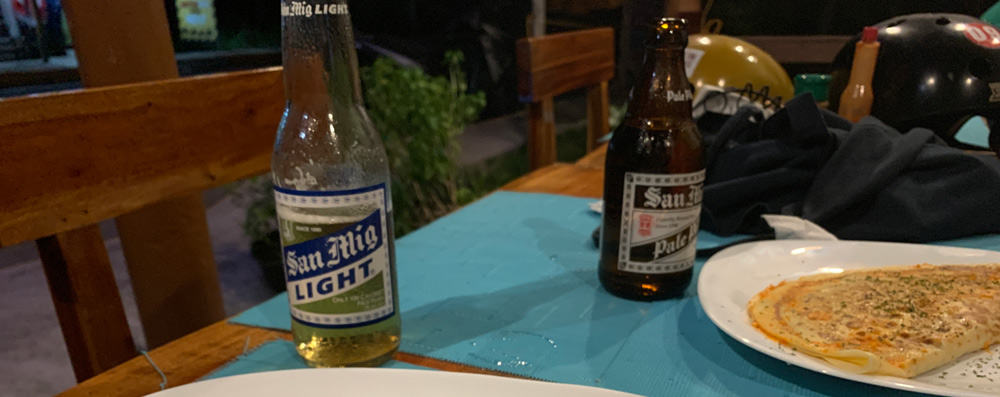
San Miguel beer is Filipino
If you’re reading us from Spain, you’ve probably had a San Miguel beer in your hands at some point in your life. Well, guess what—it originated in the Philippines!
In 1890, the San Miguel brewery opened in Manila, following the method of some Augustinian monks from a neighborhood in the capital with the same name, San Miguel. In the 1940s the company decided to expand to Spain, and in 1957, with its first factory already in Lleida, the “Manila Agreement” was signed, under which both brands became independent companies. The Spanish brand still keeps the original’s design and typography but, if you ask us, the Filipino one is way ahead. Tagay! Cheers!
The national bird of the Philippines
Very hard to see—because it’s endangered and there are only about 400 pairs left in the wild—the national bird of the Philippines is the Philippine eagle. They live up to 60 years, weigh around 8 kilos, and are also known as the “monkey‑eating eagle,” as they’re said to be capable of catching monkeys and dropping them from the air before eating them.
With a lot (a lot) of luck, you might get to see them by doing the right trekking on islands such as Mindanao, Luzon, Samar, or Leyte. For us, it’s still one of our pending dreams in the Philippines. We’re eager to see this beautiful bird up close—and its peculiar “hairdo”!
Fascinating animals for every taste
But the national eagle isn’t the only animal that deserves a place among the fun facts about the Philippines—there are many more! The tarsier, which you can see in Bohol, is the smallest primate in the world and holds the Guinness record for the mammal with the largest eyes in relation to its body. Another animal you might not expect to find in a country famous for its beaches is the Visayan spotted deer. Hard to see unless you’re trekking—or extremely lucky—they can be found in the densest areas of Negros Island.
The Philippines lies within the so‑called Coral Triangle, which is the place with the greatest marine biodiversity on the planet. This means you won’t be able to tick off fast enough the endless list of animals that await you. The whale shark and the sleek thresher shark are two of our favorites, but you’ll also meet hundreds of turtles, nudibranchs, starfish, seahorses, and fish of every color and shape.

Cemeteries full of life
Manila is one of the cities (it hovers between top 1 and top 2) with the highest population density in the world, which translates into a lack of space and housing for thousands of people. A quarter of Manila’s inhabitants—more than 10 million people—live in what are known as “informal settlements”: shacks in parks, constructions on vacant lots, little houses over the sea… But some of them have moved, literally, into cemeteries.
The Manila North Cemetery is a great example of this and, if you visit, the gloomy image you might have in your head will surely vanish quickly. With an area of more than half a million square meters—what would be a small city—hundreds of families live among mausoleums, tombs, and crypts. Children run and play through its streets and squares, adults sit outside on chairs to catch the breeze at night, and there are even tiny sari‑sari stores (little shops where you’ll find practically anything) where you can do your basic shopping. Many of these residents have been there for more than a generation and take care of the mausoleum they live in in exchange for being able to stay there.
If you hear a little bell ringing, don’t be scared—it’s the ice‑cream cart coming your way.
Religion in the Philippines
We’re sorry to say that if you came to the Philippines looking for “exotic” temples like those in Thailand or Bali, you’ve picked the wrong country. The Philippines, together with East Timor, is one of the few countries where the official religion is Catholicism—again, a legacy of Spanish colonization.
A huge part of its population (more than 95%) are Christian believers and they take all traditions and festivities very seriously. In fact, the Philippines is (along with the Vatican) the only country in the world where divorce is prohibited.
Bonus: A curiosity within the religious curiosity. In many towns and cities you’ll see churches whose main façade reads “Iglesia Ni Cristo.” This doesn’t mean (though we’ve all made the joke) that “ni Cristo” goes there; it’s Tagalog and translates as “Church of Christ.” It’s a sect that differs from Catholicism and rejects the Vatican, the saints, Christmas, and even the divinity of Jesus Christ.
That said, if your trip takes you through the southern part of Mindanao you’ll see mosques, veils on women, and kufis on men, since there the predominant religion is Islam.

No toilet paper, sir/ma’am
If you’ve already traveled through other Asian countries, this fun fact about the Philippines may not surprise you too much, but our conscience wouldn’t be clear if we didn’t warn you. In many bathrooms across the country there’s no toilet paper—just as you read.
So what do I do after, well, doing my business? You’ll have to resort to the old, wet methods: wash with water. You’ll find two ways to do this. If nature calls in a remote bathroom—say, during a road trip—most likely you’ll have to fill a small bucket of water called a tabo and pour it over yourself until everything’s clean. In other, slightly more “modern” places you’ll find a small hose right by the toilet bowl, which makes everything easier and faster.
Don’t panic—most mid‑range hotels do have toilet paper. So if, after visiting one, you plan to stay somewhere more basic or take a road trip, it’s not a bad idea to bring a bit of paper so you’re ready to, ahem, lighten the load.
Filipino gestures, another fun fact about the Philippines
Just as Indians have that peculiar side‑to‑side head movement to say “yes,” “I understand,” or “good,” Filipinos have their own. Two that you’ll probably see most often are the eyebrow raise and a kind of kiss.
The kiss: Don’t panic—they’re not trying to flirt with you if you see them purse their lips the way you would to kiss a baby. This gesture is basically their version of stretching out an arm to point at something, but with far less energy. Someone might do it casually when you ask for directions in the street to show you the way, or even to ask you for something that’s near you and they want you to pass. Note to self: kissy face = pointing.
Eyebrow raise: Another thing that might happen is you’re talking with a Filipino and, after you ask them something, they stay quiet and raise their eyebrows while opening their eyes a bit wider. If you repeat the question, it’s likely they’ll keep making the same gesture, because with that they’re already telling you yes. Plus, the same gesture can be used to say “good,” “ok,” or “well.” All in one!
Bag checks at shopping malls
When you want to enter a shopping mall or another very crowded place, you’ll most likely be surprised by two things. First, that you’re required to show what you’re carrying in your backpack or bag. Second, that to avoid touching your things they do everything with a small wooden stick. It’s really more of a symbolic search, since in many cases they barely look at or touch anything, but that doesn’t mean you can skip it.
These checks began after an attack attributed to the Abu Sayyaf terrorist group, in which they detonated a bomb in a very crowded place.
What do you think of these fun facts about the Philippines? Did you know them all? If you can think of others, leave them in the comments and we’ll add them in the second installment.