Spoiler: March is one of the best months to travel to the Philippines. We’re starting off strong because yes, it’s a time we really like to visit the country for several reasons. Traveling to the Philippines in March usually means that the weather is quite calm across most of the archipelago (we’ll delve into this later), prices aren’t as sky‑high as in the “summer,” and, therefore, you won’t see huge crowds either.
Even so, it’s important to check the dates of Holy Week, since, being a predominantly Christian nation, many Filipinos have holidays then. As a result, prices shoot up and the most touristy spots get absolutely packed.
Don’t worry— in this article we’re going to tell you everything about what it’s like to travel to the Philippines in March from every angle.
Will it be possible to travel to the Philippines in March 2026?
Yes! You can travel to the Philippines in March 2026 and whenever you like, as the country is fully open. You have all the details in Requirements for traveling to the Philippines.
Just bear in mind that in 2026 Holy Week falls at the end of March, so that last weekend will be busier in tourism terms.
On the other hand, our advice is to come to the Philippines as soon as you can. Not only because it’s a trending destination that isn’t overcrowded, but also because the peso’s exchange rate is at historic lows, making it very affordable to travel here.
What we do recommend, as always, is having a travel insurance policy for the Philippines. By clicking this link you’ll get a 5% discount for the one we’ve been using for over 10 years and that has always worked great for us.

What’s the weather in the Philippines like in March?
We talk in detail about the climate in When to travel to the Philippines, but, to whet your appetite, we can tell you that the archipelago has two seasons:
- The rainy season or wet season: which runs roughly from June to November.
- The dry season or dry season: which goes more or less from November to May. This is subdivided into 2: the cooler one (October to March) and the hotter one or summer (April and May).
We could leave it at that, but the reality is these periods aren’t uniform across all the islands and, in addition, you can distinguish between 4 and 6 climate zones in which these seasons occur at different times of the year and are more or less pronounced. For example, in the south (Mindanao, including famous Siargao) and the southeastern coast of Leyte and Samar, the rainy season takes place at a different time than in the rest of the country. That is, the wet season runs from November to May. To make it clearer, take a look at this diagram:

On the other hand, don’t forget that the Philippines has a tropical climate, which means uncertainty reigns at any time of year. Downpours, which also help keep the islands so lush, are very common at any time. It’s true they’ll be even more frequent and longer in the rainy season, but they can’t be ruled out at any time— and that’s also part of the adventure and the charm.
Still, to make things a bit easier, if you’re thinking of traveling to the Philippines in March, it’s normal to experience little rain across most of Luzon, the Central Visayas (Bohol, Siquijor, Malapascua…) and Palawan. In addition, it’s not typhoon or tropical‑depression season and the wind is usually quite calm. March is also the month when temperatures start to rise, ushering in the Philippine summer.
It will rain a bit more on islands like Siargao, Dinagat and the rest of Mindanao, since they’re in the south. Even so, the rainiest months (December and January) will already have passed, so the weather should start improving.
Is it cold in the Philippines in March?
Spring starts arriving in mainland Europe, but what temperatures will you find in March in the Philippines? As we hinted above, the real heat begins to arrive.
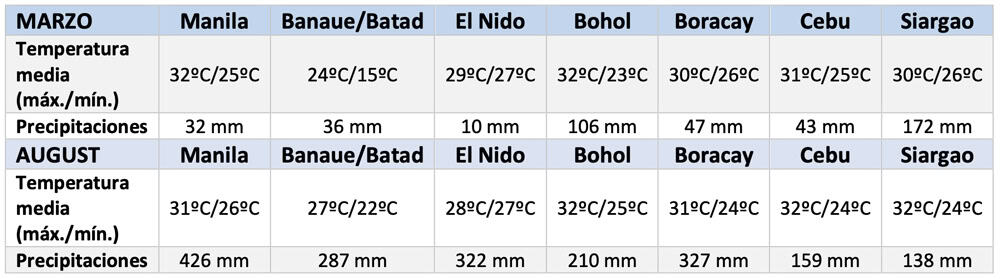
As a rule, temperatures in March in the Philippines tend to rise a couple of degrees compared to the previous month. Thus, highs hover around 32°C, and can exceed 34°C, while lows rarely drop below 22°C at dawn. Due to the humidity, the “feels like” temperature is higher. As a consequence, it would be very unusual for you to feel cold outdoors in the Philippines. Do bring a layer for air‑conditioning, though— many places are true freezers.
Of course, temperatures vary depending on where we’re talking about. In mountainous areas like Baguio, Banaue and Batad, they drop a bit. In the rice terraces of Ifugao this month, you’ll find highs around 25°C and lows around 15°C. It’s still the dry season, so it’s one of the best times to enjoy the Philippine mountains.
If you’re coming for the sea, you’ll be glad to know that the sea temperature in the Philippines in March ranges between 26°C and 29°C. March is one of the best months to go diving in the Philippines, as the sea tends to be calm and visibility is excellent.
We think you already have a pretty clear idea that it’s hot in the Philippines in March, but here’s a comparison of temperatures in the main tourist destinations in March and July:
Does it rain in the Philippines in March?
As we mentioned— and as you can see in the map and table above— March isn’t a particularly rainy month anywhere in the Philippines. It’s the dry season in the northern and central parts of the archipelago and it’s also the month when rainfall begins to ease in the southeast, so it’s unlikely you’ll face many rainy days in the Philippines in March.
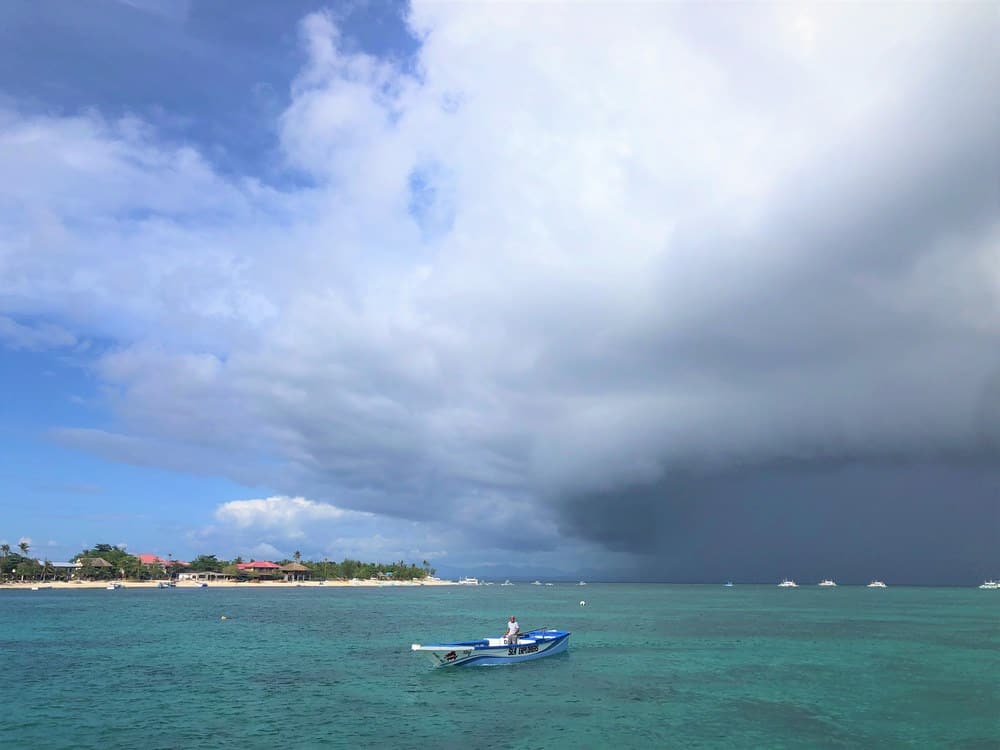
Of course, this isn’t a hard rule and it wouldn’t be unusual to have a day of downpours or cloudier skies, but the chances of rain ruining your trip are very low. Generally, showers are brief.
Typhoons in the Philippines in March— do they happen?
Related to the above, March isn’t a month when typhoons or tropical depressions are common. The month with the highest risk is usually August and the one with the lowest is May, so it’s not something you should fear.
Even so, it’s always good to follow the PAGASA Facebook page, the official meteorological agency of the Philippines. If there’s any advisory, we always share it on our WhatsApp channel and forecasts are usually given about a week in advance, so if something very severe were to happen, you’d have enough wiggle room. Even so, keep in mind that for this and many other reasons, it’s essential to travel with good travel insurance for the Philippines.
Rain in Malapascua
What’s it like to travel to the Philippines in March?
If Holy Week doesn’t fall in March, traveling to the Philippines in March still means low season, since Filipinos don’t have holidays then and it isn’t a particularly busy month. This translates into good prices for accommodation and transport, as well as quiet beaches.
If it does fall in March, as we detail in Traveling to the Philippines at Easter, you should prepare well in advance and start booking hotels and flights so you don’t end up paying double or triple. It’s advisable to avoid the most touristy areas (Boracay, Bohol, El Nido, Siargao…) that week and opt for quieter places instead. You’ll find good ideas in Lesser‑known islands in the Philippines— and there’s no shortage of options! The archipelago has more than 7,700 islands.
Looking at the cultural side, March is a good month for festivals in the Philippines. If you want something traditional and Holy Week is near, you have the Moriones Festival in Marinduque, the hair‑raising crucifixions in Pampanga, and the intriguing Healing Festival in Siquijor. The latter is particularly interesting, as you can see the hilots or traditional healers in action.
On the other hand, March is also season to see whale sharks in the Philippines. Specifically, it’s sighting season in Donsol and Pintuyan, places where they are treated with the respect they deserve. Without a doubt, another fabulous reason to travel to the Philippines in March.
Plus, since the sea is usually very calm, it’s a great time for diving and snorkeling. It’s also ideal for multi‑day boat journeys such as the Coron to El Nido expeditions or the Balabac island hopping.
Our experience in March in the Philippines
You already know we’ve been lucky enough to live in the Philippines and that we also spend long periods here every year, so we’ve experienced quite a few Marches. March is, along with January and February, one of our favorite times. Although temperatures are a bit higher and prices start to rise, for us it’s an ideal month— as long as you avoid Easter in the most touristy places. We know it’s holiday time, but personally we like enjoying places more calmly.
If you can’t travel to the Philippines at another time, we wouldn’t hesitate— we’d go in March, keeping that in mind and booking everything in advance. Since it’s a calmer‑weather period, it’s unlikely you’ll have to deal with many changes.
We can’t remember many moments of heavy rain in March in the Philippines and we’ve never experienced a typhoon or tropical storm. We also haven’t been much affected by winds, so no canceled flights, boats or island‑hopping tours. As a fun fact, all the photos in this article are from trips we’ve taken in March.

White Beach (Port Barton)
Tips for traveling to the Philippines in March
By now you already have a good idea of what the Philippines is like in March, but to wrap up, we want to give you a few tips of our own so you can make the most of your trip:
-
- The weather in the Philippines in March is usually quite good and it’s unlikely that rain or wind will ruin things, but whenever possible it’s better to travel for at least 15 days (20 is even better) and avoid a super‑packed itinerary, leaving some wiggle room. You can see some suggestions on our Routes through the Philippines page.
-
- Related to the above and given we’re still in times of change, it’s best to book accommodation with free cancellation or with flexible date changes. Don’t worry, Booking.com offers this on almost all reservations and they also have very good customer service.
- If your trip falls during Holy Week, it’s extremely important to book accommodation, flights and boats at least a month in advance. As it’s a national holiday, Filipinos travel a lot, too. Ferry routes that usually sell out: boat from Coron to El Nido and vice versa, the boat from Bohol to Siquijor and vice versa, and the one from Bohol to Camiguin.
- The same applies to island‑hopping tours, which at this time of year are even better done privately to avoid crowds. You can read more about this in Island hopping in the Philippines.
- To get a sense of the weather, don’t rely on the typical forecast sites because they’ll likely show rain all the time. The most recommended is to check the PAGASA satellite. We know the site isn’t very intuitive, but if you see very large “red or yellow patches,” something big is approaching. An easier and fairly accurate option 3–4 days out is the Windy app.
-
- And finally— but no less importantly— get the best travel insurance for the Philippines. Don’t risk it; it’s essential not only for typical travel hiccups (flight delays, damaged luggage…) but also for healthcare these days. Get a 5% discount on the one we use.

Frequently asked questions about traveling to the Philippines in March
We’re wrapping up, but first we want to answer the most common questions travelers have about what the Philippines is like in March:
What’s the weather like in the Philippines in March?
Generally quite calm. The dry season reigns across most of the country and the Philippine “summer” is beginning. You may get a shower— it’s still a tropical climate— but overall it’s a month with little rain.
Should I travel to the Philippines in March?
Absolutely! It’s a great month to discover the country. Do keep in mind that if Holy Week falls in March, it’s best to book accommodation, flights and ferry tickets as early as possible, since Filipinos themselves also have holidays.
What’s the best time to go to the Philippines?
It’s generally considered to be from November/December to May. Even so, you can travel at any time of year.
What are the best Philippine islands in March?
You can travel throughout the country, since the dry season prevails. That is, you’ll be able to explore Palawan, Busuanga, Luzon, Bohol, Malapascua, Siquijor, Romblon, Boracay and many more at ease. As for the south (Mindanao, Siargao…), it’s already starting to rain less, so we’d definitely head there, too.
If you’re considering other months, these articles will interest you:
Traveling to the Philippines in February
Best time to travel to the Philippines
Traveling to the Philippines at Easter
We hope we’ve helped you plan your trip to the Philippines in March. If you have any questions or want to suggest anything, we’ll read you in the comments!