Is February a good time to travel to the Philippines? Does it rain a lot? Is it cold? It’s perfectly normal to have these questions, especially if you live somewhere with cold winters and can’t wait to escape them. Don’t worry, you’ve come to the right place. With years of exploring these islands under our belts, we’ll walk you through the weather in the Philippines in February and cover other practical considerations if you’re planning a trip this month.
Still, we’ll let you in on something right away: as we explain in Traveling to the Philippines in January, February is one of our favorite months to enjoy the archipelago. The weather tends to be pretty good across much of the country, and since it’s low season, prices are usually more reasonable and there are far fewer tourists.
If all that sounds good, keep reading to find out what traveling to the Philippines in February is like. If you still have questions by the end, leave them in the comments and we’ll be happy to answer.
Can you travel to the Philippines in February 2027?
Of course you can. You can travel to the Philippines in February 2027 (and any other month you like). As we explain in Philippines Travel Requirements, you can visit as normal.
What’s more, if the currency continues on its current trajectory, right now is a perfect time to visit the country, since the peso is at historic lows and everything will cost you much less. And on a personal note, we recommend coming as soon as you can to enjoy a country that’s becoming popular but still hasn’t experienced mass tourism.
Lastly, we recommend getting travel insurance for the Philippines. Click this link to get a 5% discount on your policy.
What is the weather like in the Philippines in February?
You’ll find a detailed overview of the Philippine climate in When to Travel to the Philippines, but to start with, you should know that this part of Asia has two seasons:
- The wet season, or rainy season, runs roughly from June to November.
- The dry period, or dry season: from November to May. This is divided into 2 parts: the cooler months (October to February) and the hotter months, or summer (March to May).
To complicate things further, these seasons don’t follow the same pattern throughout the archipelago. You can distinguish 4 or 6 climate zones where these seasons occur at different times of year and are more or less pronounced. The clearest example is that in the south (Mindanao, including Siargao) and on the southeastern coast (Leyte and Samar), the rainy season follows the opposite pattern, running from November to May. The driest period falls between June and October. This chart and map will help you understand it better:

On top of all this, there’s uncertainty. That’s why we always use the word “usually.” The Philippines has a tropical climate, so you can get caught in a downpour even in summer (which is also what keeps the country so lush). So the best thing to do is not overthink it and head off on your adventure.
With all that said, if you decide to travel to the Philippines in February, you’re very likely to find little rain in Luzon, the Central Visayas (islands such as Bohol, Siquijor, Malapascua…) and Palawan. Typhoons and strong low-pressure systems are unusual. Still, the wind, specifically the “Amihan,” or northeast monsoon, may blow harder along some of the country’s coastlines. Overall, there’s nothing that should worry you too much as you plan your dream adventure.
The weather tends to be rainier on southern and southeastern islands such as Siargao and Dinagat. It’s true that the rain will start easing compared with December and January, which are the wettest months in this area, but February is still considered part of the rainy season here. So if you’re concerned about the weather, it’s better to avoid these islands.
Is it cold in the Philippines in February?
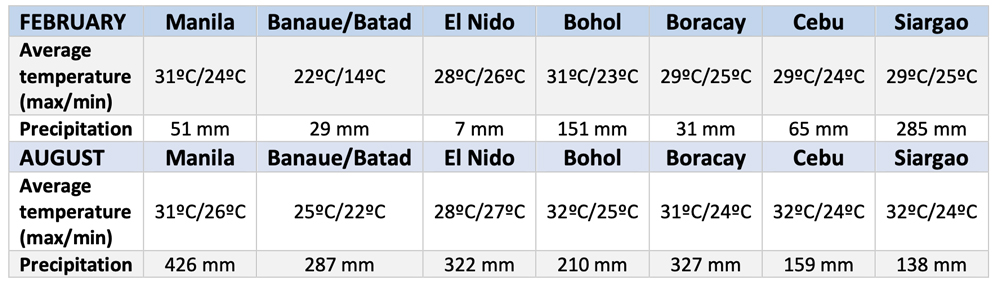
The Philippines offers the perfect escape from the cold. Highs reach 30°C almost everywhere in the country, and temperatures rarely drop below 22°C at night. Add in the humidity, which makes it feel a little warmer, and the only time you’ll feel cold is on air-conditioned public transportation.
At this time of year, the sea temperature in the Philippines in February is also around 26°-29°C, perfect for snorkeling or diving.
If you prefer the other extreme, you’ll need a coat at night in the mountainous areas of inland Luzon. At the beautiful rice terraces of Banaue and Batad, lows reach 16°C, though this is also the driest month, so you’ll be able to enjoy them to the fullest.
To give you an idea, these tables compare the weather in the Philippines’ main tourist destinations in February and August:
Does it rain in the Philippines in February?
From what we’ve covered so far, you probably have a good idea of what to expect from rainfall in the Philippines in February. In the north (Luzon) and the center (Palawan and the Visayas), things tend to be calm, but in the south, this is the rainiest time of year. For example, on the famous island of Siargao, December, January, and February are the months with the highest chance of rain, so you’re more likely to encounter overcast skies. So if you’re a little concerned about the weather, you should avoid the south of the country.
Keep in mind that predicting the weather in the archipelago (and Southeast Asia in general) is no exact science. You might get the occasional downpour somewhere that’s supposed to be in its dry season, and the opposite can happen somewhere in its rainy season. Plus, the weather can change a lot over the course of a single day. That’s why our advice is not to obsess over it.

Entalula Island (El Nido)
Are there typhoons in the Philippines in February?
Typhoons are a separate issue. Because of its location, the Philippines is one of the countries most affected by these weather events. However, February is one of the least “dangerous” months in this respect. They’re very unusual this month, though a low-pressure area or tropical depression can still develop and bring several days of rain and wind.
To give you an idea, August is the month with the highest chance of typhoons, and May has the lowest. Typhoon season is generally considered to run from roughly June to October.
How can you find out whether a typhoon or storm is on its way? We follow the PAGASA Facebook page, run by the Philippines’ official weather agency. They provide updates on typhoon paths about a week in advance, giving you time to adjust your trip. Keep in mind that you don’t need to worry. Severe typhoons aren’t the most common kind in the Philippines, and as long as you’re staying in solidly built accommodation, you should be fine. Still, it’s essential to travel with good travel insurance for the Philippines and avoid staying in areas where the center of the storm could pass whenever possible.
Get a 5% discount on your travel insurance for the Philippines here
What is traveling to the Philippines in February like?
You’ve seen that the weather is good for traveling to the Philippines in February, but what else should you keep in mind? First of all, it’s low season. Filipinos don’t usually travel this month, so you’ll find better prices on accommodation and flights. On top of that, tourist attractions aren’t crowded.
Still, keep in mind that, depending on the year, your trip could coincide with Chinese New Year. This usually means that destinations popular with the Chinese community (Boracay, Bohol, or El Nido) get absolutely packed. That’s why we recommend avoiding them on the main celebration days and heading to lesser-known places such as Malapascua, Coron, Bantayan or, for even more solitude, Romblon, Banaue/Batad, or Leyte, among others.
If you’re interested in the cultural side of things, the Panagbenga Festival takes place in Baguio. This is the Philippines’ “city of spring,” thanks to its cool weather year-round. Panagbenga (meaning “blooming season”) is the city’s flower festival and runs throughout the month, though the highlight is the parades, with people wearing flower-inspired costumes.
Other festivals in the Philippines in February: Kailangan Festival (General Santos), Pamulinawen (Laoag), Tinagba (Camarines Sur), Tawo-Tawo Festival (Bayawan City), Babaylan Festival (Bago City), Patunob sa Birhen sa Lourdes Festival (Binuangan), and Festival of Lights (Tagub City).
And if you love the sea, you should know that visiting the Philippines in February gives you plenty of opportunities to see the whale shark in the wild. As we explain in swimming with whale sharks in the Philippines, this is an ideal time to spot them in Donsol and Pintuyan/Padre Burgos. It’s also a good time to go diving in the Philippines, since the water temperature is around 28°C and the sea tends to be calm (though this depends on the wind).

Cambugahay Falls (Siquijor)
Our experience in the Philippines in February
Everything above is the “theory,” but you probably want to hear from someone who’s actually traveled around the country at this time of year, right? Well, we’ve been lucky enough to live in the Philippines and spend long stretches here, including several Februarys. So we can tell you that this is, along with January, one of our favorite months to enjoy the archipelago. Why? The weather tends to be pretty good, there aren’t many people around, and it’s more affordable.
We’ll be honest: we’ve had rainy days and the odd windy day that may have put a damper on an island-hopping outing, but nothing that made us feel our trip was ruined. We simply made other plans and carried on. That’s why we have no hesitation in recommending a trip to the Philippines in February.
All the photos in this article are from our trips to the Philippines in February.
Tips for traveling to the Philippines in February
Now that you have an idea of what visiting the Philippines in February is like, here are a few tips to help you get it right:
- To escape the rain, it’s best to avoid Mindanao and Siargao.
- The weather in the Philippines in February is usually pretty good and stable, but it’s always better to plan a longer trip with some flexibility.
- Although it’s not as “dangerous” as August or September, we recommend booking hotels with free cancellation. This is very common now on Booking, which also offers good customer support in these situations.
- For checking the weather, the most reliable source is PAGASA’s satellite imagery. Although it isn’t very intuitive, you can use it to see whether any major tropical depressions are approaching. Seriously, if you check other weather websites, you’ll think it’s going to rain all day, and that’s not true. What they’re showing is that you might get a brief downpour, but these kinds of forecasts aren’t useful here. Perhaps the best option (though only for forecasts a few days ahead) is the app from Windy.
- Don’t forget to take out good travel insurance. Seriously, it’s essential, both for travel mishaps (flight delays, damaged luggage…) and for health-related issues these days. Get a 5% discount on the policy we use.

Sabang (Palawan)
Frequently asked questions about traveling to the Philippines in February
To wrap things up, here are answers to common questions from travelers considering a visit to the Philippines in February:
What is the weather like in the Philippines in February?
The weather is usually pretty stable, especially in the central and northern parts of the country. In other words, it’s the dry season throughout the Visayas (Bohol, Siquijor, Malapascua…), Palawan, and Luzon. In the south (islands such as Mindanao, Siargao, and Dinagat), it’s the rainy season.
Is it cold in the Philippines in February?
No, it’s always hot in the Philippines, but February isn’t one of the hottest months, which makes traveling more pleasant. Temperatures are around 29°C. Only in the mountains, at night, can they drop to 14-15°C.
When is the best time to travel to the Philippines?
The best time is generally considered to be from November/December to May.
When is typhoon season in the Philippines?
It’s generally said to run from June to October, with August and September seeing the most typhoons.
What are the best islands to visit in the Philippines in February?
Any of the islands in the Visayas (Bohol, Siquijor, Malapascua, Bantayan, Cebu…), Palawan (El Nido, Coron, Port Barton…), and Luzon (Banaue, Sagada, Ilocos…).
If you’re considering other months, you might find these helpful:
Traveling to the Philippines in January
Best Time to Travel to the Philippines
The Philippines During Holy Week
Are you traveling to the Philippines in February? If you still have any questions, we’d love to read them in the comments!