For now, not many travelers are encouraged to visit this part of Palawan, but we are completely sure it will be a destination that “really takes off” in a few years, so we decided to write this list of things to do in San Vicente (Philippines).
With a small airport inaugurated in 2017 that receives (for now, few) flights from Manila, a very ambitious tourism development plan along the spectacular Long Beach, and its relative proximity to the star destination of the area (El Nido), San Vicente has everything it takes to become one of the big places to see in Palawan. Even so, it still hasn’t taken off and remains a super quiet place (we’d even say a bit too quiet for many), with little tourist infrastructure and, therefore, ideal for beach lovers and those who want to step off the typical routes.
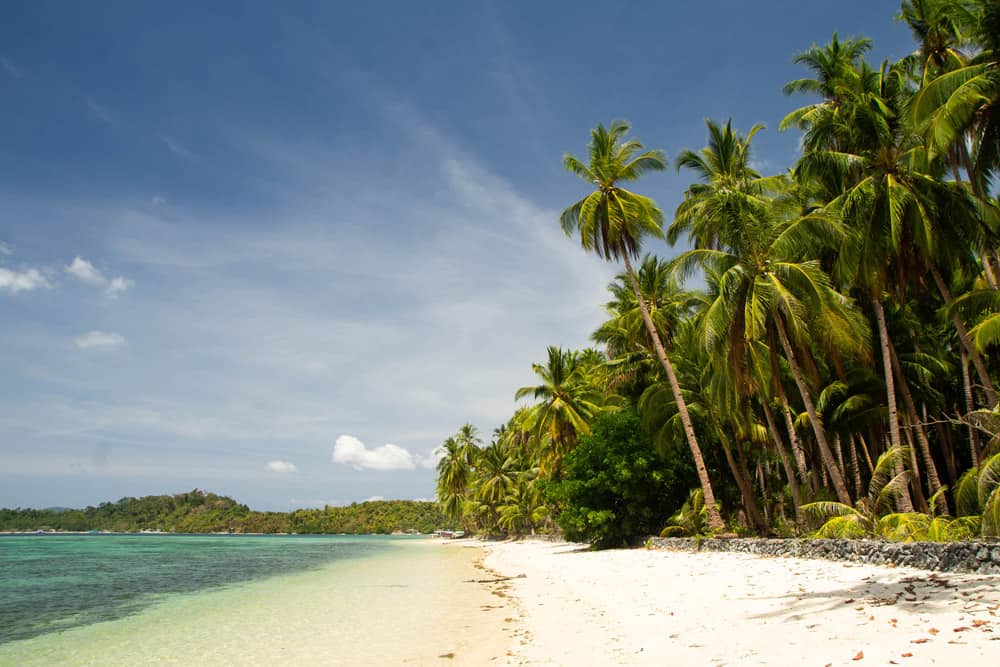
Long Beach, with its 8 uninterrupted kilometers of golden sand, is one of the most beautiful beaches in the Philippines and, for now, one of the wildest—its main attraction. Still, there are other little corners to visit in San Vicente and here we’re going to tell you about the ones we liked the most, as well as other practical info to help you plan your stop in this part of Palawan. You’ll also discover what makes it so special and see whether you feel like adding it to your itinerary in the country.
Where is San Vicente (Palawan)
San Vicente is located on the island of Palawan, possibly the best known in the Philippines. The capital is Puerto Princesa, but the vast majority of travelers are keen to discover El Nido primarily and, to a lesser extent, Port Barton. San Vicente (Población) lies a few kilometers north of Port Barton, on Palawan’s west coast, 186 kilometers from Puerto Princesa and about 130 from El Nido.
To make it a bit clearer, San Vicente is a municipality (municipality) made up of several barangays (what could be a neighborhood or town), with Port Barton being one of them. However, given the latter’s popularity and the fact that access between Port Barton and the rest of the barangays in northern San Vicente (Poblacion, Alimanguan, and New Canipo, which we’ll focus on) is still difficult, we can talk about two separate destinations: Port Barton and San Vicente.
In reality, although there is a small village called San Vicente (Población), as we’ll tell you in the accommodation section, from our perspective it’s much more appealing to sleep in one of the hotels located on Long Beach or in the little village of Alimanguan.
Although we’ll go into detail later on, the most convenient way to reach San Vicente is by plane directly from Manila, although you can also find vans from Puerto Princesa and, less frequently, from El Nido.
What to expect from San Vicente and why go
As of today, we believe San Vicente is an ideal destination for those who want absolute calm, beautiful empty beaches, to stay at a beachfront resort and/or feel a bit like a discoverer. The crowds are still light-years away and here we once again had the feeling of being in a place with lots of potential that still flies under the radar.
You know we don’t like to sugarcoat anything and that, in the end, it’s always our view, so we’ll also tell you that perhaps San Vicente isn’t for everyone. You won’t find a great variety of restaurants or hotels (in fact, the value for money leaves a little to be desired), renting motorbikes is a bit more expensive, most roads are muddy, public transport (except for some habal-habal) is scarce and, depending on the time, you may find sandflies or nik-nik on the beaches.
However, if you like exploring, doing motorbike routes, have plenty of time to visit Palawan Island, and don’t mind sacrificing some comforts, we’re sure San Vicente is for you.

San Vicente or Port Barton? Where to go?
The million-dollar question. It’s even hard to tell where one ends and the other begins, especially when you’re looking for accommodation. The first thing you need to know is that, although the map might suggest otherwise, the truth is that San Vicente and Port Barton are not well connected. The road between the two destinations is still quite bad and we only advise going by motorbike if you’re very skilled and invest in renting a cross-type bike, as it’s not uncommon to encounter some mud.
On the other hand, at the moment there is no public transport between San Vicente and Port Barton, meaning you have to go to the main road to connect them, or pay for a private car/van. Because of all this, unless you’re on a pretty relaxed Palawan itinerary, you’ll have to choose.
As we mentioned above, San Vicente is a place with very little tourist development, whereas Port Barton stopped being that unknown little village we fell in love with the first time quite a few years ago. This doesn’t mean it has lost that relaxed village vibe—especially compared with El Nido—but you will find a good offer of restaurants, bars, hostels, guesthouses, and even the odd mid-sized resort.
Port Barton’s tourism development, like everything, has its pros and cons in which, of course, personal tastes also play a part. On the one hand, with more competition, accommodation offers much better value for money and the same happens with island hopping, since you can also join other travelers and pay much less. Exploring the area is also much easier because you’ll have motorbikes for rent, tricycles, kayaks, and even bangkas at your disposal. If you want a bit of a party or somewhere to have a beer at night, Port Barton will also be for you. On the other hand, right now getting to Port Barton and connecting it with El Nido is still much easier, with more frequent public transport.
All that said, what to choose? Visit San Vicente or Port Barton? In our opinion, if it’s your first trip to the Philippines and you don’t have many days, we’d choose the latter. If you have time to take it easy or you simply like places with that unexplored touch, San Vicente is for you. In any case, the best thing is to keep reading this guide to places to see in San Vicente and the one on things to do in Port Barton and see which one calls to you more. Every trip and every traveler are different and the most important thing is to get informed to see which destinations might suit you best.

Things to do in San Vicente
Without going on much longer, here we tell you the best things to see and do in San Vicente, Palawan.
1. Bato ni Ningning, the must-see in San Vicente (Palawan)
If you’ve thought about visiting San Vicente, it’s quite likely it’s because you came across an image of the Bato ni Ningning viewpoint, which has been causing a stir on Instagram for several years now. Located on a hill, it offers glorious views of the San Vicente coastline, starting with Erawan Beach, then Alimanguan Beach and, finally, the endless Long Beach.
Entrance to the viewpoint is 25 pesos, paid at a little hut where you can also buy cold drinks and snacks. The path will take you to the iconic rounded rock from which you get top photos, but don’t stop following the trail to enjoy the panorama of palm trees in the foreground and San Vicente’s beaches in the background. If you travel with a drone, you’ll get marvelous shots.
How to get to Bato ni Ningning
You could walk there without any problem from Alimanguan, but bear in mind that the route will take you roughly an hour. In our case, we asked about habal-habal (motorbike with driver) prices at the edge of the village and, seeing them as very excessive, we started walking until one stopped and offered a figure that seemed a bit fairer (200 pesos per way).
When we were there, the road was far from good, with plenty of muddy stretches, so we did well not to risk it, but, according to San Vicente residents, it has improved considerably. Therefore, renting a motorbike can be a good idea. Both Lazuli Resort and Victoria Beach House rent them starting at 600 pesos per day.
In any case, habal-habal drivers know very well what they’re doing, but we’ll admit our hearts were in our mouths on more than one occasion. So much so that on the final stretch, where the climb to Bato ni Ningning begins, we preferred to do it on foot because the potholes were quite significant.
Another idea is to sign up for a tour. Our accommodation offered the round trip for 800 pesos per person or 1,000 to include other stops. It seems a bit excessive to us, since the route takes barely 30 minutes, but that’s what usually happens when there’s no competition.
By the way, a little further on there’s another viewpoint that’s less well known but equally beautiful. It’s called SanVic Viewpoint, in case you want to check it out. From Bato ni Ningning it’s about a 10‑minute walk.

2. San Vicente Long Beach
Another powerful reason to visit San Vicente in Palawan is to walk along the endless Long Beach. In almost any advertising sign or guide, it reads that it’s the “longest white‑sand beach in the Philippines”; in our opinion, the sand is more golden than white. That doesn’t mean it isn’t wonderful—far from it—as it’s a kilometer‑long virgin beach where you’ll rarely bump into anyone.
We don’t know how long Long Beach will remain in this state because the planned tourism development is almost scary. We were told there that almost all the land already belongs to large Filipino corporations and several mega‑resorts are planned (some already exist), but, as of today, we still wonder how a place like this has managed to stay under the radar of the tourist boom for so many years.
As with White Beach in Boracay, you can make out different stations along Long Beach. And although in some places you can read that it has 14.7 kilometers, the truth is that 8 are uninterrupted. Our recommendation is to enjoy it to the fullest: walk as much as you can, be amazed by the endless palm groves, and take in a scene or two of life in a little slice of paradise.
If at some point you get hungry, you can head out to the main road to see if you come across somewhere. Even so, bear in mind there isn’t much. We ended up eating at Club Agutaya, which we thought was very well‑priced and, moreover, they served us in the beach area. We could wait for our lunch peacefully lying on their loungers.
One thing to keep in mind is that, while we were lucky, it’s normal to find the occasional sandfly or nik‑nik, the annoying biting sand midges. Therefore, we suggest walking near the shoreline and using coconut oil, which usually repels them.

3. Other beaches to visit in San Vicente
It’s true that Long Beach is the best known, but it’s by no means the only San Vicente beach that’s worth it. In our case, the one we enjoyed the most was Alimanguan, where our accommodation was. Like all the others, it’s wonderful—completely virgin and full of beautiful palm trees. Here you’ll find 3–4 restaurants, but completely spaced apart from each other, giving you the feeling of still being in a fairly remote place.

Between Alimanguan and Bato ni Ningning is Erawan Beach, which, like all the others, is totally wild and virgin. When we visited, it had much bigger waves than Alimanguan and, we assume because of that, a steep slope at the shore, so swimming was quite dangerous. Even so, we recommend stopping and, if it coincides with lunchtime, eating at the little hotel’s restaurant at the northern tip.
Situated between Long Beach and Alimanguan is Tagpis Beach, which in our opinion has little to envy of the former. It’s another kilometer‑long beach, with golden sand and endless palm groves. We walked almost its entire length and found it gorgeous. We reached it by walking from Alimanguan at low tide.

If you’re up for continuing to explore, north of Bato ni Ningning are the beaches of New Canipo and Binga, perhaps the prettiest of all. The road still isn’t in perfect condition, but if you have motorbike experience, getting to them won’t take more than 20 minutes. From Población to Port Barton you also have plenty more to check out.
It hardly needs saying, but beaches are nature. In other words, they don’t always look the same and that’s especially true in the Philippines, as the wind blows in one direction or another depending on the time of year. The rougher the sea, the more common it is to find them dirtier or with less‑clear water. Therefore, you should know that San Vicente’s beaches have more waves from December to March, but in April and May they’re calmer.
By the way, something else that makes San Vicente very special is that its beaches are a turtle nesting site, specifically for the olive ridley turtle, between November and February. With luck, you might have the chance to see them laying eggs or witness the hatching and the hatchlings’ dash to the sea. The latter usually happens between March and April. This association is in charge of their protection in Alimanguan and you can see the activities they carry out on their Facebook page. You can try asking them.
4. Island hopping in San Vicente
While it isn’t the most famous destination for island hopping in the Philippines, from San Vicente you can also do some boat excursions hopping from island to island. From here there are 3 routes which, as in El Nido, we could call A, B, and C. Here’s a brief summary:
- Tour A, or the Port Barton island hopping: you visit more or less the same islands as from Port Barton, i.e., Maxima or Exotic Island, Paradise Island, Turtle Spot, Twin Reef, or Starfish Sandbar. Our advice is to stop at Peña Plata for lunch; it’s one of the prettiest and has the best facilities. Many boatmen don’t want to stop because it costs 100 pesos, but we recommend paying because it’s very cool. You can read more about these tours in Island hopping in Port Barton; just bear in mind the navigation is longer, since you depart from Población (San Vicente).
- Tour B, or Boayan Island: if you look at the map, this is a fairly large island that also boasts beautiful beaches. Stops are usually made at Starfish Sanctuary, Niapuray Reef, and Pulang Bato Reef first for snorkeling, and then Paradise Island (another private island) and Kalipay Cove, both with white sand. You also depart from Población.
- Tour C, or Imuruan Island: a spectacular private island located north of Alimanguan. It’s combined with several snorkeling stops and gives you the chance to see the beaches of New Canipo and Binga. We couldn’t do it because of the waves, but we were left really wanting to. So please, if you do it, tell us how it was. This San Vicente island hopping departs from Alimanguan itself.
Prices range around 1,500–2,500 pesos per person with lunch included (depending on how many you are) and, for the first two tours, it’s best to go to Población to get the boat, although hotels usually organize it (paying the transport separately). The schedules are usually from 8:00 to 16:00 or 17:00. For what it’s worth, we were offered the Imuruan tour at this little hotel, which has its own boat.
Capsalay Island
5. Go surfing (in season)
Finally, another thing to do in San Vicente is to go surfing. Whether you’re a beginner or a pro, it’s feasible to enjoy friendly waves on completely empty beaches. As always, nature is the key factor here and the surfing season in San Vicente usually runs from December to March, although from June to November there can also be waves.
In fact, every January the Paragua San Vic Surfing Competition is held, normally on Alimanguan Beach between January and February each year.
It’s possible to rent boards in Alimanguan at some of the little stalls you see on the beach. Estimate 600 pesos per hour with a surf instructor or 300 for the board only.
If you’re passionate about this sport, our article Surfing in the Philippines will come in very handy.

6. Simply enjoy the peace of San Vicente
It might sound a bit cheesy, but we believe that sometimes the important thing is simply to stop and enjoy a place without doing anything, and in San Vicente this takes on a special dimension because it’s a destination that still has very little infrastructure and where you can breathe a special air. It’s one of those places you know will soon change and, selfishly, you don’t want it to—where sunsets mingle with children or cows running along the beach; where you know if it rains you’ll get muddy (but so what?); and where you know you’ll wake up by the beach safe in the knowledge that you’ll be alone.
If you want more activity, you can also take a kayak ride along the Inandeng River or the Mangrove Forest (you can ask at the San Vicente tourism office), and even visit Port Barton for a day by motorbike or by boat.
For all these reasons, though we never tire of repeating it, we recommend giving it enough time to enjoy it—and don’t go running around like a “headless chicken.” A trip to the Philippines is best enjoyed slowly and you won’t feel you’ve seen more just by ticking off more places. Promise!

Practical information about San Vicente
We’re aware there isn’t much information to organize a visit to San Vicente (Philippines), not even in English. So here we’re going to give you all the practical details so you can enjoy this corner of Palawan without so much hassle.
Where to stay in San Vicente
As we mentioned a little above, the town of San Vicente—apart from a pleasant seaside food court—doesn’t have much going on. It’s true that it’s more convenient because vans get here and then you have tricycles to move around the rest of the area, but we don’t think it’s a place with much charm. For this reason, we looked for places to stay in San Vicente next to one of its beaches. Specifically, we stayed in the village of Alimanguan, where there are some accommodations, several carinderias, and the odd restaurant.
When looking for accommodation in San Vicente, it’s very important to check the location on the map, as it’s very likely that hotels in Port Barton will also appear. You already know these destinations aren’t close or well connected, so double‑check.
Here’s a selection of places to stay in San Vicente, within the very limited tourist offer in the area:
- Victoria Beach House: truth be told, we took quite a risk because we thought there would be more accommodation options in San Vicente and we ended up here because it was one of the few decent places that didn’t charge us a fortune… We won’t tell you it’s our favorite hotel in the Philippines, but it has a privileged location, right on Alimanguan Beach, with a sun‑lounger and table area that’s a wonder. They have small huts directly on the sand that aren’t bad at all, but we stayed in the more economical ones, in the second row. They’re small but sufficient, with air‑conditioning and hot water in the shower. The hotel also has a restaurant and that’s important in San Vicente, where the dining offer isn’t very big. The internet connection isn’t bad and the girls who run it are very nice. They also organize tours and it’s one of the more popular ones, so with luck you’ll find another guest to share with. Note, it isn’t a very big place, so we recommend booking as soon as possible. You can do so directly here.
- Lazuli Resort: the best hotel in Alimanguan by far, with spacious rooms, a pool overlooking the sea, a beach bar, and a very pleasant restaurant. If you’re traveling with family or friends, it has group rooms that are truly wonderful, some with sea views. Tours are organized here as well, so you won’t be lacking anything. Book your room here.
- Peak View Resort: we came across this little hotel when we came down from Bato ni Ningning and needed a place to eat. The restaurant prices aren’t cheap at all, but the food is spectacular and we also enjoyed views of Erawan Beach. The owner is charming and indulged our desire to nose around the rooms. The hotel is divided into three areas, one inaugurated in 2022, and even an awesome villa with a jacuzzi. They have their own boat to do island hopping. Check availability and prices from this link.
- The Elizabeth Resort and Villas: if what you want is luxury, this newly built hotel in the best part of Long Beach is for you. You only have to see the photos to start freaking out. You can do that here.
- Club Agutaya: this is one of the best places to stay in San Vicente, a resort also located on Long Beach with a large pool and, best of all, a beautiful beach area with loungers and a bar that we were able to enjoy for a few hours. The restaurant is very pretty and we found the food’s value for money excellent. It was renovated between 2022 and 2023, so you’ll find it ready to enjoy. Book your room here.
- Sunset Beach Resort: if you prefer the convenience of staying in Población, since here you’ll have a larger offer of restaurants, direct access to a couple of island hoppings and a bus/van “stop,” our recommendation is this resort. You can check availability and prices from this link.
Since public transport isn’t very abundant and given the scarce hotel offer, our recommendation is that you don’t show up in San Vicente without a hotel booked. It’s quite easy to get stuck or, to avoid wandering around, end up paying prices that don’t make much sense. The difference compared with Port Barton prices is, unfortunately, abysmal.

Victoria Beach House
How to get to San Vicente
The fastest way to get to San Vicente is to search for flights to its airport (IATA code: SWL). However, it’s a tiny airport that only receives flights on Thursdays and Sundays from Manila and, for now, only from the airline Sunlight Air. Even so, depending on the week, frequencies go up to 3.
Ticket prices start at around 3,500 pesos, but they often launch promotions, so it’s worth keeping an eye on the airline’s social networks. Bear in mind that, being a small airport, flights suffer delays or cancellations if the weather is iffy. Therefore, avoid planning your return home or to another international country with little margin.
Another option to reach San Vicente is to search for flights to Puerto Princesa, the capital of Palawan, which receives aircraft from major airlines such as AirAsia, Cebu Pacific, or Philippine Airlines from destinations like Manila, Cebu, Davao, or Iloilo. In advance, you can find flights from €25 each way. If you wait, it’s normal to see them around €50.
Once in Puerto Princesa, you’ll need to look for ground transport to San Vicente. Sometimes there are vans from the airport, but if you don’t see them, you just have to go to the San José terminal in Puerto Princesa. From there, vans leave for San Vicente for 500 pesos per person from 6:00 to 16:00. Most drop you in San Vicente Población, although sometimes they reach Alimanguan, so it’s best to ask the driver. It takes about 3 hours. You can’t book in advance.
You can also get to San Vicente from El Nido. If you’re elsewhere in the Philippines, as we tell you in How to get to El Nido, you can search for flights to El Nido (operated only by AirSwift). Departure points are Manila, Clark, Coron, Bohol, and Boracay. They aren’t very cheap unless you catch an offer, so it’s better to book well in advance.
Afterwards, you’ll have to take one of the vans heading to San Vicente from the El Nido terminal. The ticket costs 600 pesos per person and they only leave at 13:00 and 17:00; for this reason, it’s better to reserve a seat by phone (contact numbers: 09126635557, 09452873622, or 09504695298). In the opposite direction, from San Vicente to El Nido they leave at 6:00 and 9:00. If you fly with Sunlight Air, you should know they have transfer packages from San Vicente airport to El Nido. The journey takes 2–2.5 hours.
Finally, you can also go to San Vicente from Port Barton. However, you should know that, for now, there’s no public transport and the road is roughly 70% paved. If you’re skilled on a motorbike, the cheapest option is to rent one in Port Barton. Allow around an hour, although you’ll surely want to stop at beaches as pretty as Nao Nao, near Bigaho Falls. Otherwise, you’ll have to negotiate with a tricycle or van (travelers tell us around 1,500 pesos per journey by tricycle) or try to get a boat to take you to Población. We also know that some Port Barton hostels occasionally organize tours to visit San Vicente and Bigaho Falls, so don’t hesitate to ask at different accommodations.
To go from San Vicente to El Nido or Puerto Princesa, ask your accommodation to arrange pickup for you in one of the vans that go to both places. It’s normal for them to pick you up at the hotel, as they did with us. This is important because you run the risk of being left without a seat—there aren’t many.

How to get around San Vicente
The vast majority of vans going to San Vicente will drop you in the town of San Vicente, although we recommend pushing to see if they can take you to Alimanguan if your accommodation is there. If you don’t manage it, you’ll see some electric tricycles waiting by the “terminal.” These are what locals use to move between barangays or neighborhoods, but, of course, it’s common that there aren’t many people waiting, so you’ll usually end up paying the full fare. We paid 100 pesos to go from Población to Alimanguan.
To visit the different spots to see in San Vicente that we’ve mentioned, the most comfortable option is to use habal‑habal, i.e., motorbikes with drivers. Not for the faint‑hearted, as the roads can be terrifyingly muddy, but it’s the usual way to move between the towns in northern San Vicente and, as you can imagine, drivers are more than used to carrying two people (or more) as passengers.
In Alimanguan you can see them parked around or you can also ask at your accommodation to see if they can call someone and then negotiate the cost. For reference, we paid 200 pesos to go from the junction we point out to where the climb to Bato ni Ningning begins.
Although we would have loved to—since it’s how we usually explore other corners of the country—this time we didn’t rent a motorbike due to the condition of the roads. Also, to our surprise, daily rental prices didn’t drop below 600–700 pesos (as opposed to the 300–500 in other parts of the Philippines), we assume due to the very limited supply. If you get a better figure, please let us know to help other travelers. They rent them at Lazuli and Victoria Beach House.
If you’re up for it, you can also try hitchhiking. We ended up doing it a couple of times to get to and from Long Beach and, besides making life easier, it was a good way to chat with locals and learn a bit of gossip.

Where to eat in San Vicente Palawan
When it comes to food, you won’t find a huge variety of options to eat in San Vicente either. We’re sure this will change in the coming years, but for now the most interesting options are these:
- Victoria Beach House: it’s not five‑star cuisine, but the value for money is good. It’s advisable to order well in advance, especially dinner, as they’re a bit slow when cooking. If you’re vegetarian/vegan, they have a decent munggo (lentil stew).
- Alimanguan carinderias: not for dinner, as there’s usually almost nothing and they close early, but for lunch you have several carinderias/shops scattered along the village’s main road.
- Lazuli Resort: possibly Alimanguan’s most decent restaurant, with tasty pizzas and cold beer. The place is very pleasant and on weekends, with luck, you’ll have live music.
- Turtle Beach Resort: it’s the restaurant next to Victoria Beach House and they prepare huge plates of pancit at a good price. They also have pizzas. Don’t expect much or quick service, but they have some tables right on the beach that are ideal to make the wait more pleasant.
- San Vicente Food Court: next to the bus “stop,” there’s a small food court with several very economical restaurants and stalls. We ate at the one on the right‑hand side with sea views and left happy.
- Peak View Resort: located in Erawan, the only place we found to eat. They made us a pinakbet. It isn’t cheap, but one dish fed the two of us.
- Club Agutaya: starving on Long Beach, we asked if they could serve us food at the bar they have on the beach and the green curry tasted like pure bliss.
Tips for visiting San Vicente
In addition to all of the above, here are the tips we think will help you have a deluxe experience in San Vicente:
- Bring everything you think you’ll need because you won’t find big stores in San Vicente and not even the smaller ones usually have sunscreen or similar. Seriously, it’s not a very touristy place. In Backpack for the Philippines you have a list of the things we consider essential.
- Although we saw an Euronet ATM around and some ATMs in Población, the former were switched off and the latter were only for Filipino bank customers. Bring enough cash.
- You’ll have to pay 200 pesos per person as environmental fees. It’s a fee that covers the whole municipality of San Vicente, so in theory it’s valid for Port Barton as well. Keep the receipt.
- If you need a good internet connection, in our experience the Smart network is good. At Victoria House they had a Wi‑Fi network that worked fairly well, though don’t expect 5G. In Internet in the Philippines you have all the information on this topic.
- The best time to visit San Vicente is, without it being a rule, from December to May. In any case, Palawan is hardly ever hit by typhoons.
- Spend at least a couple of full days in San Vicente to enjoy it, but if you have 3 or 4, even better. In our opinion, it’s essential to complement it with El Nido, since you’re in Palawan.
- Be more careful than usual because there are no hospitals in the area—only basic clinics—and if necessary (hopefully not) you’ll have to be transferred to Puerto Princesa. To avoid unpleasant surprises, we recommend always traveling with insurance that works well in the country. Unfortunately, we’ve had to use IATI’s policies many times and even in serious hospitalizations they’ve been up to the task. By clicking this link, you get a 5% discount and you also help us keep dedicating our time to creating content like this guide.
Map of places to visit in San Vicente
As always, here’s the map with the different places to see in San Vicente, plus hotels and restaurants we’ve been mentioning throughout the guide:
You’re all set to visit San Vicente! Hopefully this article has helped you make the most of it, or simply encouraged you to step off the traditional circuit. If you still have any questions, you can write to us in the comments