What is it like to travel to the Philippines in September? Does that mean it’ll rain every day of your trip? It’s normal to ask yourself these questions if you’ve already looked into the climate in the Philippines. Since it’s a tropical country, there’s always a chance of heavy downpours and even typhoons. And when you’re only there for a few weeks, the last thing you want is to spend your whole holiday in the Philippines in September soaked to the bone.
In this article, we’ll explain what the weather is like this month and cover other aspects of traveling to the Philippines in September, such as tourist numbers, prices, and events.
Let’s start with the most important point: it’s perfectly possible to travel to the Philippines in September without having to worry about rain all the time. Although it’s true that it’s the rainy season in much of the archipelago, some areas are still in their dry season. Plus, at the end, you’ll find some practical tips based on our own experience that will help you enjoy your trip even more.
Can you travel to the Philippines in September 2026?
Yes! You can travel around the country as usual. You’ll find all the information you need in our guide to the requirements for traveling to the Philippines. Make the most of the quieter atmosphere and enjoy exploring the country with far fewer tourists around!
What’s more, the Philippine peso is particularly weak at the moment, so your money will go much further.
As you know, we always recommend having travel insurance for the Philippines. As a reader of our site, you’ll get a 5% discount on your policy when you use our link.
What is the weather in the Philippines like in September?
In our guide to the best times to visit the Philippines, we discuss the country’s climate in detail, but to sum things up, there are two main seasons:
- The wet season: roughly from June to October.
- The dry season: from November to May. The dry season is also split into two periods: the cooler period (October to May) and the hotter period, known locally as “summer” (March to May).
This is roughly how the seasons are distributed throughout the year in Luzon, Palawan, and the Western Visayas.
However, the Philippine archipelago is very large and diverse. Technically speaking, the country can be divided into four main climate types—or six under a more detailed classification—with seasons that are more or less pronounced. For example, in the south of the country—including Mindanao and its well-known island of Siargao—and along the southeastern coast, including Leyte and Samar, the seasonal pattern tends to differ from the one described above. In these areas, the rainy season runs from November to May, while the dry season generally runs from June to October. You can get a clearer idea from this map:

On top of that, the weather in the Philippines isn’t as predictable as it is in many other countries. For example, in Europe or the US, it’s rare to have several days of rain at the height of summer, right? Well, in the Philippines, even during the dry season, that can happen—and the opposite is also true. You might visit right in the middle of the rainy season, as is the case in September, and not see a single drop of rain.
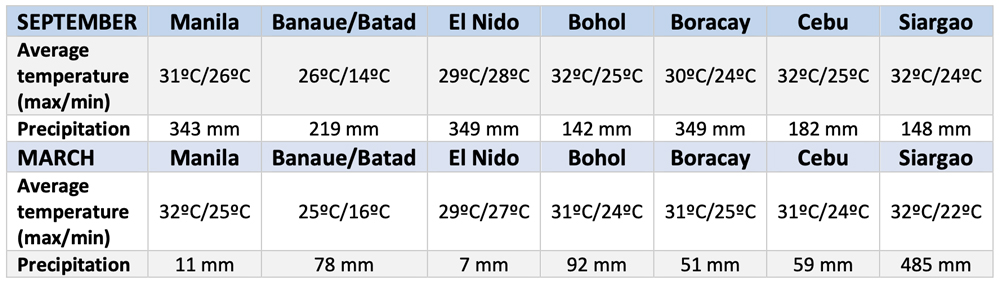
As much as we’d love to have a crystal ball that could tell you exactly what the weather will be if you decide to travel to the Philippines in September, the truth is that it’s impossible to know for sure. Broadly speaking, you can expect the occasional shower across most of the country, although rainfall is generally lower in the south. And yes, there’s a risk of a typhoon, as September falls within typhoon season.

Is it cold in the Philippines in September?
Not at all! Unless you head to mountainous areas, you can expect warm weather throughout your trip to the Philippines in September. Daytime temperatures rarely fall below 30°C. Temperatures drop slightly at night, but you’re still unlikely to need warm clothing.
As for the sea, you’ll be pleased to know you can spend hours in the sea without feeling cold. Sea temperatures average around 28°C. These conditions are particularly appealing if you’re planning to dive in the Philippines or do plenty of snorkeling.
To get an idea of average temperatures and rainfall by area, check out these tables for the main tourist destinations in the Philippines in September:
Typhoons in the Philippines in September
The Philippines is one of the countries most frequently affected by typhoons in Southeast Asia. Most typhoons travel from east to west, passing through the Eastern Visayas and Luzon (they rarely hit Mindanao or Palawan), and they are most common in August. Typhoon and tropical depression season runs roughly from July to October, although they can occur at any time of year, and climate change is making their patterns less predictable.
If you’re thinking of traveling to the Philippines in September, you should be aware that typhoons are possible. There’s no need to worry—that certainly doesn’t mean one will occur during your trip—but it’s good to stay informed. We recommend following the PAGASA Facebook page, the Philippines’ national weather agency.
⛈️ Forecasters can often identify a developing typhoon or tropical depression more than a week in advance. In that case, forecasts begin to show its potential path and which islands it may affect. This gives you time to adjust your plans and avoid the areas most likely to be affected. Sadly, those most at risk are people in vulnerable communities, particularly those living in poorly constructed homes.
For most travelers, the risk is manageable as long as you stay informed and follow official advice. Many of the typhoons that enter the Philippine Area of Responsibility don’t even make landfall. When they do, the most severe impacts are usually felt by vulnerable communities, particularly those living in poorly constructed housing. Our advice is therefore to check where the typhoon is forecast to pass and, if you’re nearby, change your route, move to another area, or stay in well-built accommodation in an area with reliable infrastructure. Of course, don’t even think about traveling to the Philippines without travel insurance.
Get 5% off your travel insurance for the Philippines
Are there parts of the Philippines with a lower risk of rain in September?
While this isn’t a hard-and-fast rule, the southern Philippines generally sees less rainfall in September, so it’s a good time to visit Mindanao, Siargao, and the eastern parts of Leyte and Samar. You may also enjoy good weather in Bohol, Camiguin, and, to a lesser extent, Siquijor.
To be clear, this doesn’t mean it will rain throughout your trip if you visit Palawan, Luzon, or other parts of the Visayas—far from it! The important thing to remember is that it’s the rainy season, so you may experience some cloudy days or showers, which tend to be short-lived and generally happen in the afternoon.
It’s particularly important to check the forecast before visiting mountainous areas such as Banaue, Batad, or Bontoc. The same applies if you’re thinking of visiting Mount Pinatubo. After several days of heavy rain, landslides may occur and some roads may be closed.

Traveling to the Philippines in September
Our experience of traveling in the Philippines in September
We’ve been lucky enough to experience several Septembers in the Philippines, as we spend long periods of time in the country. If we had to sum it up, we’d say we haven’t experienced many consecutive days of rain. We’ve had cloudy days and the occasional shower lasting an hour or two.
We also haven’t personally encountered any typhoons in September, unlike in December and February, even though both months—ironically—generally fall within the dry season…
What is traveling to the Philippines in September like?
You’ve already seen what the weather is generally like at this time of year, but what else is it like to travel to the Philippines in September? Because it’s the rainy season in much of the country, September is considered part of the low season. This means you can often find better prices on accommodation and transport than you’ll typically find between December and May.
That said, as more European travelers visit during their summer holidays, bear in mind that in the most popular tourist destinations, such as El Nido or Boracay, the price difference may not be particularly significant.
You can expect far fewer tourists than during the peak season. September is a great month for enjoying quieter beaches and less crowded island-hopping tours.
As for events, September isn’t one of the busiest months for major festivals in the Philippines, but there is one important thing to bear in mind: Siargao hosts major surfing competitions from late September to mid-October, depending on the year. We therefore recommend checking the dates and, if they coincide with your travel dates, booking transport and accommodation well in advance.
Other events held in the Philippines in September include Bonok-Bonok Maradjaw Karadjaw Festival (Surigao), Banigan-Kawayan Festival (Basey), Peñafrancia Festival (Naga), Burdang Lumban Festival (Lumban), Agal-Agal Festival (Bongao), Diyandi Festival (Iligan), Dalit Festival (Tangub), and Lapay Bantigue Dance Festival (Masbate).
If seeing whale sharks is high on your list, you should know September usually still falls within the season for responsible whale shark tours in Puerto Princesa, the capital of Palawan. You can read more about this in Where to swim with whale sharks in the Philippines.
Tips for traveling to the Philippines in September
If you decide to travel to the Philippines in September, here are some tips drawn from our experience:
- If you’re particularly concerned about rain, spend part of your trip in the south. You can explore Siargao and other islands such as Camiguin or Bohol. You could also explore Dinagat, which is still largely off the tourist radar. The route featured in our two-week Philippines itinerary for August works well in September too.
- Try to plan a relatively long and flexible trip. The longer your trip, the easier it will be to adjust your route and head to areas where it rains less. As we explain in detail in How many days to travel to the Philippines?, a three-week trip in September would be ideal.
- When it comes to flexibility and bookings, most hotel booking platforms now offer free cancellation. We usually use Booking.com, as it provides reliable customer support.
- For domestic flights, you’ll need to decide what matters more to you: booking in advance to get a better price or paying more for greater flexibility. In our case, we prefer to book 3–4 weeks in advance and, if our plans change, we’re happy to pay a little more—but ultimately, it depends on your priorities.
- To check the weather, we recommend using the Windy app, but bear in mind that it’s only really reliable four or five days in advance. Check the forecast for each destination individually and monitor it day by day as your trip approaches. Ultimately, the weather in the Philippines is always unpredictable—whether in September or April.
- Don’t travel to the Philippines without comprehensive travel insurance. You can get 5% off your policy through our link.

Frequently asked questions about traveling to the Philippines in September
To wrap up, here are the questions travelers most frequently ask about visiting the Philippines in September:
Where to go in the Philippines in September?
You can travel anywhere in the country, but the areas with the lowest chance of rain are generally in the south, including destinations such as Siargao, Camiguin, Dinagat, and other parts of Mindanao. Bohol and Siquijor also tend to have relatively good weather.
Are there typhoons in the Philippines in September?
It varies from year to year, but typhoons can occur. August and September are among the months when typhoons are most common, though it’s not a hard-and-fast rule.
Are there dry-season areas in the Philippines in September?
Yes, September is considered part of the dry season in the south and southeast. This includes destinations such as Siargao and Camiguin.
Can you travel to Palawan in September?
Absolutely. The fact that it’s the rainy season doesn’t mean it will rain all the time or that a typhoon will hit.
Is it cold in the Philippines in September?
Not at all—temperatures hover around 30°C and sea temperatures average around 28°C.
We’ve written several other weather guides that may help if you’re considering traveling in a different month. For example:
Traveling to the Philippines in July
Traveling to the Philippines in August
Traveling to the Philippines in October
We hope this guide to traveling to the Philippines in September has answered your questions. If there’s anything else you’d like to know, leave us a comment and we’ll be happy to help.