What is traveling to the Philippines in January like? Will I be cold? Will it rain the whole time? These are very common questions among travelers looking to escape the cold and enjoy a pleasant vacation somewhere warmer. We’ll answer these questions in detail, but here’s a sneak peek: traveling to the Philippines in January is a great choice, and it’s one of our favorite times to go for two reasons. First, the weather tends to be pretty good across almost the entire archipelago, and second, after New Year’s, it’s low season, which means better prices and fewer tourists.
Here’s everything you need to know about traveling to the Philippines in January: weather, prices, events, and useful tips for planning your adventure. If you have any questions, leave them in the comments below.
Can you travel to the Philippines in January 2027?
Yes! With no problems at all. Travel to the Philippines has been back to normal for a long time. Still, it’s worth reading a little more in our article on Requirements for traveling to the Philippines.
Our advice is to come as soon as you can and make the most of it, because the country is becoming increasingly popular, and you’ll want to experience it while it’s still as unspoiled as possible. What’s more, the Philippine peso’s exchange rate against the euro and the dollar is more favorable than ever, so your trip will be much cheaper.
It’s also extremely important to have good travel insurance for the Philippines. Click this link to get a 5% discount on the insurance we’ve been using for more than 10 years, which has worked wonderfully for us.
What’s the weather like in the Philippines in January?
You’ll find plenty of information on this topic in our article on When to travel to the Philippines, but to give you a quick idea, there are two seasons:
- The wet season, or rainy season: roughly from June to November.
- The dry season: from November to May. The dry season is also divided into 2 further periods: the cooler months (November to February) and the hotter months, or summer (March to May).
However, you also need to keep in mind that the Philippine archipelago is large, and these “seasons” aren’t the same everywhere. In fact, there are 4 or 6 climate zones where these seasons occur at different times of the year and are more or less pronounced. That’s why the weather in the south (Mindanao, including the famous island of Siargao) and on the southeastern coast (Leyte and Samar) tends to differ from what we described above. In other words, the rainy season usually runs from November to May (with December and January being the rainiest months), while the dry season falls roughly between June and October.

You’ll notice that we always say “usually” because the weather in the Philippines can be less predictable than travelers expect. If you’re used to reliably sunny summers or clearly defined seasons, keep in mind that even during the dry season, you might get caught in a downpour or have a tropical depression bring several days of rain. The reverse is also true: during the rainy season, you might enjoy several days of sunshine. That’s why it’s best to stay flexible and not worry too much about the weather.
Even so, January is usually a fairly calm month with little rain in Luzon, the Central Visayas (on islands such as Bohol, Siquijor, Malapascua…) and Palawan. Skies tend to be clear, and typhoons or strong low-pressure systems are uncommon. You might encounter stronger-than-usual winds along some of the country’s coasts, as the “Amihan” (the northeast monsoon) doesn’t ease until March. Our take? It’s nothing you really need to worry about.
On the other hand, it is the rainy season in the south, especially along the southeastern coast. That means it’s not a good time to travel to Siargao and Dinagat. In fact, December and January are the rainiest months on these islands. We’re not saying you shouldn’t go, but you are more likely to get rain there than in other parts of the country.
Is it cold in the Philippines in January?
If you’re looking to escape the cold, you’ll love traveling to the Philippines in January. Still, keep in mind that in mountainous areas such as Banaue or Batad, lows can hover around 14°C, so you’ll be reaching for a sweatshirt at night. Although January is the coldest month in the Philippines, it’s rare that you won’t break a sweat during the day in the rest of the country, as highs hover around 30°C and lows around 21°C. The high humidity also makes it feel warmer.
Once you get in the water, you can stay in for a while without getting cold. The sea temperature in the Philippines in January ranges from 25°C to 29°C. So you’ll have no trouble swimming at the beach, snorkeling, or scuba diving.
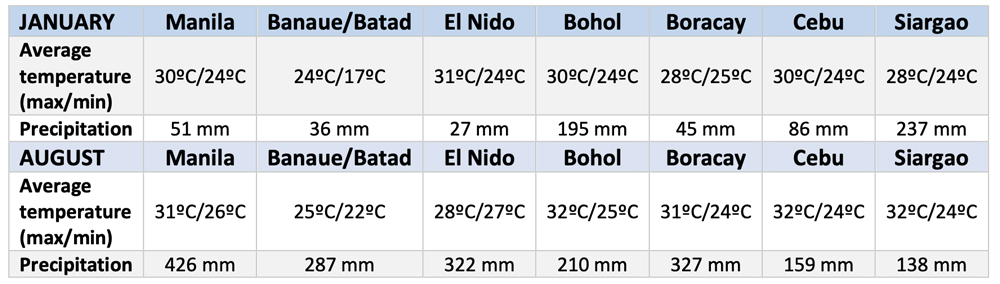
These tables let you compare the weather in the Philippines’ main tourist destinations in January and August:
Are there typhoons in the Philippines in January?
Because of its geographical location, the country is one of the countries most exposed to typhoons. They usually approach from the east, affecting the eastern parts of Luzon and the Visayas. Although they can occur at any time of year, August is the month with the highest chance of typhoons, and May has the lowest. Typhoon season is generally considered to run roughly from June to October, so typhoons are rare in the Philippines in January.
Specifically, if you’re thinking about traveling to the Philippines in January, the risk of typhoons is low. A tropical depression can still occur, bringing a day of rain or wind that could spoil a day of island hopping, but this isn’t as common as it is in other months.
To stay up to date, we follow the Facebook page of PAGASA, the Philippines’ official weather agency. You can check the paths of these weather systems a little over a week in advance here, so it’s very rare for a traveler to be seriously affected by a typhoon. Even so, don’t even think about traveling without travel insurance for the Philippines, and take shelter in well-built accommodations if a major typhoon is forecast.
Get a 5% discount on your travel insurance for the Philippines here
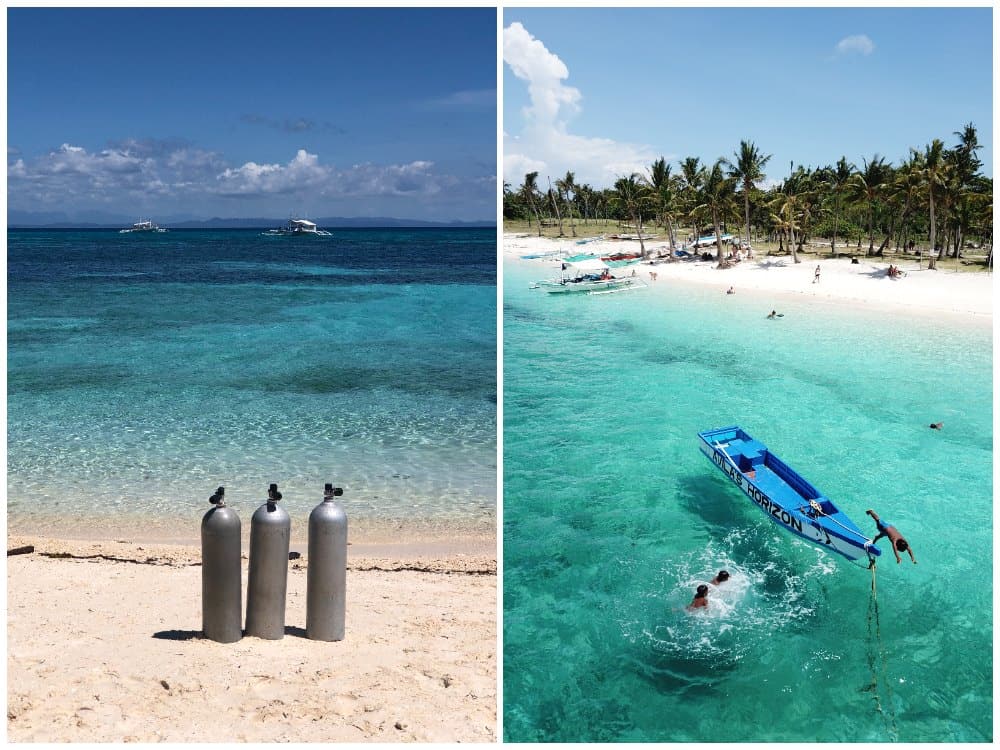
Malapascua
Are there parts of the Philippines with no risk of rain in January?
As you can see in the tables above, the south is the rainiest part of the country in January, specifically Siargao. Meanwhile, in January, the north (Luzon and Banaue) and the central region (El Nido, Boracay…) receive less rain. So, if you’re traveling to the Philippines in January and want to play it safe and avoid rain as much as possible, it’s best to focus on those areas and avoid the south and Eastern Samar.
Still, this is hardly an exact science. You may end up getting a little rain in January in destinations that are theoretically drier, but that doesn’t mean your trip will be ruined.
What’s it like to travel to the Philippines in January?
The weather is fairly stable this month, but what else can you expect when traveling to the Philippines in January? As for prices, although it isn’t a particularly rainy month, Filipinos don’t tend to travel much at this time, so it’s considered low season. That means accommodations and flights offer much better value than at Christmas or in April–May. Plus, even in the most touristy places (think El Nido or Boracay), you won’t see as many people, so you’ll enjoy them so much more.
On the cultural side, things get even better. Some of the best festivals in the Philippines take place in January. Sinulog in Cebu is especially important, but if you’re going to be near Boracay, Ati-Atihan in Kalibo is spectacular too. In Manila, a highlight is the huge Black Nazarene procession, held every year on January 9.
Other important celebrations include Biniray Festival (Romblon), Vigan Fiesta & Longanissa Festival (Vigan), Ati-Atihan (Kalibo), Dinagyang (Iloilo), Apribada Festival (Donsol), and Bagoong Festival (Lingayen).
Lastly, as we explain in Swimming with whale sharks in the Philippines, January is a good month to enjoy seeing this wonderful animal in both Donsol and Pintuyan/Padre Burgos. It’s also a good time overall to go scuba diving in the Philippines.

Sinulog Festival (Cebu)
Our experience in the Philippines in January
As we mentioned above, January and February are our favorite months to travel around the country. Since we like enjoying places without the crowds, it’s ideal for us and also cheaper than going in April–May or even July–August.
As for the weather, it has generally been calm during our many January visits to the Philippines. We’ve certainly had cloudy days and had to skip island hopping in Coron or Romblon on some days because of the wind, but we don’t remember anything being so bad that we’d rule out this month.
Fun fact: we took all the photos in this article during January visits to the Philippines in different years.
Tips for traveling to the Philippines in January
If you’re thinking about traveling to the Philippines in January, be sure to read these tips based on our experience:
- To avoid the rain, it’s best to skip Mindanao and nearby Siargao. It’s not a good month for Dinagat either, but it is a good time for the Coron – El Nido Expedition, which is amazing.
- The weather tends to be good in January, but as we always say, the longer and more flexible your trip, the better. That way, you won’t get frustrated if it rains one day. You need to keep in mind that the Philippines is so beautiful because it has a tropical climate and rain is fairly common.
- In January, you can expect more stable weather than in August or September, for example, but it’s worth taking advantage of free cancellation on hotel bookings. We always use it on Booking.com, which has good customer service. The same goes for flights; keep in mind that the earlier you book them, the cheaper they’ll be.
- The most reliable page for checking the weather is the PAGASA satellite page. It’s not very easy to interpret, but you can get an idea of where it will rain by looking at the red or yellow “patches.” PAGASA also tracks the paths of typhoons and tropical depressions. A much more intuitive and also reliable app is Windy. Just make sure you check specific areas and only rely on the forecast for the next 3–4 days. Ignore other weather apps on your phone, because they’ll always tell you it’s going to rain. Another very good source is this meteorologist.
- Please don’t leave home without good travel insurance. It will be there for you if something happens because of the weather, as well as for medical issues. Get a 5% discount on your policy.

Frequently asked questions about traveling to the Philippines in January
To wrap up, here are answers to your most common questions about the weather this month:
Which island in the Philippines is best to visit in January?
You can travel throughout the country, but it’s the dry season across Luzon (Manila, Banaue, Sagada…), the Visayas (Bohol, Siquijor, Malapascua…), and Palawan (El Nido, Coron, Port Barton…). So any of these islands is great to visit in January.
What’s the weather like in the Philippines in January?
It’s considered the dry season throughout Luzon, the Visayas, and Palawan. Temperatures are mild this month, so it’s not as hot as in April and May. It’s best to avoid the south and southeast of the country, namely Siargao and Dinagat, since it’s the rainy season there.
What’s the best month to go to the Philippines?
You can travel all year round, but December through May are considered the best months.
Is it cold in the Philippines in January?
No, temperatures range from 24°C to 30°C. In mountainous areas, though, lows can drop to around 14°C.
If you’re still unsure about when to visit this wonderful country, we have more information about other months:
Traveling to the Philippines in February
Ready to travel to the Philippines in January? If you have any questions, we’ll be happy to answer them in the comments.