You probably already have a rough idea of things to do in Apo Island. If you’ve made it this far, it’s because you’ve heard siren songs or, better yet, turtle songs. The tiny volcanic island of Apo has a fantastic marine reserve that’s home to dozens of turtles and is therefore one of the best places for snorkeling and/or diving in the Philippines.
Not only that—Apo Island is a very underdeveloped tourist destination. Many of its visitors come on a day trip from Dumaguete, Siquijor or Dauin and often don’t even set foot on it, so it’s a great place to enjoy a few days of calm, snorkeling, walks and sunsets surrounded by lovely people.
We admit it: we’re in love with Apo Island. “Luckily”, the last time we were there we got stuck for a week thanks to a typhoon, so we had time to squeeze every drop out of it. Keep reading and discover what to see and things to do in Apo Island with us.
Where is Apo Island
Apo Island is a tiny island located on the eastern coast of Negros Island. Specifically, it’s 7 kilometers from the port of Malatapay, in the province of Negros Oriental. Its capital is Dumaguete, a medium‑sized city with all services that’s known as a gathering point for students. Silliman University, one of the most prestigious in the Philippines, is located there.
In Dumaguete you have Sibulan Airport (IATA: DGT), a port and several bus terminals, the most important being Ceres Bus Terminal. This way you can connect with other corners of the Philippines.
Apo Island or Apo Reef? On the other hand, make sure you don’t confuse Apo Island with Apo Reef. Although both are incredible places to go diving in the Philippines, you access Apo Reef from the island of Mindoro, whereas you get to Apo Island from Negros. They’re separated by hundreds of kilometers.
Why visit Apo Island
What could draw you to this little piece of land of just 72 hectares? Mainly its 619‑hectare marine sanctuary, the first declared in the Philippines in 1986.
Angel Alcalá, from the Marine Laboratory at Silliman University, raised awareness among Apo Island locals more than 30 years ago about the importance of what they had around them. With more than 650 species of fish and 400 species of corals documented, Apo Island is an underwater wonder and therefore one of the best places for snorkeling in the Philippines, especially if you’re eager to swim with sea turtles.
And although the best thing to do in Apo Island is to enjoy its reefs, we simply love being there. Apo is a very underdeveloped island (in fact, electricity still doesn’t run 24 hours a day) and there are still few travelers who stay overnight. Many come just for the day from Siquijor, Dumaguete or Dauin, so strolling around is a lovely experience.
Here’s a secret: we like the experience of swimming with turtles in Apo much more than the snorkeling tour to Balicasag. Both islands are gorgeous, but if you can stay the night, Apo is better. In terms of diving, both are incredible.
Did you know that “apo” means grandchild in Bisaya? Apo is the little granddaughter of “lola” (grandmother) Negros. Siquijor is the “anak” (daughter) of Negros. Also, the correct pronunciation is “apó”.
How many days to spend in Apo
If you have time, we recommend staying on Apo Island at least one night. If you’re on a tighter schedule, of course, the one‑day trip from Siquijor to Apo is also worth it.
For those who enjoy supreme tranquility or love diving, Apo is a true paradise. We’ve visited the island 3 times and on one of those we spent a full week. 100% recommended!

What to see and things to do in Apo Island
By now you have an idea of what you’ll find on this tiny island, but keep reading to discover what to see and things to do in Apo Island in detail. We’ll give you the tips we wish we’d had the first time we set foot there.
1. Swim with turtles on Apo Island
Apo is a paradise for turtles and for those of us who are in love with them. Why? The island’s seabed has lots of algae and seagrass beds, a turtle’s favorite diet. Plus, the sanctuary’s protection for more than three decades has made the turtles trust that nothing will happen to them there. For the same reason, turtles don’t bolt every time they see a person, as they spend months around Apo.
It would be extremely rare not to find turtles swimming around the island. They’re usually feeding very close to shore, where there are also beautiful coral reefs. And turtles don’t stay underwater all the time—they come up to breathe, so it’s common to see them without needing to do freediving like a pro.
Apo has a huge population of green turtles and hawksbill turtles, most of them female. You’ll easily tell them apart. The former have a rounder shell, while the latter’s is more pointed. In addition, hawksbills are a striking yellow color and have a sharper beak, which they use to break hard coral and sponges—their favorite delicacies. You’re more likely to see green turtles when snorkeling in Apo, as they live in shallow waters (0 to 15 meters).
? How to tell a male from a female? Basically by the tail. Females have a short one.
How to see turtles on Apo Island?
The best spots to see them are the Chapel reef and its natural continuation, Katipanan. Both are in the same area where boats moor—in front of Liberty’s resort. All you need to do is jump in and swim around there.
Note there is a buoy‑delimited area where a guide is required. This costs 300 pesos per group and is arranged at the Apo Island tourist office. Supposedly, this is where more turtles are seen, but as you can imagine, they swim everywhere. If you feel like going on your own, you can do so without paying this fee (you will still have to pay the 100‑peso environmental fee for Apo, which is only paid upon arrival). Even so, going with a guide helps you tire less and they’re super used to taking cool photos. It’s also a way to support the community.
If you don’t have snorkeling gear, you can rent it at the tourist office on Apo Island. They usually charge 100 pesos. It’s advisable to rent fins as well (100 pesos). They also have life jackets (100 pesos) and reef shoes (100 pesos). As we mention in Backpack for the Philippines, we always recommend traveling with your own mask and snorkel. It’s much more hygienic and means you’re not dependent on finding a place that rents decent ones. Take a look at the one we use: this one.
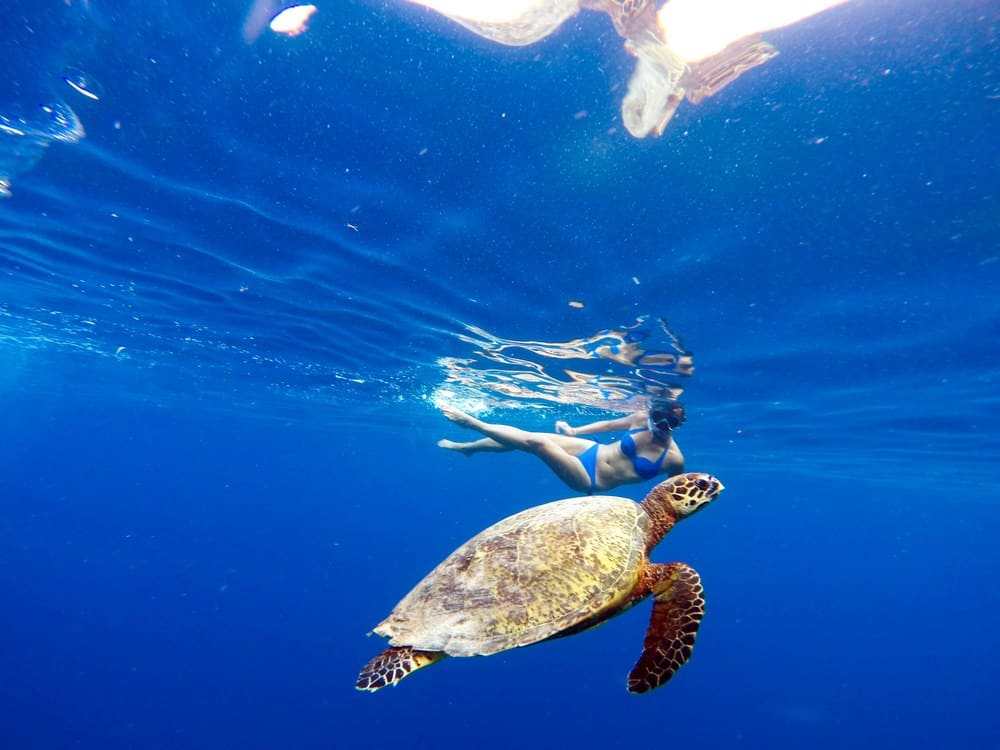
Tips for swimming with turtles in Apo
The main thing to do in Apo Island is to swim with the turtles—and that’s exactly what the day tours from Siquijor, Dumaguete and Dauin come to do. So it’s normal that by mid‑morning there’s a lot of people, which can spoil the experience.
If you stay overnight on Apo Island, our tip is to try to get into the water first thing in the morning. Around 7:00 the sea is usually calmer. Another good time is around 16:00, when all the boats have left and you’ll almost have them to yourself.
Is there a best time of year to see them? No, turtles are in Apo all year round. In the rainy season (approximately June to November) it can be windier and, therefore, snorkeling is less comfortable.
Responsible tourism tips to spot turtles in Apo without harming them
Sea turtles are wild, fragile animals. Please follow these recommendations so that Apo Island remains their home:
- Don’t use regular sunscreens: almost all contain oxybenzone, a chemical that harms reefs and marine life. In small concentrations it’s fine, but imagine how many tourists wear sunscreen every day and the damage that causes. In fact, there are scientific studies showing that chemicals in these creams cause tumors in turtles. If you burn easily, we encourage you to buy biodegradable creams or wear UPF clothing. This sunscreen, for example, doesn’t harm marine life.
- Don’t touch them: this rule applies to any animal or coral in the sea. A simple gesture can change their lives, transmit diseases and cause stress.
- Keep a distance of at least 3 meters: as we said, turtles are wild animals—being too close causes stress.
- Don’t chase them or stick a selfie stick in their face.
- Don’t feed them.
- Don’t block their way: don’t stand right in front of them or, if you’re in a group, don’t surround them.
- Don’t stand up on the reef: definitely not on corals or sponges (which sometimes look like rocks) and avoid standing in the algae zone as well.
- If you see someone doing any of these things, please politely call it out and explain why it’s wrong. Little by little we’ll raise awareness—none of us were born knowing.
- Out of the water: reduce your use of single‑use plastics. Turtles and other marine animals mistake them for jellyfish, which they also eat, and end up dying. If you see plastics in the sea or on the beach, you can really help by picking them up. Reduce fish consumption or make sure the fishing is sustainable. Overfishing harms ecosystems and some methods, like bottom trawling, kill huge numbers of turtles every year.

2. Go diving on Apo Island
Closely related to the above, another thing to do in Apo Island is to go diving. Not just to enjoy the turtles in peace, but because its reefs have tons of marine life and, thanks to that, make up some of the most interesting dive sites in the Visayas region.
Apo has dives for all levels. From relaxed reef cruises and wall/cave exploration to current‑swept dives where schools of jacks, huge groupers and—if you’re lucky—even whale sharks are common. You’ll also find great macro diving, with loads of nudibranchs, frogfish, orangutan crabs and curious candy crabs.
When is the best time to dive in Apo? You can dive year‑round and visibility is usually very good, but the best time is from November to June. July to September is rainy and windy season, so the sea can be rougher. If you can avoid full‑moon days and those close to it, even better, as currents are stronger then.
What dive shops are there in Apo? Basically 2 from the 2 main hotels operating: Liberty’s and Mario’s. We’ve always dived with Liberty’s dive center (Paul’s Dive Center) and we really liked both the service and the gear, but we’ve heard about some recent bad experiences. Our advice is to drop by all 3, which are very close, and check the equipment carefully. Prices are around 1,400 pesos per dive with gear.
Dive sites in Apo Island
- Chapel: named because it’s in front of the island’s chapel, this is one of Apo’s most popular sites. You start on a small sandy slope that becomes an awesome wall with caves, packed with soft and hard corals, sponges and sea fans. It’s not a difficult dive and lionfish, scorpionfish, morays, nudibranchs, frogfish, turtles, Napoleon wrasse… are common. Keep an eye on the blue—thresher and hammerhead sharks have been spotted occasionally.
- Coconut Point: known as “the washing machine” for its currents, this is a fun drift dive where you can see large schools and big fish like bumphead parrotfish, tunas, snappers, barracudas, groupers, reef sharks and the occasional manta ray.
- Cogon: another currenty dive that all but guarantees schools of jacks, eagle rays, mantas and reef sharks; it also runs along a sandy slope and a small reef where turtles, cuttlefish, rays and mantis shrimps are common.
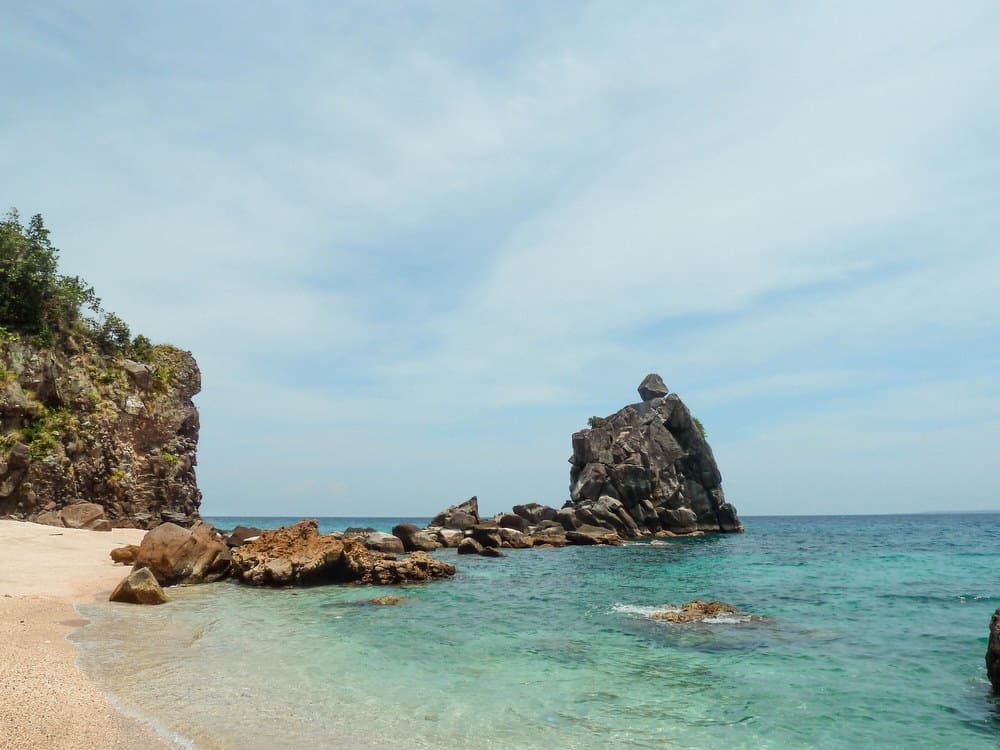
- Boluarte: this is the picturesque rock you’ll see on Apo’s beach. It’s an easy, mostly flat dive with the curiosity of volcanic bubbles rising from the seabed.
- Kan‑Uran: a wall dive full of vibrant hard and soft corals with lots of small caves—thousands of opportunities for macro life.
- Katipanan: there’s usually no current here, so it’s an easy site for less‑experienced divers. It’s a pretty slope full of soft corals where turtles, cuttlefish, nudibranchs and sea snakes are common.
- Largahan: you can also find volcanic activity here and tons of macro life. It’s not unusual to see frogfish, scorpionfish, ribbon eels, nudibranchs and flatworms.
- Mamsa Point: “mamsa” means jack in Bisaya, so it’s no surprise to find schools of them surrounded by sharks and tunas on the hunt. Currents are usually strong.
- Marine Sanctuary: when we last visited Apo it was closed because a 2012 typhoon had destroyed it.
- Olo: currents hit hard here too, but the reward is a site that looks almost like an aquarium.
- Rock Point East: located at Apo’s tip, where there are also currents, you’ll see reef fish and can look out into the blue for schools of jacks, mantas and reef sharks.
- Rock Point West: a fairly steep slope with different ledges. There are pretty hard corals at the bottom. Watch out—currents are common here too.
Although the first time we stayed around Chapel, Katipanan and Largahan, the second time we visited Apo Island we dived the “back side” and were blown away. We loved Coconut Point and Cogon.
And if you like diving, Dauin is another extremely interesting spot to consider. On the coast of Negros, a bit south of Dumaguete and before reaching Malatapay (where the boats to Apo Island depart), it offers loads of amazing dive sites if you’re into muck diving. This is where we saw our first mimic octopi and seahorses.
Snorkeling or diving on Apo Island?
Both! In our opinion, diving is more enjoyable and more comfortable, but snorkeling with turtles in Apo is also fantastic.
If we were on a day trip from Siquijor or Dumaguete to Apo, we’d do 2 dives and the rest snorkeling. If you stay overnight on Apo, we’d devote at least one day to diving with 3 dives, and the rest of the time—plenty of it—to snorkeling.

3. Walk up to the lighthouse (Apo Island Lighthouse)
There are things to do in Apo Island out of the water! We encourage you to get lost a bit in the village streets and savor island life but, if you want a specific goal, the clearest is the walk to the lighthouse.
Although it’s not a particularly pretty lighthouse and you can’t go inside, the views from the Apo Island Lighthouse are well worth it and it’s a beautiful place to enjoy sunrise or sunset.
The trail is marked on both Google Maps (Lighthouse Treek) and Maps.me, and you’ll also find a few signs. While it’s not very difficult (somewhat tiring because you’ll climb 369 steps), we don’t recommend flip‑flops as it can be muddy. Most of the route is concrete stairs. It takes about 30–45 minutes.
4. Enjoy sunset from Rock Point (Apo Island View Deck)
More viewpoints! Another thing to do in Apo Island is to walk to Rock Point, also known as the Apo Island View Deck. It’s not hard to get there (follow Lagoon Ave and then the Habagat Eco Trail shown on Google Maps) and the walk is very pleasant, as you’ll pass the huge lagoon at the heart of Apo and the marine sanctuary beach.
There’s another viewpoint called Talaytay Viewpoint, which has even more amazing views of the island. In Maps.me you’ll see it marked as “View over Apo”. Despite being so small, its mountainous terrain means you won’t run out of walking options.
5. Enjoy Apo Island life
It may sound cheesy, but we simply love “being” on Apo Island. The island is so small that after just a couple of walks you feel at home and start greeting people.
Peek into the chapel, the basketball court, buy a drink at the shops and sit to watch kids and dogs play on the beach, read a book on Liberty’s terrace, join a karaoke session… If you want to contribute to the community, you can get involved at the school or high school. Several travelers from our Facebook group have run environmental awareness activities there and had a great time. The owner of Liberty’s can help you organize it.

6. Bask on the beach
To be clear, in Apo you won’t find the best beaches in the Philippines, but there are nice beaches to relax for a while.
The area where the bangkas land—right in front of Liberty’s resort, which you’ll easily recognize—is the most popular. However, swimming isn’t very comfortable because the shore is mostly rocky. In our opinion, the best beach on Apo Island is the one at Apo Island Beach Resort. If you look at the map, it’s to the right of Liberty’s, separated by the island’s most famous rock formation: the Boluarte.
Heads‑up: some readers have told us they now ask for 50 pesos to enter. In our opinion, it’s worth it if they keep it clean.
If you want absolute peace and quiet, we suggest walking to Rock West Beach. It’s in front of the Katipanan reef, so it’s also perfect for snorkeling. At low tide you can reach it on foot from the main beach—wear proper footwear because you’ll walk over rocks. Otherwise, you can follow the path to the viewpoint and then go down.
There are a couple more beaches you can access by walking the little paths around Apo. They’re all rocky, but perfect to disconnect from everything. One faces the Kan Oran Reef and the other faces the Mamsa Reef. You can see the trails marked in Maps.me.
Where to stay
There isn’t a huge choice, but these are the places you’ll find on the island today:
If you want more comforts (you won’t find many on Apo), another option is to sleep in Dumaguete, Dauin or Zamboanguita and take a day trip to Apo Island. We recommend places like:
- Blue Horizon Hostel in Dumaguete.
- Mike’s Dauin Dive Resort in Dauin.
- Kav’s Beach Resort in Zamboanguita.
You’ll find all the info you need in Where to stay in Apo Island.

Our sea‑view room at Liberty’s Lodge
How to get there
We can summarize 4 options:
- From Dumaguete on your own: from Ceres bus station, buses go to Malatapay, and from there you take one of the boats to Apo Island.
- From Siquijor on a day trip: Coco Grove and Island Vibes hotels organize day trips for diving or snorkeling.
- From Dumaguete on a day trip: Mad Monkey Dumaguete runs trips several days a week.
- From Dauin or Zamboanguita with a dive shop: there are some great resorts in this area that go to Apo to dive.
Everything is explained in great detail in How to get to Apo Island. We also summarize how to reach Dumaguete from other places like Siquijor, Bohol, Moalboal or Cebu.
Tips for visiting Apo Island
- The best time to visit Apo Island is roughly from December to May, when it’s the dry season in this part of the country and the sea is usually calmer—important both for getting there (those bangkas can really rock!) and for snorkeling. Even so, you can go to Apo Island at any time; just be careful during typhoon season, as what happened to us could happen to you and you might end up isolated for a week. You’ll find all the information in Best time to travel to the Philippines.
- What to pack for Apo Island? Two things are particularly important: snorkeling gear and reef shoes. You can rent the former on Apo for 100 pesos and you can also rent fins, which make you more comfortable. Reef shoes, in our opinion, are essential. Almost the entire main beach on Apo has a rocky entry, so it can be uncomfortable and dangerous to go without them. We also recommend bringing a dry bag and a backpack cover to protect them on the boat ride, which can be bumpy. See all our recommendations in Backpack for the Philippines.
- Internet on Apo: don’t expect great hotel Wi‑Fi. 4G works quite well, so we suggest getting a local SIM card. See Internet in the Philippines for details.
- Money on Apo Island: you won’t find ATMs and you can’t pay by card, so bring cash. You can withdraw and exchange money in Dumaguete.
- Where to eat on Apo: the hotels are your allies, as there are hardly any carinderias on Apo. Liberty’s and Mario’s serve dishes between 150 and 200 pesos.
- There are no hospitals or clinics on Apo, so you’ll need to be taken to Dumaguete if something happens. That’s why it’s very important to travel with good travel insurance for the Philippines. Make sure it covers accidents during snorkeling or diving activities. We recommend IATI Mochilero or IATI Grandes Viajeros. Here’s a 5% discount on your policy.
Map of Apo Island
You’ll find all the activities and things to do in Apo Island and accommodation suggestions on this map we created for you:
We hope you liked this guide to Apo Island! If you have any questions or suggestions, we’ll be happy to help in the comments.