Swimming with whale sharks in the Philippines is a dream for many travelers. Many even plan to travel to the Philippines just to see them. Simply imagining yourself alongside the largest fish in the world (did you know they can grow up to 12 meters long?) is probably enough to send a thrill through your entire body. However, as with any activity involving animals, you have a responsibility to learn about the impact interacting with them may have and, of course, which places offer responsible encounters.
We can already tell you that you can swim with whale sharks in several places in the Philippines, but that one of them is extremely harmful to this endangered species. Please, from the bottom of our hearts, we ask you to keep reading and be a responsible traveler.
Whale sharks in the Philippines
Whale sharks are migratory animals, meaning they travel thousands of miles in search of food, breeding opportunities, and for reasons that researchers have yet to discover. This means they can be seen in the waters of Australia, Honduras, the Maldives, Mexico, Mozambique, Panama, and, of course, the Philippines.
It is estimated that almost half of the world’s whale sharks have disappeared over the past 75 years, which is why they were declared an endangered species in 2016. That same year, the LAMAVE (the Large Marine Vertebrates Research Institute Philippines) identified the 1,000th whale shark in the Philippines, leading researchers to conclude that the waters of the archipelago are home to the third-largest population in the world and the largest population of these animals in Southeast Asia.
Whale sharks can be found along the coastlines of the Philippines. However, they are much more commonly seen in certain parts of the country and at particular times of year. Mainly due to the high concentrations of plankton that rise to the surface, they have been regularly spotted for decades in places such as Donsol and Pintuyan.
And while tourism centered around swimming with whale sharks has grown exponentially across the planet, the Philippines is no exception. As a result, some places are better than others when it comes to swimming with them.
Is it safe to swim with whale sharks?
Of course! Whale sharks feed mainly on plankton or phytoplankton, although they may also eat some small fish. There is no danger to humans as long as you follow the distance rules and, of course, use your common sense.
Although they may look a little clumsy, a strike from one of their fins can hurt you. This is why you should stay at least 3 meters away from the shark’s body and 4 meters from its tail.
The greatest risk during this activity is bumping into something or cutting yourself while getting on or off the boat in all the excitement and rush, or on the nearby coral. This is another of the many reasons why we always emphasize how important it is to have travel insurance. The policy we have been using for years, unlike others, also covers activities such as diving and snorkeling. In “Best Travel Insurance for the Philippines” we explain everything you need to know but, in addition, as a reader of our website, you can get a 5% discount when you purchase it through this link. As well as paying less, you’ll be helping us enormously by allowing us to continue working on this project, which we put so much care into:

Humans are the real danger to whale sharks.
Can you scuba dive with whale sharks in the Philippines?
As we mentioned, you can swim with whale sharks in the Philippines, but scuba diving is NOT allowed in most places where these animals are treated responsibly. In other words, in Donsol, Padre Burgos/Pintuyan, and Puerto Princesa, you cannot dive inside the protected areas where the whale shark encounters take place.
However, if you want to scuba dive with whale sharks in the Philippines, you can go on dives in areas close to these locations:
- In Donsol and Pintuyan, occasional sightings occur while diving outside the designated area.
- Whale sharks sometimes (rarely—don’t think this happens all the time) appear in the waters around Moalboal or Panglao (Bohol).
- In Tubbataha, one of the most inaccessible diving destinations in the Philippines, they are commonly seen. Bear in mind that this reef can only be visited during the season (roughly from February to May) on a liveaboard trip lasting 7–10 days.

DO YOU LIKE OUR CONTENT? Help us keep the website alive.
Keeping this website up to date—from researching routes, trying accommodations, and writing every guide
to answering hundreds of your questions every day—takes time, energy, and more coffee than we would care to admit.
If you find any of our advice useful and are considering purchasing discounted travel insurance,
booking a hotel, booking flights, using Remitly, etc. We would be grateful if you did so through our links.
- You pay exactly the same price (and sometimes even less thanks to our discounts).
- We receive a small commission, which we reinvest in continuing to work,
research, and publish free guides. - You get the same price, we can continue creating independent content,
and everyone wins.
Thank you for supporting this project and for joining us in every corner of the Philippines.
Where NOT to swim with whale sharks in the Philippines: Oslob (Cebu) and Lila (Bohol)
If you want to swim with whale sharks in the Philippines, we absolutely CANNOT recommend doing it in Oslob. Although it is the best-known and most accessible place, what has been happening there since 2011 is a true atrocity committed against such a wonderful animal, which is also endangered.
A few years ago, in the barangay of Tan-Awan in Oslob, in southern Cebu, fishermen decided to feed the whale sharks swimming nearby with uyap, a mixture of shrimp and crustaceans. Their goal was to keep them away from their fishing nets, but they soon noticed tourists traveling to Oslob to swim with them, generating more income. What started with just a few people has now become a huge industry attracting more than 1,000 people every day. This is causing serious problems for whale sharks for several reasons:
- Uyap does not provide them with the nutrients they need (whale sharks feed primarily on plankton), but it keeps them effectively captive. Several LAMAVE studies have shown that, unlike in other places where they only remain seasonally for a short period of time, some whale sharks have stayed in Oslob for more than a year, returning every morning.
- LAMAVE also points out that this feeding method affects the animals’ posture, as whale sharks naturally feed in a horizontal position, while in Oslob they can be seen feeding vertically.
- Preventing whale sharks from migrating may end up disrupting their migratory and, therefore, reproductive patterns. What can that lead to? It can contribute to their extinction. Many of the whale sharks in Oslob are juveniles, meaning young sharks that are learning how to survive in the ocean. What will happen if this is what they learn?
- The whale sharks in Oslob are learning to associate boats with food. A pattern has been identified in which sharks approach boats outside Oslob and are struck or cut by their propellers. Their migratory patterns are also disrupted.
- The interaction rules established in Oslob are violated in 97% of cases. There is a rule stating that you cannot get closer than 1.5 meters to the animal or touch it, but LAMAVE demonstrated in its studies that 1,823 instances of physical contact occurred over 64 hours—that is more than 29 contacts per hour. What does this cause? Stress.
- If more than 1,000 people swim with whale sharks every day in an area measuring no more than 20 meters by 50 meters, you do not have to be a genius to know the result: the animals are exposed to human bacteria and sunscreen that damage their skin. Not to mention, of course, the blows and cuts caused by people and boats.
- On top of that, recent news reports have highlighted the poor water quality where these animals are kept, which has even caused skin reactions among swimmers.
Lastly, from the (selfish) perspective of a traveler, seeing a whale shark this way, surrounded by hundreds of people and knowing that you are guaranteed to see it because they are feeding and harming it, is the least exciting and “romantic” way you could possibly do it. Seriously, the excitement and adrenaline of being lucky enough to spot a whale shark in the wild are indescribable.
More information about whale sharks in Oslob
Similarly, since late 2019, the same activity has been promoted in a place in Bohol called Lila. The process is exactly the same: the whale sharks are fed using buckets and no distance regulations whatsoever are followed. In fact, images have emerged of people directly touching the sharks. The governor of Bohol urged the mayor of Lila to stop this activity, and the LAMAVE foundation also expressed its disapproval, as you can read here. Please, if you are offered this activity in Alona Beach or anywhere else in Bohol, let them know that you do not support this irresponsible form of tourism.
Fortunately, at the beginning of 2025, all whale shark-related activities in Bohol (Lila and the surrounding area) were banned precisely because of all the harm they cause to these animals, as discussed above. Hopefully, the same will soon happen in Oslob.

The best (and most responsible) places to swim with whale sharks in the Philippines
Now that we have explained where not to go, we are going to tell you a little more about other parts of the country where you can see whale sharks in the Philippines naturally.
Swimming with whale sharks in Puerto Princesa (Palawan)
For the past few years, whale sharks have been spotted in Honda Bay, in Palawan, just a few kilometers from Puerto Princesa (the main gateway to the island, as it has a major airport). If you are traveling to El Nido or Port Barton between April (usually from the middle or end of the month, although it is impossible to know) and late October, you have the wonderful opportunity to see these giants of the sea swimming freely in a responsible setting. Tours depart from Puerto Princesa itself, and the agencies operating them will pick you up from your accommodation.
Tours usually depart at 7 a.m. and reach the area where the sharks are usually found a couple of hours later. Small fishing boats are usually there to help spot them. As soon as they give the signal, travelers enter the water in small groups, taking turns to enjoy this enormous animal. Tours usually return to Puerto Princesa at 2 p.m., meaning you can continue your journey to El Nido or Port Barton that same afternoon.
You have a better chance of swimming with whale sharks in Puerto Princesa, Palawan, if your visit also coincides with full moon periods. The weeks before and after a full moon are best. This, of course, does not guarantee a sighting because, as we mentioned, this is a completely natural encounter.
There are currently two agencies offering this tour. So far, everything seems to indicate that they prioritize the animals’ well-being over financial gain, and readers continue to tell us that they had an amazing experience. If you choose one of these agencies, we’d like you to let them know that you are there because you respect whale sharks, did not want to visit Oslob, and chose to go with them instead. If you notice any unusual behavior, we would appreciate it if you let us know so that we can stop recommending them immediately.
Price for swimming with whale sharks in Palawan: 3,000 pesos per person (including food and equipment). They refund 25% of the cost if no sharks are seen.
2026 update: the season in Puerto Princesa began in early April 2026. Whale shark sightings in Puerto Princesa are now occurring almost daily.

Swimming with whale sharks in Padre Burgos (Leyte)
Our favorite place to swim with whale sharks in the Philippines is also the place LAMAVE describes as the most sustainable location in the country. In the south of Leyte Island lies an enormous bay known as Sogod Bay. This small corner of the country, specifically along the coast of Pintuyan and San Ricardo, provides whale sharks with high concentrations of plankton.
Besides offering considerably better visibility than Donsol (and usually Puerto Princesa), it is a peaceful and, above all, responsible place to see these animals. While around 30,000 people visit Donsol during the sighting season, only between 600 and 2,000 people visit Padre Burgos/Pintuyan. Not surprisingly, on the days we went on this tour, we only saw our own boat, carrying around 10–12 passengers.
The season for swimming with whale sharks in Padre Burgos runs from November to late April. As of today (July 2026), the season in this area has already ended.
If you decide to try your luck here, you can ask us for a contact in the comments.
We need to clarify something here. Boats from Padre Burgos travel to Pintuyan, so you have 2 options:
- Go to Padre Burgos and take a one-day tour from there to Pintuyan with one of the dive schools in Padre Burgos. The advantage is that, although it is more expensive, if they know the sharks are being spotted in Liloan, they will head there instead of traveling all the way to Pintuyan.
- Travel to Pintuyan (which involves more time in transit) and hire spotters there. We will explain this option in the next section.
How do you get there? If you choose the first option (faster but more expensive), getting there is very easy, so there is no excuse. You can fly to Cebu and then take a ferry to Maasin. Oceanjet operates this route every day, departing at 7:00 a.m. and arriving in Maasin at 10:00 a.m. You can purchase your ticket here.
Another way to travel from Cebu to Maasin is on the ferries operated by Cockalion Shipping Lines. They are a little slower and less frequent. Tickets cost 350 pesos.
If you cannot find any ferries to Maasin, another option is to travel to Hilongos. Roble Shipping Lines departs every day at 12:00 p.m. and 9:00 p.m. Tickets cost around 300 pesos, although this depends on the class; the most comfortable option is to book a bed. The journey takes 4 hours. Gabisan Shipping Lines operates every day at 2:30 p.m. (arriving at 4:00 p.m.) and at 9:00 p.m. from Friday to Sunday (arriving at 3:00 a.m.). Prices start at 240 pesos, depending on the class you travel in. Once there, you will need to take a bus or van to Maasin, which will take a couple of hours, and then a jeepney to Padre Burgos (20 minutes).
If you want to travel from Bohol to Padre Burgos, you can take one of the ferries from Ubay to Hilongos or Bato. The most reliable company from Bato is Medallion Transport, which publishes schedules on its website. To travel to Hilongos, Leopard has a ferry at 10:00 a.m. Once you arrive at either location, you will have no trouble finding overland transportation to Padre Burgos.
It is also possible to fly to Ormoc or Tacloban and travel to Padre Burgos from there. This will take you 3 or 4 hours.
☀️ Everything is explained in detail in How to Get to Padre Burgos.

What is swimming with whale sharks in Padre Burgos like? As we mentioned, tours to see whale sharks from Padre Burgos depart from the dive centers, which take you to Pintuyan/Liloan (depending on where the sightings are occurring). The boat ride from Padre Burgos takes 2 hours. Tours depart at around 8:00 a.m. and return at around 2:00–3:00 p.m.
The procedure is fascinating. Before reaching the protected area, the boat stops in front of the town, where the people responsible for regulating the interaction are waiting, along with a LAMAVE volunteer (who helps conduct research on the whale sharks in Padre Burgos) and the small bangkas belonging to numerous spotters. These fishermen tie their boats to ours and, once we reach the designated location, they untie themselves and begin searching for whale sharks by putting their heads in the water. It is very straightforward: as soon as they see one, they wave their paddle and the boat carrying the swimmers approaches.
The process of entering the water is strictly regulated and carried out gradually to avoid frightening the shark and prevent you from colliding with other people.
The maximum time you can remain in the area is also regulated: 3 hours per boat. During that period, you can get in the water as many times as you like, depending on how many whale sharks are spotted. But that is not all—we also saw turtles and manta rays! Honestly, it is an incredible experience.
Padre Burgos is also one of the best places to go diving in the Philippines. We recommend spending at least 3 days in the area: 1 for the whale sharks, 1 for diving in Napantao, and another for the night dive at the pier (one of our favorites in the Philippines), or to try seeing the whale sharks again if you were unsuccessful the first time (or to repeat the experience, as we did).
Price for swimming with whale sharks in Padre Burgos: 3,750 pesos per person, including fees and snorkeling equipment rental (less if you bring your own).
Swimming with whale sharks in Pintuyan (Leyte)
The second option we mentioned earlier involves traveling to Pintuyan, in Leyte, and hiring a boat there to swim with whale sharks.
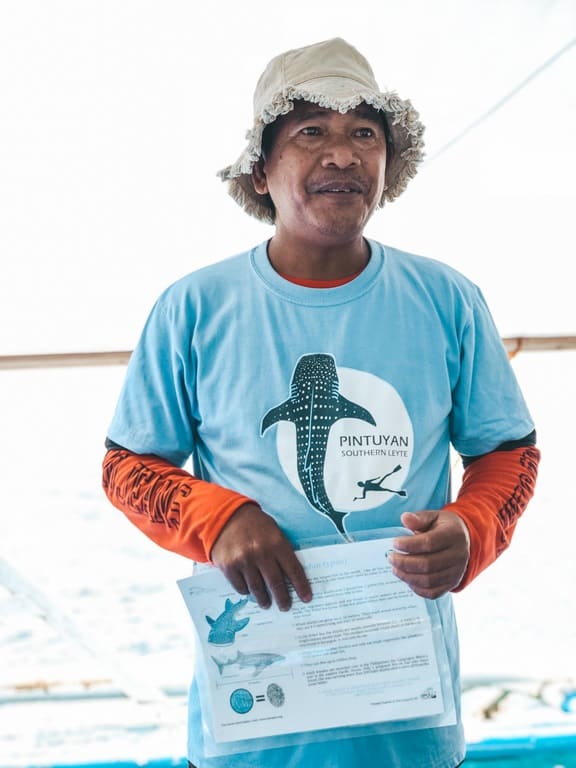
In Pintuyan, you will find boats available for whale shark watching. Our advice is to do things properly and support KASAKA, the organization authorized to operate this activity. Through the Pintuyan Tourism Office, which is located inside the town hall, they organize the boat, guide, and spotters you need. The maximum permitted time at sea is 3 hours. You do not need to book in advance; simply go to the Pintuyan Municipal Hall and they will arrange everything for you.
In our opinion, this is the most responsible option. The last time we visited Pintuyan, we were the only tourists there, and ours was the only boat that went out to look for them. Everything is fully regulated.
How do you get there? You can take a ferry from Cebu to Hilongos. Roble Shipping and Gabisan Shipping depart several times a day. You can find more information in How to Get to Pintuyan. You then need to take a bus to Sogod (any bus heading to Tacloban), which takes around one hour and costs 50 pesos, followed by a van or bus heading to San Ricardo, getting off in Pintuyan (around 100 pesos).
You can also travel from Surigao to Pintuyan, making it a good option if you are visiting Siargao. You simply need to take the Montenegro ferry from Lipata Port in Surigao to Liloan, the ferry from Surigao to Benit (Fast Cat, schedules here), or the ferry from Lipata to Benit (San Ricardo Shipping Lines, check here). Several depart each day, more or less between 8:00 a.m. and 12:00 p.m., although it is best to confirm with the ferry company. Once there, take any bus or van heading toward Pintuyan. The journey will take no more than 20–30 minutes.
☀️ In any case, everything is clearly explained in How to Get to Pintuyan.
There are several guesthouses in Pintuyan where you can spend the night. We recommend D&G Lodge and, if you are looking for more comfort, a dive resort called Pintuyan Dive Resort.
Price for swimming with whale sharks in Pintuyan: the price varies depending on the number of people in your group. The boat costs 1,350 pesos in total (maximum 3 people), plus a fee of 300 pesos per person. You also need to hire a guide for 600 pesos (shared between everyone), and each boat is required to have 2 spotters, who charge 500 pesos. If you do not have snorkeling equipment, rental costs 150 pesos.
This is only a brief summary; everything is explained in Swimming with Whale Sharks in Pintuyan.
2026 update: the season in Pintuyan/Padre Burgos began in mid-October 2025 and ended in early June 2026. There are no more tours operating here to see them. As soon as the season starts again (expected in October), we will update this guide. As you know, we are constantly updating our articles.

Swimming with whale sharks in Donsol (Luzon)
For many decades, the largest population of whale sharks in Southeast Asia has gathered in Donsol Bay. An ecotourism project supported by WWF-Philippines was established there in 1998, leading to the introduction of strict interaction rules for swimming with them.
The season for swimming with whale sharks in Donsol runs from December to May, with the best period being between March and May, when plankton concentrations are higher.
You will need to go to the Donsol Whale Shark Interaction Center. The bangkas (traditional Philippine boats) head out into open water from there, and you do not need to book in advance. After watching the video explaining the interaction rules, you will notice that some members of the crew are spotters. If they see a whale shark, they will organize the swimmers so they enter the water in stages.
Although the number of tourists has increased over the years and weekends are busier, whale sharks in Donsol are not fed and interaction rules are followed. That said, travelers have told us that on some occasions (especially during holidays and weekends), the rules are not being followed as WWF originally intended. Despite regulations allowing only one boat per whale shark, the crowds that form when no shark has been seen for some time can be excessive. However, other travelers have told us that everything was done by the book and that the entire experience was very responsible.
How do you get to Donsol? To swim with whale sharks in Donsol, you can take a flight to Legazpi (available from destinations such as Manila and Cebu). From there, you can take a bus or van to Donsol. The journey takes roughly 90 minutes. The great thing about traveling to Donsol is that you can combine swimming with whale sharks with visiting Legazpi and Mayon Volcano (read Things to Do in Legazpi for more information) and even consider visiting Caramoan and the little-known island of Ticao (fantastic diving).
Price for swimming with whale sharks in Donsol: boats have a maximum capacity of 6 people and cost 3,500 pesos in total. You also need to pay a fee of 300 pesos per person.
2026 update: unfortunately, it seems that this year’s whale shark season in Donsol has not been very good. We do not know whether the situation will change, but so far very few whale sharks have been seen, and travelers have also told us that whenever one is spotted, the area becomes extremely crowded.
Frequently asked questions about whale shark tours in the Philippines
To wrap things up, here are the answers to travelers’ most common questions about whale sharks in the Philippines and the tours available to see them:
Where can you see whale sharks in the Philippines?
There are several places depending on the time of year, which is determined by the concentration of nutrients in the water. Broadly speaking, they can usually be seen near Puerto Princesa in Palawan from April to October. From around October until May, they are usually seen in Sogod Bay (accessible from Pintuyan or Padre Burgos) and in Donsol (on Luzon Island).
When is whale shark season in the Philippines?
It varies by area and, since this is a completely natural occurrence, depends on the year. However, you can generally expect to see them in Puerto Princesa from mid-April until mid-October. In Pintuyan/Padre Burgos, the season runs from early October until the middle or end of May, and in Donsol from October until May, with sightings being more frequent between March and May.
Can you scuba dive with whale sharks in the Philippines?
Scuba diving is not permitted inside the protected areas. In other words, you cannot scuba dive in Puerto Princesa, Pintuyan, or Donsol specifically to see them. However, if you go diving in nearby areas, you may have a chance encounter. Snorkeling is permitted.
Are there ethical places to swim with whale sharks in the Philippines?
Yes. Far from the atrocity of Oslob, where an endangered animal is not treated with respect, both Puerto Princesa and Pintuyan enforce strict interaction rules and the whale shark encounters are not overcrowded. Unfortunately, best practices do not appear to have been followed in Donsol in recent years. This is also partly a result of the decline in the number of whale sharks in the area, which causes boats to gather around them.
Can you swim with whale sharks in Puerto Princesa, Palawan?
Yes, the season runs roughly from mid-April until mid-October.