If you’re thinking of traveling to the Philippines in May, you’ve come to the right place. Here you’ll find answers to all your questions about the weather, travel requirements, and tips to make sure your Philippine adventure goes wonderfully. Here’s a little spoiler: May is the height of summer in the Philippines, which usually means almost no rain and lovely warm weather, ideal for enjoying its beaches, volcanoes, rice fields, and cities.
Keep reading to discover what traveling to the Philippines in May is like, based not just on theory but on our own experience after many years of living and traveling in the Philippines.
Can you travel to the Philippines in May 2026?
Yes! You can travel to the Philippines in May 2026 as normal. Our guide to Travel requirements for the Philippines has all the information you need, but the main thing is to fill out a simple form and make sure your passport is valid.
If you’re worried about the impact of the war in the Middle East on the Philippines, you should know that there are no problems with exploring the country. As things stand, you can still get around. Fuel prices are indeed very high, but planes and ferries are still running. Some ferry services have been reduced, with departures consolidated into fewer trips, but that doesn’t mean you’re going to get stranded anywhere.
In our opinion, traveling to the Philippines in 2026 is a great opportunity. First, because although it’s a popular destination right now, it still isn’t overcrowded, especially now that it’s welcoming fewer travelers. Second, because the Philippine peso exchange rate is extremely favorable for us, so your trip will be much cheaper than it would have been in the past.
That said, you know we always recommend getting travel insurance for the Philippines. Click this link to get a 5% discount on the insurance we’ve been using here for more than 10 years, which has worked wonderfully for us.
What’s the weather like in the Philippines in May?
In When to visit the Philippines, we go into more detail about the climate, but to give you an idea, we can broadly divide the year in the archipelago into two seasons:
- The rainy season, or wet season: it usually runs roughly from June to November.
- The dry season or dry months: roughly from November to May. This is also divided into two parts: the cooler months (October to March) and the hotter months, or summer (April and May).
We could leave it there, but in reality, the Philippines has 4 to 6 climate zones, where the seasons occur at different times of year and are more or less pronounced. In Mindanao and along the entire southeastern coast of Leyte and Samar, for example, the rainy season runs from November to May. In other words, it’s the opposite of the rest of the country. This should help make it clearer:

Another thing to keep in mind is that the Philippines has a tropical climate. That’s why you get to enjoy the lush vegetation it’s known for. So even if you travel during the driest months, you may get caught in a downpour, and that’s part of the adventure too.
You’ve probably guessed by now, but traveling to the Philippines in May usually means little rain in Luzon, the Visayas (on islands such as Siquijor, Bohol, Malapascua…) and Palawan (El Nido, Coron…) and plenty of heat. It’s the height of summer in the Philippines! Typhoons and tropical depressions are rare at this time, and the Amihan (the northeast wind) usually prevails, so strong gusts of wind are uncommon. We also get a few extra minutes of daylight each day, giving us more time to enjoy the thousands of activities the archipelago offers.
Even islands such as Siargao and Dinagat usually have good weather, since their rainiest months (December, January, and February) are long over.
You should also keep in mind that the Amihan (the northeast monsoon) usually ends during the third or fourth week of the month, when the Habagat, or southwest monsoon, starts blowing. This usually means a little more rain during the last week of the month, but it’s hardly a hard-and-fast rule, nor does the change happen abruptly.
Temperatures in the Philippines in May
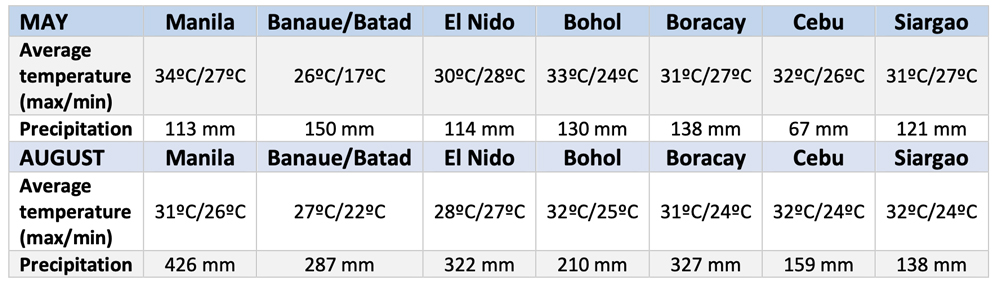
The Philippines is hot all year round, but temperatures climb a little higher in April and May. Still, don’t worry: we’re not talking about the heat of Death Valley at 3 p.m. in August. Highs don’t exceed 33-34°C and lows hover around 22°C in coastal areas.
In our experience, April and May feel a little less humid, so the heat is quite manageable, even when sleeping with just a fan. Get away from the cities and you can enjoy the sea breeze without feeling overwhelmed by the heat. If you tend to get hot easily, of course, book accommodations with air conditioning.
Still, don’t let your guard down: bring warm clothes. You’ll need them on buses, boats, and planes, which turn into freezers.
Traveling to the Philippines in May without enjoying the sea would be a sin, because the water temperature is incredibly pleasant. At this time of year, it ranges from 26°C to 29°C, and the sea is usually quite calm, with good visibility too. That makes it a fabulous month if you’re planning to go diving in the Philippines or go snorkeling.
Here’s a comparison of temperatures and rainfall in the Philippines’ main tourist destinations in May and August:
Does it rain in the Philippines in May?
The million-dollar question! As you’ve seen, in almost all of the Philippines, May isn’t a particularly rainy month. In fact, it isn’t even particularly rainy in the southeastern part of the country (the entire eastern coast of Mindanao, including Siargao, and the coasts of Samar, Leyte, and Luzon).
That said, as we mentioned above, the Amihan usually fades at some point in May, and the Habagat, the southwest monsoon, starts to arrive. There’s no exact date for this, although it’s quite common to start noticing it a little in the third or fourth week. Don’t panic! It doesn’t mean it’ll start raining immediately, though some beaches may get windier depending on which direction they face, and downpours may become a little more frequent. Nothing that will put a damper on your trip.
Of course, while traveling to the Philippines in May usually means fairly settled weather, that doesn’t rule out cloudier skies on some days. The weather can change up to 10 times in a single day!
Are there typhoons in the Philippines in May?
No, typhoons in the Philippines in May are by no means common. In fact, according to sources, it’s the month with the lowest risk of these weather events.
However, we always recommend following the Facebook page of PAGASA, the Philippines’ official weather agency. They issue warnings about typhoons and low-pressure systems roughly 6-7 days in advance. The app Windy also usually works very well and provides a pretty decent forecast a few days ahead.
Still, bear in mind that for this and many other reasons, it’s essential to have good travel insurance for the Philippines.

Malapascua
What’s it like to travel to the Philippines in May?
Traveling to the Philippines in May means you’re still visiting during high season. Prices aren’t as high as in April (when people usually have more time off work and school), but it’s summer, the weather is generally good, and accommodations are a little more expensive. That’s why it’s worth booking a little in advance.
It’s a good idea to avoid the long weekend that often comes with May 1, Labor Day, especially in well-known, easily accessible places such as Siargao, Boracay, Bohol, or El Nido. And, as during most of the year, avoid weekends at the most popular beaches if you’re looking for peace and quiet. Still, take a look at Less touristy islands in the Philippines and you shouldn’t have much trouble finding it.
When it comes to food, April and May are the months when the most mangoes are harvested, and these aren’t just any mangoes: they’re the best mangoes in the world! So make the most of the chance to enjoy the sweetest mangoes of your life. If you can, don’t miss the opportunity to visit the Mango Festival on the island of Guimaras, famous for this fruit.
And speaking of festivals, traveling to the Philippines in May gives you the chance to explore the country’s cultural side in more depth. Besides the festival in Guimaras, there’s the lovely festival honoring Mayon Volcano in Legazpi, the Bohol Fiestas, and the Pahiyas Festival in Lucban. The last of these is particularly colorful: it celebrates the harvest every May 15, and people decorate their homes spectacularly with vegetables, fruit, and kiping (a rice wafer).
Will you be diving on your trip to the Philippines in May? If so, the season for seeing the whale shark in the Philippines is nearly over in Donsol and Pintuyan, but just beginning in Puerto Princesa. It’s also when liveaboard diving trips to Tubbataha start departing, and conditions for visiting Apo Reef are still very good.
Otherwise, it’s a perfect month for enjoying the sea, and there usually isn’t much swell, so you can still enjoy experiences such as the Coron to El Nido expedition or the island-hopping trip in Balabac without worrying.
Our experience living and traveling in the Philippines in May
We’ve been lucky enough to spend May in the Philippines several times and have enjoyed the clear skies this month usually brings. We also don’t remember experiencing any typhoons or prolonged tropical storms during this month, so we have no hesitation in recommending it for your next vacation.
We do recommend planning ahead for the Labor Day festivities and avoiding the most famous beaches on weekends, but beyond that, we highly recommend traveling to the Philippines in May.
We don’t get hot very easily ourselves (you won’t believe us when we tell you that we never use air conditioning and always sleep with the fan off), but we don’t think you need to worry about the heat.

Naked Island (Siargao)
Tips for traveling to the Philippines in May
We think you now have a pretty good idea of what traveling to the Philippines in May is like, but here are a few more tips to help everything go smoothly:
- May is a month with settled weather, so you can take a trip to the Philippines lasting around 10 days without having to make many changes, with your hotels and transportation all arranged. Still, you know we’d set aside a little time. To start planning your itinerary, take a look at our page on Philippines itineraries.
- Although the weather is fairly settled this month, we recommend booking hotels with free cancellation on Booking.com, which offers it on almost all its bookings.
- Unless you’re very used to tropical climates, you’d be better off booking rooms with air conditioning.
- Although this guide is about the weather, and you’ve probably ended up here because it’s something you’re worried about, our advice is not to dwell on it too much and to visit the places that appeal to you most, since the weather is usually settled across the country this month.
- Don’t rely on the usual weather websites like Accuweather. Seriously, they don’t work in the Philippines and will only scare you. Your best bet is to check the PAGASA satellite imagery. The website isn’t very intuitive, but if you see very large “red or yellow patches,” something big is approaching. An easier-to-use app is Windy, but don’t rely on its forecasts more than 4-5 days ahead. Seriously, the weather in the Philippines is incredibly changeable.
- Definitely get the best travel insurance for the Philippines. Don’t take any chances: it’s essential, not only for travel mishaps (flight delays, damaged luggage…) but also for medical care these days. Besides, it’s currently mandatory for travel to the Philippines. Get a 5% discount on the insurance we use.

Boracay
Frequently asked questions about traveling to the Philippines in May
Before we wrap up, we want to answer the most common questions travelers have about visiting the country during this month:
What’s the weather like in the Philippines in May?
The weather is generally very dry, as May is considered summer in the Philippines (along with April). Still, remember that this is a tropical climate, so a downpour can happen at any time, especially during the last week of the month.
What’s the best month to visit the Philippines?
Without making too sweeping a statement, March, April, and May are the months with the most settled weather. We usually prefer March because it’s less hot and destinations are less busy with tourists, but you really can travel to the Philippines all year round.
What are the best islands in the Philippines in May?
You can travel throughout the country without much trouble. You can’t really say that the weather is better in one place than another.
Does it rain a lot in the Philippines in May?
No, generally it doesn’t. Rainfall may start to increase in the last week.
Considering other months? Then you’ll find these articles useful:
Best time to visit the Philippines
The Philippines during Holy Week
Traveling to the Philippines in April
Traveling to the Philippines in June
We try to make everything as clear as possible, but if you have any questions, we’ll be happy to answer them in the comments below.