Swimming with dugongs in Coron is possible and, moreover, an experience that’s hard to forget. Not only that—unlike what happens in Oslob—it’s a fully regulated activity that is respectful of these curious animals, also called sea cows and very similar to manatees.
If you’re thinking of visiting Coron and you’re an animal lover, it can be an ideal add‑on activity. On the other hand, you don’t need any diving certification; you can see them (and, in fact, we think it’s better) by snorkeling, and it’s relatively straightforward.
Feeling up for it? Keep reading because here we’re going to tell you everything about how to swim with dugongs in Coron.
What is a dugong or dugongo
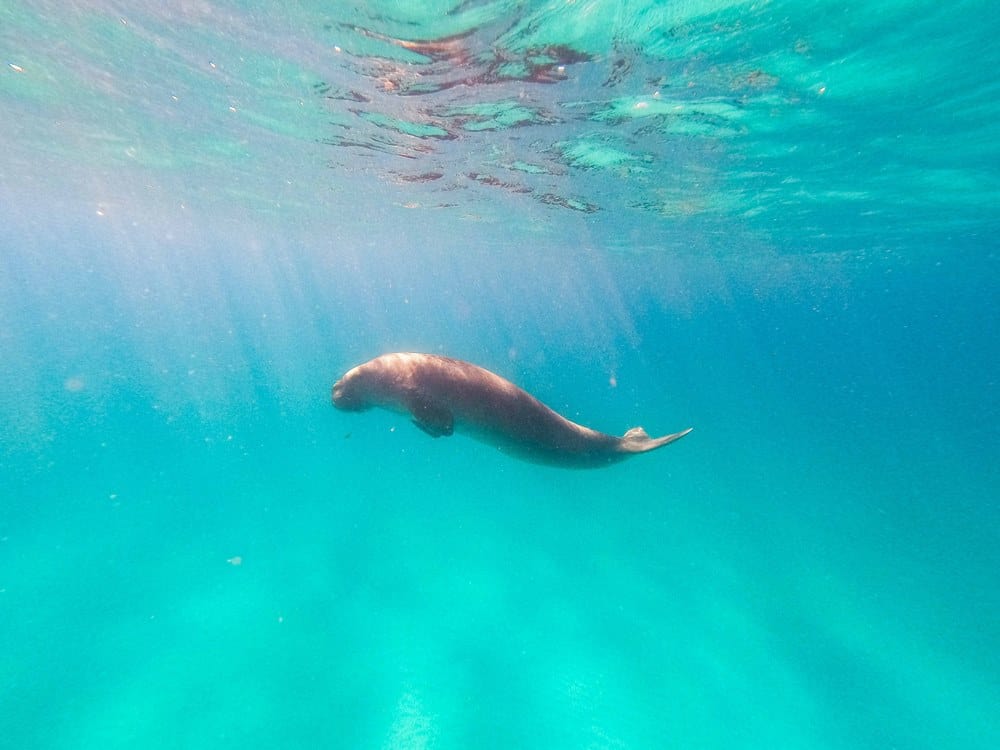
The dugongos or dugongs are sirenian marine mammals very similar to manatees. Although they can be confused, dugongs are a little smaller and mainly inhabit the waters of the Pacific and Indian Oceans, that is, only in salt water. Still, don’t think it’s a small animal. They can reach 3 meters in length and weigh 200 kilos.
They look really curious. With a tail similar to a dolphin’s, they swim in a very similar way, although they tend to move much more slowly. Their snout is flat, as they feed mainly on algae or seagrass, which is also why they are known as “sea cows” (in English, sea cow). In fact, they are the only herbivorous marine mammals (together with manatees) that exist.
Where to find dugongs in Coron
Although the title says “Coron”, the truth is that Coron is how this tourist destination is commonly known because dugongs are actually easiest to see on the northwest coast of Busuanga Island. Specifically, next to a peninsula called Calauit or Calawit and, more precisely, in an area called Aban, to the north.
Of course, dugongs move freely and it’s possible to see them (with a lot of luck) on other nearby islands (over the years we’ve heard of sightings in Siete Pecados, Debotunay, Pamalican, Lusong Coral Garden…), but Aban—the one we’ll tell you about below—and its occasional companions live in Aban (hence the name). Therefore, if you want a 90% chance of seeing one, you’ll need to make the trip to this side of the island and, of course, that takes time and money.
On the map we’ve marked both the location of Aban (in yellow) and those of Coron Town, Salvacion, Concepción, Ocam Ocam, Macalachao and Quezon (in blue) so you can get a sense of the distances.
How to swim or dive with dugongs in Coron
To swim or dive with dugongs in Coron you have different options:
1. Book a diving, snorkeling or freediving tour in Coron Town
There are several dive schools offering this activity, although keep in mind that, since it’s not yet such a popular activity (fortunately), departures aren’t daily. If you need to do it on a specific day, the best thing is to walk around and ask the centers to see which fits you best.
We also know of some freediving experts who put a group together roughly every week and go to Calauit to swim with the dugongs or sea cows in Coron. If you’re interested, we can give you a contact. We were told you don’t need prior freediving experience.
The interesting thing about these two alternatives is that, besides being convenient, they usually take you to other dive spots and, in the case of freediving, to a “manta point”. As you’ve probably guessed, it’s also the most expensive option, with snorkeling prices starting at 4,000 pesos per person. Even so, as we’ll tell you later, if you’re traveling alone or as a couple or you don’t have much time, it’s still an option that works out.
Tours to see the dugongs leave Coron around 8:00 and don’t return until 16:00 or 17:00. Keep in mind that you’ll have to drive 2 hours before getting on the boat. So it’s a full‑day excursion.
Finally, Coron also offers small live‑aboard cruises or live aboards of 1 or 2 nights that combine dugong diving with some wreck dives. As we haven’t tried it, we can’t recommend any particular company.
2. Stay in Concepción, Salvación or Ocam Ocam and do it on your own
If you’ve read us a bit, you already know we’re big fans of exploring the west of Busuanga Island and, from there, doing some interesting island hoppings or dropping by Ocam Ocam. If you stay in Salvación, Concepción or Ocam Ocam Beach (the latter is closer, but public transport is impossible), the starting point to see the dugongs in Busuanga is much more accessible.
From here, you have two alternatives:
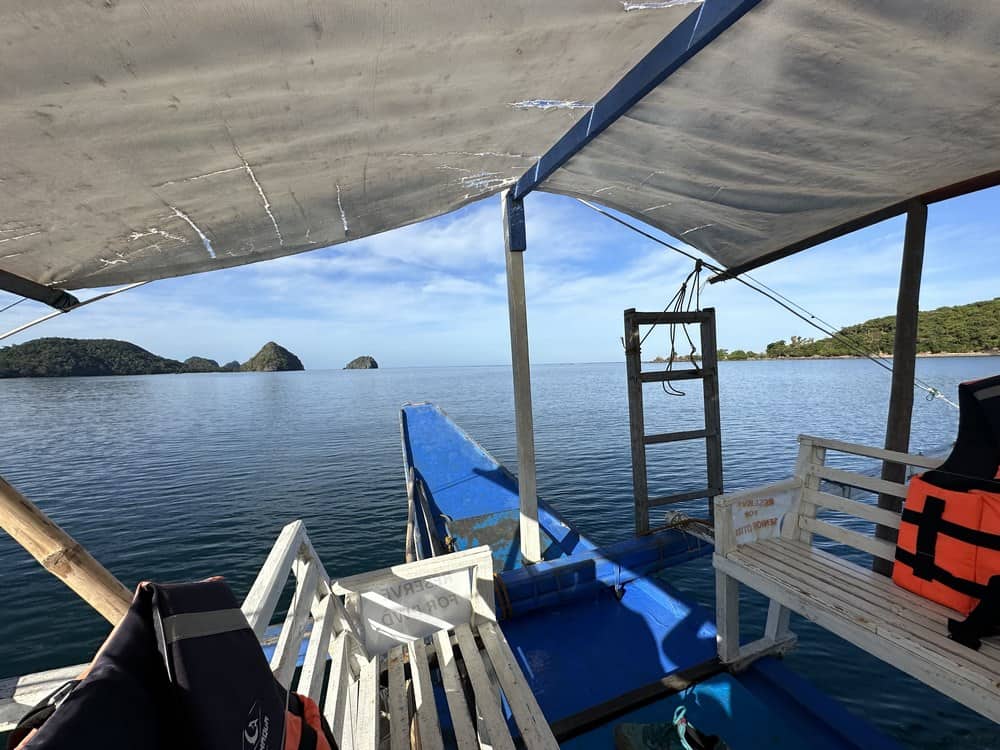
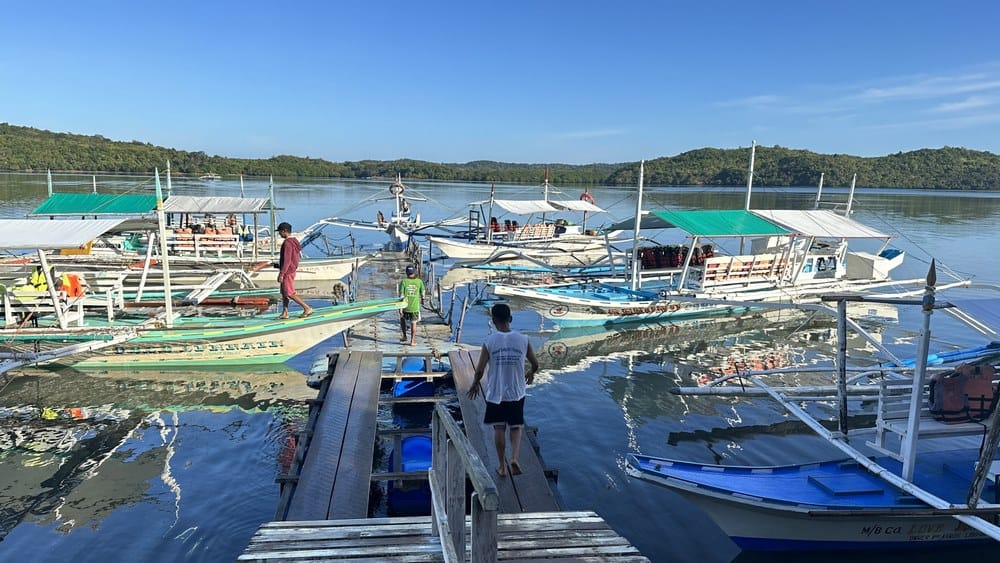
- Go to Macalachao Port: this was the option we chose. The reason? The road that connects New Busuanga with Quezon (where Calawit Dugong Watching, the body that regulates the activity, is located) is not paved and can be dangerous by motorbike, which is the means of transport we chose. From Salvacion it’s about 50 minutes by motorbike on a 100% paved, safe road. Once in Macalachao you’ll need to hire a bangka to get to Aban, a journey that takes about 1 hour. The price is 4,000 pesos, but up to 10 people fit, so if you find other travelers to share with, you’ll save a lot. For that, we have our calendar and we can also give you the contact of the boatman who took us.
- Go to Quezon: the boat from here is cheaper (2,500 pesos) because the route is shorter, but we preferred to pay more to avoid the bad stretch of road. Even so, some travelers tell us a compactor seems to have passed through and, although there are dirt sections, it’s manageable. As far as we know, there’s no public transport here, but there’s a resort, Miley Lodging Restobar, that offers the transfer to Coron for 700 pesos per person (1.5 hours).
In either case, you’ll need to get in touch with Calawit Dugong Watching to make a reservation and confirm the best time to see the dugongs, since they’re usually in the area only when the tide is low. They’ll also coordinate everything so you have a guide waiting for you. Note that you can only snorkel if you organize it with them. If you want to dive, you’ll need to arrange it beforehand with a dive center.
Of course, if there are several of you, you can consider renting a car in Coron Town (approximately 3,000 pesos per day) and going to Macalachao or Quezon to catch the boat. Figure on 2 to 3 hours each way.
How to get to Salvacion, Concepcion or Ocam Ocam
To keep it simple, here’s how to get to the starting point you choose:
- Salvacion or Concepcion: there are a few jeepneys from Lualhati Park in Coron Town, but the most comfortable way is to go in one of the Q Transport vans. They charge 250 pesos to Salvacion or Concepcion. The journey takes 1–1.5 hours.
- Ocam Ocam: you’ll need to rent a motorbike or car, since there’s no public transport. Another option is to contact your hotel and ask how much a transfer would cost, but expect no less than 2,500 or 3,000 pesos, since it’s about a 2‑hour trip.
Accommodation recommendations
If you choose to stay in one of the places we’ve mentioned, here are the best spots to sleep:
- Salvacion: Josefina’s Tourist Inn, brand‑new accommodation with all the comforts. They have double rooms, family rooms and even shared dorms. The best in Salvacion.
- Concepcion: West Atlantic Inn if you want something basic and Al Faro Cosmio for a sublime experience.
- Ocam Ocam: OcamOcam Azur Inn, sublime, with a pool and 10/10 service.
- Quezon: Miley Lodging Restobar, they’re still finishing it, but it even has an infinity‑style pool.
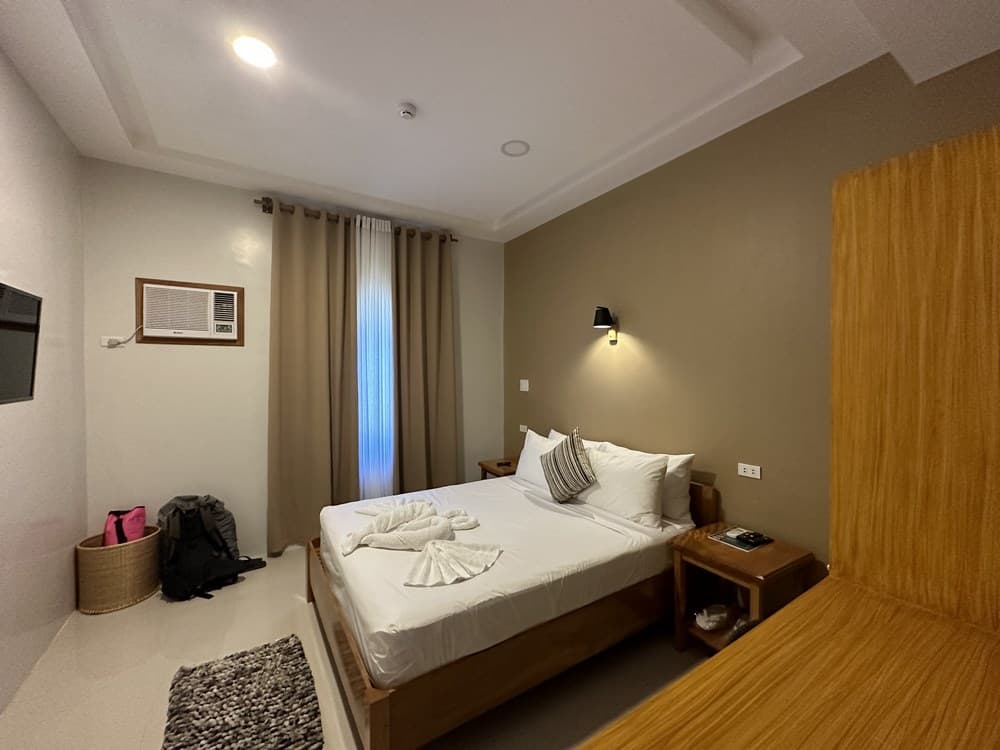
Josefina’s in Salvacion
3. Arrange the dugong tour with a center in northern Busuanga (Decalachao or Maricaban)
This was the other alternative we considered. We’d been told about two people in particular:
- Cheeky Diver: you can stay at their place, and they also organize diving or snorkeling tours with pickup in Coron for 4,000/8,750 pesos (2 dives, with equipment), including lunch.
- Dugong Dive Center, located at El Rio y el Mar Resort: they depart from Maricaban Port (which you have to reach on your own). The price is 3,500 pesos per person for transport plus 1,350 pesos per dive + gear rental + dugong fees (vary depending on the number of people). It seemed the most expensive option to us, but it gives you the option to stay at The Riverhouse, which is great for exploring this part of Coron.
If you like exploring well‑known places we don’t think it’s bad, but we really didn’t consider the savings significant, especially because you’ll have to get yourself here and, as far as we know, there’s no public transport, so you’ll need to negotiate with a tricycle or ask for a transfer.
4. Combine the dugong excursion in Coron with a visit to Black Island (and Ocam Ocam)
Something that’s also recently become possible is going to see the dugongs from Ocam Ocam Beach. It’s one of the prettiest on Busuanga Island and, in addition, the starting point for the spectacular Black Island, one of our favorites. For this reason, we think it’s one of the best options, since on the same tour you can combine a visit to the island with spotting these animals.
Keep in mind that Black Island is almost 2 hours from Coron Town and there’s no public transport, so you’ll have to make your own way. The day will be quite long, so a good idea is to stay overnight for 1 or 2 nights.
You have all the information about this place in our Black Island Guide and if you need a contact for the excursion, you can also leave us a comment below and we’ll send it to you as soon as possible.
How much does it cost to see dugongs in the Philippines
The prices for swimming or diving with dugongs in the Philippines depend on the mode of transport chosen, to which you have to add the fees. As of today they’re these:
- Foreign adult: 550 pesos.
- Child (5–17 years): 300 pesos.
Note that if you’re just one person, it’s 1,550 pesos and, if there are 2 of you, it’s 2,100. This is because it includes a guide and a boatman. That is, the 550 pesos per person starts counting if there are 4 people.
Of course, you’ll have to pay in cash. Fin rental and snorkel, if you don’t have them, are 200 pesos.
We, since we went to Macalachao, paid: 500 pesos for the motorbike rental + 100 pesos of fuel + 4,000 for the boat + 2,000 for the fees = 6,600 pesos (3,300 pesos per person). To this cost you’d have to add staying in Concepcion/Salvacion, meals and so on.
When can you see dugongs in Coron
According to what we were told there, unlike whale sharks, dugongs are always in the area.
The activity can be done Monday to Sunday from 8:00 to 15:00, but it’s best to confirm in advance in case opening hours change and because of what we mentioned about low tide. They’ll be able to advise you on the best time to do it.
Note that they’re closed on the 30th of each month, January 1, Maundy Thursday and Good Friday, April 10, June 10, December 25 and, most importantly, the entire month of September.
What it’s like to swim with dugongs in Coron: our experience
In our case, since we came from Macalachao, we had to go around the Calauit peninsula until we reached the coast opposite Aban. This is a bay of clear waters with shallow areas (around 5 meters at low tide) where you can find beds populated with algae, the dugongs’ favorite food.
Once there, the guide (bantay dugong, the “protector of the dugong”) got on our bangka until it was our turn to get into the water. Only 4 people can swim or dive alongside them, so it’s quite possible you’ll have to wait a bit. Before anything else, you’ll receive a short talk with the interaction rules.
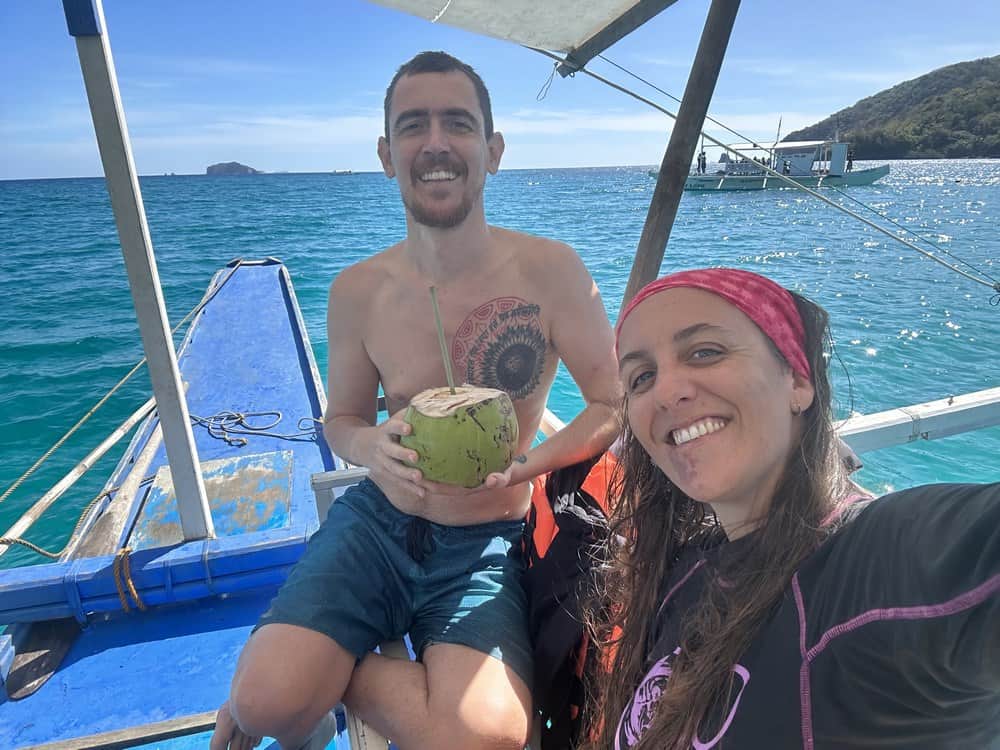
When it was our turn, we slipped more or less quietly into the sea until we reached the point where he was. There we started to freak out and swam calmly next to him for the maximum 15 minutes the interaction lasts (on days with few tourists it’s stretched a little longer). The guides tell you when these end and it’s time to return to the boat. There we paid the fees, bought a coconut that a man in a small boat offered us (50 pesos) and, when we were ready, we returned to Macalachao.
On the other hand, although we speak in the plural, the truth is that usually only one dugong is sighted: Aban. Known as such because he’s usually off the coasts of Aban, he’s the least skittish. He calmly eats algae and even sleeps while we all marvel at him. The guides told us there are more dugongs (some females), but it’s not normal to spot them or, if you do, they quickly swim away.
Is all the effort (and the price) worth it for 15 minutes swimming with a dugong? From our perspective, as animal lovers, yes, but it depends on each person’s tastes. For us it was a beautiful, relaxing experience. It was our first time with one of these animals and we were blown away!
Regulations for this activity
Most importantly, you should know and follow the rules for swimming with dugongs in Coron:
- Only 40 people per day can swim or dive with the dugong. That’s why you have to book in advance.
- For every 4 people there must be a guide (bantay dugong) and a dive master (if diving).
- You can only remain for 15 minutes per dive or snorkel. This is strictly enforced for both diving and snorkeling. Until one group (of up to 4 people) finishes, another doesn’t go.
- You must keep a distance of at least 5 meters from the dugong and you can’t get in front of it to block its path.
- Of course, it cannot be touched.
- Silence should be maintained as much as possible.
- If the animal shows signs of stress or wants to leave, it must not be pursued.
- No photos with flash.
- You can’t jump into the water; you have to go down the ladder slowly so as not to stress it.
- Drones are not allowed.
As of today, all these rules are followed, and that’s why we consider it an ethical, respectful activity for the animal. We were just the two of us with the guide for 95% of the time. In the end two divers (with their dive master) came, but we really didn’t see the animal stressed or uncomfortable at any time. On the contrary… he literally fell asleep in front of us.
Please, if you go and notice anything strange, let us know because we’ll be the first to stop recommending it.
Tips for swimming with dugongs in Coron
These are the details or tips we think are most useful to know for diving or swimming with dugongs in Coron:
- Carefully weigh the alternatives to choose the one that suits you best depending on the time you have and the level of comfort you want. From our perspective, if you’re traveling solo or as a couple and the dates line up, the freediving excursion (no experience required) from Coron is a convenient option and has the plus that they usually take you to see mantas for just a little more. If you plan to stay in Concepcion or Salvacion because you’re going to do more island hopping, you can do it just as we did: on your own and from Macalachao Port.
- Although we’re divers, we don’t think it’s worth paying the diving surcharge. The area where dugongs are usually found isn’t deep at all and most of the time they’re at the surface. We think snorkeling is very enjoyable.
- Bring your own snorkeling gear and, if possible, fins. If you don’t have fins, the interaction center rents them for 200 pesos, but you have to be very insistent. In our case, they forgot, and although we enjoyed it, we would have been more comfortable with fins.
- We recommend bringing a sun‑protective shirt. Please avoid using non‑biodegradable sunscreens so as not to harm the animal.
- Don’t forget to take out solid travel insurance. In this case, we recommend IATI Mochilero, which covers both diving and snorkeling. With our link you get 5% off.
We hope we’ve helped you crack the puzzle of how to swim or dive with dugongs in Coron. As you can see, there’s a lot to it and we had to research quite a bit to find the way that best suited us. Of course, if you have any questions, we’ll be here to help.
This is just a small guide within our huge Coron Guide. Don’t miss it if you’re planning your trip.