To be honest, before doing our first expedition (the Coron to El Nido Expedition) we had a few doubts about signing up for something like this. Will it be worth it? Won’t it be too long? Is it safe? What will we eat? What will the boat be like? And so on.
But as you’ve probably guessed—since we jumped right back into a new expedition—this experience stole our hearts! Not only did it not feel long, but saying goodbye to our travel companions on the last day truly made us sad. That’s why, after that first adventure, we decided to go again with this one through the waters around Busuanga.
In this guide we’re going to tell you all the details so you also fall in love with one of our favorite things to do in the Philippines. Ready? We’re boarding the Coron – Coron Expedition!
What is an expedition in Palawan and which one to choose
You already know that the top activities to do in El Nido and Coron are their island hopping tours. Over a full day, and aboard a classic Filipino outrigger boat (a bangka), you visit gorgeous beaches and islands in the area, marveling at dramatic karst rock formations, dreamlike seabeds, and beaches you won’t want to leave. Once it’s around 4 or 5 in the afternoon you’ll return to dry land and this experience will be over. Expeditions go much further.
For 3 or 4 days you’ll be visiting incredible places without returning to Coron or El Nido Town. Depending on the expedition you choose, you’ll visit some of the most in-demand stops from their respective island hopping routes, but (and here’s where the big differences start) you’ll also head to other islands or snorkel spots much farther from the main tourist circuit and you can often be practically alone.
At the end of each day’s itinerary, it’s time to moor the boat at a small island, take a shower, and get comfy in the simple seafront huts where you’ll sleep. The next day… breakfast in paradise and off to discover new places!
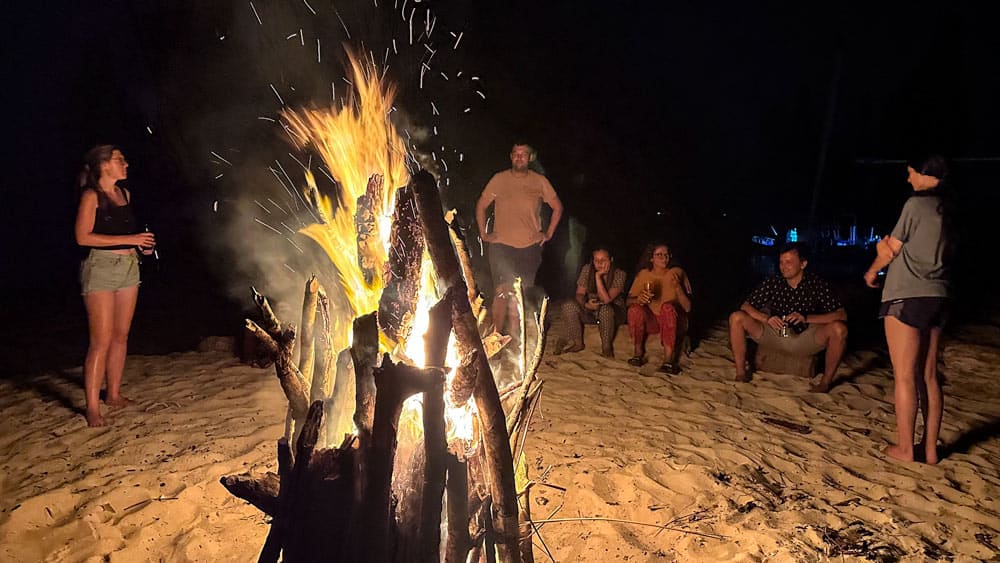
How could we explain it? What you truly take away from this experience is what they call “island life”—and rightly so. It’s the overall idea or feeling you’re left with. You’ll remember the cool scenery you’ll see, but also that experience of spending several nights in castaway mode, sleeping in little huts on far-flung islands and getting to know Filipino culture a bit better (we’ll tell you, but the crew is so loving you’ll want to take them home). Those breakfasts and dinners by the sea with only the sound of the waves and the birds. We don’t know how to express it better; it’s a certain something you don’t get on regular island hopping, and it hooks us.
We’ll talk about the boat later. Since these are open-sea crossings, we can already tell you it’s not the typical bangka used on regular island hopping—here you can expect far more comforts.
Who do we recommend an expedition for?
Honestly, for everyone. We estimate the average age to be around 30, but we’ve shared routes with all kinds of travelers—from an 18-year-old Australian couple on their first trip to a daughter traveling with her mother in her late 60s. The boat’s comforts and the great vibe you feel on an experience like this make it something we recommend to everyone. Just keep in mind that children are not allowed.

Which expedition to choose
When we decided to do our first expedition, we didn’t think twice and quickly signed up for the Coron to El Nido Expedition (it’s also possible to do it from El Nido to Coron). The other option was to do the Coron to Coron Expedition, and we thought that having been to the Coron area so many times, it wouldn’t interest us much. How wrong we were!
Now that we’ve done both expeditions, it’s really hard for us to choose one over the other because we’re fascinated by both. With the one that connects to El Nido you can explore the Linapacan area in more depth—which we love—but you’ll also have to do longer crossings between points because the distances are much greater. The Coron to Coron Expedition, while visiting places off the classic tourist circuit, doesn’t involve as many hours of navigation and has epic islands waiting for you that you wouldn’t discover if you only did Coron’s classic island hopping—like, for example, our beloved Black Island.
Believe us: by the end of the itinerary you realize it’s not so much about the stops you’ve made (most people don’t mind either way) but the overall experience—and here the key, without the slightest doubt, is the service and the boat.
Whichever you choose, trust us, you’ll get it right. And not only because of the experience of going from island to island and sleeping in camps all to yourself, but because the crew at Big Dream Boatman (the company we’ve done the expedition with twice—and hopefully many more) is one of the main jewels of it all. They’ll make your trip pleasant, fun, moving, and comfortable… They’re incredible.

What the boat is like on the Coron to Coron Expedition
As we mentioned earlier, the boat used on the Coron to Coron Expedition isn’t like the classic bangkas that do the tours around Coron Island. Big Dream Boatman (as of today the only company that runs the tour exclusively around the Coron area) has several boats, but more or less all follow the same pattern:
- They have a ton of space—really a lot. On our Coron expedition we were 14 travelers, and it was possible for each person to do their own thing without bothering others. Spending 3 days all sitting elbow to elbow could feel a bit suffocating, but with this type of vessel you don’t have to worry about that.
- On the sides of this super bangka, as you can see in our photos or videos, there are huge nets to stretch out on comfortably during the crossings. Sleep, read, listen to music, enjoy the scenery… You decide how to use them. Claudia spent half the trip there.
- The rear–upper area has 5 mattresses split between shade and sun zones where you can relax with views over the whole boat and the sea horizon. This is where Jairo set up camp while we were sailing.
- Inside, next to the kitchen, there’s a small toilet in case you need to go while at sea or want to change clothes.
- In the central area of the boat there’s a large table where you’ll eat the delights the chef prepares for lunch as well as surprise snacks—perfect after getting out of the water from snorkeling among fish of every color.
- There are several coolers (non-electric) where at any time you can grab a soft drink, some water or, why not, a drink to celebrate the adventure you’re living.
“What about luggage?” This was one of our main doubts before doing our first expedition. It’s not unusual during island hopping for rain and waves to splash into the bangkas. We travel with quite a bit of electronic gear and weren’t sure whether to risk it or not. Now, after two expeditions, we can assure you: worry zero.
The lower deck of the Coron to Coron Expedition boat is a huge “trunk.” Before starting the journey they usually ask that everything you won’t use over those 3 days stays there and that in your small backpack you keep on top what you do want handy. They cover this lower area with a large plastic tarp that helps keep everything dry. On the other hand, what you leave on deck will also be safe—under the table, in the captain’s cabin, on the seats, on top of the mattresses… We’ve carried the backpack with laptops, the drone, and the camera there, and it’s been safe at all times. One less problem!
To show you what we’re talking about, we’ve put together this video where we show you the boat we did the Coron – Coron expedition with:
What’s the best time to do the Coron to Coron Expedition?
Weather-wise, the best time to do an expedition like this is between November and May. July and August coincide with the rainy season in Palawan, when many more showers can occur. In fact, as you can see on Big Dream Boatman’s own page, they only offer expeditions until mid-July. After those dates they take a break that coincides with the rainy season.
Another important point to keep in mind—which we never tire of repeating—is that during Christmas and Holy Week there’s usually more local tourism. This means flights, hotels and, yes, this type of activity fill up earlier. If you wait too long to book, you could miss out on a spot.
Lastly, and partly “our fault,” these expeditions have become more popular and now sell out outside those dates too. If you don’t book in advance, it’s very easy to be left without a place.
How long does the Coron – Coron Expedition last?
The Coron to Coron Expedition lasts 3 nights, which is more than enough to explore this area. As we already told you, the other expedition requires many hours of navigation, but on this one you can visit the different spots without spending so much time on board.
That said, a “little bird” told us they’re going to tweak the Coron Expedition soon. We can’t reveal anything yet, but if you’re doing it from the 2023 – 2024 season onward, it’s very possible there will be changes. As soon as that happens, we’ll update it here.
What to pack for an expedition like this
After you reserve your spot on the Coron to Coron Expedition, you’ll receive an email that, in addition to telling you where and what time to be there, asks you to split your luggage in two.
Your “big luggage” will go on the lower deck. The idea—and what they ask—is that, as much as possible, you try not to leave anything there that you’ll want to use later. If you forget something important down below, no problem: they’ll open it for you and you can grab it; but since there are 14 people all with luggage, it’s much more comfortable to try to follow this guideline.
Your “travel backpack” will go on the upper deck. We always go with one backpack each (typical school size) and a dry bag where we give priority to electronics and important documents. From our experience doing this type of expedition, we recommend you take:
- Sunscreen: Essential both for when you’re on the different islands and for the sailing stretches. Forget this and you’ll get burned and, beyond the long-term issues, you’ll lose a lot of energy to keep enjoying the adventure. We recommend—and please—choose a reef-friendly sunscreen that doesn’t damage corals and marine life. We suggest this one: Eco sunscreen.
- Travel insurance: It’s not something you’ll physically put in your backpack, but it is one of the mandatory requirements to do the expeditions. When you go to book, they’ll insist you have one. As you know, we really stress the huge importance of having one, beyond it being mandatory. Here we talk about the best one: Best travel insurance for the Philippines. And here you have the discount for your policy: 5% discount on your travel insurance.
- Towel: As we mentioned in our guide on the expedition that connects with El Nido, the only thing we missed is being given towels. We always travel with our quick-dry towel and would love to use it just for the beach and have them provide one for showering. The funny thing is we’ve talked to several travelers and they were given towels. Maybe it was just bad luck for us on both expeditions?
- Clothing: Take the minimum. On the one hand, that way everything fits in a single backpack, and on the other, you won’t need much. For footwear, flip-flops will do (on Black Island, water shoes help a little, but they’re not essential). Then pack the minimum underwear, T‑shirts, and swimsuits and you’re set.
- Toiletry kit: Also the bare minimum. Toothbrush, toothpaste, and whatever soap you need for showering.
- Dry bag: For us it’s a must. Both to keep valuables safe in case of rain or waves, and if you want to snorkel from the boat to shore and take the drone, camera, phone… In the Philippines they’re cheaper, but if you want to bring one from home already, check this out: dry bag for travel.
- Electricity: Every camp is different. On the ones we stayed at on this Coron expedition we had electricity in both huts (though on a limited afternoon/evening schedule). In that sense we have 3 recommendations. First, get a power adapter. Both here and in other parts of the Philippines you may run into old sockets that don’t work with European plugs. For example: this international adapter. Second, we always travel with our beloved “cube power strip.” Besides taking up much less space than a typical strip, it helps us charge everything at once where there’s only one outlet. Have a look at this one: cube-shaped power strip. Lastly, another gadget that always travels with us is a portable battery so we can also charge the phone on the boat if needed. With 20.000 mAH you’ll be fine, like this: portable travel power bank.
- Photography and phone: Of course, some type of camera is a must to capture unforgettable moments from this beautiful experience. A GoPro for snorkeling among fish, coral, and the sunken ship that awaits you; a drone if you want epic aerial views; a camera for photos from the boat or beaches; or your phone to post to social media or send to friends. Speaking of phones, don’t expect much signal. You’ll have more than on the El Nido expedition, but in some places there’ll be no coverage (that’s part of the charm, right?).
- Snorkel: We always like to take our own snorkel mask on trips. The expedition has several to use, but we prefer to use our own. We avoid putting our mouths where others have and we’re sure they don’t fog up as easily. We take these: snorkel mask and tube.
How was the food during the expedition?
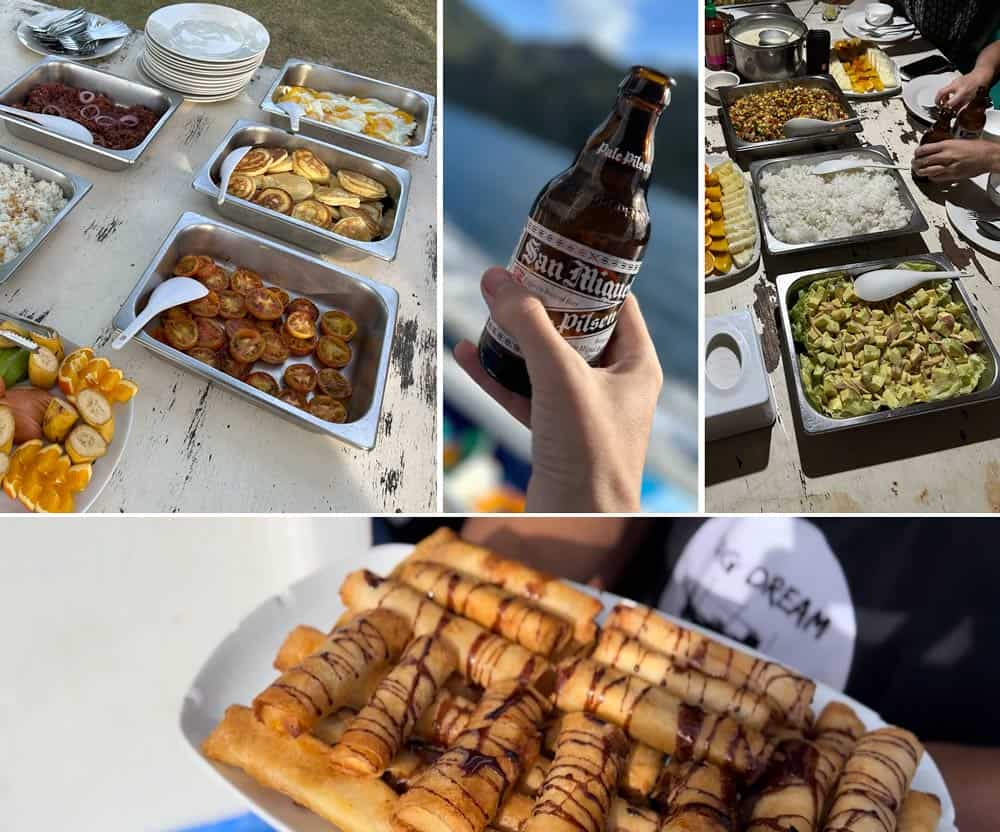
The bar was VERY high. The first time, chef Ramón delighted us with quality and variety that blew us away. Both at main meals and with surprise mid‑day snacks, everything was delicious.
We went into the Coron expedition already knowing the food is way above the basics served on island hopping tours, but without expecting to reach the level of the first time and… we were wrong again! The variety of dishes was overwhelming—from vegan options (let them know when booking if that’s your case and they’ll take great care) to fresh seafood and fish—plus all sorts of really tasty Filipino dishes. As for quantities, there was no issue either; there was always food left over, and not because it wasn’t delicious.
Breakfasts are generally served at the different camps and include everything from tasty pancakes to fruit, plus the typical meat‑and‑rice combo in pure Filipino style.
If during the expedition your partner has a birthday or you’re perhaps on your honeymoon in the Philippines, let them know in advance and they can surely do something special. On the last one they brought out a delicious chocolate cake to celebrate one couple’s recent wedding.
Which company to choose for the Coron to Coron Expedition
Currently, the only company offering the Coron to Coron Expedition is our beloved Big Dream Boatman. We only have good words for them—and it’s something you’ll understand and share once you do your first expedition.
On a personal level, they’re incredible. It really seems like they’ve cast the friendliest, kindest, funniest, and most professional Filipinos and put them all to work for the same company. They’ll look after you at all times, they’ll make your experience a 10, and, no doubt about it, when you say goodbye to them on the last day, you’ll be sad to say goodbye until next time.
Beyond their fantastic crew, which truly plays a hugely important role in all this, there are also their boats. Compared to what we’ve seen from other companies that run the other expedition, Big Dream Boatman’s are more modern, newer, and more comfortable (except for one from TAO Experience that’s extra‑luxury—and costs a small fortune).
Another point that makes us always recommend BDBM for both the Coron to Coron Expedition and the one to El Nido is their value for money. We’ve compared prices and, by far, they have the best price for what they offer.
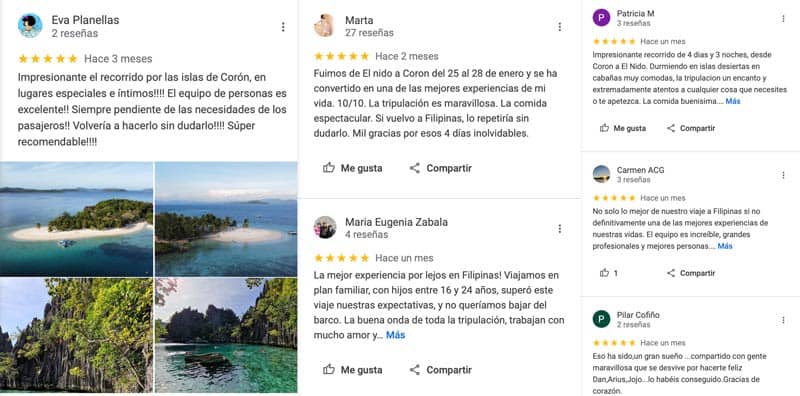
And it’s not just us saying it—if you take a look at other travelers’ reviews on Google, you’ll find things like these:
How much does the Coron to Coron Expedition cost
Since it requires fewer kilometers over open sea, this is the most affordable expedition, around $500, and it includes everything:
- Three days of travel.
- Entrance fees and charges for all islands and snorkel spots.
- Use of masks, snorkels, and even some water shoes.
- Premium boat.
- Accommodation for three nights.
- All lunches, dinners, and breakfasts.
- Unlimited drinks.
- Use of kayaks and paddle board.
The longer expedition usually costs about 50$ more, compared to the 700$ it can cost you with other companies. You can check prices and availability (remember that spots are limited and go fast) by clicking here: BOOK THE EXPEDITION.
Itinerary of the Coron to Coron Expedition, our experience
Now that we’ve told you everything you need to know about this expedition (what to pack, best time, best company, prices, etc.), you’re probably itching to know: “ok, but which places will I discover?” Below we’ll tell you the route we did; however, it’s important to be clear that it’s not a fixed route. You’ll usually see the same number of places, but not always the same ones. Depending on weather conditions and how the camping areas are booked, your route will vary. If any of the islands we show here don’t end up in your itinerary, it’s because you’ll be going to others.
In our case, there were a couple of islands we’ll show you at the end that weren’t on our route. Since we had previously visited them on our own, we’ll show them so you can see the wide range of wonders waiting for you there.
Day 1:
As you’ll see in the dossier they send you when you book, they’ll give you a specific meeting place and time. It’s usually the upper floor of a restaurant near the port. Travelers who will be part of this adventure will start arriving there. In these first minutes they’ll all be strangers to you, but in three days you’ll surely feel a bit sad to say goodbye.
Here they’ll explain again how the luggage works, collect any remaining balance, and you’ll head to the boat where you’ll be welcomed with a fresh juice. Once the crew and passengers have been introduced, engines on!
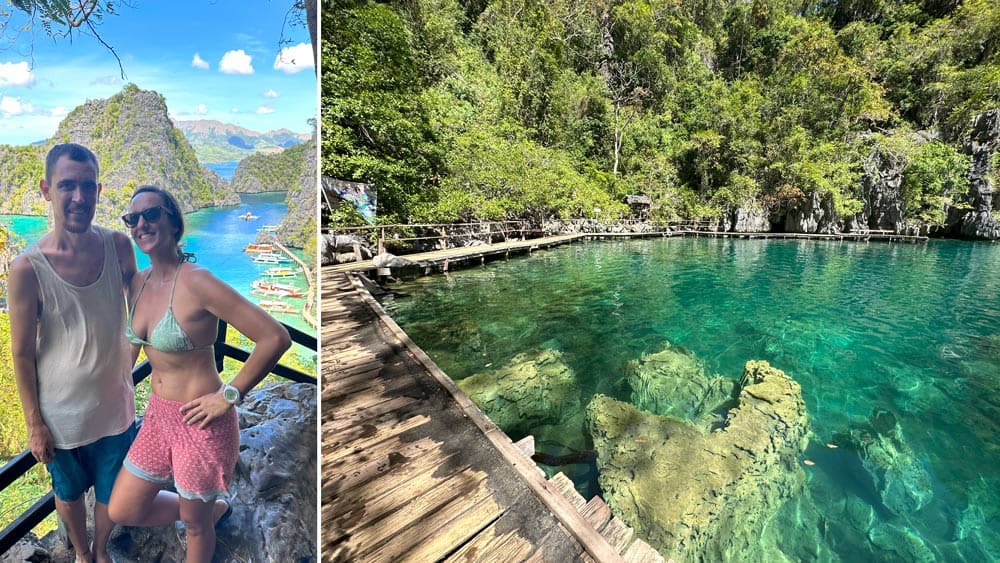
Kayangan Lake
What can be said about Kayangan Lake that hasn’t already been said, right? This is one of the top spots on Coron’s island hopping and the starting point of the expedition. By arriving later than the early birds and earlier than those who go around lunchtime, it’s very possible that, like us, you’ll have it almost to yourself.
After getting off the boat, walk along the wooden boardwalk and climb a few steps (the effort pays off!) to reach the viewpoint where one of the most sought-after photos in the Philippines is taken. Catch your breath after the climb and then, calmly, head down to the lagoon.
No matter how many times we’ve visited Kayangan Lake, we like it more every time. This beautiful lagoon mixes fresh and salt water and is surrounded by monumental karst rock walls. Don’t forget your snorkel mask and head to the side of the lagoon opposite to where you arrived. Here, under the water, there are some spectacular rock formations that one of your guides will help you discover—there’s almost always a freediving expert.
Twin Lagoon
Our second stop was another of Coron’s crown jewels, the gorgeous Twin Lagoon. Sometimes they drop you at a wooden boardwalk away from the entrance—which is very pretty to walk along—and other times directly at the entrance. Wherever you start, once you jump into the water you’ll have to go through a small tunnel and—boom!—you’ll find yourself in the middle of a huge crystal-clear lagoon surrounded, once again, by the imposing rock formations that made Coron so famous.
You don’t need to bring your snorkel mask here, but a great plan can be to take the kayak or paddle board that’s included on the Coron Expedition boat.

Pass Island
After enjoying our first meal on the boat near Coron, we headed to Pass Island, a tiny and beautiful island that was our first camp. Once the crew unloads all the luggage, it’s time to assign rooms. On our first expedition some slept in tents and others in huts. This time, thanks to two couples of friends who agreed to share the big hut together, we were all able to sleep as couples in the remaining huts. They’re super simple but more than enough and also have electricity between approximately 18:00 and 22:00.
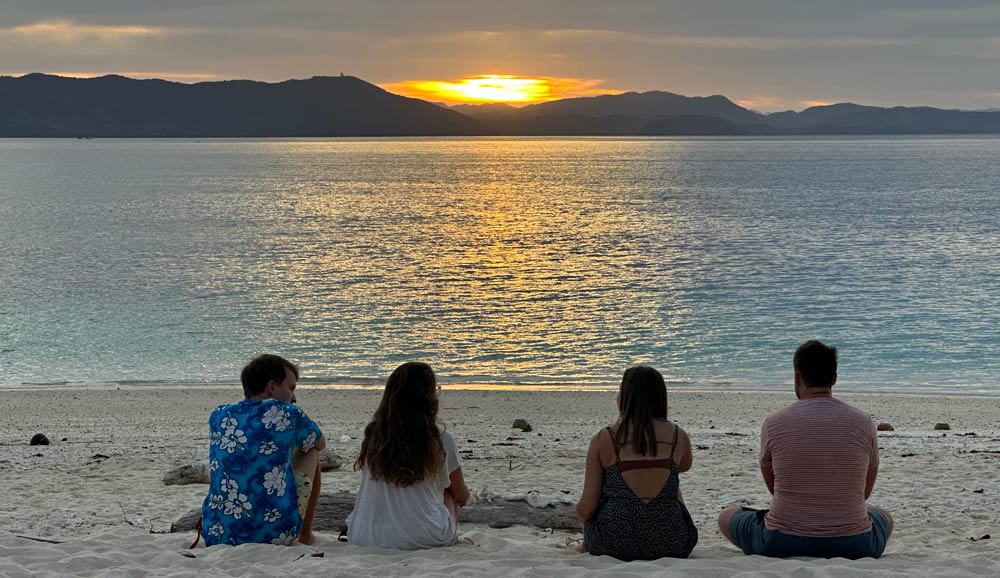
Take a stroll around the island, go snorkeling (it’s great—at shallow depth you’ll see all sorts of things, including a ton of giant clams). One girl even circled the whole island on a paddle board in about 30 minutes. Then don’t miss the sunset from its main beach. Once the sun went down and it got dark, we all headed to the shore and, after stirring the water, pretty bioluminescence started to appear. Give it a try!
After dinner and some laughs together (and a drink or two), we turned in to be 100% ready for the next day.

Day 2
Day 2 began with pancakes, coffee, fruit, and rice. After packing up and saying a temporary goodbye to Pass Island, the Coron to Coron Expedition set course for another of our favorite islands in the area.
Black Island
This crossing is perhaps one of the longest on this expedition (about 2 hours), but with a boat where you can stretch out comfortably anywhere, it’s actually nice to experience.
We’re obsessed with Black Island. The first time we visited we were overwhelmed by that small beach guarded by its huge cliffs, and this time was no different. After disembarking, we all went together to its cave. Arryus, one of the expedition guides and a guy who cracks one joke after another, invited us all to enter the hidden natural pool as a group. After a few minutes of silence and respect for the island’s ancestors, the laughter exploded again and some of us jumped into a nearby pool from about 4–5 meters high.
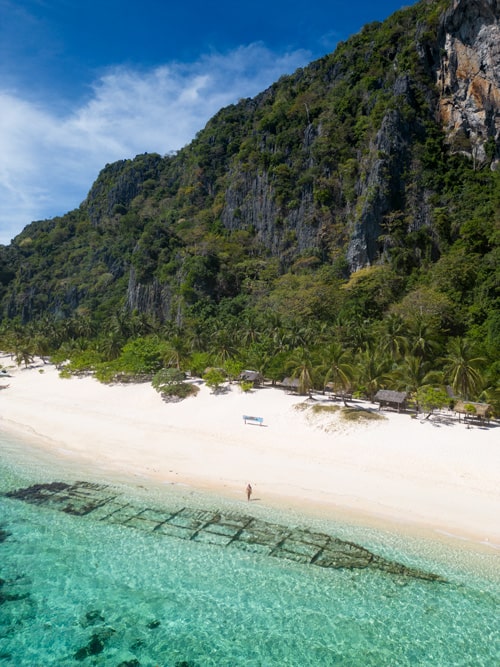
The good thing about returning to Black Island with a guide is that they know the island inside out. On our first visit we had to swim for a while to reach the cove next door, but this time they showed us a cave which—after climbing wooden stairs and squeezing through holes—led us back to the water. It was such a cool exploration!
After eating something tasty while moored in front of the island, we set course for our next destination.

Maltatayoc Island
The next stop on the Coron Expedition is anything but small, even if it’s totally different from the previous one. Maltatayoc Island is a very long and, at the same time, very narrow island that ends in a beautiful sandbar.
It’s a great plan to get off and walk along its sandy stretch or take a dip on the side sheltered from the wind, but don’t hesitate to grab your snorkel mask and check out the biodiversity waiting for you a few meters from the end of the sandbar. Ask the boat’s crew and they’ll tell you the best place to try to see coral, rays and, with a lot of luck, a whitetip reef shark.
North Cay / South Cay
These two sister islands are very close to each other, and it’s possible to stop at either one. They’re two small islands you can circle in minutes and that sometimes also serve as a base camp for the Coron – Coron Expedition.
What to do here? Enjoy beachside relaxation and, once again, have a blast at the nearby snorkel areas.
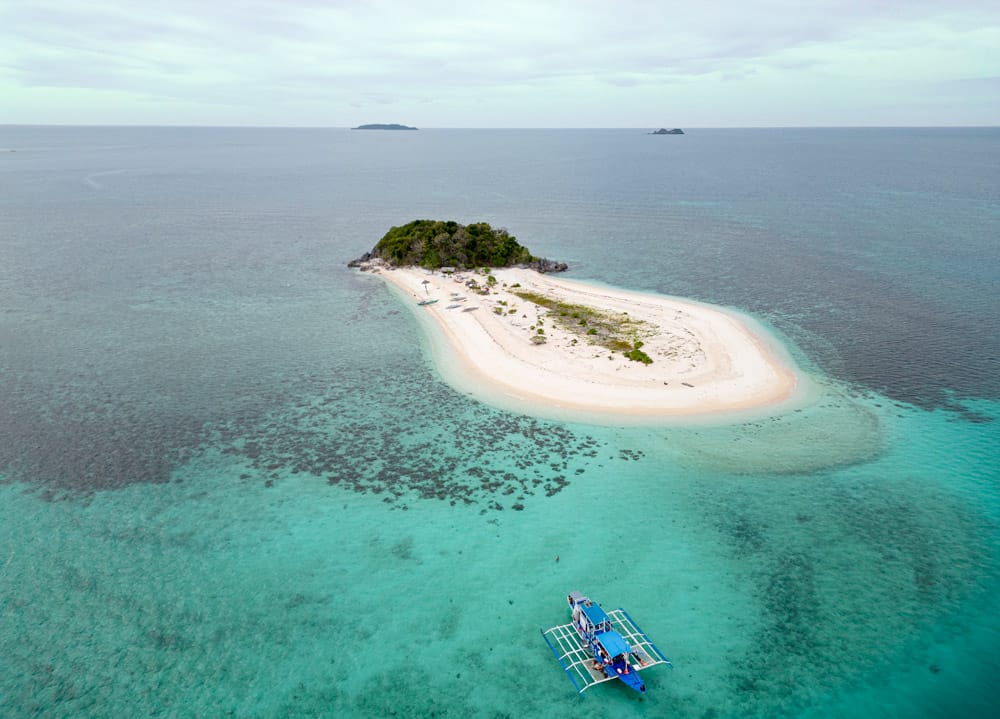
Debutonay Island
Debutonay Island was our base camp for the second night of the Coron to Coron Expedition. Depending on the time you arrive, it’s a great plan to go for a lap around with the kayak or paddle board.
We went snorkeling hoping to see some of the dugongs that rarely show up in the area. We didn’t manage it, but instead we saw barracudas, beautiful coral and—surprise!—3 or 4 turtles, which we even managed to film with the drone.
The huts here are smaller than those on Pass Island but more than enough to sleep with sea views. Although it’s hot during the day, a light extra layer doesn’t hurt because at night it can get cooler in huts like these.

Day 3
After another great breakfast, we set off to enjoy what would be the last full day of the expedition—a day focused heavily on snorkeling.
Pamalican Island – Snorkeling
The first stop was the snorkel spot in front of Pamalican Island. The truth is the island itself wasn’t on the route, only the swimming area; but since we have the utopian mission of stepping on more than 7,000 islands of the Philippines, we swam over and officially added it to our list of islands visited.
Once the island was “conquered,” we joined the rest of the group to discover the area’s seabed.

Lusong Gunboat
Lusong Gunboat is a place we’d visited before, but it always surprises us with something new. It’s a shallow shipwreck that’s easily accessible while snorkeling.
Over the decades it’s been submerged, all kinds of corals and fish of every color have settled in. Every time we go, we find different surprises. This time, in addition to the corals and colorful fish—which are the minimum you’ll see there—we also spotted turtles, a school of squid, and a huge Napoleon— a fish with a very large head that will surely surprise you.
Lusong Coral Garden
Very close to the shipwreck is another of our favorite snorkeling spots in the Philippines. This reef surrounding Lusong Island boasts a massive amount of coral in every color.
Ideally, start on the side where the current comes from and let it carry you while you discover everything this seabed hides.
Pass Island
Our third and final night of the expedition was again on Pass Island, and we all got back the rooms from the first day. As we mentioned at the beginning, each Expedition is unique and you might sleep here just one night or even none.
If you do return via Pass Island, we recommend wrapping up the day with one last snorkeling session. Near the shore there’s a very pretty area where you can see giant clams and coral very close to the surface.
The last night of the expeditions is usually synonymous with a party. After three days together, those strangers from day one aren’t so strange anymore, and you’ll very likely end the night dancing and singing with them. Of course, if you want to rest, you can do so peacefully from your hut.

Day 4
When booking your expedition you’ll have seen that those going to El Nido are 4 days and this one is 3. So this fourth day is basically for returning to Coron Town. Depending on the time you leave and the schedule of the following expeditions, you might get an extra stop on the way, but normally this day is just for the return.
Let’s take the chance, though, to tell you about two islands that weren’t on our route but that we know can also be included in the different versions of the expedition.
Ditaytayan Island
The first “extra” island we want to introduce is Ditaytayan Island. It’s included on most expeditions with El Nido and on some of the Coron ones. As you can see in the photos, it’s a huge crescent-shaped sandbar with fine white sand.
If you’re looking for shade, you can settle into one of the hammocks in the green area. We recommend putting on your mask and snorkeling on the inner side, since we were able to see a great variety of marine life there.

Banana Island
Another island that’s sometimes used as a camp on this Expedition is Banana Island, a bit closer to the previous one relative to Coron Town. Here you’ll also find a beach that, as on Pass Island, juts out from the rest of the island and is ideal for watching the sunset.
In addition, its crystal-clear waters invite you to swim and discover what lies below.
Frequently asked questions and tips for the Coron to Coron expedition
Before wrapping up this guide, we’re going to answer the most frequent questions that usually come to mind before signing up for this unforgettable adventure. For example:
I’ve read there’s unlimited alcohol—is this a party boat?
Not at all! We’ve done two expeditions so far, and we can assure you that nobody signs up for something like this looking for a party. Some people have a beer at lunchtime, others a soft drink at sunset, and on the last night whoever wants a drink is served one—but always within a normal, non-party vibe. We’ve shared this experience with everyone from young people to a lady of almost 70 (mother and daughter traveling), as well as a couple on their honeymoon. No one is trying to drink beyond the social.
If the Coron – Coron Expedition is full, do you recommend another company?
No. If you’re really keen to try the experience, we suggest trying to move your itinerary so it lines up with available dates, or go for the Coron to El Nido Expedition (or El Nido to Coron), which you can check here: Ver disponibilidad en la página oficial.
How much money do I need during the expedition?
Zero. It’s all included—from accommodation and food to the fees for each island. On the last day, upon arriving back at Coron port, when the crew officially said goodbye, we quickly placed a box in the middle of the boat’s table and encouraged all travelers to leave a tip for the amazing and caring service received. Most of us put about 1000 pesos per person, but some were more generous and raised that figure quite a bit. It’s up to you and how you felt about the adventure in the end.
Will I have hot water?
It’s not guaranteed, but it’s possible. Each of the islands where you sleep has different facilities. One of them, as far as we know, has hot water. On the rest, the water comes from a tank that spends so many hours in the sun that—even though we’re quite sensitive to the cold—it’s never actually felt cold to us.
If I do this expedition, should I skip island hopping in Coron?
It depends solely on how much time you want to devote to Coron. If you want to get the most out of it, we recommend doing one of the two offered here: the Ultimate or the Escpade. The best way is to do it privately after the expedition and ask your guide to swap the places you’ve already seen for others.
Where to stay before and after the expedition
Unless, by a huge stroke of luck and a perfect combo of flights or ferries, you’re going to need to stay in Coron before and after the expedition. As you know, since it’s one of the most beloved places in the Philippines, we always recommend booking in advance so you don’t end up without a place you like or paying more than you should. These are some of our suggestions:
- Acacia Garden Inn: Very new hotel, away from the hustle and bustle of the center, with large, clean rooms. Book by clicking here.
- The Funny Lion: one of Coron’s most recommended resorts, with amazing views, an infinity pool, and gorgeous rooms. Book by clicking here.
- The Bay Area: We’ve stayed here the last three times. It’s very close to everything yet quiet despite being central, and it has a restaurant that’s gaining fame and drawing more people each time. Make your reservation by clicking here.
- Dayon Hostel: One of the best—if not the best—hostels in Coron. Good prices, well located, and breakfast included. Click here to book and see prices.
Do you still have any questions about this adventure? We assume not, but if you want to ask anything, you know we always reply down here in the comments.