During the planning of your trip to the Philippines, many questions will naturally come up. Which places to visit, how to get around, where to sleep and, among all these things, what the outlets are like in the Philippines. You’ll want to charge your phone to WhatsApp with friends and family, fill your camera batteries, maybe even charge your drone to take epic aerial photos but, if you can’t connect to their power grid, none of that will be possible.
To make it easy, we’ve prepared this brief guide that tells you everything you need to know to resolve this question and cross the matter of outlets in the Philippines off your list.
Let’s get started!
Which plug is used in the Philippines
If you’ve traveled a bit around the world, you may already have seen that there are a great many types of outlets, and it’s possible that at some point you found you couldn’t connect your devices with the plugs you encountered. We’ve all been there, and quite a few travelers write to tell us they had problems with outlets in the Philippines because their chargers didn’t fit properly there.
Of the more than 10 plug types that exist, in the Philippines you’ll mostly find 3 in different proportions. But before showing you that, let’s also put a face and name to the outlets and plugs in the main Spanish-speaking countries many of you read us from. After all, it’s no use telling you that the Philippines uses Type A if you don’t know—which is very common—what you use at home.
Plug types in different Spanish-speaking countries
Outlets in Spain: Type C.
Outlets in Argentina: Type C and Type I.
Outlets in Mexico: Type A and Type B.
Outlets in Chile: Type C and Type L.
As you can see, except for Mexico, Type C is the most widespread and, as you’ll see below, the least used in the Philippines.
Plug types in the Philippines
In the Philippines, the Type A outlet is used mainly. It’s the one you’ll find in 90% of cases, both in hotels and in the typical airport outlet where you leave your phone charging for a few minutes before taking your next flight. You can also find Type B outlets to a lesser extent, which is very similar but with one extra hole. Finally, although there are still few, you’re starting to see more and more sockets in the Philippines that accept Type C. These are the kind of sockets you see in the next photo, and they’re adapted for the three we’ve just mentioned.

Little by little, these outlets in the Philippines that accept Type C plugs are becoming more common
So, by way of summary, unless you’re from Mexico, in most cases you’re going to need a power adapter from Type C to Type A. Take a look at this image to understand it more visually.
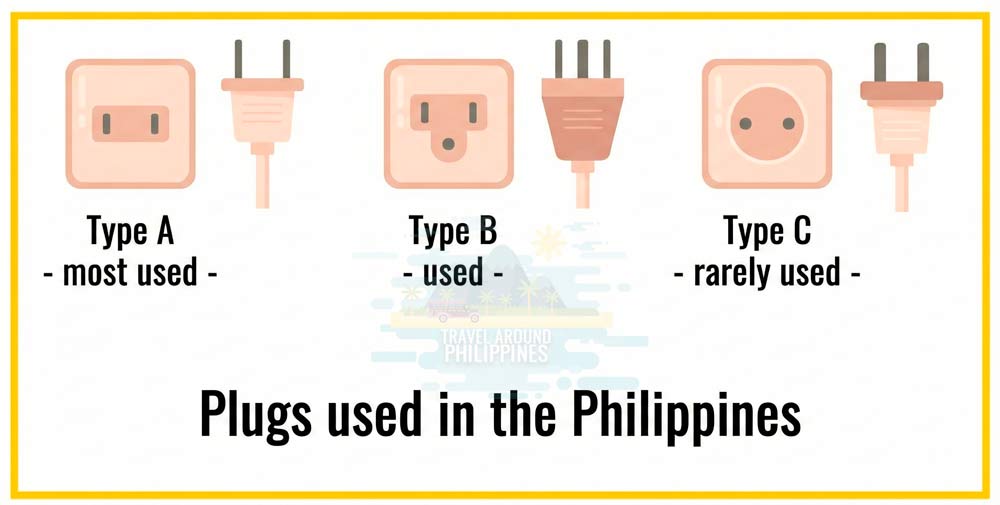
But watch out, there’s one more detail to keep in mind. If you travel with a Type F plug (the ones that are like Type C but thicker and are often used for computers or also for multi-plug power strips like this one we recommend), many times you won’t be able to insert it even into the Type C sockets in the Philippines, which are slightly smaller than those in Spain. This makes it even more necessary to have a power adapter, since these do accept thick plugs.
Power adapter for the Philippines
Now that you’ve seen the plug type used in the Philippines and the one used in your country, you’ve most likely come to the conclusion that you will, without a doubt, need a power adapter. Don’t worry—besides being something you can use on many more trips around the world, it’s something that does not cost much.
We’ve been using this kind of power adapter in the Philippines for years and, from our experience, we can tell you it’s the best option: Best plug adapter for the Philippines. In addition to being inexpensive and working in countless countries, it has a couple of USB slots that make it much more convenient to charge your devices at the same time if you only have a single outlet. And speaking of USB charging, if your phone is relatively new it may already use the USB‑C port, the thinner, symmetrical one. In that case, we recommend getting this other one that lets you charge with both USB types: Plug adapter for the Philippines with USB‑C.
Something that doesn’t make much sense to buy are simple adapters like this: Simple adapter for the Philippines. On the one hand, they often come defective; on the other, they don’t work for all countries and, to top it off, they don’t handle weight well—many times they end up falling or the pins bending. And don’t even dream of putting a thick plug in there (Type F).
Lastly, to close out the things that will be very useful for charging your devices in the country. As we mention in our guide What to pack for the Philippines, something that’s super useful if you travel with more than one device you want to charge is having a power strip that lets you plug several things in at once. Years ago, these kinds of gadgets were bulky and took up too much space, but now you can get one of these charging cubes that greatly reduce the size and, in addition to having multiple inputs for connecting cameras, phones, etc., they also include USB ports. We use and recommend this one: Multi‑plug charging cube.

We currently travel with this adapter and this power strip.
Voltage and frequency in the Philippines—does it matter?
If you take a look at your different devices, you’ll see that their specs include two more data points: voltage and frequency. Don’t overthink it— in 99% of cases it won’t affect you.
Frequency: Some countries use a frequency of 50Hz, as in Spain, and others use 60Hz, like the Philippines. You can use a 50Hz device in a 60Hz Filipino outlet without any issues or danger. So forget about frequency.
Voltage: The voltage in the Philippines is 220V, while in Spain it’s 230V. This slight difference also won’t affect you, and you don’t need to do anything about it. Argentina also uses the Philippines’ 220V, but there are exceptions such as Mexico’s 127V. Although most new devices can already adapt to that difference, it’s highly recommended to check before traveling. And if they aren’t compatible, it might be useful to use an adapter like this: Voltage adapter from Mexico to the Philippines. Unlike the rest of our recommendations, this isn’t something we’ve tried, and we recommend making sure the things you want to plug in are compatible.
Summary and FAQs about outlets in the Philippines
To sum up, these are the main ideas you should keep in mind about outlets in the Philippines.
What plug type is there in the Philippines?
The most used is Type A. It’s possible to find sockets in modern hotels that accept Type C.
Do I need an adapter for the Philippines?
Yes, in most cases. The most common plug is Type A and you’ll need an adapter like this: Adapter for the Philippines.
Does the difference in voltage and frequency affect me?
Frequency doesn’t affect you. Voltage can affect you if you’re from Mexico, but modern electrical devices are compatible with voltages ranging from 110V to 240V. You’ll rarely need a converter.
Do you have any other questions about outlets in the Philippines? Leave them down below in the comments and we’ll try to lend you… a cable.