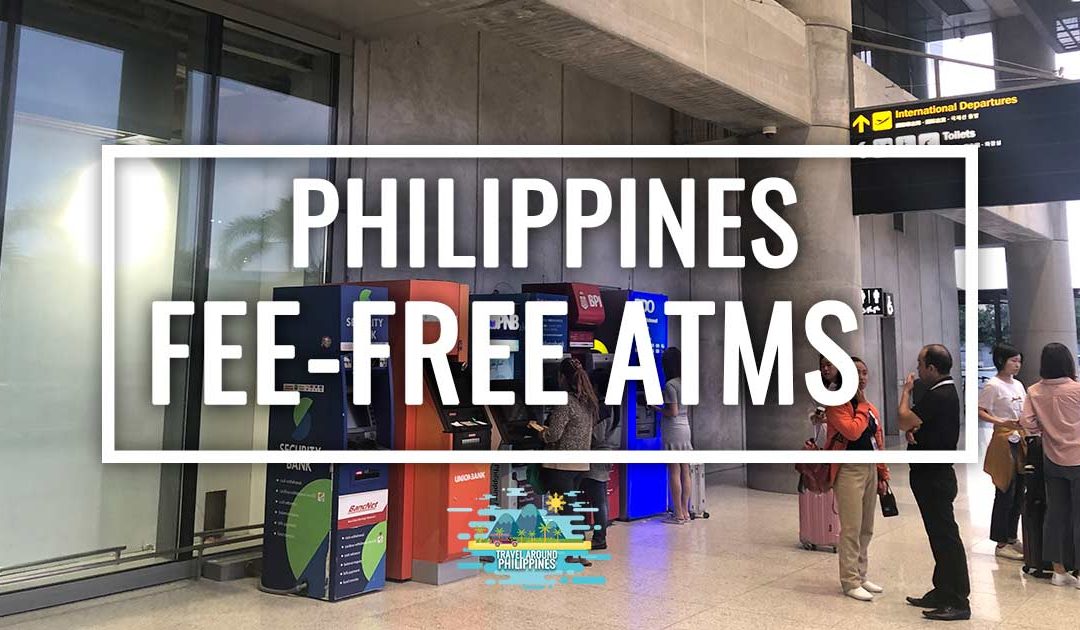
If you are looking for fee-free ATMs in the Philippines, you’ve come to the right place. We’ve been traveling/living around the archipelago since 2010 and we know the best money‑saving tricks, which we’re going to share with you below.
ATMs with no fees in the Philippines
The first and most important thing you need to know is that 99% of ATMs in the Philippines charge cash‑withdrawal fees. This is regardless of the card or bank you use; it’s a fee charged by the ATM itself.
Both local bank ATMs (BDO, BPI, Landbank…) and foreign ones (the widespread Euronet network, marked as ATM, initials of Automatic Teller Machine, with blue and yellow machines) will charge you a withdrawal fee of 250 Philippine pesos. Not only that, all these ATMs (except some BPI ones, the red machines, which allow 20.000) only let you withdraw 10.000 pesos (about 150 dollars) per transaction. Considering that you’ll have to pay for almost everything in cash (including tours, dives, and hotels) because card payment isn’t widespread, you’ll end up withdrawing money quite often.
The only fee‑free ATMs in the Philippines are HSBC’s, but the biggest problem is that these are only in Manila and Cebu and not at the airports, which isn’t very practical. In other words, you won’t be able to withdraw from these ATMs unless you head to the city center (which, as we warn you, will take quite a while). The fee‑free ATMs in the Philippines, HSBC’s, let you withdraw up to 50.000 pesos in one go.
Heads up: the fact that an ATM doesn’t charge you a fee doesn’t mean you won’t have to pay any. You’ll need to check with your bank what fees it applies for withdrawing abroad, not only for ATM use but also for foreign‑currency withdrawals, since what comes out of an ATM is Philippine pesos. We go into this in detail in Best travel debit cards for the Philippines, but we’ll already tell you that the most advisable is to use Revolut and N26, which will reduce them (not eliminate them) a little.
On the other hand, when withdrawing at the ATM (especially at Euronet ones, which we avoid like the plague) it’s important to choose that you don’t want the ATM to do the conversion, but rather your bank/card does it. This matters because the exchange rates applied by ATMs are terrible.

How to withdraw money without fees in the Philippines
If you’ve made it this far, it’s surely because you want to save money—and that’s where we come in. There’s a trick not many people know, but it’s the one we use 99% of the times we need cash in the Philippines: using Remitly.
At first it might sound a little unusual because it’s not something people usually do, but honestly, trust us—your money will go a lot further.
In short: Remitly is a company that lets you send money to yourself (or to someone else, if you choose) by paying online in dollars with your card and receiving the money in Philippine pesos at the so‑called pawnshops. These pawnshops are everywhere in the Philippines, even in remote, non‑touristy towns, because Filipinos use them to send/receive money to and from family and friends, whether inside the country or abroad (there are millions of Filipinos working overseas to send money to their families). The main companies are Cebuana, M Lhuillier, and Palawan Pawnshop, but there are plenty more.
Within minutes and with just your passport (plus the transaction ID number Remitly gives you), at these pawnshops you’ll be able to collect the money you sent yourself at an exchange rate much better than the market rate (and better than what banks like Revolut and N26 give you when withdrawing or paying) and, if you want, in amounts greater than 50.000 pesos. If you add to that that by using our link and entering the code VPFTAKE10 the first transaction is free, done at an improved exchange rate, and, on top of that, you get 15 dollars, you can imagine you’re coming out very well ahead.
What’s more, you don’t even have to specify which pawnshop you want to pick it up at or when. You can choose whichever you like, and the money is available for at least 15 days, so you don’t have the stress of rushing. If you want, you can cancel the transaction and the money goes back to your account—no tricks.
We explain the step‑by‑step process in detail in our guide Remitly in the Philippines.

Minimizing fees in the Philippines
In short, if you’re looking for fee‑free ATMs in the Philippines, the only ones that won’t charge you anything are HSBC’s, but you already know you’ll have to go to downtown Manila or Cebu, since there aren’t any at the airports.
Therefore, unless it suits you because you’re staying in those areas, our tips to save money are:
- Bring around 300$ per person and exchange it at Manila airport (not Cebu’s, where the rate is awful) or at a favorable money‑changer. Open Xe.com and see how the Philippine peso is doing, and compare across different exchange houses.
- When that cash runs out, use Remitly to get cash. You already know that with our link and the code VPFTAKE10 you get an improved rate, 10$ for free, and no delivery fees. Subsequent transactions have a 2,99€ fee, but given the fees charged by Philippine ATMs and the higher amounts you can withdraw with Remitly, it works out far better.
- Use cards like Revolut (10$ free when you get it with our link) and N26 to make your accommodation and flight bookings, since they’ll apply exchange rates much more favorable than traditional banks. In Revolut’s case, try not to pay on weekends because the standard plan applies a 1% on foreign‑currency transactions.
- In the few places where it’s possible (usually in big cities and higher‑end accommodations or restaurants) pay with a card that minimizes foreign‑currency payment fees. Remember to check with your bank so you don’t get any surprises.
To read much more about this topic, don’t miss our guide Money in the Philippines.

Do you have any questions about fee‑free ATMs in the Philippines or how to save money? You can write them in the comments and we’ll reply almost instantly.