Have you ever heard of the Gigantes Islands? Probably not, as they are not among the best-known destinations in the Philippines, especially among international visitors. However, that does not mean these islands in the heart of the Visayas, a few hours from the interesting city of Iloilo, are not worth the effort it takes to get there. That is why we have decided to put together this Gigantes Islands Guide with all the information you need to enjoy them and include them in your trip to the Philippines.
Why the Gigantes Islands?
Originally called Sabuluag after a type of tree that grew on them, the Gigantes Islands acquired their current name from Spanish settlers after they heard a local legend about gigantic human remains found in the caves.
Another story says that a giant hurled the islands into the sea after learning that pirates had kidnapped his fiancée just before their wedding. The giant died of grief, becoming what is now Gigantes Sur Island, while his wife became Gigantes Norte.
Whatever the origin of the islands or their name, the truth is that the Gigantes Islands are an incredible destination for anyone who wants to get off the beaten path in the archipelago and explore places where electricity still isn’t even available around the clock. This group of islands is home to rock formations, lagoons, caves, sandbars, and one of the most Instagrammable places in the Philippines: Cabugao Gamay.
The Gigantes Islands are a wonderful place to mingle with locals, get a closer look at their way of life, and support a growing tourism industry. Gigantes Norte, where most of the accommodations are located, is a peaceful place where you will find a few hostels and basic resorts where you will probably have to shower using a bucket, but where you can watch epic sunsets. So, if you are looking for a five-star hotel and plenty of amenities, you would be better off heading to Boracay.
Where the Gigantes Islands are located
The Gigantes Islands are in the Western Visayas. This group of 12 islands belongs to the province of Iloilo, located on Panay Island. More specifically, the Gigantes Islands are part of the municipality of Carles, the jumping-off point for reaching them. The Gigantes Islands are barely 18 kilometers off the coast of Panay. To give you a clearer idea, they are northeast of Panay, south of Masbate, and north of Negros.
The two main islands are Gigantes Norte and Gigantes Sur, separated by a channel about 800 meters wide. Near the former are several smaller islands: Uaydajon, Bulubadiang, Gigantillo, and Gigantuna. South of Gigantes Sur are Antonia, Bantigue, Cabugao Gamay, Cabugao Daku, Tanguigui, and Turnina. Other islands in the group include Balbagon and Pulupandan.

How to get to the Gigantes Islands
There are tours that run from Iloilo to the Gigantes Islands, but we are going to tell you how to get to the Gigantes Islands on your own from different parts of the Philippines.
1. Getting to Panay from other parts of the Philippines
The first step in getting to the Gigantes Islands is reaching Panay. You have several options:
- Fly to Iloilo: it has an international airport with flights from elsewhere in Asia and, of course, the Philippines.
- Fly to Roxas: this city is closer to the departure point for the islands and also has a domestic airport.
- Fly to Kalibo or fly to Caticlan: both cities have airports, but this is more of a secondary option because they are farther away.
- Take a boat to Iloilo from Cebu or from Bacolod: the former takes almost a full day, but there are fast boats to Bacolod almost all day long.
- Take a boat from Sibuyan to Roxas or from Romblon to Roxas: yes, if you have been visiting these beautiful islands in the Romblon archipelago, there are ferries from Romblon.
- Take a boat from Bantayan to Estancia: if you are visiting this island and want to travel to the Gigantes Islands, boats depart on Tuesdays, Thursdays, and Sundays (double-check this). The journey takes about 3 hours and the ticket costs 500 pesos.
2. Getting to Carles
Once you have set foot on Panay Island, you will need to travel to Bancal Port (in Carles), where boats depart for the Gigantes Islands.
How to get from Roxas to Carles
If you have arrived at Roxas Airport, take a tricycle to the Roxas Integrated Bus Terminal (10-15 minutes/150 pesos for the entire tricycle).
Once at the terminal, take a van to Carles (2 hours/approximately 200 pesos). You will usually be dropped off at Balasan Terminal, where you will need to take a tricycle to Bancal Port (30 minutes/50 pesos).
How to get from Iloilo to Carles
As in the previous case, if you have flown into Iloilo, you will need to take a bus to Tagbak Terminal (50 pesos). You can also take a taxi, but you will have to negotiate the fare.
Once at the station, take a Ceres bus or van to Carles (2.5-4 hours/around 300 pesos). They start running at 5:00 and stop around 16:00. There is no fixed schedule. Although vans are a little more expensive, they are better because they will take you directly to Bancal Port.
If you do not want the hassle or are short on time, you can book shared tours or private tours to the Gigantes Islands from Iloilo.
How to get from Boracay to the Gigantes Islands
We did this journey in the opposite direction, as we decided to return to this popular island in the Visayas after visiting the Gigantes Islands. In this case, the journey is long but not impossible. The route would be:
- Take one of the frequent boats from Boracay to Caticlan (10 minutes/100 pesos).
- Take a bus from Caticlan to Roxas (4-5 hours/300 pesos). They leave more or less every hour starting at 5:00. Another option is to travel from Caticlan to Kalibo and, once there, take a bus or van to Roxas (1 hour/100 pesos).
- Take a bus or van from Roxas to Carles. This is explained a few lines above.
You can follow parts of this route if you are thinking about flying to Kalibo or Caticlan.
3. How to get to the Gigantes Islands from Carles
You have reached the port where boats leave for the Gigantes Islands! First, pay the 75-peso environmental fee. Then, hop aboard one of the bangkas. They depart every day at 8:00, 13:30, and 16:30. They cost 200 pesos per person, and the journey takes about 90 minutes. They arrive in Langub, on Gigantes Norte, where most of the hostels and restaurants are clustered. There are also faster boats (fastcrafts) that cost 300 pesos per person.
In the opposite direction, boats depart from Gigantes Norte to Carles at 7:00, 10:30, and 15:00.
As always in the Philippines, it is best to reconfirm the schedules, especially in places that see as few tourists as this one. To do so, we recommend contacting the Carles Tourism Office.
If you are traveling with a large group and do not want to wait for the next boat, you will probably be offered the option of chartering a private one. The usual price is around 5,000 pesos for 8-10 people.
Boat departures from Bancal Port
As we mentioned, boats also depart from Bancal. At the moment, there is a boat at 9:00 on Mondays, Tuesdays, Fridays, Saturdays, and Sundays, and at 8:00 on Wednesdays, Thursdays, Fridays, Saturdays, and Sundays. There is also one at 10:00 on Wednesdays and Thursdays. It returns to Bancal at 14:30 on some days and at 15:00 on others. On Wednesdays and Thursdays, it returns at 13:00. It costs 200 pesos per person.

Things to do in the Gigantes Islands
We have reached the highlight of this guide: things to do in the Gigantes Islands. Here, we cover the different activities you can enjoy in this part of the Philippines, including the famous island-hopping tour.
1. Island hopping in the Gigantes Islands
Coming all the way to this corner of the Philippines without going on the island-hopping tour it is known for would be like never having been here at all. If you search for “Gigantes Islands” on Google, the first things you will see are photos of spectacular Cabugao Gamay Island, one of the islands visited on this tour. That is why setting aside a day to enjoy these paradises is an absolute must.
You can arrange a Gigantes Islands island-hopping tour at any of the resorts dotted around the island. The price will depend on the number of people and/or the size of the bangka. A tour of the main places to visit in the Gigantes Islands will usually cost around 2,000 pesos per boat (for up to 6 people), plus 500 pesos for the guide, but this will depend on your negotiating skills, how long you want it to last, and which stops you plan to make.
We recommend clarifying two points when arranging it: whether admission fees and food are included in the price. You will usually be responsible for paying for them separately. As for lunch, you can enjoy a wonderful meal at Antonia Beach for very little money or bring some prepared food from Gigantes Norte.
If you have never taken a tour of this kind, do not miss our Island hopping in the Philippines article to get a better idea of what it involves.
Below, you will find the main places usually visited on this tour:
Cabugao Gamay
This is the quintessential postcard image of the Gigantes Islands. You will understand as soon as you see a photo: this island, divided into 3 sections (rock, sandbar, and rock), is a feast for the eyes and, no, you will not need a drone to see it in all its glory, as there is a popular viewpoint on one side from which you can admire it.
Until 2015, Cabugao Gamay was a well-kept little secret, but appearances in the Lonely Planet guide and, later, on a Filipino television show mean that today you have to wait in line for a bit before taking your turn at the recently renovated selfie point. That is why our advice is to avoid visiting the Gigantes Islands on weekends or national holidays.
There are some very basic huts on “Little Cabugao,” and camping is also allowed. If you want to arrange it, contact Maruja Resort: +639995580626.
Admission: 50 pesos per person

Antonia Beach
Another thing to do in the Gigantes Islands—and an essential stop on any boat tour—is Antonia Beach. This white-sand beach belongs to Gigantes Sur and is also known as “Sandwich Island” because of a rock formation at one end that looks like a stack of sliced bread.
There is a resort at Antonia Beach with tents (yes, the kind the United Nations donates when a natural disaster strikes) and a small restaurant that is very popular for serving fresh seafood at ridiculously low prices. This makes it a fantastic place to eat and take a dip.
If you did not bring snorkeling gear, you can rent it right there and enjoy the underwater scenery (perhaps the best you will see all day). For more excitement, you can also jump off the rocks or try some water sports: a banana boat ride or jet skiing.
If you want to stay overnight, they rent tents for 250 pesos per person. Huts with fans cost 800 pesos for 2 people or 1,200 for 4 people. Contact Patroceno Mahipos at +639192685896 or Danilo dela Cruz at +639473884070 for more information.
Admission: 40 pesos per person

Tangke Lagoon
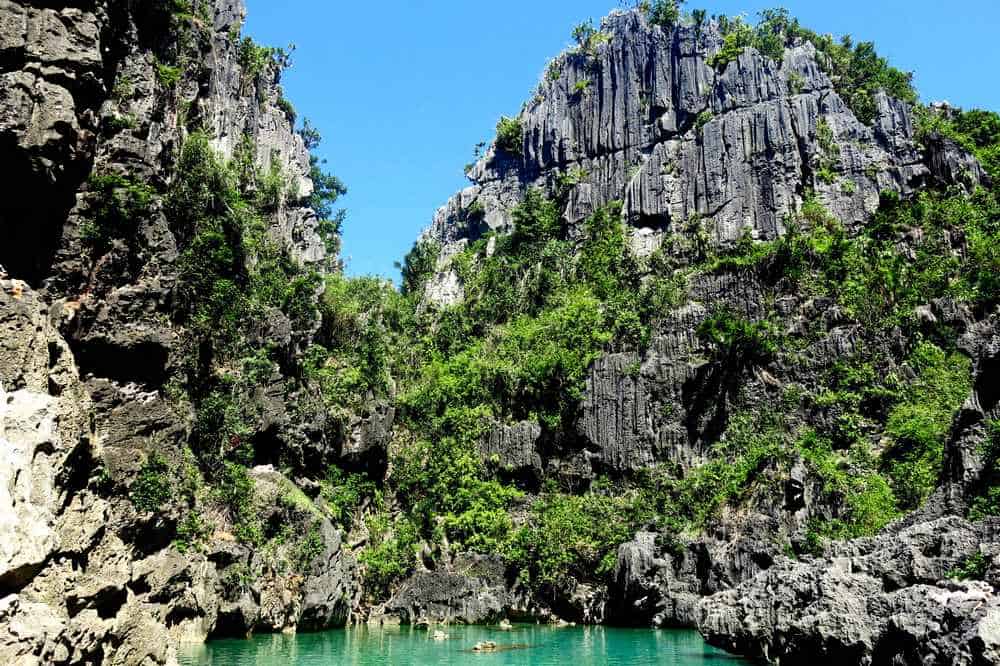
Did you think spectacular karst rock formations were exclusive to El Nido and Coron? The Gigantes Islands have some of their own too, at a place known as Tangke Lagoon.
This saltwater lagoon seems almost hidden at the tip of Gigantes Sur. It is the subject of myths and legends, and the truth is that when you arrive at the entrance, it is hard to believe what you are seeing. Surrounded by stunning cliffs of dark rock, the pool fills with crystal-clear water when the tide comes in, so be sure to remind your boatman that you want to visit the lagoon when the tide is coming in.
A word of warning: if the winds and waves are strong (which often happens between June and September), it is not accessible because the boat cannot moor to let you get off.
Admission: 50 pesos per person
Bantigue Sandbar
If you have already visited one of the sandbars we tell you about in Best sandbars in the Philippines, the Bantigue sandbar may not give you goosebumps, but it will certainly be a feast for your eyes. As is always the case, this sandbar changes shape depending on the month you visit and, of course, the time of day. You will see it in all its glory at low tide, but it does not usually disappear even at high tide, and you will always be able to take a dip.
Admission: 20 pesos per person

Other possible island-hopping stops
We have already covered the essential things to do in the Gigantes Islands, but here are a few extra suggestions:
- Pulupandan Island or Pandan Island: a tiny circular island with barely a couple of palm trees, surrounded by beautiful rock formations. It is usually visited if you take the island-hopping tour from Carles; otherwise, it is a little far away.
- Tinagong Dagat or Mini Boracay Beach: this gorgeous beach is named for the fine white sand that characterizes it. It is very close to Antonia Beach, so you can ask your boatman to stop there. There is no admission fee.
- Cabugao Grande or Cabugao Daku: Cabugao Gamay’s big sister is composed mainly of cliffs similar to those in El Nido. If you enjoy exploring lesser-known places, it has a small beach to the south.
Bear in mind that if you decide to add more stops, you will have to negotiate the price with your boatman.
Island hopping from Carles (instead of from Gigantes Norte)
If, for whatever reason, you stay overnight in Carles and only want to take a one-day island-hopping tour from there, all you have to do is go to the Carles Tourism Office and hire a boat. Prices are already fixed: the small boat (1-10 people) costs 3,500 pesos; the medium boat (1-15 people) costs 5,000 pesos; and the large one (16-30 people) costs 6,000 pesos. If you stay overnight in the Gigantes Islands, add 1,500 pesos to the trip. In addition to these prices, you will have to pay the admission fees for each place you visit.
As we mentioned above, taking this tour from Iloilo is very common. You can book it through KLOOK (which is basically the Southeast Asian equivalent of Civitatis):
PRIVATE Gigantes Islands Tour from Iloilo
SHARED Gigantes Islands Tour from Iloilo
2. The Gigantes Norte lighthouse
In the Gigantes Islands, you will also get to discover a small piece of history, as the ruins of one of the 27 lighthouses built during the Spanish era in the Philippines stand at the northeastern tip of Gigantes Norte. More specifically, it was erected in 1893.
The old lighthouse collapsed during a typhoon in 2008, and a new structure (which cannot be climbed) can now be seen. Even so, you can visit the former lighthouse keepers’ house and the remains of the beautiful colonial fence that once surrounded it. A small museum with some documents and objects from the island was recently set up.

3. Bakwitan Cave
Thanks to the islands’ topography, there are a couple of interesting caves you can explore. The best-known is Bakwitan Cave, located on Gigantes Norte. This is said to be where the coffins containing the large bones that gave rise to the island’s name were found. Interestingly, during the devastating Typhoon Yolanda, these caves provided shelter for more than 60 families.
To explore it properly, you will need to hire a guide (500 pesos per group), and you can easily spend a couple of hours exploring it with them. Even so, you can take a walk on your own and at least see the beginning of the cave.
4. Enjoy the peace and quiet and feast on scallops
As you can see, the most important thing to do in the Gigantes Islands is the island-hopping tour, but one of the undeniable attractions of coming all the way here is adapting to the simple lifestyle of the people who live here.
Despite their growing fame, the Gigantes Islands still have the feel of a little-known destination, and walking along the streets of Gigantes Norte means seeing children play among the millions of shells left over from the seafood that provides their families’ main livelihood. It also means enjoying peaceful sunsets on the sandbar at Langub Beach (in the south of the island) or joining a marathon karaoke session.
If you have more days, you can also look for other things to do. For example, we persuaded a boatman to take us to a neighboring island for the day: Uaydajon Island, the “Treeless Island.” For 500 pesos (round trip), we enjoyed a day on this uninhabited island, which has a beautiful beach and which you can swim all the way around. The underwater scenery is not fabulous, but you are sure to see a few interesting things.
Lastly, since you are here, you will surely be tempted to try the renowned scallops. Filipino scallops sell for about 1 peso each, an incredibly low price. They are cooked in all sorts of different ways. They are so revered that the “Tikab-Tikab” or Scallops Festival is held between March and April.

Where to stay in the Gigantes Islands
To sum up: do not expect the places to stay in the Gigantes Islands to be very fancy. Although local tourism has grown significantly, most travelers visit on a day trip and return to Iloilo or Roxas to spend the night. As a result, tourism development has not been extensive, with all the advantages and disadvantages that entails.
Most hotels in the Gigantes Islands are located on Gigantes Norte, specifically along its western coast. Our top picks include:
- Se San Beach Resort: one of the best options thanks to its location in a very unspoiled setting right on the beach. It has very basic nipa rooms as well as air-conditioned bungalows. It is the only one that can be booked through Booking.com.
- North Coast Island Resort: tastefully decorated, air-conditioned glamping tents. It is positioned for sunset views and has a café/bar that is perfect for watching the sunset. There are several tents.
- Jesa Beach Resort: also by the beach and located where it gets a little internet coverage, it is one of the most pleasant resorts on Gigantes Norte.
- Gigantes Hideaway Tourist Inn: the place we chose to stay at a few years ago and also one of the most popular (partly because it was one of the first). It is quite basic and clearly caters to groups of Filipinos on weekend trips, with everything that entails (karaoke sessions late into the night). It is also a little farther from everything else, something to keep in mind if you want a livelier atmosphere or more restaurant options nearby. This resort has an annex on an island called Bulobadian, where it has several more basic huts. We stopped here for lunch during the island-hopping tour, but you can actually walk there at low tide.
Bear in mind that there are a few more hostels in the Gigantes Islands, but they cannot be booked online because of the island’s poor internet connection. If you go there without a reservation, keep in mind that they will very likely try to sell you a package that includes accommodation, food, and activities. We are not saying that it will not be good value, but our advice is to do the math and decide whether it will be cheaper than arranging everything yourself or whether you want to eat elsewhere on the island (even if that means eating less seafood).
If you are looking for somewhere a little nicer and only want to do an island-hopping tour, we recommend staying at Solina Beach & Nature Resort. It is located in Carles, and its sprawling grounds even include a swimming pool.
Tips for visiting the Gigantes Islands
- Best time to visit the Gigantes Islands: as in the rest of the region, the dry season on these islands runs from December to May. For the greatest peace of mind, March to May is when it rains the least. Outside these months, if it is very windy, it is common for boats not to visit Tangke Lagoon because mooring is difficult.
- Watch out for peak season: since the islands are so popular with local tourists, if you are visiting during Holy Week, school vacations (April/May), or on a weekend, we recommend booking your accommodation well in advance.
- How many days you need to enjoy them: our advice is to set aside at least 3 days and 2 nights. This will give you time to take the island-hopping tour and visit a few places on Gigantes Norte without having to rush.
- Getting around the Gigantes Islands: you can get around Gigantes Norte on foot, but you can also use the services of habal-habal drivers (motorcycle taxis). To give you an idea, the longest route (from the northeastern tip to Langub Beach) costs 30 pesos per person. Some resorts also rent motorcycles for 350 pesos a day.
- Internet: forget about getting a good connection. Only Smart and Sun Cellular have any coverage, and usually only for calls. There is a spot locals call the “call center,” which is on a hill and can be reached by habal-habal for 10 pesos.
- Money: forget about ATMs or anything similar too. You will have to pay for everything in cash.
- Electricity: as is still the case on many islands in the Philippines, electricity is available for only a few hours a day. When we were in the Gigantes Islands, it came on at sunset and shortly before sunrise, so take the opportunity to charge your devices then. Even so, some resorts have a generator.
- Food: if you have a special diet or are a vegetarian, we recommend bringing supplies because almost every meal is based around fish and seafood (scallops everywhere!), and there are very few restaurants. Be prepared to order food 1 or 2 hours in advance; it takes a long time to arrive. There are a few sari-sari stores where you can buy the basics.
- Where to eat: almost every hotel serves food, but there are also some carinderias, such as Thalassa (try the scallop burger) or Libod snacks & grill.
- Responsible tourism: please do not buy souvenirs made from shells or other marine products.
- Travel insurance: if anything serious happens to you, you will need to be rushed to Iloilo, where there are hospitals, as there is nothing in the Gigantes Islands. Please do not travel to the Philippines without good insurance that covers unexpected events. You will find more information in our Travel insurance for the Philippines article. You can get 5% off your policy here.

Map of the Gigantes Islands
We hope this Gigantes Islands guide has inspired you to discover this little corner of the Visayas, which is still not that well known internationally but is very much worth visiting.
Questions? Suggestions? We would love to hear from you in the comments.